Jailani: A Sufi Shrine in Sri Lanka
by Dennis B. McGilvray (2004)
(Imtiaz Ahmad and Helmut Reifeld, eds. Lived Islam in South Asia: Adaptation, Accommodation & Conflict Delhi: Social Science Press, 2004: pp. 273-289. Distributed by Berghahn Books: New York and Oxford)
Introduction
It may seem a strange topographic irony that the most famous mountain in Sri Lanka, an overwhelmingly Buddhist and Hindu island for well over two millennia, is known to the English-speaking world by a Muslim name, Adam's Peak. However, early Muslim connections with Sarandibl are quite well documented. At the summit of this granite pinnacle overlooking the gem district of Ratnapura is a stone impression claimed by Muslim tradition to have been created by the impact of Adam's foot as he fell to earth from the Garden of Eden.
Located along a generalized Muslim pilgrimage route that stretches northward from the Arabian Sea ports of Galle and Weligama to the pinnacle of Adam's Peak lies the hermitage shrine of Daftar Jailani,2 where the Sufi saint, Sheikh Muhiyadeen Abdul Qadir Jilani (d. 1166 CE, in Baghdad), renowned throughout South Asia as the founder of the Qadiriya order, is by legend said to have meditated for twelve years after paying his respects to Śrī Pada, the Resplendant Foot.
Despite opposition from conservative Islamic groups, Jailani today attracts large crowds of Tamil-speaking Muslim devotees to the annual kandoori festival, reflecting the surprising vitality and growth of popular Sufi devotionalism in Sri Lanka.3 However, in an island nation where sacred geography also maps hostile ethnic boundaries and 'homelands', the growth of the shrine at Jailani has also placed the Sri Lankan Muslims in a potential geo-religious zone of conflict with hostile elements of the Sinhala Buddhist majority.
Jailani as a Muslim Place

 Left: Steps leading to Dafthar Jailani. Right: View of the Kaltota Plains.
Jailani is situated at about 70 km from Adam's Peak, but the terrain is formidable. Roads daringly engineered by British tea planters wind part of the way upward from Ratnapura, 60 km away, and Maskeliya, the most convenient base for climbing the mountain, is a four hour drive from Jailani. Even more isolating is the ethnic and religious environment of the shrine: the nearest town is Balangoda, seat of a 96 per cent Sinhalese parliamentary constituency that encompasses the estate of the Ratwatte family, one of the leading twentieth century Sinhalese Buddhist political dynasties in the island.
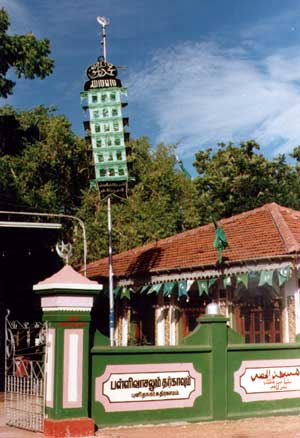
Unlike dargahs located in historic urban Muslim enclaves, such as Galle or Beruwala, or village mosques in the Muslim-dominated agricultural regions of the eastern coast, the shrine at Jailani lies serenely exposed at the edge of a dramatic granite escarpment 22 km southeast of Balangoda, flanked by wet-zone forested hills and surveying Sinhala Buddhist peasant resettlement projects on the Kaltota plain below. A small Muslim community of about thirty families has grown up in the vicinity, but relations with their Sinhala neighbours have been distant and at times hostile {Spencer 1990: 38-9, 50-1). It is a wildly beautiful location set midway up the Kandyan Hills, with a commanding, view southward toward the coast at Hambantota; a perfect site, it is said, for meditation and mystical gnosis. Although there are some tombs of local faqirs and holy men at Jailani, the place is not a mortuary shrine (dargah) but a hermitage, a place of saintly visitation and mystical meditation.
The legends linking Jailani to the twelfth century travels (astral or otherwise) of Sheikh Muhiyadeen Abdul Qadir Jilani have been collected elsewhere' (Aboosally 1975, 2002), but the plausibility of these traditions is closely linked to the historical evidence of medieval Arab and Persian pilgrimages to Adam's Peak.4 In my fieldwork, I found it to be a common assumption among Sri Lankan Muslims that the 'logical' route for Arab and Persian pilgrims heading toward South India would be via the Maldive Islands and Sri Lanka, stopping to visit Adam's Peak along the way.5
Although the modern Sinhalese and Tamil pilgrims who constitute the vast majority of devotees ascending the mountain each year identify it as the footprint of the Buddha or of the Hindu god, Siva, the fourteenth century Arab traveller Ibn Battuta reported that it also attracted a stream of Muslim pilgrims from the Middle East seeking contact with their primordial ancestor, Adam. Gem traders would also have been drawn to the vicinity of Adam's Peak because of its alluvial deposits of precious stones, but Ibn Battuta did encounter a party of Arab and Persian dervishes 'who had come from visiting the Foot' in the Maldive islands (Gibb 1986: 247). Battuta himself made the Adam's Peak pilgrimage soon after, en route to the South Indian city of Madurai.
The Jailani site consists of a steep forested ravine surrounded by three bald granite outcroppings to which the Muslims have given Tamil names: Kappal Malai (ship mountain), Jin Malai (djinn or spirit mountain), and Curankam Malai (cave mountain). The largest and most dramatic of the stone formations is Kappal Malai, which is said to resemble the prow of a petrified ship, and tucked at the base of the rock is an open air mosque built in 1922 that is the centre of festival activities. The overhanging monolith is also referred to as Kaiyadi Malai (handprint mountain), because it is where the saint and his successors left their handprints in sandalwood paste. Jin Malai is a gentle stone slope with few cultural features apart from an early Arabic inscription6 and some Muslim flags, but with spectacular views of the Kandyan massif. Curankam Malai is the summit of a sheer granite cliff-face suspended high above the irrigated rice fields of Kaltota, and it is here one finds the cramped but panoramic cave cell where Muhiyadeen Abdul Qadir Jilani is believed to have meditated.
Although Jailani is said to have been a place of Muslim refuge and Sufi meditation from the beginning of the fourth century of the Islamic era—and both a discovered dervish tombstone and some Arabic inscriptions would seem to support this view (Aboosally 2002)—all of the infrastructure of the Jailani shrine today is of twentieth century origin.
The site was rediscovered in 1875 through the efforts of an Indian Muslim of Lakshadweep origin who subsequently married and settled in Balangoda. However, it is worth noting that the rediscovery of the Jailani site did not serve to charter an exclusive lineage of saintly caretaker-descendants, such as the hereditary saheb shareholders of Nagoor (Saheb 1998) or the pirzad-e families of the Nizamuddin Auliya Dargah in Delhi (Jeffery 1979).
 The mosque at the base of the rock remains the centre of the festival to this day.Indeed, almost no such established dargah-based elite lineages exist in Sri Lanka.7 Members of the small but prosperous Muslim merchant community in Balangoda began celebrating the Jailani festival annually from 1890, and in 1922 C.L.M. Marikar ('Balangoda Hajiyar') constructed the mosque at the base of the rock that remains the centre of the festival to this day.
Seyed Mustafa Abdul Rahuman (Periya Bawa'), the Lakshadweep maulana who reopened Jailani to popular worship, is buried in a special ziyaram next to the Balangoda Jumma Mosque, and beside him lie his local patrons, Sinna Lebbe Cassim Lebbe and the latter's son, C.L.M. Marikar. The Lakshadweep saint's Balangoda-born son, Seyed Buhari, seems to have been a recognized figure in the 1920s, but he did not perpetuate a local saintly lineage.
In addition to the cliffside cave ledge where Muhiyadeen Abdul Qadir Jilani is believed to have meditated, another key location is the china room,8 a small enclosed cave-cell built into the overhanging rock above the mosque where it is said the Sixteenth Century saint Shahul Hamid and his travelling companion Seyed Sahabdeen—whose ziyaram is at the Meera Maccam Mosque in Kandy—meditated in the company of Allah's 'green' servant al-Khidr during an astral journey from his shrine at Nagoor, Tamilnadu. When he returned to Nagoor, Shahul Hamid brought with him an iron chain originally used by Khidr (or, in another version, by the Macedonian hero, Dhul Qarnayn) to bind himself while performing severe austerities at Jailani. A distinctive 'shrinking chain' identified with this legend hangs from the ceiling in front of the tomb of Hazrat Yusuf Saheb, the miraculously conceived son of Shahul Hamid, at the Nagoor Dargah.
The Annual Kandoori Festival
During most of the year, Jailani is a tranquil place to visit, devoid of crowds, and conducive to solitary sightseeing and contemplation. But each year during the kandoori9 festival commemorating the death anniversary of the Iraqi saint—popularly known inTamil as Muhiyadeen Andavar (Lord Muhiyadeen)—the site fills with Muslim pilgrims from all parts of the island and loudspeakers echo with amplified singing and recitation.
During both the inaugural flag raising ceremony and the concluding feast day, the pilgrim shelters are packed; most devotees sleep under the open sky on the plaza, along the footpaths, or under the trees and boulders that surround the central mosque. Tea stalls and eating establishments are crowded, souvenir boutiques cater to pilgrims with children, and the itinerant Bawa faqirs are conspicuously installed in their headquarters at the confluence of two walkways leading to the shrine.
It is hard to move freely without stepping on some family's sleeping mat or bumping into spectators watching a devotional or curing performance of some kind. The crowd is patient and good-natured; kinship groups remain surprisingly relaxed as they sit jammed together shoulder-to-shoulder.
Jailani also affords an opportunity for some rude high-jinks by the children and for some flirtation between large roving groups of young people. And above it all, from dawn until midnight, the loudspeaker crackles and blares, carrying a steady stream of announcements interspersed with a variety of Muslim recitations, recordings, and ratibs.
Flag Raising Ceremony
by Dennis B. McGilvray (2004)
(Imtiaz Ahmad and Helmut Reifeld, eds. Lived Islam in South Asia: Adaptation, Accommodation & Conflict Delhi: Social Science Press, 2004: pp. 273-289. Distributed by Berghahn Books: New York and Oxford)
Introduction
It may seem a strange topographic irony that the most famous mountain in Sri Lanka, an overwhelmingly Buddhist and Hindu island for well over two millennia, is known to the English-speaking world by a Muslim name, Adam's Peak. However, early Muslim connections with Sarandibl are quite well documented. At the summit of this granite pinnacle overlooking the gem district of Ratnapura is a stone impression claimed by Muslim tradition to have been created by the impact of Adam's foot as he fell to earth from the Garden of Eden.
Located along a generalized Muslim pilgrimage route that stretches northward from the Arabian Sea ports of Galle and Weligama to the pinnacle of Adam's Peak lies the hermitage shrine of Daftar Jailani,2 where the Sufi saint, Sheikh Muhiyadeen Abdul Qadir Jilani (d. 1166 CE, in Baghdad), renowned throughout South Asia as the founder of the Qadiriya order, is by legend said to have meditated for twelve years after paying his respects to Śrī Pada, the Resplendant Foot.
Despite opposition from conservative Islamic groups, Jailani today attracts large crowds of Tamil-speaking Muslim devotees to the annual kandoori festival, reflecting the surprising vitality and growth of popular Sufi devotionalism in Sri Lanka.3 However, in an island nation where sacred geography also maps hostile ethnic boundaries and 'homelands', the growth of the shrine at Jailani has also placed the Sri Lankan Muslims in a potential geo-religious zone of conflict with hostile elements of the Sinhala Buddhist majority.
Jailani as a Muslim Place

View of Dafther Jailany Rock Cave Mosque

Jailani is situated at about 70 km from Adam's Peak, but the terrain is formidable. Roads daringly engineered by British tea planters wind part of the way upward from Ratnapura, 60 km away, and Maskeliya, the most convenient base for climbing the mountain, is a four hour drive from Jailani. Even more isolating is the ethnic and religious environment of the shrine: the nearest town is Balangoda, seat of a 96 per cent Sinhalese parliamentary constituency that encompasses the estate of the Ratwatte family, one of the leading twentieth century Sinhalese Buddhist political dynasties in the island.
Unlike dargahs located in historic urban Muslim enclaves, such as Galle or Beruwala, or village mosques in the Muslim-dominated agricultural regions of the eastern coast, the shrine at Jailani lies serenely exposed at the edge of a dramatic granite escarpment 22 km southeast of Balangoda, flanked by wet-zone forested hills and surveying Sinhala Buddhist peasant resettlement projects on the Kaltota plain below. A small Muslim community of about thirty families has grown up in the vicinity, but relations with their Sinhala neighbours have been distant and at times hostile {Spencer 1990: 38-9, 50-1). It is a wildly beautiful location set midway up the Kandyan Hills, with a commanding, view southward toward the coast at Hambantota; a perfect site, it is said, for meditation and mystical gnosis. Although there are some tombs of local faqirs and holy men at Jailani, the place is not a mortuary shrine (dargah) but a hermitage, a place of saintly visitation and mystical meditation.
The legends linking Jailani to the twelfth century travels (astral or otherwise) of Sheikh Muhiyadeen Abdul Qadir Jilani have been collected elsewhere' (Aboosally 1975, 2002), but the plausibility of these traditions is closely linked to the historical evidence of medieval Arab and Persian pilgrimages to Adam's Peak.4 In my fieldwork, I found it to be a common assumption among Sri Lankan Muslims that the 'logical' route for Arab and Persian pilgrims heading toward South India would be via the Maldive Islands and Sri Lanka, stopping to visit Adam's Peak along the way.5
Although the modern Sinhalese and Tamil pilgrims who constitute the vast majority of devotees ascending the mountain each year identify it as the footprint of the Buddha or of the Hindu god, Siva, the fourteenth century Arab traveller Ibn Battuta reported that it also attracted a stream of Muslim pilgrims from the Middle East seeking contact with their primordial ancestor, Adam. Gem traders would also have been drawn to the vicinity of Adam's Peak because of its alluvial deposits of precious stones, but Ibn Battuta did encounter a party of Arab and Persian dervishes 'who had come from visiting the Foot' in the Maldive islands (Gibb 1986: 247). Battuta himself made the Adam's Peak pilgrimage soon after, en route to the South Indian city of Madurai.
The Jailani site consists of a steep forested ravine surrounded by three bald granite outcroppings to which the Muslims have given Tamil names: Kappal Malai (ship mountain), Jin Malai (djinn or spirit mountain), and Curankam Malai (cave mountain). The largest and most dramatic of the stone formations is Kappal Malai, which is said to resemble the prow of a petrified ship, and tucked at the base of the rock is an open air mosque built in 1922 that is the centre of festival activities. The overhanging monolith is also referred to as Kaiyadi Malai (handprint mountain), because it is where the saint and his successors left their handprints in sandalwood paste. Jin Malai is a gentle stone slope with few cultural features apart from an early Arabic inscription6 and some Muslim flags, but with spectacular views of the Kandyan massif. Curankam Malai is the summit of a sheer granite cliff-face suspended high above the irrigated rice fields of Kaltota, and it is here one finds the cramped but panoramic cave cell where Muhiyadeen Abdul Qadir Jilani is believed to have meditated.
Although Jailani is said to have been a place of Muslim refuge and Sufi meditation from the beginning of the fourth century of the Islamic era—and both a discovered dervish tombstone and some Arabic inscriptions would seem to support this view (Aboosally 2002)—all of the infrastructure of the Jailani shrine today is of twentieth century origin.
The site was rediscovered in 1875 through the efforts of an Indian Muslim of Lakshadweep origin who subsequently married and settled in Balangoda. However, it is worth noting that the rediscovery of the Jailani site did not serve to charter an exclusive lineage of saintly caretaker-descendants, such as the hereditary saheb shareholders of Nagoor (Saheb 1998) or the pirzad-e families of the Nizamuddin Auliya Dargah in Delhi (Jeffery 1979).

Seyed Mustafa Abdul Rahuman (Periya Bawa'), the Lakshadweep maulana who reopened Jailani to popular worship, is buried in a special ziyaram next to the Balangoda Jumma Mosque, and beside him lie his local patrons, Sinna Lebbe Cassim Lebbe and the latter's son, C.L.M. Marikar. The Lakshadweep saint's Balangoda-born son, Seyed Buhari, seems to have been a recognized figure in the 1920s, but he did not perpetuate a local saintly lineage.
In addition to the cliffside cave ledge where Muhiyadeen Abdul Qadir Jilani is believed to have meditated, another key location is the china room,8 a small enclosed cave-cell built into the overhanging rock above the mosque where it is said the Sixteenth Century saint Shahul Hamid and his travelling companion Seyed Sahabdeen—whose ziyaram is at the Meera Maccam Mosque in Kandy—meditated in the company of Allah's 'green' servant al-Khidr during an astral journey from his shrine at Nagoor, Tamilnadu. When he returned to Nagoor, Shahul Hamid brought with him an iron chain originally used by Khidr (or, in another version, by the Macedonian hero, Dhul Qarnayn) to bind himself while performing severe austerities at Jailani. A distinctive 'shrinking chain' identified with this legend hangs from the ceiling in front of the tomb of Hazrat Yusuf Saheb, the miraculously conceived son of Shahul Hamid, at the Nagoor Dargah.
The Annual Kandoori Festival
During most of the year, Jailani is a tranquil place to visit, devoid of crowds, and conducive to solitary sightseeing and contemplation. But each year during the kandoori9 festival commemorating the death anniversary of the Iraqi saint—popularly known inTamil as Muhiyadeen Andavar (Lord Muhiyadeen)—the site fills with Muslim pilgrims from all parts of the island and loudspeakers echo with amplified singing and recitation.
During both the inaugural flag raising ceremony and the concluding feast day, the pilgrim shelters are packed; most devotees sleep under the open sky on the plaza, along the footpaths, or under the trees and boulders that surround the central mosque. Tea stalls and eating establishments are crowded, souvenir boutiques cater to pilgrims with children, and the itinerant Bawa faqirs are conspicuously installed in their headquarters at the confluence of two walkways leading to the shrine.
It is hard to move freely without stepping on some family's sleeping mat or bumping into spectators watching a devotional or curing performance of some kind. The crowd is patient and good-natured; kinship groups remain surprisingly relaxed as they sit jammed together shoulder-to-shoulder.
Jailani also affords an opportunity for some rude high-jinks by the children and for some flirtation between large roving groups of young people. And above it all, from dawn until midnight, the loudspeaker crackles and blares, carrying a steady stream of announcements interspersed with a variety of Muslim recitations, recordings, and ratibs.
Flag Raising Ceremony