In late 2012, workers digging foundations for a new wing in Matale Hospital unearthed partial skeletons of more than 150 people. Of the various theories that sought to explain how this mass grave came to be, the one that most people instinctively thought might be true was that this was the final resting place of victims of death squads from 2nd JVP insurgency, which from 1987 to 1989 almost brought the Sri Lankan State to total collapse. The counter-insurgency (COIN) campaign, which in turn destroyed the JVP had few equals (except perhaps the 1990s Algerian counter-insurgency campaign and the India’s anti-‘Khalistan’ counter-insurgency in the Punjab) for its ruthlessness.
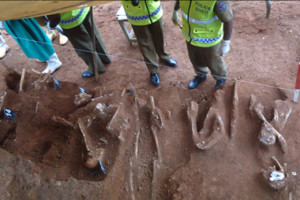
Mass grave being excavated in Matale Hospital, 2012
Unlike today’s COIN warriors who use seemingly benign terms like “Fight, Secure, Build”, Sri Lanka’s COIN warriors used the more honest, “Search, Interrogate and Destroy” to characterise their brutal, blood-stained and ultimately successful campaign to crush the JVP.

Family members mourn the loss of a loved one who was killed by JVP. April 1989. (Photo by Robert Nickelsberg/Liaison)
The US State Dept neatly summarised the background to the 1987-1989 JVP insurgency.
“In 1989 the JVP stepped up its campaign against the Government and population at large. Likened by some observers to Pol Pot’s Khmer Rouge and the Maoist Shining Path in Peru, the JVP sought to topple Sri Lanka’s elected Government through a campaign of murder, intimidation, and strikes designed to paralyse civil administration, cripple the economy, and disrupt society. It did so despite repeated efforts by the Sri Lankan Government to bring the JVP into the political mainstream. In 1988 the Government had legalized the JVP and invited it to participate in the elections.

“Let us kill JR” – anti-govt graffiti by DJV (military arm of the JVP) urging death to President JR Jayawardene, displayed in front of a post office. December 1989. (Photo by Robert Nickelsberg/Liaison)
The JVP responded by killing voters and candidates in an attempt to disrupt elections held in late 1988 and early 1989. In January 1989, in an effort to open a dialog with the JVP, newly elected President Ranasinghe Premadasa released 1,800 JVP suspects and lifted the state of emergency. The JVP nonetheless continued its terror campaign of targeting hospitals, transportation, and other essential services, murdering union leaders who refused to participate in JVP-called strikes and killing the families of security force personnel. At mid-year, the Government began a massive crackdown on the JVP. It detained several thousand JVP suspects. By the end of the year, security forces had captured or killed much of the JVP’s top leadership.”
A “massive crackdown” sounds quite reasonable until you realise the levels of ultra-violence used by the state to defeat the JVP.
The Years of Blood
An incomplete body count showed that from 1987-1989 the JVP murdered hundreds of members of the working class to force them to join anti-government strikes. They also murdered 1,700+ government supporters, 500+ government servants, 200+ service personnel, 350+ police personnel, 100+ home guards and 70+ politicians of all parties including many senior politicians. And over 32,000 civilians for various ‘offences’ committed against the movement.

Family gathered around open coffin mourning at funeral for policeman killed by land mine blast set off by the JVP.
April 1989 (Photo by Robert Nickelsberg//Time Life Pictures/Getty Images)
In 1989, the JVP murdered 24 members of the Buddhist clergy for refusing to bow to their demands. Their killing spree continued to include over 120 school principals, educationalists, professors, doctors, lawyers, journalists and medical staff. Even TV announcers were killed. Anyone who held any kind of leadership function in government or commerce was deemed a legitimate target by the JVP.

Armed soldier stands before the Bank of Ceylon, which is locked up tight and has crossed-out graffiti on the front.
Dec 1988 (Photo by Robert Nickelsberg//Time Life Pictures/Getty Images)
And the JVP killed hundreds of leftist politicians and activists. In September 1988, JVP ordered nationwide strikes with widespread compliance. Shops, transport, hospitals and government services were shut. Listening to radios or watching TV was prohibited with death as punishment for disobeying orders. By November 1988, Sri Lanka experienced near total anarchy. Oil refineries remained closed due to JVP instigated strikes. Public and private transport reduced to such low levels that food shortages threatened.

A lone cyclist rides on empty street in Akuressa, past shops closed due to general strike called by the JVP.
December 1988. (Photo by Robert Nickelsberg//Time Life Pictures/Getty Images)
Bank, Postal and Telecommunications virtually halted. It was a relentless, daily round of killings, sabotage and strikes organised by the JVP and of counter-terror by Security forces. The JVP’s stated aims were to seize power, overthrow the existing power structure and transform society along more equitable lines. Its first political assassination was killing a leftist student leader. The JVP really proved dictum, “Kill one man, terrorise a thousand”.
The Army Fights on Two Fronts
The Armed Forces, whilst fighting the LTTE in the Tamil-majority North also had to contend with JVP attacks in the Sinhala-majority South. For instance, Pallekelle Army camp was attacked by the JVP in April 1987 and a quantity of automatic weapons removed. The JVP also took advantage of crises in the Northern front to stage attacks in the South. A classic instance of this was the JVP attack on Katunayake Air Force base in June 1987 after the LTTE had massacred 33 novice Buddhist monks in Aaranthalawa and as the Indian Air Force air-dropped food supplies in Jaffna, against Sri Lanka’s wishes. [p.1137-9 YOT]

Children look at weapons held by soldiers on guard in Colombo. December 1989. The soldiers were deployed to prevent attacks by JVP radicals who torched 43 passenger buses in central and southern Sri Lanka. (AP Photo)
The JVP claimed that these captured arms would be used “for the freedom of the motherland.. to drive away the Indian monkeys [the Indian Peace Keeping Force – IPKF – stationed in the North] and the Tigers who have been a curse on the motherland”. As the Sinhala South soon discovered, the JVP instead, used their arms on the Security forces, their Sinhala opponents and ‘traitors’. In fact there’s not a single confirmed account of a JVP attack on the LTTE or IPKF which was trying to keep the peace in Northern Sri Lanka.

Victim killed as suspected informer by JVP, April 1989.
(Photo by Robert Nickelsberg//Time Life Pictures/Getty Images)
The JVP continued their propaganda aimed at getting soldiers to desert and join their ranks, with JVP radio repeatedly warning that August was the deadline for security forces personnel of all ranks to desert or face the consequences: death. By August 1989 on finding that their appeals had fallen on barren ground, it finally resorted to an act of such monumental folly that it echoed Tallyrand’s famous saying, “this is worse than a crime, it’s a blunder”. The JVP informed the security forces that their families would be specifically targeted for death, which provoked a wave of indignation and anger within the armed forces. An officer said “even the fellows who are sweeping the camps went out with their broomsticks against the JVP” [p.293 SL:YOT]

Heavily armed soldiers sit on top of an APC vehicle, rolling down the street.
December 1988.(Photo by Robert Nickelsberg//Time Life Pictures/Getty Images)
“Twelve of Yours for One of ours!” – JVP’s Fatal Blunder
The JVP knew at once that they had made an irrevocable and fatal mistake. No sooner had they issued death threats to the families of the servicemen, posters appeared all over the country announcing, “Ape ekata thope dolahak!” (“Twelve of yours for one of ours!) The dirty war against the JVP would be even dirtier.

Death threat posters sent out by the JVP
A vigilante group called the Deshapremi Sinhala Tharuna Peramuna (Patriotic Sinhala Youth Front) under whose auspices the ‘12 for 1’ posters appeared, circulated a note to the families of JVP activists that read:
“Dear Father/Mother/Sister,
We know that your son/brother/husband is engaged in brutal murder under the pretence of patriotism. Your son/brother/husband, the so-called patriot, has cruelly taken the lives of mothers like you, of sisters, of innocent little children. In addition he has started killing the family members of the heroic Sinhalese soldiers who fought with the Tamil Tigers and sacrificed their lives, in order to protect the motherland.
“It is not amongst us, ourselves, the Sinhalese people, that your son/brother/husband has launched the conflict in the name of patriotism? Is it then right that you, the wife/mother/sister of this person who engages in human murder of children should be free to live? Is it not justified to put you to death? From this moment, you and all your family members must be ready to die. May you attain Nirvana!”
“Patriotic Sinhala Youth Front.”
‘In October 1989 after Capt T.E. Nagahawatte, the Assistant Registrar of the Peradeniya University and a volunteer soldier was killed by two gunmen inside the University premises, eighteen heads were found the next day placed neatly around the University pond. The headless corpses had been placed in various postures in the vicinity. In the rest of the country, bodies kept appearing by the dozen.’ [p. 296-7, SL:YOT]

Dead JVP suspect with note attached saying “this is the punishment for followers of JVP signed by the PRRA”, in Thihagoda. December 1988.
(Photo by Robert Nickelsberg//Time Life Pictures/Getty Images)
The State Strikes Back
The main weapons in the anti-JVP counter-insurgency were small teams equipped with small arms, unmarked vans and led by young officers and NCOs. Unlike the campaign against the LTTE, tanks, artillery, ground attack aircraft and other heavy weapons and divisional-sized manoeuvres were of no use in this dirty war. It was a hit-job, killing-at-close-range, war.
‘Detachments were established in villages throughout Sri Lanka. The troops moved light, often out in tents in mini groups, all the while. It was imperative that the maximum number of troops did spend the maximum time operating out in the field all the time. It was considered a rare occurrence for everyone to be in a base. Troops were positioned not only at snap road blocks but also undercover. Troops dominated the terrain, by frequent incursions into the jungles and to the villages, the road by road blocks, and the countryside by setting up ambushes.’ [p.331 SL:ALR]
‘When the JVP offensive escalated, the government forces, particularly the paramilitary groups such as the PRRA (Peoples Revolutionary Red Army), Shra, Black Cats, Yellow Cats, Scorpion, Eagle, etc, went on killing extra-judicially. Reverse of fear psychosis was induced – this appeared somewhat successful, but in the long run the JVP capitalised on it by recruiting members from the families of the victims.’ [p.295 SL: ALR]
‘Under the provisions of the state of Emergency, Sri Lankan security forces were given ‘almost unlimited powers to combat the JVP, including shooting suspects on sight and disposing of bodies without an inquest. Under the Indemnity Act of December 1998, [passed before the Presidential elections in the same month] security personnel have been granted immunity from prosecution for any such abuses committed.’ [p. 144, TSCSL]

Mass grave being excavated in Matale Hospital, 2012
Unlike today’s COIN warriors who use seemingly benign terms like “Fight, Secure, Build”, Sri Lanka’s COIN warriors used the more honest, “Search, Interrogate and Destroy” to characterise their brutal, blood-stained and ultimately successful campaign to crush the JVP.

Family members mourn the loss of a loved one who was killed by JVP. April 1989. (Photo by Robert Nickelsberg/Liaison)
The US State Dept neatly summarised the background to the 1987-1989 JVP insurgency.
“In 1989 the JVP stepped up its campaign against the Government and population at large. Likened by some observers to Pol Pot’s Khmer Rouge and the Maoist Shining Path in Peru, the JVP sought to topple Sri Lanka’s elected Government through a campaign of murder, intimidation, and strikes designed to paralyse civil administration, cripple the economy, and disrupt society. It did so despite repeated efforts by the Sri Lankan Government to bring the JVP into the political mainstream. In 1988 the Government had legalized the JVP and invited it to participate in the elections.

“Let us kill JR” – anti-govt graffiti by DJV (military arm of the JVP) urging death to President JR Jayawardene, displayed in front of a post office. December 1989. (Photo by Robert Nickelsberg/Liaison)
The JVP responded by killing voters and candidates in an attempt to disrupt elections held in late 1988 and early 1989. In January 1989, in an effort to open a dialog with the JVP, newly elected President Ranasinghe Premadasa released 1,800 JVP suspects and lifted the state of emergency. The JVP nonetheless continued its terror campaign of targeting hospitals, transportation, and other essential services, murdering union leaders who refused to participate in JVP-called strikes and killing the families of security force personnel. At mid-year, the Government began a massive crackdown on the JVP. It detained several thousand JVP suspects. By the end of the year, security forces had captured or killed much of the JVP’s top leadership.”
A “massive crackdown” sounds quite reasonable until you realise the levels of ultra-violence used by the state to defeat the JVP.
The Years of Blood
An incomplete body count showed that from 1987-1989 the JVP murdered hundreds of members of the working class to force them to join anti-government strikes. They also murdered 1,700+ government supporters, 500+ government servants, 200+ service personnel, 350+ police personnel, 100+ home guards and 70+ politicians of all parties including many senior politicians. And over 32,000 civilians for various ‘offences’ committed against the movement.

Family gathered around open coffin mourning at funeral for policeman killed by land mine blast set off by the JVP.
April 1989 (Photo by Robert Nickelsberg//Time Life Pictures/Getty Images)
In 1989, the JVP murdered 24 members of the Buddhist clergy for refusing to bow to their demands. Their killing spree continued to include over 120 school principals, educationalists, professors, doctors, lawyers, journalists and medical staff. Even TV announcers were killed. Anyone who held any kind of leadership function in government or commerce was deemed a legitimate target by the JVP.

Armed soldier stands before the Bank of Ceylon, which is locked up tight and has crossed-out graffiti on the front.
Dec 1988 (Photo by Robert Nickelsberg//Time Life Pictures/Getty Images)
And the JVP killed hundreds of leftist politicians and activists. In September 1988, JVP ordered nationwide strikes with widespread compliance. Shops, transport, hospitals and government services were shut. Listening to radios or watching TV was prohibited with death as punishment for disobeying orders. By November 1988, Sri Lanka experienced near total anarchy. Oil refineries remained closed due to JVP instigated strikes. Public and private transport reduced to such low levels that food shortages threatened.

A lone cyclist rides on empty street in Akuressa, past shops closed due to general strike called by the JVP.
December 1988. (Photo by Robert Nickelsberg//Time Life Pictures/Getty Images)
Bank, Postal and Telecommunications virtually halted. It was a relentless, daily round of killings, sabotage and strikes organised by the JVP and of counter-terror by Security forces. The JVP’s stated aims were to seize power, overthrow the existing power structure and transform society along more equitable lines. Its first political assassination was killing a leftist student leader. The JVP really proved dictum, “Kill one man, terrorise a thousand”.
The Army Fights on Two Fronts
The Armed Forces, whilst fighting the LTTE in the Tamil-majority North also had to contend with JVP attacks in the Sinhala-majority South. For instance, Pallekelle Army camp was attacked by the JVP in April 1987 and a quantity of automatic weapons removed. The JVP also took advantage of crises in the Northern front to stage attacks in the South. A classic instance of this was the JVP attack on Katunayake Air Force base in June 1987 after the LTTE had massacred 33 novice Buddhist monks in Aaranthalawa and as the Indian Air Force air-dropped food supplies in Jaffna, against Sri Lanka’s wishes. [p.1137-9 YOT]

Children look at weapons held by soldiers on guard in Colombo. December 1989. The soldiers were deployed to prevent attacks by JVP radicals who torched 43 passenger buses in central and southern Sri Lanka. (AP Photo)
The JVP claimed that these captured arms would be used “for the freedom of the motherland.. to drive away the Indian monkeys [the Indian Peace Keeping Force – IPKF – stationed in the North] and the Tigers who have been a curse on the motherland”. As the Sinhala South soon discovered, the JVP instead, used their arms on the Security forces, their Sinhala opponents and ‘traitors’. In fact there’s not a single confirmed account of a JVP attack on the LTTE or IPKF which was trying to keep the peace in Northern Sri Lanka.

Victim killed as suspected informer by JVP, April 1989.
(Photo by Robert Nickelsberg//Time Life Pictures/Getty Images)
The JVP continued their propaganda aimed at getting soldiers to desert and join their ranks, with JVP radio repeatedly warning that August was the deadline for security forces personnel of all ranks to desert or face the consequences: death. By August 1989 on finding that their appeals had fallen on barren ground, it finally resorted to an act of such monumental folly that it echoed Tallyrand’s famous saying, “this is worse than a crime, it’s a blunder”. The JVP informed the security forces that their families would be specifically targeted for death, which provoked a wave of indignation and anger within the armed forces. An officer said “even the fellows who are sweeping the camps went out with their broomsticks against the JVP” [p.293 SL:YOT]

Heavily armed soldiers sit on top of an APC vehicle, rolling down the street.
December 1988.(Photo by Robert Nickelsberg//Time Life Pictures/Getty Images)
“Twelve of Yours for One of ours!” – JVP’s Fatal Blunder
The JVP knew at once that they had made an irrevocable and fatal mistake. No sooner had they issued death threats to the families of the servicemen, posters appeared all over the country announcing, “Ape ekata thope dolahak!” (“Twelve of yours for one of ours!) The dirty war against the JVP would be even dirtier.

Death threat posters sent out by the JVP
A vigilante group called the Deshapremi Sinhala Tharuna Peramuna (Patriotic Sinhala Youth Front) under whose auspices the ‘12 for 1’ posters appeared, circulated a note to the families of JVP activists that read:
“Dear Father/Mother/Sister,
We know that your son/brother/husband is engaged in brutal murder under the pretence of patriotism. Your son/brother/husband, the so-called patriot, has cruelly taken the lives of mothers like you, of sisters, of innocent little children. In addition he has started killing the family members of the heroic Sinhalese soldiers who fought with the Tamil Tigers and sacrificed their lives, in order to protect the motherland.
“It is not amongst us, ourselves, the Sinhalese people, that your son/brother/husband has launched the conflict in the name of patriotism? Is it then right that you, the wife/mother/sister of this person who engages in human murder of children should be free to live? Is it not justified to put you to death? From this moment, you and all your family members must be ready to die. May you attain Nirvana!”
“Patriotic Sinhala Youth Front.”
‘In October 1989 after Capt T.E. Nagahawatte, the Assistant Registrar of the Peradeniya University and a volunteer soldier was killed by two gunmen inside the University premises, eighteen heads were found the next day placed neatly around the University pond. The headless corpses had been placed in various postures in the vicinity. In the rest of the country, bodies kept appearing by the dozen.’ [p. 296-7, SL:YOT]

Dead JVP suspect with note attached saying “this is the punishment for followers of JVP signed by the PRRA”, in Thihagoda. December 1988.
(Photo by Robert Nickelsberg//Time Life Pictures/Getty Images)
The State Strikes Back
The main weapons in the anti-JVP counter-insurgency were small teams equipped with small arms, unmarked vans and led by young officers and NCOs. Unlike the campaign against the LTTE, tanks, artillery, ground attack aircraft and other heavy weapons and divisional-sized manoeuvres were of no use in this dirty war. It was a hit-job, killing-at-close-range, war.
‘Detachments were established in villages throughout Sri Lanka. The troops moved light, often out in tents in mini groups, all the while. It was imperative that the maximum number of troops did spend the maximum time operating out in the field all the time. It was considered a rare occurrence for everyone to be in a base. Troops were positioned not only at snap road blocks but also undercover. Troops dominated the terrain, by frequent incursions into the jungles and to the villages, the road by road blocks, and the countryside by setting up ambushes.’ [p.331 SL:ALR]
‘When the JVP offensive escalated, the government forces, particularly the paramilitary groups such as the PRRA (Peoples Revolutionary Red Army), Shra, Black Cats, Yellow Cats, Scorpion, Eagle, etc, went on killing extra-judicially. Reverse of fear psychosis was induced – this appeared somewhat successful, but in the long run the JVP capitalised on it by recruiting members from the families of the victims.’ [p.295 SL: ALR]
‘Under the provisions of the state of Emergency, Sri Lankan security forces were given ‘almost unlimited powers to combat the JVP, including shooting suspects on sight and disposing of bodies without an inquest. Under the Indemnity Act of December 1998, [passed before the Presidential elections in the same month] security personnel have been granted immunity from prosecution for any such abuses committed.’ [p. 144, TSCSL]