


Blu-Ray Disks

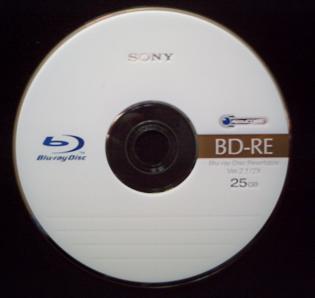
A Blu-ray Disc (also called BD) is a high-density optical disc format for the storage of digital media, including high-definition video.
The name Blu-ray Disc is derived from the blue-violet laser used to read and write this type of disc. Because of its shorter wavelength (405 nm), substantially more data can be stored on a Blu-ray Disc than on the DVD format, which uses a red, 650 nm laser. A single layer Blu-ray Disc can store 25 gigabytes (GB), over five times the size of a single layer DVD at 4.7 GB. A dual layer Blu-ray Disc can store 50 GB, almost 6 times the size of a dual layer DVD at 8.5 GB.
Blu-ray Disc is similar to PDD, another optical disc format developed by Sony (which has been available since 2004) but offering higher data transfer speeds. PDD was not intended for home video use and was aimed at business data archiving and backup.
* About 9 hours of high-definition (HD) video can be stored on a 50 GB disc.
* About 23 hours of standard-definition (SD) video can be stored on a 50 GB disc.
* On average, a single-layer disc can hold a High Definition feature of 135 minutes using MPEG-2, with additional room for 2 hours of bonus material in standard definition quality. A dual layer disc will extend this number up to 3 hours in HD quality and 9 hours of SD bonus material.
Physical size ______Single layer capacity ______Dual layer capacity
12 cm, single sided______25 GB______50 GB
12 cm, double sided______50 GB______100 GB
8 cm, single sided______7.8 GB______15.6 GB
8 cm, double sided______15.6 GB______31.2 GB
Blu-Ray Profiles
1.0
This is the basic profile that all current Blu-ray players (as of April 2007) are based on. Players based on this profile are only required to have 64 KB of application data area storage, which is typically used for bookmarks and other preference storage.[citation needed] Most players have more than the minimum required 64 KB.[citation needed] After October 31, 2007, this profile will be superseded by profile 1.1 as the new minimum profile.
1.1 (mandatory November 2007)
What is typically referred to as "Profile 1.1" (but is more formally known as "Final Standard Profile") adds a secondary video decoder (typically used for picture in picture), secondary audio (typically used for interactive audio and commentary) and capability of supporting a minimum of 256 MB of local storage (for storing audio/video and title updates). Compliance with this profile will be mandatory for player models introduced to the market after October 31, 2007, but existing products will be unaffected. As of July 24, 2007, only the Denon DVD-3800BDCI and DVD-2500BTCI have been announced as supporting this feature when they become available in the fall of 2007.
Some profile 1.0 players may be upgradeable via firmware update to profile 1.1 if they have the appropriate hardware, but no manufacturer has announced any such upgrade. When software authored with interactive features dependent on Profile 1.1 hardware capabilities are played on profile 1.0 players some features may not be available or may offer limited capability. Profile 1.0 players will still be able to play the main feature of the disc, however.
2.0 (BD-Live)
Profile 2, also known as BD-Live, adds network connectivity to the list of mandatory functions and increases mandatory local storage capability to 1 GB. No players have been announced as compatible with this profile. Players of earlier profiles will still be able to play the main feature of the disc, however.
3 (audio only)
Profile 3 is meant for an audio-only player and does not require video decoding or BD-J.
Last edited:


