


So what is the Seed Vault
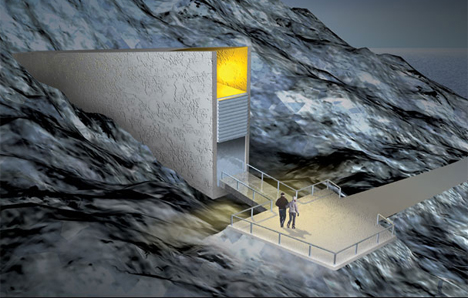
The Svalbard Global Seed Vault (Norwegian: Svalbard globale frøhvelv) is a secure seedbank located on the Norwegian island of Spitsbergen near the town of Longyearbyen in the remote Arctic Svalbard archipelago. The facility was established to preserve a wide variety of plant seeds from locations worldwide in an underground cavern. The seed vault holds duplicate samples, or "spare" copies, of seeds held in genebanks worldwide. The seed vault will provide insurance against the loss of seeds in genebanks, as well as a refuge for seeds in the case of large scale regional or global crises. The island of Spitsbergen is about 1,300 kilometres (810 mi) from the North Pole. The seed vault is managed under terms spelled out in a tripartite agreement between the Norwegian government, the Global Crop Diversity Trust (GCDT) and the Nordic Genetic Resource Center (also known as NordGen and previously named the Nordic Gene Bank, a cooperative effort of the Nordic countries under the Nordic Council of Ministers).
Construction of the seed vault, which cost approximately 45 million Norwegian Kroner (9 million USD), was funded entirely by the Government of Norway. Storage of seeds in the seed vault is free of charge. Operational costs will be paid by Norway and the Global Crop Diversity Trust. The primary funding of the Trust came from the Bill & Melinda Gates Foundation, United Kingdom, Norway, Australia, Switzerland, and Sweden, though funding has been received from a wide variety of sources including four developing countries: Brazil, Colombia, Ethiopia, and India.
Latest News from

Norway doomsday seed vault hits 1/2 million mark.!!
OSLO, Norway – Two years after receiving its first deposits, a "doomsday" seed vault on an Arctic island has amassed half a million seed samples, making it the world's most diverse repository of crop seeds, the vault's operators announced Thursday.
Cary Fowler — who heads the trust that oversees the seed collection, which is 620 miles (1,000 kilometers) from the North Pole, said the facility now houses at least one-third of the world's crop seeds.
"In my lifetime, I don't think we'll go over 1.5 million. I'd be rather surprised if we go over a million," Fowler told The Associated Press. "At that point, we'd have all the diversity in the world ... and the most secure samples."
Located in Norway's remote Svalbard archipelago, the Svalbard Global Seed Vault is a safeguard against wars or natural disasters wiping out food crops around the globe. It was opened in 2008 as a master backup to the world's other 1,400 seed banks, in case their deposits are lost.
War wiped out seed banks in Iraq and Afghanistan, and another bank in the Philippines was flooded in the wake of a typhoon in 2006. The Svalbard bank is designed to withstand global warming, earthquakes and even nuclear strikes.
Despite the rapid progress, Fowler said the bank still has significant holes in its collection.
"There are a few unique collections that we don't have up there yet — Ethiopia and some of the Indian materials and some of the Chinese materials," he said.
The most recent additions include a mold-resistant bean from Colombia and a collection of nearly every agricultural soybean species developed in the U.S. in the last century.


The Svalbard Global Seed Vault (Norwegian: Svalbard globale frøhvelv) is a secure seedbank located on the Norwegian island of Spitsbergen near the town of Longyearbyen in the remote Arctic Svalbard archipelago. The facility was established to preserve a wide variety of plant seeds from locations worldwide in an underground cavern. The seed vault holds duplicate samples, or "spare" copies, of seeds held in genebanks worldwide. The seed vault will provide insurance against the loss of seeds in genebanks, as well as a refuge for seeds in the case of large scale regional or global crises. The island of Spitsbergen is about 1,300 kilometres (810 mi) from the North Pole. The seed vault is managed under terms spelled out in a tripartite agreement between the Norwegian government, the Global Crop Diversity Trust (GCDT) and the Nordic Genetic Resource Center (also known as NordGen and previously named the Nordic Gene Bank, a cooperative effort of the Nordic countries under the Nordic Council of Ministers).
Construction of the seed vault, which cost approximately 45 million Norwegian Kroner (9 million USD), was funded entirely by the Government of Norway. Storage of seeds in the seed vault is free of charge. Operational costs will be paid by Norway and the Global Crop Diversity Trust. The primary funding of the Trust came from the Bill & Melinda Gates Foundation, United Kingdom, Norway, Australia, Switzerland, and Sweden, though funding has been received from a wide variety of sources including four developing countries: Brazil, Colombia, Ethiopia, and India.
Latest News from
Norway doomsday seed vault hits 1/2 million mark.!!
OSLO, Norway – Two years after receiving its first deposits, a "doomsday" seed vault on an Arctic island has amassed half a million seed samples, making it the world's most diverse repository of crop seeds, the vault's operators announced Thursday.
Cary Fowler — who heads the trust that oversees the seed collection, which is 620 miles (1,000 kilometers) from the North Pole, said the facility now houses at least one-third of the world's crop seeds.
"In my lifetime, I don't think we'll go over 1.5 million. I'd be rather surprised if we go over a million," Fowler told The Associated Press. "At that point, we'd have all the diversity in the world ... and the most secure samples."
Located in Norway's remote Svalbard archipelago, the Svalbard Global Seed Vault is a safeguard against wars or natural disasters wiping out food crops around the globe. It was opened in 2008 as a master backup to the world's other 1,400 seed banks, in case their deposits are lost.
War wiped out seed banks in Iraq and Afghanistan, and another bank in the Philippines was flooded in the wake of a typhoon in 2006. The Svalbard bank is designed to withstand global warming, earthquakes and even nuclear strikes.
Despite the rapid progress, Fowler said the bank still has significant holes in its collection.
"There are a few unique collections that we don't have up there yet — Ethiopia and some of the Indian materials and some of the Chinese materials," he said.
The most recent additions include a mold-resistant bean from Colombia and a collection of nearly every agricultural soybean species developed in the U.S. in the last century.


