


t of all we would like to mention all of you  here after don’t insult any of the religions or cultures. we never born expecting to be in one of the religious or culture pre planning. We get those from our parents coming from generation to generation.
Now we would like to ask riyaz211 whether “You” know anything about your post???
For the other members in elakiri we would like to say that As we know he sure must not have any idea about the post he has put.Because he has just copy paste the news from the following site.
http://www.lankanewspapers.com/news/2007/10/20846_space.html
Esala perahara
SRI LANKA is a land of pageants and processions, dating back over 2,500 years. Every year, in the lunar month of August, the scenic hill capital of Kandy comes alive with the grand spectacle of the "Kandy Perahera". Kandy is the venue of the Esala Perahera, easily the most colourful pageant of Asia, held in July/August each year, in honour of the tooth Relic. As the pageantry of the Esala Perahera unfolds through ten nights each year, the city takes on the air of a torch-lit dreamland, complete with a hundred or more colourfully caparisoned elephants, drummers, dancers, and chieftains in the rare colourful trappings of the old kingdom.
The Tooth Relic continues to be housed in Kandy, which was the last royal capital of ancient Sri Lanka. As the August moon begins to wax, the misty hills of Kandy will give itself up to a new excitement in preparation for the spectacular festival of the "Kandy Perahera". For ten nights, as the old cannon booms after dusk, the Perahera, the event for which Kandy lives each year, will take to the streets growing longer each night until on the final night of pageantry, the past shatters the present. The whips crack like pistol shots, the torches gild the pallid moonlight, the drums roll like thunder down the narrow streets, the oboes wail, the braying conchs re-echo from the hills, the pious cries of 'Sadhu-Sadhu' lift in thanksgiving to the sky, the dancers leap and whirl in flashing crimson, white and silver, the stately chiefs strut by, rank upon rank of elephants loom up and dwindle, and the glitter of the Sacred Casket fades as the mile long magnificence passes.
kandyPerahara started during the reign King Megavanna , (301 - 331 A.D.) who decreed that the that the Tooth Relic of Lord Buddha should be taken out of it's gilded shrine inside Dalada Maligawa ( Temple of the Tooth), and paraded around the city so that the public could pay their respects. Today this pageant or perahara, held for two weeks in August (Esala in Buddhist calender), has grown to be one of the most splendid sights in Sri Lanka and South East Asia and perhaps even the whole world. Magnificently decorated elephants, colorful Kandyan dancers with their drummers, devil dancers from the southern temples, fire eaters, whip crackers, stick walkers, and an assortment of other artistes from all walks of life, take part in the perahara.
History of Kandy esala perahara
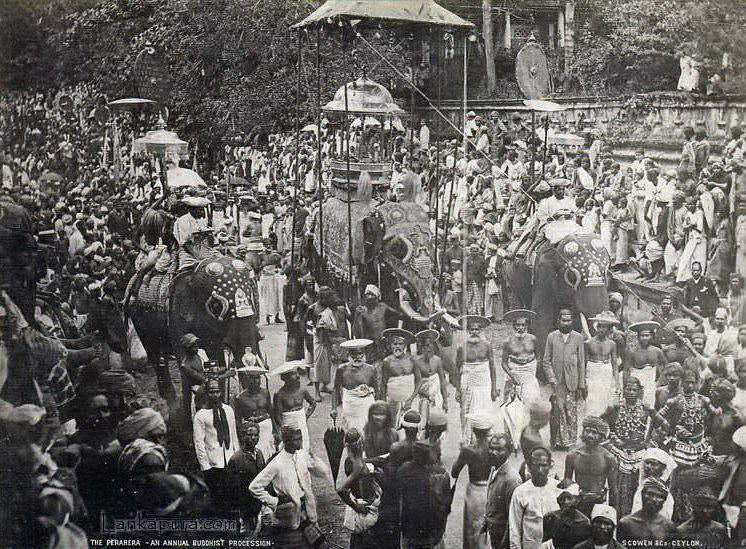

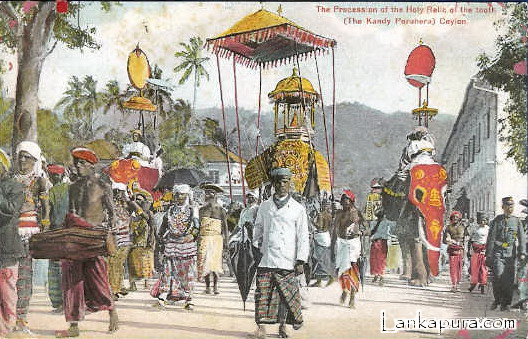
the esala perahara annually held in the month of july-august is originating from Indo-Aryan traditions, Esala festivities signify the victories of the mythical Hindu God Indra over the demon Vritra who prevented the burst of rain clouds. In fact Esala Perahara was originally a ritual invoking the blessings of the Gods to cause rainfall in the dry month. Later the Sinhala kings who possessed the sacred Tooth Relic coupled that event with the procession in honour of the sacred Tooth Relic, maintaining some of the ancient rituals of yore. The sacred Tooth Relic was brought to Anuradhapura, the ancient capital of Sri Lanka, from Kalinga during the reign of the King Kitsiri Mevan (A.D. 303 - 331). That was about 500 years since the arrival of Theri Sanghamitta and the planting of the sacred Bodhi Tree. The Chinese Buddhist traveller Fa Hien given an account of the rituals associated with the sacred Relic when it was taken to Abhayagiri vihara for the annual festival during the month of Esala. The fourteenth century Sinhala text "Dalada Sirita" gives a vivid description of these rituals. There was a strong conviction particularly among Sinhala Buddhists that the legitimate claim for the Sinhala Throne could be made by the possessor of the sacred Tooth Relic. The belief that the sacred Tooth Relic was a harbinger of rain never diminished even after the British occupation of Kandy. When the perahara was suspended by the British rulers in 1815 a severe drought and a crop failure followed. Due to public protest the perahara was allowed. It was reported that torrential rains followed the initiation of perahara rituals. The author of "Dalada Sirita" gives a vivid description of that event. The perahara rituals begin with the planting of kap poles (about 60 cm in length cut from a lactiferous tree) within the premises of each dewale at an auspicious hour. Kapa symbolises god Indra and it is cut from a lactiferous tree to signify fertility and prosperity. When the kap-poles are brought to each Dewale they are placed on a clean mat where fresh mango and margosa leaves are spread. That ritual is associated with the Pattini cult. Goddess Pattini, according to mythical literature, was born out of a mango and her husband was killed under a margosa tree. When the kap poles are installed in each dewale premises the officiating priest (kapurala) circumambulates the kap pole on three consecutive days carrying the insignia of the respective deity. At the beginning for five days the procession is confined to the dewala premises. The second stage of the perahara is the Kumbal Perahara. Here the relic casket along with such regalia traditionally associated with the ancient royalty of Kandy are taken out. The Relic Casket is taken out amidst the blowing of conch shells. A gaily decorated elephant carries the casket. A gun is fired when the Diyawadana Nilame takes his place in the procession. The Diyawadana Nilame, according to historical traditions was the minister who supplied water to the King. The title "Nilame" was given to a Minister of the royal court.However a contrary view was held by some writers with regard to the duties of the Diyawadana Nilame. He was required to do everything within his capacity to ensure rain at the correct seasons. This conclusion was arrived at because there was another official in the royal palace with the title Ulpange Rala who made bathing facilities for the king. The third stage of the perahara is the "Randoli" symbolizing the participation of the royalty in the procession. Randoli was the name of a special palanquin in which the Queen was taken. The perahara parades with full splendour at this stage.
History of Sacred tooth relic

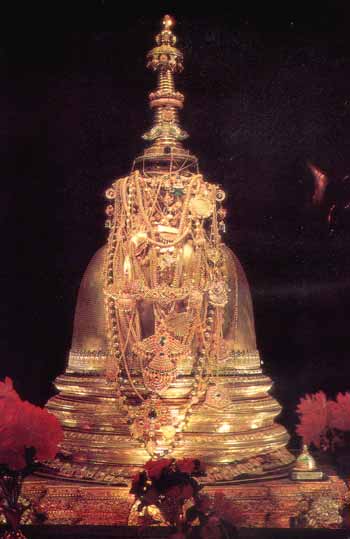


Ever since the four canine teeth of the Buddha after cremation came to be in the possession of devas, nagas and men, these were preciously guarded and received special veneration and worship.
A great war started in India around 371 A.D. against King Buhasiva to take the Sacred tooth relic of Lord Buddha pocessed by the King.
The King handed over this tooth relic to his son in law Dhantha and instructed Dhantha take the tooth relic to Sri Lanka where his friend King Mahsen was living.
The king lost the battle and his daughter princes Hemamali and son in law Dhantha brought the tooth relic to Sri Lanka, and it was hidden in her knot of hair foe safety.
When they reached Sri Lanka King Buhasivafriendly king Mahasen had died. So they handed the sacred tooth relic to king Megavan who was ruling in Anuradhapura.
The sacred tooth relic was then handed over to bikku, buddhist monks of Abayagiriya for safe keeping and also object of worship for Buddhas.
Traditionally thereafter the sacred tooth relic was regarded as a royal treasure and symbol of kingship and was enshrined in the private shrine room of temple in the royal palace complex of Capital and protected by the king himself.
When the capital was shifted from Anuradhapura to Polonnaruwa the tooth relic was taken to Polonnaruwa by king Vijayabahu 1 and he constructed Atadage and enshrined it. Aftertsome time Queen Sugala has taken the tooth to her fortress and it was hidden there.
After a long battle king Parakramabahu the 1st brought the tooth relic again to Polonnaruwa. lately king Nissankamalla constructed the tooth relic temple called "Hatadage" and enshrined it.
After that it was brought to Dmbadeniya,Yapahuwa, Kurunegala from Kurunegala they brought to Kotte. During the period of Mayadunna it was taken to Seethawaka.
During period of Rajasinghe 1, portugues power spread in the costal area and it was taken to Delgamuwa Viharaya, which is situated at Kuruwita in Rathnapura district, and it was taken to Kandy in 1593 and kept by king Wimaladharmasuriya. In 1753 the Kandy Perahara started to honour the tooth relic, and it was taken around the Kandy town.
After Sri Lanka was concord by British in 1815 the custody of the sacred tooth relic given over to three custodians. The venerable mahanayaka thero of Asgiriya and malwatta chapters and to the Diyawadana Nilame, the chief custodian, and continue even to day.
Historical places associated with Dalada Maligava
According to Mandarampura Puwata, the Kandyan Kingdom was established after king Vimaladarmasuriya ascendent to the throne defeating Yamasinha Bandara in 1592 AD.
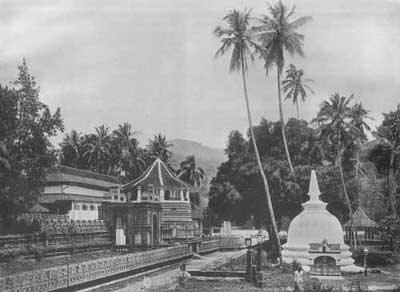
The king immediately embraced Buddhism and brought the sacred Tooth Relic to Kandy then known as Senkadagalapura and later came to be known Sri Wardhanapura (meaning the city that increases her beauty) from Delgamuva and built the present Dalada Maligava.
The temple was originally built in two storeys by king Vimaladarmasuriya and subsequently erected a three storeyed building to house the tooth relic. The Pattirippuva or the octagon with the moat in front was added later by the last king of Kandy. Along the moat runs a brick wall, the Diyaweli Bemma or the "Waveswell wall". In the main building the first chamber is called the pallemale and upper chamber is called Uda Male or Vedahitina Maligava where the tooth relic resides.
Natha Devale
The oldest of the four directly faces the Dalada Maligava. It has the rare distinction of being identified as the oldest building in the ancient capital dating back to the 14th century and is said to have built by Vikramabahu III. The God Natha to whom a deistic shrine was dedicated is taken to be the power deity who influenced the political affairs at the time. The shrine shows the influence of the Dravidian school of architecture.
Natha Devale receives a special prominence during the times of the kings. Hence statuswise it ranked first among four devales. It played an important role on king's behalf in the affairs of the state. A new king is obliged to call on this devale and in front of the image of Natha, select the name by which he is to be known. Also this devale played an important role in preparing and distributing the Nanu or medicinal herbs that go with the first bath taken in the Sinhala New Year. A tradition which comes down from the time of the Sinhalese kings. Natha Devale possessed a flag depicting Natha deiya. An image of Natha with left hand broken and seated in the Raja Leela is housed in the inner sanctum of the devalaya.
Visnu Devalaya
Visnu Devalaya popularly known as Maha Devalaya, is situated in front of the main gate of the Natha Devale across the road and near the Royal Palace in the Deva Sanhinde. The history of this place is not known. Robert Knox called the deity in it as Alut Nuvara Deiyyo or the God of Alut Nuvara indicating that the god was originally residing in Alut Nuvara in the Kegalle district. According to another folk legend the god residing at Devundara in the deep south was also brought to Alut Nuvara. This god is called Upulvan or 'blue coloured' (god Rama?) and later identified as Visnu because of the colour. However, in later times, the resident god in this devale came to be known as Visnu and a separate shrine-room for the local god - Dedimunda of Alut Nuvara Devale was built near by the main Devale.
According to mythology the Buddha entrusted to Sakra (Indra) the task of preserving the Buddhist dispensation (sasana) in Sri Lanka and Sakra in turn delegated this power to Visnu. He is believed to be a future Buddha after Natha.
In the 15th century the God at Devundara, as described in the Paravi Sandesaya, a Sinhalese Sandesa (epistle) poem, is viewed as a powerful god and a vanquisher of Asuras, full of power, glory an might. Therefore, it may be said that this god described as Upulvan is perhaps Rama. This hypothesis is supported by the above named poem where the Devale in Kandy is referred to as Rama Devale. It is also interesting to note that this Devale had in its possession a cloth canopy depicting the battle of Rama and Rawana.
During the time of the Kings, the Abhiseka Mangalle or the anointing ceremony of the newly appointed King was held in the Maha Devale. It is believed a gold plated Conchshell was offered to this shrine by King Rajadhi Rajasinha after the defeat of the Dutch at Gurubebila.
Traditionally the perahera conducted by the Visnu devale is believed to have taken place to commemorate the birth of Visnu, or the victory of King Gajabahu over the Cholas. During the Esala Perahara this Devale plays an important role by supplying the remaining Devales with the Kapa or the sacred pole necessary for planting at the Kapsituwime Mangalle before the perahara commences. A ritual known as Valiyakun Netima is performed at the Visnu Devale immediately after the perahera for seven successive days in order to seek divine forgiveness for any lapses in the pageant and also to give profuse thanks to the Divine powers.
Pattini Devale
The Pattini Devale dedicated to Goddess Pattini is situated to the west of the Natha devale. In the past, the two devales were separated by a cross-road called Et Vidiya or the Elephant Street which is no more. The history of the devale is not known. That it is at least four centuries old, there is no doubt, for Robert Knox makes references to the perahara of Pattini Devale.
Pattini, the goddess of chastity was and still is the most popular deity amongst the peasantry of Sri Lanka. Though a goddess of South Indian origin, she became more popular in this country. Her virtues are extolled in a Tamil epic called Cilappadikaram written in the 2nd century and in a number of Sinhalese poetical works written during the 18th and 19th centuries. According to the Tamil epic, one of the earliest known deistic shrines in Sri Lanka was built by King Gajabahu in the 2nd century A.D. enshrining the golden anklet of this goddess. There are a large number of shrines dedicated to her scattered all over the country, but the most popular is the one at Kandy next to Navagamuva Devale. She is beneficial to the people in many ways. She is associated with the cure of infectious diseases and children's diseases and is also propitiated in times of drought and consequent famine.
The devale devoted to her in Kandy is a simple, small rectangular building on the usual stone platform. The shrine is at the south end like that of Natha, and unlike the one at Maha Devale which is on the north end, and the Kataragama Devale in the west end. It consists of four compartments. Kandyan roof adorns this simple but beautiful devale.
TO riyaz211
If u have any proof that buddists has hijacked the Tamil Hindu festival and named it as Esala perahara please post details about your religious festival with the name of the festival.
To all the members
Some information has been taken from web sites.
http://www.bharatwisdom.com/tabid/772/tag/Sri-Lanka/c/palace/p/1/Default.aspx
http://www.info.lk/srilanka/srilankaculture/kandyperahara/historyofdaladaperahara.htm
http://daladamaligawa.org/historical-places.htm
This post is no insult to any of the religions or cultures.It is only a post to save the identity of our buddism.
created by:-
asta
free2rthayme
here after don’t insult any of the religions or cultures. we never born expecting to be in one of the religious or culture pre planning. We get those from our parents coming from generation to generation.Now we would like to ask riyaz211 whether “You” know anything about your post???
For the other members in elakiri we would like to say that As we know he sure must not have any idea about the post he has put.Because he has just copy paste the news from the following site.
http://www.lankanewspapers.com/news/2007/10/20846_space.html
Esala perahara
SRI LANKA is a land of pageants and processions, dating back over 2,500 years. Every year, in the lunar month of August, the scenic hill capital of Kandy comes alive with the grand spectacle of the "Kandy Perahera". Kandy is the venue of the Esala Perahera, easily the most colourful pageant of Asia, held in July/August each year, in honour of the tooth Relic. As the pageantry of the Esala Perahera unfolds through ten nights each year, the city takes on the air of a torch-lit dreamland, complete with a hundred or more colourfully caparisoned elephants, drummers, dancers, and chieftains in the rare colourful trappings of the old kingdom.
The Tooth Relic continues to be housed in Kandy, which was the last royal capital of ancient Sri Lanka. As the August moon begins to wax, the misty hills of Kandy will give itself up to a new excitement in preparation for the spectacular festival of the "Kandy Perahera". For ten nights, as the old cannon booms after dusk, the Perahera, the event for which Kandy lives each year, will take to the streets growing longer each night until on the final night of pageantry, the past shatters the present. The whips crack like pistol shots, the torches gild the pallid moonlight, the drums roll like thunder down the narrow streets, the oboes wail, the braying conchs re-echo from the hills, the pious cries of 'Sadhu-Sadhu' lift in thanksgiving to the sky, the dancers leap and whirl in flashing crimson, white and silver, the stately chiefs strut by, rank upon rank of elephants loom up and dwindle, and the glitter of the Sacred Casket fades as the mile long magnificence passes.
kandyPerahara started during the reign King Megavanna , (301 - 331 A.D.) who decreed that the that the Tooth Relic of Lord Buddha should be taken out of it's gilded shrine inside Dalada Maligawa ( Temple of the Tooth), and paraded around the city so that the public could pay their respects. Today this pageant or perahara, held for two weeks in August (Esala in Buddhist calender), has grown to be one of the most splendid sights in Sri Lanka and South East Asia and perhaps even the whole world. Magnificently decorated elephants, colorful Kandyan dancers with their drummers, devil dancers from the southern temples, fire eaters, whip crackers, stick walkers, and an assortment of other artistes from all walks of life, take part in the perahara.
History of Kandy esala perahara

the esala perahara annually held in the month of july-august is originating from Indo-Aryan traditions, Esala festivities signify the victories of the mythical Hindu God Indra over the demon Vritra who prevented the burst of rain clouds. In fact Esala Perahara was originally a ritual invoking the blessings of the Gods to cause rainfall in the dry month. Later the Sinhala kings who possessed the sacred Tooth Relic coupled that event with the procession in honour of the sacred Tooth Relic, maintaining some of the ancient rituals of yore. The sacred Tooth Relic was brought to Anuradhapura, the ancient capital of Sri Lanka, from Kalinga during the reign of the King Kitsiri Mevan (A.D. 303 - 331). That was about 500 years since the arrival of Theri Sanghamitta and the planting of the sacred Bodhi Tree. The Chinese Buddhist traveller Fa Hien given an account of the rituals associated with the sacred Relic when it was taken to Abhayagiri vihara for the annual festival during the month of Esala. The fourteenth century Sinhala text "Dalada Sirita" gives a vivid description of these rituals. There was a strong conviction particularly among Sinhala Buddhists that the legitimate claim for the Sinhala Throne could be made by the possessor of the sacred Tooth Relic. The belief that the sacred Tooth Relic was a harbinger of rain never diminished even after the British occupation of Kandy. When the perahara was suspended by the British rulers in 1815 a severe drought and a crop failure followed. Due to public protest the perahara was allowed. It was reported that torrential rains followed the initiation of perahara rituals. The author of "Dalada Sirita" gives a vivid description of that event. The perahara rituals begin with the planting of kap poles (about 60 cm in length cut from a lactiferous tree) within the premises of each dewale at an auspicious hour. Kapa symbolises god Indra and it is cut from a lactiferous tree to signify fertility and prosperity. When the kap-poles are brought to each Dewale they are placed on a clean mat where fresh mango and margosa leaves are spread. That ritual is associated with the Pattini cult. Goddess Pattini, according to mythical literature, was born out of a mango and her husband was killed under a margosa tree. When the kap poles are installed in each dewale premises the officiating priest (kapurala) circumambulates the kap pole on three consecutive days carrying the insignia of the respective deity. At the beginning for five days the procession is confined to the dewala premises. The second stage of the perahara is the Kumbal Perahara. Here the relic casket along with such regalia traditionally associated with the ancient royalty of Kandy are taken out. The Relic Casket is taken out amidst the blowing of conch shells. A gaily decorated elephant carries the casket. A gun is fired when the Diyawadana Nilame takes his place in the procession. The Diyawadana Nilame, according to historical traditions was the minister who supplied water to the King. The title "Nilame" was given to a Minister of the royal court.However a contrary view was held by some writers with regard to the duties of the Diyawadana Nilame. He was required to do everything within his capacity to ensure rain at the correct seasons. This conclusion was arrived at because there was another official in the royal palace with the title Ulpange Rala who made bathing facilities for the king. The third stage of the perahara is the "Randoli" symbolizing the participation of the royalty in the procession. Randoli was the name of a special palanquin in which the Queen was taken. The perahara parades with full splendour at this stage.
History of Sacred tooth relic


Ever since the four canine teeth of the Buddha after cremation came to be in the possession of devas, nagas and men, these were preciously guarded and received special veneration and worship.
A great war started in India around 371 A.D. against King Buhasiva to take the Sacred tooth relic of Lord Buddha pocessed by the King.
The King handed over this tooth relic to his son in law Dhantha and instructed Dhantha take the tooth relic to Sri Lanka where his friend King Mahsen was living.
The king lost the battle and his daughter princes Hemamali and son in law Dhantha brought the tooth relic to Sri Lanka, and it was hidden in her knot of hair foe safety.
When they reached Sri Lanka King Buhasivafriendly king Mahasen had died. So they handed the sacred tooth relic to king Megavan who was ruling in Anuradhapura.
The sacred tooth relic was then handed over to bikku, buddhist monks of Abayagiriya for safe keeping and also object of worship for Buddhas.
Traditionally thereafter the sacred tooth relic was regarded as a royal treasure and symbol of kingship and was enshrined in the private shrine room of temple in the royal palace complex of Capital and protected by the king himself.
When the capital was shifted from Anuradhapura to Polonnaruwa the tooth relic was taken to Polonnaruwa by king Vijayabahu 1 and he constructed Atadage and enshrined it. Aftertsome time Queen Sugala has taken the tooth to her fortress and it was hidden there.
After a long battle king Parakramabahu the 1st brought the tooth relic again to Polonnaruwa. lately king Nissankamalla constructed the tooth relic temple called "Hatadage" and enshrined it.
After that it was brought to Dmbadeniya,Yapahuwa, Kurunegala from Kurunegala they brought to Kotte. During the period of Mayadunna it was taken to Seethawaka.
During period of Rajasinghe 1, portugues power spread in the costal area and it was taken to Delgamuwa Viharaya, which is situated at Kuruwita in Rathnapura district, and it was taken to Kandy in 1593 and kept by king Wimaladharmasuriya. In 1753 the Kandy Perahara started to honour the tooth relic, and it was taken around the Kandy town.
After Sri Lanka was concord by British in 1815 the custody of the sacred tooth relic given over to three custodians. The venerable mahanayaka thero of Asgiriya and malwatta chapters and to the Diyawadana Nilame, the chief custodian, and continue even to day.
Historical places associated with Dalada Maligava
According to Mandarampura Puwata, the Kandyan Kingdom was established after king Vimaladarmasuriya ascendent to the throne defeating Yamasinha Bandara in 1592 AD.
The king immediately embraced Buddhism and brought the sacred Tooth Relic to Kandy then known as Senkadagalapura and later came to be known Sri Wardhanapura (meaning the city that increases her beauty) from Delgamuva and built the present Dalada Maligava.
The temple was originally built in two storeys by king Vimaladarmasuriya and subsequently erected a three storeyed building to house the tooth relic. The Pattirippuva or the octagon with the moat in front was added later by the last king of Kandy. Along the moat runs a brick wall, the Diyaweli Bemma or the "Waveswell wall". In the main building the first chamber is called the pallemale and upper chamber is called Uda Male or Vedahitina Maligava where the tooth relic resides.
Natha Devale
The oldest of the four directly faces the Dalada Maligava. It has the rare distinction of being identified as the oldest building in the ancient capital dating back to the 14th century and is said to have built by Vikramabahu III. The God Natha to whom a deistic shrine was dedicated is taken to be the power deity who influenced the political affairs at the time. The shrine shows the influence of the Dravidian school of architecture.
Natha Devale receives a special prominence during the times of the kings. Hence statuswise it ranked first among four devales. It played an important role on king's behalf in the affairs of the state. A new king is obliged to call on this devale and in front of the image of Natha, select the name by which he is to be known. Also this devale played an important role in preparing and distributing the Nanu or medicinal herbs that go with the first bath taken in the Sinhala New Year. A tradition which comes down from the time of the Sinhalese kings. Natha Devale possessed a flag depicting Natha deiya. An image of Natha with left hand broken and seated in the Raja Leela is housed in the inner sanctum of the devalaya.
Visnu Devalaya
Visnu Devalaya popularly known as Maha Devalaya, is situated in front of the main gate of the Natha Devale across the road and near the Royal Palace in the Deva Sanhinde. The history of this place is not known. Robert Knox called the deity in it as Alut Nuvara Deiyyo or the God of Alut Nuvara indicating that the god was originally residing in Alut Nuvara in the Kegalle district. According to another folk legend the god residing at Devundara in the deep south was also brought to Alut Nuvara. This god is called Upulvan or 'blue coloured' (god Rama?) and later identified as Visnu because of the colour. However, in later times, the resident god in this devale came to be known as Visnu and a separate shrine-room for the local god - Dedimunda of Alut Nuvara Devale was built near by the main Devale.
According to mythology the Buddha entrusted to Sakra (Indra) the task of preserving the Buddhist dispensation (sasana) in Sri Lanka and Sakra in turn delegated this power to Visnu. He is believed to be a future Buddha after Natha.
In the 15th century the God at Devundara, as described in the Paravi Sandesaya, a Sinhalese Sandesa (epistle) poem, is viewed as a powerful god and a vanquisher of Asuras, full of power, glory an might. Therefore, it may be said that this god described as Upulvan is perhaps Rama. This hypothesis is supported by the above named poem where the Devale in Kandy is referred to as Rama Devale. It is also interesting to note that this Devale had in its possession a cloth canopy depicting the battle of Rama and Rawana.
During the time of the Kings, the Abhiseka Mangalle or the anointing ceremony of the newly appointed King was held in the Maha Devale. It is believed a gold plated Conchshell was offered to this shrine by King Rajadhi Rajasinha after the defeat of the Dutch at Gurubebila.
Traditionally the perahera conducted by the Visnu devale is believed to have taken place to commemorate the birth of Visnu, or the victory of King Gajabahu over the Cholas. During the Esala Perahara this Devale plays an important role by supplying the remaining Devales with the Kapa or the sacred pole necessary for planting at the Kapsituwime Mangalle before the perahara commences. A ritual known as Valiyakun Netima is performed at the Visnu Devale immediately after the perahera for seven successive days in order to seek divine forgiveness for any lapses in the pageant and also to give profuse thanks to the Divine powers.
Pattini Devale
The Pattini Devale dedicated to Goddess Pattini is situated to the west of the Natha devale. In the past, the two devales were separated by a cross-road called Et Vidiya or the Elephant Street which is no more. The history of the devale is not known. That it is at least four centuries old, there is no doubt, for Robert Knox makes references to the perahara of Pattini Devale.
Pattini, the goddess of chastity was and still is the most popular deity amongst the peasantry of Sri Lanka. Though a goddess of South Indian origin, she became more popular in this country. Her virtues are extolled in a Tamil epic called Cilappadikaram written in the 2nd century and in a number of Sinhalese poetical works written during the 18th and 19th centuries. According to the Tamil epic, one of the earliest known deistic shrines in Sri Lanka was built by King Gajabahu in the 2nd century A.D. enshrining the golden anklet of this goddess. There are a large number of shrines dedicated to her scattered all over the country, but the most popular is the one at Kandy next to Navagamuva Devale. She is beneficial to the people in many ways. She is associated with the cure of infectious diseases and children's diseases and is also propitiated in times of drought and consequent famine.
The devale devoted to her in Kandy is a simple, small rectangular building on the usual stone platform. The shrine is at the south end like that of Natha, and unlike the one at Maha Devale which is on the north end, and the Kataragama Devale in the west end. It consists of four compartments. Kandyan roof adorns this simple but beautiful devale.
TO riyaz211
If u have any proof that buddists has hijacked the Tamil Hindu festival and named it as Esala perahara please post details about your religious festival with the name of the festival.
To all the members
Some information has been taken from web sites.
http://www.bharatwisdom.com/tabid/772/tag/Sri-Lanka/c/palace/p/1/Default.aspx
http://www.info.lk/srilanka/srilankaculture/kandyperahara/historyofdaladaperahara.htm
http://daladamaligawa.org/historical-places.htm
This post is no insult to any of the religions or cultures.It is only a post to save the identity of our buddism.
created by:-
asta
free2rthayme


