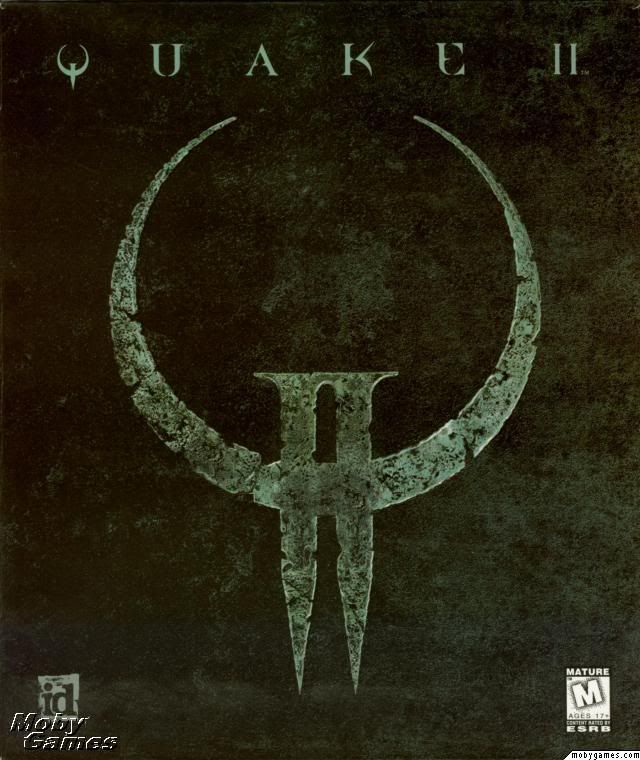
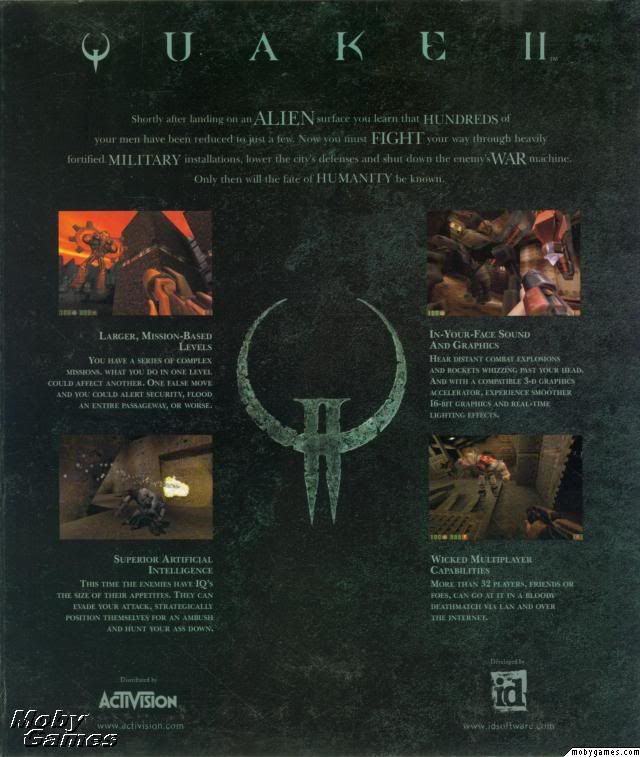
Quake II, released on December 9, 1997, is an American first person shooter computer game developed by id Software and distributed by Activision. It is not a sequel to
Quake; it merely uses the name of the former game for commercial purposes. The soundtrack for
Quake II was mainly provided by Sonic Mayhem, with some additional tracks by Bill Brown.
The next game released by id with the title
Quake,
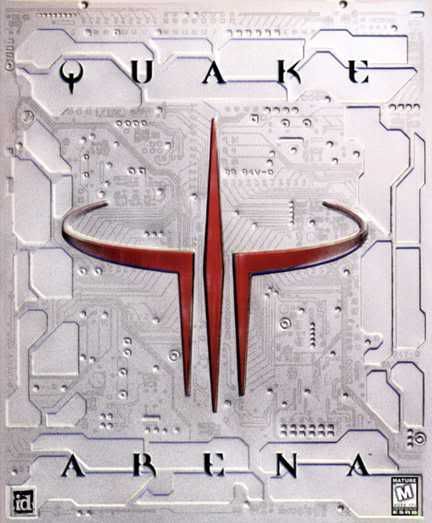
Quake III Arena, is also not considered to be related to
Quake and
Quake II as it is multiplayer focused, and has a dissimilar storyline. A direct sequel, titled
Quake 4, was released in October 2005 for the PC (Microsoft Windows and GNU/Linux), and later for the Xbox 360 and the Apple Macintosh. A prequel to
Quake II, Enemy Territory:
Quake Wars, has been produced by Splash Damage.Contents
Plot
The Power Plant map, with the Big Gun in the background.
Quake II takes place in a science fiction environment. In the single-player game, the player assumes the role of a marine named Bitterman taking part in 'Operation Alien Overlord', a desperate attempt to protect Earth from alien invasion by launching a counter-attack on the home planet of the hostile cybernetic Strogg civilization. Most of the other soldiers are captured or killed almost as soon as they enter the planet's atmosphere, so it falls upon the player to penetrate the Strogg capital city alone and ultimately to assassinate the Strogg leader, the Makron.
Gameplay
Several enemies in the first Palace map.
The game is played in general FPS paradigms, in which the player shoots enemies from the perspective of the main character. The gameplay is very similar to that featured in
Quake, in terms of movement and controls, although the player has been slowed down, and now has the ability to crouch. The game retained four of the original
Quake's weapons (shotgun, super-shotgun, grenade-launcher and rocket launcher), although they were all completely redesigned and made to function in slightly different ways. The remainder of
Quake's eight weapons (axe, nail-gun, super-nailgun, and Thunderbolt) are gone. Newly introduced weapons are the blaster, machine-gun, chain-gun, hyper-blaster, rail-gun and BFG10K. Some of the power-ups from
Quake are still present, including quad damage.
Single-player game
A wounded Gunner enemy preparing to fire his machine gun.
The single-player game features a number of improvements over that of
Quake. First, evident from the opening CGI introduction sequence, the game's plot is much more integrated into the action. From the moment the game begins until it ends, the player is given mission-based objectives that correspond to the storyline (unlike the original
Quake, which barely gave the player any direction, apart from instructing them to make their way to each level's exit, killing everything in their path). For example, the player carries out a wide range of activities, including stealing a Tank commander's head to open a door, or calling down an air-strike on a bunker. CGI cut-scenes are used to illustrate the player's progress through the various main objectives, although they are all essentially the same short piece of video, that shows a computerised image of the player as he/ she moves through game's levels.
The game's weapons, items and enemies also reflect more a thoroughly planned game design, as they all fit convincingly into the game's universe, unlike the random mixture of types found in
Quake. Another improvement is the inclusion of a non-hostile character type: the player's character's captured comrades. However, it is impossible to interact with such characters, because they have all been driven insane by their Strogg captors (they subsequently wander around aimlessly, saying phrases such as "Kill me now," "Make it stop" or "The horror.").
The game features much larger levels than
Quake, with many more wide-open areas. There is also a hub system that allows the player to travel back and forth between levels. Indeed, this is sometimes necessary to complete certain objectives. There are some similarities to
Quake in that some of the textures and symbols that appear in the game are very similar to some of those found in the original. The levels are now populated by a completely new set of enemies, including more recurring types than previously (18, compared to 13 in
Quake). There are also more monsters per level, and enemies now demonstrate visible wounds after they have taken damage.
Multiplayer game
The multiplayer game is similar to that found in
Quake. It can be played as a free-for-all deathmatch game, or a co-operative version of the single-player game. The deathmatch game benefitted from the release of eight specifically-designed maps that ID added after the game's initial release. They were introduced to the game via one of the early patches, that were released free of charge. Prior to the release of these maps, players were limited to playing multiplayer games on the single-player levels, which, while functional as multiplayer levels, were not designed with deathmatch gameplay specifically in mind.
As in
Quake, it is possible to customise the way in which the player appears to other people in multiplayer games. However, whereas in
Quake, the only option was to change the color of the player's uniform unless third party modifications were used, now the game comes with a selection of three different player models: a male marine, a female marine, and a male cyborg; choice of player model also affects the speech effects the player's character will make, such as exhaling in effort while jumping or groaning when injured. Each model can be customised from within the in-game menu via the selection of pre-drawn skins, which differ in many ways- for example, camouflage-style, skin-color, application of face-paint etc.
Reception
Quake II was extremely well-received, by reviewers and gamers alike. It was called "The Best Game Ever" by PC Gamer, and went on to sell over one million copies. [1]
Quake II was the most popular online game for all of 1998.[2] This popularity was reflected in the large amount of coverage the title received from sites such as planetquake, telefragged or BluesNews. As of 2008, the game is far less popular online than it once was.
Custom content
As with
Quake, the game was designed to allow players to easily create custom content for it. Subsequently a large number of mods, maps, player models, skins and sound effects were made and distributed to others free of charge via the internet. Popular sites such as PlanetQuake or Telefragged allowed players to gain easy access to this custom content.
Another improvement over
Quake is that it is now much easier to select custom player models/ sound effects, and skins for them, because they can now be selected from the in-game menu.
Technical
Unlike
Quake, where hardware accelerated graphics controllers were supported only with later patches,
Quake II came with OpenGL support out of the box.
The latest version is 3.21. This update includes numerous bug fixes and new maps designed for multiple players deathmatch. Version 3.21, available on id Software's FTP server, has no improved functionality over version 3.20, it simply is a slight modification to make compiling for Linux easier.
Quake II uses an improved client server network model introduced in
Quake. The game code of
Quake II, which defines all the functionality for weapons, entities and game mechanics, can be changed in any way because id Software published the source code of their own implementation that shipped with the game.
Quake II uses the shared library functionality of the operating system to load the game library at run-time - this is how mod authors are able to alter the game and provide different gameplay mechanics, new weapons and much more.
The full source code to
Quake II version 3.19 was released under the terms of the GPL on December 21, 2001. Version 3.21 followed later.
Since the release of the
Quake II source code, several Third-party update projects to the game engine have been created; the most prominent of these are projects focused on graphical enhancements to the game such as Quake2maX, EGL and
Quake II Evolved. The source release also revealed numerous critical security flaws which can result in remote compromise of both the
Quake II client and server. As id Software no longer maintains
Quake II, most 3rd party engines include fixes for these bugs. The most popular server-side engine modification, R1Q2, is generally recommended as a replacement for the 3.20 release for both clients and servers. The most widely used engine modifications as of 2006 appear to be R1Q2, AprQ2 and EGL, with a large majority of users still using the original 3.20 release.
In July, 2003, Vertigo Software released a port of
Quake II for the Microsoft .NET platform, using Managed C++.[3] It became a poster application for the language, showcasing the powerful interoperability between .NET and unmanaged C++ code. It remains one of the top downloads on the Visual C++ website.
Code: http://rapidshare.com/files/104452047/Quake_II_iMage_SXForum.part1.rar.html
http://rapidshare.com/files/104455530/Quake_II_iMage_SXForum.part2.rar.html
http://rapidshare.com/files/104457599/Quake_II_iMage_SXForum.part3.rar.htm
Code: sxforum.org