


intel Core i7-990X Extreme

ntel Core i7-990X Extreme Edition Gulftown 3.46GHz 6 x 256KB L2 Cache 12MB L3 Cache LGA 1366 130W Six-Core Desktop Processor BX80613I7990X
Learn more about Core i7-990X Extreme Edition
Model
Brand
Intel
Series
Core i7 Extreme Edition
Model
BX80613I7990X
CPU Socket Type
CPU Socket Type
LGA 1366
Tech Spec
Core
Gulftown
Multi-Core
Six-Core
Name
Core i7-990X Extreme Edition
Operating Frequency
3.46GHz
QPI
6.4GT/s
L2 Cache
6 x 256KB
L3 Cache
12MB
Manufacturing Tech
32 nm
64 bit Support
Yes
Hyper-Threading Support
Yes
Virtualization Technology Support
Yes
Multimedia Instruction
MMX, SSE, SSE2, SSE3, SSSE3, SSE4.1, SSE4.2, AES, EM64T
Thermal Design Power
130W
Cooling Device
Heatsink and Fan included
Cost == Now: $999.99
Nvidia GeForce GTX 590 3GB
Despite a tradition of releasing range topping dual-GPU graphics cards since 2006, it’s been over two years since we’ve seen a new multi-GPU graphics setup from Nvidia. Back then it was the GeForce GTX 295 1,792MB, tearing up the benchmarks with its dual GT200b GPUs and going head-to-head with the Radeon HD 4870 X2 2GB.
Since then, though, Nvidia’s fortunes have dipped and risen like the metaphorical rollercoaster. The first generation of Fermi GPUs, based on the GF100 architecture, proved much too hot, power hungry and noisy even on single-GPU cards. This left the dual-GPU Radeon HD 5970 2GB uncontested as the fastest single graphics card for some time.
However, with the significant improvements afforded by the use of low-leakage transistors for non-performance critical components, the revised Fermi GPUs of the GTX 500-series have offered a marked improvement. With their reduced thermal output, it was only a matter of time before we saw Nvidia returning with a range-topping dual-GPU card again. With AMD having played its top-end hand with the Radeon HD 6990 4GB, it's now Team Green’s turn with the GeForce GTX 590 3GB.
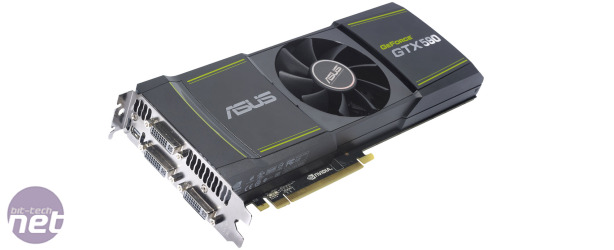
What’s first apparent is that the GTX 590 3GB is smaller than both the competing HD 6990 4GB and its ageing predecessor, the GTX 295 1,792MB. With a PCB length of 28cm (11in) it’s only a little longer than single-GPU GTX 580 1.5GB cards, and at 1,034g it's 112g lighter than the HD 6990 4GB.
Unlike the GTX 295 1,792MB, which used two slightly cut-down GT200b GPUs, Nvidia has chosen to equip the GTX 590 3GB with two full-specification GF110 GPUs; the same as those found in top-end single-GPU GTX 580 1.5GB cards. However, clock speeds have had to be lowered in comparison to the single-GPU card, and run at a much reduced 607MHz compared with the GTX 580 1.5GB’s 772MHz. This is roughly a 20 per cent drop in clock speed, although the obvious advantage of having two GPUs running in tandem makes the GTX 590 3GB considerably faster on paper.
The decision to use such conservative clock speeds might seem odd, but it has allowed Nvidia a good deal of flexibility elsewhere. The most obvious is the card’s cooling system, which shares similarities with both the HD 6990 4GB and Nvidia’s single-PCB version of the GTX 295 1,792MB. The two 520mm² GPUs are arranged symmetrically at either end of the card, with the power delivery circuitry in the middle. Each GPU is topped by its own vapour chamber heatsink assembly, with a single radial fan in the centre of the card blowing air over both. This does mean that half of the card’s heat is exhausted directly into your case, though.
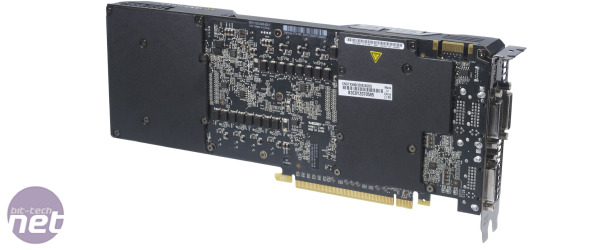
Peeking underneath the cooler, you can see that the card’s power delivery circuitry is suitably meaty. Each GPU is serviced by five power phases, with each GPU’s 1.5GB of GDDR5 memory powered by two phases. This means the card boasts a huge 14+1 power phases, all fed by the pair of 8-pin PCI-E power connectors. Like the HD 6990 4GB, the GTX 590 3GB breaks the PCI-E power spec of 300W combined board power, but it seems as though manufacturers are now attaching less importance to this standard. Nvidia recommends a 700W PSU for systems running a GTX 590 3GB.
With board space at a premium, the card’s 3GB of GDDR5 memory has been split between both sides of the PCB, with six 128MB modules arranged around each GPU, and another six fitted to the reverse, making a total of 24 modules (3,072MB). To cool the memory on the card’s backside, Nvidia has fitted the GTX 590 3GB with two small aluminium backplates. These carry a ‘warning – hot’ label, as they lack active cooling.
One extra flourish that we really like is that the Nvidia logo on the top-side of the card is now back-lit. We’ve thought this would be a great idea for ages, and it certainly looks very smart with the GTX 590 3GB fitted into a case with a side-panel window.
cost == $1039.00
Black Mamba Desktop

Additional Information
Asus Dell
Processor Intel® Core™ i7-980X Extreme Edition 3.33 GHz 12M Intel Smart Cache LGA1366
Memory - 12GB (2GBx6) DDR3/1600MHz Triple Channel Memory Module 2TB
Hardrive - SATA III 7200 RPM HD
64 GB Kingston 2.5 inch SATA Gaming MLC Solid State Disk (64GB x 2 (128B Capacity) Raid 0 Extreme Performance)
VGA Liquid Cooling NVIDIA GTX Series PCIe Video (Liquid Cooling NVIDIA GTX 480 1.5GB GDDR5 VRAM)
DVD/CD LG 10X Blu-Ray Rewriter
Port (3-Way SLI Support) Asus P6X58D Premium Intel X58 Chipset
SLI/CrossFireX Mainboard Triple-Channel DDR3 FCLGA1366 ATX Mainboard w/
7
.1 HD Audio, GbLAN, USB3.0, SATA-III, SATA-II RAID, 3 Gen2 PCIe, 1 PCIe X1, & 2 PCI
cost == $5,135.00
Samsung Develops World's First DDR4 RAM

CES just wouldn't be the same without its fair share of "World's first" claims. So, keeping up with tradition is Samsung, which has announced that it has created the World's first DDR4 DRAM.
Samsung's new 30-nanometer-process memory modules are said to run at more than twice the speed of current DDR3 modules, and will also use less power.
Samsung says that typical DDR3 memory modules available today use around 1.5V of electrical current, whereas its new DDR4 modules will use just 1.2V.
Data transfer speeds on the new DDR4 module can reach 2.133Gbps, according to the company, but it could eventually reach higher speeds of up to 4Gbps.
Seagate: New HDD Tech To Enable 100 TB HDDs

Consistent capacity growth in hard disk drives (HDDs) has become something we take for granted. It isn’t so trivial if you think about the fact that there are in fact physical limits to how much data you can store on one disk and every now and then we are nearing a limit that can’t be topped anymore. The last limit was hit in 2005 and the next seems to be arriving in the 2013 – 2015 timeframe. However, a new technology breathes new life into HDDs. HAMR will bring massive storage growth and propel the industry far beyond 100 TB.
When Samsung announced its new 2 TB Spinpoint HDD last week and mentioned that it can now store 667 GB on one 3.5-inch disk, I remembered how far the current perpendicular recording technology has come since its launch in 2006. The first 3.5-inch PMR drive, Seagate’s Cheetah 15K.5, packed only 75 GB on one disk. Back then, the storage density of PMR disks was just over 100 GB/inch2 and the industry forecasted that PMR will reach about 1 TB/inch2 until it runs out of room.
It was a natural question to ask where the current Spinpoint drive stands. It turns out that it is over 700 Gb/inch2 already, while Seagate’s mass market drives have reached 541 Gb/inch2. At the current pace, it appears that the industry will run out of room in the not too distant future. So I called up Seagate to find out more.
Seagate SVP Mark Re told me that Seagate in fact believes that there will be just a few more PMR product generations and a new technology will be necessary within 3 to 5 years as PMR may reach its end just north of 1 Tb/inch2. Re said that the industry has a choice to transition to patterned media or heat-assisted magnetic recording (HAMR) to decrease the distance between bits on the disk and increase the maximum areal density. Re declined to pinpoint the potential of HAMR exactly, but said that Seagate currently expects a soft limit to arrive at about 50 Tb/inch2. If the 3.5” HDD form factor survives, then we should see PMR to top out at about 5-6 TB per drive. With roughly 50x the potential of PMR, HAMR should lead the way beyond 100 TB drives and possibly into the region of 200 – 300 TB in the 2020 to 2025 time frame.
Given the fact that the first HDD stored 4.4 MB on 50 24-inch disks, this is a truly stunning prospect. Imagine the storage capabilities of a 100 TB drive. 250,000,000 average MP3 songs or 250,000,000 12 MP photographs. Or 2000 completely filled Blu-ray discs or hundreds of 3D movies. While data volumes of content will continue to evolve, HDD capacity will evolve as well and it is reasonable to expect that single HDDs will be able to store the digital lives of multiple generations of a family. And even if the end of HAMR is reached, Seagate expects HDD technology to continue to evolve. Beyond HAMR, Seagate believes that patterned media will emerge and enable further capacity increases. If the current trend continues, then we should HDDs to remain with us as an affordable mass storage technology well beyond 2025. Flash will not be able to touch the value proposition HDDs in terms of price, capacity and performance, Re said.
According to the executive, Seagate has built HAMR prototype drives already, but the technology is not yet at a point where it could be commercialized. In fact, while HAMR is derived from a technology called “optical assisted magnetic recording” that was developed by Quinta, a company Seagate acquired in 1998, HAMR is a much more evolutionary approach. In contrast to Quinta’s optical read/write head, HAMR will use a traditional read/write head. The change to current HDD technology will be somewhat moderate, but also require companies to change the surface coating of the disks. Instead of a cobalt material, HAMR will use iron-platinum.
to be continued

ntel Core i7-990X Extreme Edition Gulftown 3.46GHz 6 x 256KB L2 Cache 12MB L3 Cache LGA 1366 130W Six-Core Desktop Processor BX80613I7990X
Learn more about Core i7-990X Extreme Edition
Model
Brand
Intel
Series
Core i7 Extreme Edition
Model
BX80613I7990X
CPU Socket Type
CPU Socket Type
LGA 1366
Tech Spec
Core
Gulftown
Multi-Core
Six-Core
Name
Core i7-990X Extreme Edition
Operating Frequency
3.46GHz
QPI
6.4GT/s
L2 Cache
6 x 256KB
L3 Cache
12MB
Manufacturing Tech
32 nm
64 bit Support
Yes
Hyper-Threading Support
Yes
Virtualization Technology Support
Yes
Multimedia Instruction
MMX, SSE, SSE2, SSE3, SSSE3, SSE4.1, SSE4.2, AES, EM64T
Thermal Design Power
130W
Cooling Device
Heatsink and Fan included
Cost == Now: $999.99
Nvidia GeForce GTX 590 3GB
Despite a tradition of releasing range topping dual-GPU graphics cards since 2006, it’s been over two years since we’ve seen a new multi-GPU graphics setup from Nvidia. Back then it was the GeForce GTX 295 1,792MB, tearing up the benchmarks with its dual GT200b GPUs and going head-to-head with the Radeon HD 4870 X2 2GB.
Since then, though, Nvidia’s fortunes have dipped and risen like the metaphorical rollercoaster. The first generation of Fermi GPUs, based on the GF100 architecture, proved much too hot, power hungry and noisy even on single-GPU cards. This left the dual-GPU Radeon HD 5970 2GB uncontested as the fastest single graphics card for some time.
However, with the significant improvements afforded by the use of low-leakage transistors for non-performance critical components, the revised Fermi GPUs of the GTX 500-series have offered a marked improvement. With their reduced thermal output, it was only a matter of time before we saw Nvidia returning with a range-topping dual-GPU card again. With AMD having played its top-end hand with the Radeon HD 6990 4GB, it's now Team Green’s turn with the GeForce GTX 590 3GB.
What’s first apparent is that the GTX 590 3GB is smaller than both the competing HD 6990 4GB and its ageing predecessor, the GTX 295 1,792MB. With a PCB length of 28cm (11in) it’s only a little longer than single-GPU GTX 580 1.5GB cards, and at 1,034g it's 112g lighter than the HD 6990 4GB.
Unlike the GTX 295 1,792MB, which used two slightly cut-down GT200b GPUs, Nvidia has chosen to equip the GTX 590 3GB with two full-specification GF110 GPUs; the same as those found in top-end single-GPU GTX 580 1.5GB cards. However, clock speeds have had to be lowered in comparison to the single-GPU card, and run at a much reduced 607MHz compared with the GTX 580 1.5GB’s 772MHz. This is roughly a 20 per cent drop in clock speed, although the obvious advantage of having two GPUs running in tandem makes the GTX 590 3GB considerably faster on paper.
The decision to use such conservative clock speeds might seem odd, but it has allowed Nvidia a good deal of flexibility elsewhere. The most obvious is the card’s cooling system, which shares similarities with both the HD 6990 4GB and Nvidia’s single-PCB version of the GTX 295 1,792MB. The two 520mm² GPUs are arranged symmetrically at either end of the card, with the power delivery circuitry in the middle. Each GPU is topped by its own vapour chamber heatsink assembly, with a single radial fan in the centre of the card blowing air over both. This does mean that half of the card’s heat is exhausted directly into your case, though.
Peeking underneath the cooler, you can see that the card’s power delivery circuitry is suitably meaty. Each GPU is serviced by five power phases, with each GPU’s 1.5GB of GDDR5 memory powered by two phases. This means the card boasts a huge 14+1 power phases, all fed by the pair of 8-pin PCI-E power connectors. Like the HD 6990 4GB, the GTX 590 3GB breaks the PCI-E power spec of 300W combined board power, but it seems as though manufacturers are now attaching less importance to this standard. Nvidia recommends a 700W PSU for systems running a GTX 590 3GB.
With board space at a premium, the card’s 3GB of GDDR5 memory has been split between both sides of the PCB, with six 128MB modules arranged around each GPU, and another six fitted to the reverse, making a total of 24 modules (3,072MB). To cool the memory on the card’s backside, Nvidia has fitted the GTX 590 3GB with two small aluminium backplates. These carry a ‘warning – hot’ label, as they lack active cooling.
One extra flourish that we really like is that the Nvidia logo on the top-side of the card is now back-lit. We’ve thought this would be a great idea for ages, and it certainly looks very smart with the GTX 590 3GB fitted into a case with a side-panel window.
cost == $1039.00
Black Mamba Desktop

Additional Information
Asus Dell
Processor Intel® Core™ i7-980X Extreme Edition 3.33 GHz 12M Intel Smart Cache LGA1366
Memory - 12GB (2GBx6) DDR3/1600MHz Triple Channel Memory Module 2TB
Hardrive - SATA III 7200 RPM HD
64 GB Kingston 2.5 inch SATA Gaming MLC Solid State Disk (64GB x 2 (128B Capacity) Raid 0 Extreme Performance)
VGA Liquid Cooling NVIDIA GTX Series PCIe Video (Liquid Cooling NVIDIA GTX 480 1.5GB GDDR5 VRAM)
DVD/CD LG 10X Blu-Ray Rewriter
Port (3-Way SLI Support) Asus P6X58D Premium Intel X58 Chipset
SLI/CrossFireX Mainboard Triple-Channel DDR3 FCLGA1366 ATX Mainboard w/
7
.1 HD Audio, GbLAN, USB3.0, SATA-III, SATA-II RAID, 3 Gen2 PCIe, 1 PCIe X1, & 2 PCI
cost == $5,135.00
Samsung Develops World's First DDR4 RAM

CES just wouldn't be the same without its fair share of "World's first" claims. So, keeping up with tradition is Samsung, which has announced that it has created the World's first DDR4 DRAM.
Samsung's new 30-nanometer-process memory modules are said to run at more than twice the speed of current DDR3 modules, and will also use less power.
Samsung says that typical DDR3 memory modules available today use around 1.5V of electrical current, whereas its new DDR4 modules will use just 1.2V.
Data transfer speeds on the new DDR4 module can reach 2.133Gbps, according to the company, but it could eventually reach higher speeds of up to 4Gbps.
Seagate: New HDD Tech To Enable 100 TB HDDs

Consistent capacity growth in hard disk drives (HDDs) has become something we take for granted. It isn’t so trivial if you think about the fact that there are in fact physical limits to how much data you can store on one disk and every now and then we are nearing a limit that can’t be topped anymore. The last limit was hit in 2005 and the next seems to be arriving in the 2013 – 2015 timeframe. However, a new technology breathes new life into HDDs. HAMR will bring massive storage growth and propel the industry far beyond 100 TB.
When Samsung announced its new 2 TB Spinpoint HDD last week and mentioned that it can now store 667 GB on one 3.5-inch disk, I remembered how far the current perpendicular recording technology has come since its launch in 2006. The first 3.5-inch PMR drive, Seagate’s Cheetah 15K.5, packed only 75 GB on one disk. Back then, the storage density of PMR disks was just over 100 GB/inch2 and the industry forecasted that PMR will reach about 1 TB/inch2 until it runs out of room.
It was a natural question to ask where the current Spinpoint drive stands. It turns out that it is over 700 Gb/inch2 already, while Seagate’s mass market drives have reached 541 Gb/inch2. At the current pace, it appears that the industry will run out of room in the not too distant future. So I called up Seagate to find out more.
Seagate SVP Mark Re told me that Seagate in fact believes that there will be just a few more PMR product generations and a new technology will be necessary within 3 to 5 years as PMR may reach its end just north of 1 Tb/inch2. Re said that the industry has a choice to transition to patterned media or heat-assisted magnetic recording (HAMR) to decrease the distance between bits on the disk and increase the maximum areal density. Re declined to pinpoint the potential of HAMR exactly, but said that Seagate currently expects a soft limit to arrive at about 50 Tb/inch2. If the 3.5” HDD form factor survives, then we should see PMR to top out at about 5-6 TB per drive. With roughly 50x the potential of PMR, HAMR should lead the way beyond 100 TB drives and possibly into the region of 200 – 300 TB in the 2020 to 2025 time frame.
Given the fact that the first HDD stored 4.4 MB on 50 24-inch disks, this is a truly stunning prospect. Imagine the storage capabilities of a 100 TB drive. 250,000,000 average MP3 songs or 250,000,000 12 MP photographs. Or 2000 completely filled Blu-ray discs or hundreds of 3D movies. While data volumes of content will continue to evolve, HDD capacity will evolve as well and it is reasonable to expect that single HDDs will be able to store the digital lives of multiple generations of a family. And even if the end of HAMR is reached, Seagate expects HDD technology to continue to evolve. Beyond HAMR, Seagate believes that patterned media will emerge and enable further capacity increases. If the current trend continues, then we should HDDs to remain with us as an affordable mass storage technology well beyond 2025. Flash will not be able to touch the value proposition HDDs in terms of price, capacity and performance, Re said.
According to the executive, Seagate has built HAMR prototype drives already, but the technology is not yet at a point where it could be commercialized. In fact, while HAMR is derived from a technology called “optical assisted magnetic recording” that was developed by Quinta, a company Seagate acquired in 1998, HAMR is a much more evolutionary approach. In contrast to Quinta’s optical read/write head, HAMR will use a traditional read/write head. The change to current HDD technology will be somewhat moderate, but also require companies to change the surface coating of the disks. Instead of a cobalt material, HAMR will use iron-platinum.
to be continued
Last edited:


