


Crimea has fast-tracked preparations for the republic's referendum and for its possible joining with Russia, statements from the autonomy’s leaders reveal. Though no decision has been made by Moscow, they say Crimea may be part of Russia by late March.
Amid the ongoing media hysteria on the alleged Russian “invasion” of Crimea, the region’s pro-Russian leaders are staying calm, if not jubilant. Following claims that the Ukrainian hryvna may soon be swapped for the Russian ruble, and that the result of the March 16 referendum on the future of the Autonomous Republic is “easily predictable” by the mood of the majority of Crimea’s population, they are now saying that joining Russia could take place this month.
“The transition from one jurisdiction to the other is a complicated process, but I think in the case of favorable outcome of the referendum, the Crimeans will be able to feel as citizens of another country within one month – within March,” the speaker of the region’s Supreme Council, Vladimir Konstantinov, said, as quoted by RIA Novosti.
Konstantinov then announced that if Crimea becomes Russian, the autonomy’s budget will become larger than under the Ukrainian standards. According to the speaker, the Crimean authorities “did not count on that” but the Russian side gave “guarantees” of budget enlargement.
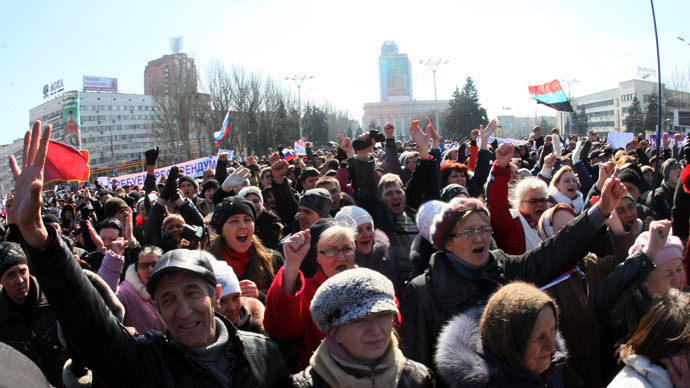
Pro-Russian demonstrators raise their hands as they shout slogans during a rally in the eastern Ukrainian city of Donetsk on March 8, 2014.(AFP Photo / Alexander Khudoteply)
There was no immediate reaction from Moscow on statements coming from Simferopol, but earlier the State Duma – Russia's parliament – said it would debate the issue of Crimea joining Russia only after the referendum takes place.
Earlier on Friday, Grigory Ioffe, first deputy chair of the region’s parliament, said that Crimea is not looking for any “privileges” from Russia if it joins the country, and that the Crimean authorities are certain the regional economy will prosper after getting rid of Ukrainian corruption.
Ioffe stressed that the “historic” referendum will be “very democratic and open” and will be held “in full compliance” with both the Ukrainian constitution and the international treaties that Ukraine had adopted. International observers, including those from the OSCE, as well as media and NGO representatives are “most welcome” to observe the referendum, he told journalists.
Crimea’s Central Election Committee is indeed expecting that some international observers will come to inspect the March 16 referendum, the committee’s head, Mikhail Malyshev, told Interfax on Saturday. About 1,250 voting stations will be set up for the event and over 2.2 million ballot papers printed. The autonomy’s population was just under two million people as of 2013, with Russians making up 58.5 percent of it, Ukrainians comprising 24.3 percent, and Crimean Tatars constituting an important minority of 12.1 percent.
While the Russian-speaking majority has for years been in favor of separating from Ukraine – at least by obtaining a broader autonomy and returning to the 1992 constitution – the Tatars have been divided on the issue. Many Tatars strongly reject the idea of Crimea joining Russia, as they have themselves been pushing for the creation of a national autonomy within the Ukrainian state.
Self-defense squads swear in
Thousands of pro-Russian demonstrators rallied in Sevastopol on Saturday, calling on everyone to cast their votes at the March 16 All-Crimean referendum. The city has a special status, and is officially not part of Crimean Autonomous Republic, but will nevertheless join the referendum and vote whether they want to become part of the Russian Federation.

Pro-Russia supporters attend a rally in the Crimean port city of Sevastopol March 8, 2014.(Reuters / Baz Ratner)
Organizers of the event displayed a huge banner with the words of famous Russian Admiral Pavel Nakhimov, who was killed in the Crimean War:
“Protect Sevastopol to the last!” Speaking at the rally, city administration officials promised that new, larger social security benefits are being readied for the residents of Sevastopol.
Pro-Russian activists have also announced a flashmob in support of the peninsular region joining Russia. They plan to gather at least 5,000 people to form a “living flag” of Russia on Sunday.
Meanwhile, the first batch of the so-called self-defense squads swore allegiance to Crimean authorities in Simferopol on Saturday.
Crimean Prime Minister Sergey Aksyonov called the swearing-in ceremony a “historic event,” stating that Crimea’s own Armed Forces are being formed.
Speaking to journalists, Aksyonov said the forces will ensure that the referendum is held in a peaceful manner. He stressed that “the Armed Forces of the Republic of Crimea have been created for defense, not for offense.”
So far, the self-defense squads keeping peace and order across the peninsula have been mostly quiet when asked about their origins and command, but many maintained that they are Crimean citizens who joined the improvised militia as vigilantes to prevent the violent events of Kiev’s Maidan from engulfing Crimea. Others said they are from Russia, sparking media speculations that all these forces are in fact Russian military in disguise – something Russian President Vladimir Putin has categorically denied.
In eastern Ukraine, the weekend also started with mass pro-Russian demonstrations. A crowd of anti-Maidan demonstrators gathered to rally in the city of Donetsk, where the “People’s Governor” Pavel Gubarev was arrested along with dozens of pro-Russian protesters earlier on Thursday. Thick police presence was reported from the scene of the rally, which took place in front of the regional administration building, with at least 500 law enforcers, some unidentified armed men, and police vehicles maintaining order, according to Interfax.
In Kharkov, about 6,000 people rallied in protest of the coup-imposed Kiev authorities on the central Freedom Square. Some of the demonstrators later formed an anti-fascist march, in which some 1,500 people with Russian flags marched to the city’s Constitution Square.
The Kharkov, protesters demanded that coup-imposed regional heads show up and speak with them, but none of the authorities came out. The police did not attempt to block the rally. The demonstrators gave officers white tulips and tied St. George’s ribbons on riot shields.
Amid the ongoing media hysteria on the alleged Russian “invasion” of Crimea, the region’s pro-Russian leaders are staying calm, if not jubilant. Following claims that the Ukrainian hryvna may soon be swapped for the Russian ruble, and that the result of the March 16 referendum on the future of the Autonomous Republic is “easily predictable” by the mood of the majority of Crimea’s population, they are now saying that joining Russia could take place this month.
“The transition from one jurisdiction to the other is a complicated process, but I think in the case of favorable outcome of the referendum, the Crimeans will be able to feel as citizens of another country within one month – within March,” the speaker of the region’s Supreme Council, Vladimir Konstantinov, said, as quoted by RIA Novosti.
Konstantinov then announced that if Crimea becomes Russian, the autonomy’s budget will become larger than under the Ukrainian standards. According to the speaker, the Crimean authorities “did not count on that” but the Russian side gave “guarantees” of budget enlargement.
Pro-Russian demonstrators raise their hands as they shout slogans during a rally in the eastern Ukrainian city of Donetsk on March 8, 2014.(AFP Photo / Alexander Khudoteply)
There was no immediate reaction from Moscow on statements coming from Simferopol, but earlier the State Duma – Russia's parliament – said it would debate the issue of Crimea joining Russia only after the referendum takes place.
Earlier on Friday, Grigory Ioffe, first deputy chair of the region’s parliament, said that Crimea is not looking for any “privileges” from Russia if it joins the country, and that the Crimean authorities are certain the regional economy will prosper after getting rid of Ukrainian corruption.
Ioffe stressed that the “historic” referendum will be “very democratic and open” and will be held “in full compliance” with both the Ukrainian constitution and the international treaties that Ukraine had adopted. International observers, including those from the OSCE, as well as media and NGO representatives are “most welcome” to observe the referendum, he told journalists.
Crimea’s Central Election Committee is indeed expecting that some international observers will come to inspect the March 16 referendum, the committee’s head, Mikhail Malyshev, told Interfax on Saturday. About 1,250 voting stations will be set up for the event and over 2.2 million ballot papers printed. The autonomy’s population was just under two million people as of 2013, with Russians making up 58.5 percent of it, Ukrainians comprising 24.3 percent, and Crimean Tatars constituting an important minority of 12.1 percent.
While the Russian-speaking majority has for years been in favor of separating from Ukraine – at least by obtaining a broader autonomy and returning to the 1992 constitution – the Tatars have been divided on the issue. Many Tatars strongly reject the idea of Crimea joining Russia, as they have themselves been pushing for the creation of a national autonomy within the Ukrainian state.
Self-defense squads swear in
Thousands of pro-Russian demonstrators rallied in Sevastopol on Saturday, calling on everyone to cast their votes at the March 16 All-Crimean referendum. The city has a special status, and is officially not part of Crimean Autonomous Republic, but will nevertheless join the referendum and vote whether they want to become part of the Russian Federation.

Pro-Russia supporters attend a rally in the Crimean port city of Sevastopol March 8, 2014.(Reuters / Baz Ratner)
Organizers of the event displayed a huge banner with the words of famous Russian Admiral Pavel Nakhimov, who was killed in the Crimean War:
“Protect Sevastopol to the last!” Speaking at the rally, city administration officials promised that new, larger social security benefits are being readied for the residents of Sevastopol.
Pro-Russian activists have also announced a flashmob in support of the peninsular region joining Russia. They plan to gather at least 5,000 people to form a “living flag” of Russia on Sunday.
Meanwhile, the first batch of the so-called self-defense squads swore allegiance to Crimean authorities in Simferopol on Saturday.
Crimean Prime Minister Sergey Aksyonov called the swearing-in ceremony a “historic event,” stating that Crimea’s own Armed Forces are being formed.
Speaking to journalists, Aksyonov said the forces will ensure that the referendum is held in a peaceful manner. He stressed that “the Armed Forces of the Republic of Crimea have been created for defense, not for offense.”
So far, the self-defense squads keeping peace and order across the peninsula have been mostly quiet when asked about their origins and command, but many maintained that they are Crimean citizens who joined the improvised militia as vigilantes to prevent the violent events of Kiev’s Maidan from engulfing Crimea. Others said they are from Russia, sparking media speculations that all these forces are in fact Russian military in disguise – something Russian President Vladimir Putin has categorically denied.
In eastern Ukraine, the weekend also started with mass pro-Russian demonstrations. A crowd of anti-Maidan demonstrators gathered to rally in the city of Donetsk, where the “People’s Governor” Pavel Gubarev was arrested along with dozens of pro-Russian protesters earlier on Thursday. Thick police presence was reported from the scene of the rally, which took place in front of the regional administration building, with at least 500 law enforcers, some unidentified armed men, and police vehicles maintaining order, according to Interfax.
In Kharkov, about 6,000 people rallied in protest of the coup-imposed Kiev authorities on the central Freedom Square. Some of the demonstrators later formed an anti-fascist march, in which some 1,500 people with Russian flags marched to the city’s Constitution Square.
The Kharkov, protesters demanded that coup-imposed regional heads show up and speak with them, but none of the authorities came out. The police did not attempt to block the rally. The demonstrators gave officers white tulips and tied St. George’s ribbons on riot shields.


