
Latest ads
-
 Google Pixel 9 Pro
- vgp
- Updated:
-
Jobreceive.com for sale
- Blogerwiki
- Updated:
-
 Post Your Vehicle for Sale — FREE! - https://libro.lk
- Kalu_Puth
- Updated:
-
 ඔයාගෙ Assignment හෝ Thesis එක හරියට හදාගමු
- ErMurazor
- Updated:
-
BlackWall V2ray servers
- hu KANNA
- Updated:
You are using an out of date browser. It may not display this or other websites correctly.
You should upgrade or use an alternative browser.
You should upgrade or use an alternative browser.


Sri Lanka’s Port City to apply its own economic, commercial laws: PM
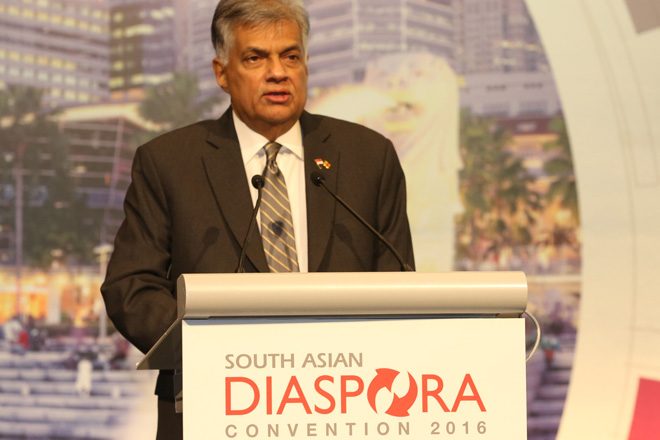
July 18, 2016 (LBO) – The proposed Financial City better known as the Port City will function as a special jurisdiction area with its own economic and commercial laws to facilitate operations of global multinational corporations, Prime Minister said.
Delivering the keynote address at the third South Asian Diaspora Convention, Prime Minister Ranil Wickremesinghe said the proposed city is ideal to fill the vacuum for a financial city along the trading route between the cities of Singapore and Dubai.
Wickremesinghe highlighted that the proposed ETCA with India is expected to be signed by the end of this year, and the agreement will “remove all barriers to trade.”
“The ETCA will provide the opportunity to strengthen cooperation between the two-port system – paving the way for an inter-related and integrated port system between the two countries.”
Prime Minister said ETCA has the potential to promote a rapid growth of the 500 billion US dollars sub regional economy.
He added that by next year the Singapore-India, the Indo-Lanka ETCA and the Sri Lanka-Singapore FTA will enable the southern sub region of South Asia and Singapore establish a tripartite arrangement for trade and investments.
Wickremesinghe reiterated that he will introduce a new Foreign Exchange Act to remove restrictions on current accounts and will reform the tax law to favour simplicity and cut red tape for business enterprises thereby offering a better environment for business.
Full text of the speech is reproduced below.
Mr Tharman Shanmugaratnam, Deputy Prime Minister and Coordinating Minister for Economic and Social Policies, Singapore, Ambassador Gopinath Pillai, Chairman, Institute of South Asian Studies, National University of Singapore, Distinguished delegates and Friends.
Let me thank you at the outset for inviting me to this, the third South Asia Diaspora Convention, hosted by the Institute of South Asian Studies in Singapore. This event underscores the strategic position to which Singapore has evolved in the last 51 years as a key intersection between the East and the West. That we South Asians are congregating for this event in a South-East Asian nation is testimony to Singapore’s vision and skill in hosting these events.
South Asian relations with this region go a long way back. The ancient historical chronicle, records that our people first came to Swarnabhumi 25 centuries ago. They were adventurers, sailors, traders, emissaries of Emperor Ashoka, astrologers, priests, and the like.
The best known is Kaundinya, an Indian Brahmin, who founded the kingdom of Funan. This kingdom was connected to the ancient Pallava Kingdom of South India. For centuries, the alliance between the Pallavas and the Sri Lankan Kingdoms dominated shipping in the Bay of Bengal. South Asia was the pinnacle of progress in the ancient world.
2. Today, with a population of 1.7 Billion and an impressive growth rate that the World Bank calls the highest in the world, South Asia is very much the place to be in. Supported by low oil prices and high domestic demand, growth rates are currently high in South Asia.
However there are limitations to domestic-based growth, especially for smaller South Asian economies.
South Asian Businesses need to respond to the new de-regulation sweeping global trade, taxation, financial management and business.
In order to sustain medium and long-term growth, South Asia Governments must focus on further opening the national economies and promoting foreign trade and investments. This requires a structured and consistent reform agenda, macro-economic stability, free trade, decreasing deficits, improving the ease of doing business and an increase in public infrastructure investment across the region from 3.5 % of GDP to 7.5 %.
3. My country Sri Lanka which has been ranked the highest in economic freedom in the region by the Heritage Foundation, which has been pioneering economic liberalization in South Asia. Yet today, in Sri Lanka we are also forging a fresh political initiative – a politics of convergence to consolidate democracy.
In 2015, the people of Sri Lanka voted twice for a national unity government that assured the country prosperity and stability, eschewing myopic political and economic policies that lacked long term focus. On January 8 th last year, the voters elected Maithripala Sirisena as President to execute this mandate. This was further strengthened in August after the Parliamentary elections when we formed a National Government consisting of the two main political parties. The national government, has resulted in political stability and a bi-partisan agreement to formulate consistent and stable economic policies. This, in turn, has set in motion long overdue smart and sustainable economic reforms to harness the country’s tremendous potential.
These include:
• Reducing the budget deficits from 5.4% of the GDP this year to 3.5% by 2020.
• Introducing a new Foreign Exchange Act – to remove restrictions on current accounts.
• Reforming the tax law to favour simplicity and cut red tape for business enterprises thereby offering a better environment for business.
• A new set of incentives for investments is being formulated in consultation with the IMF and the World Bank.
• The sale of non-strategic ventures such as The Colombo Hilton, Lanka Hospitals, the Hyatt Regency Hotel – amongst others – will herald investment opportunities. SriLankan Airlines with its diverse network of routes is a mature airline and is up for investment collaboration.
• With 13 years of compulsory education, Sri Lanka has scored high in the Human Development Index in the region for two decades. The regional average for youth literacy was 83% but Sri Lanka’s is over 98% as confirmed by World Bank.
• We recognize that poor infrastructure, obsolete policies and unfavorable business environments constrain the ability to do business across borders and act as a drag on competitiveness in South Asia.
In response, Sri Lanka has launched an ambitious program of physical infrastructure development to overhaul the sea, air, road transportations, the energy sector and telecommunications so as to form the backbone of the country. These efforts are intended to support government initiatives to develop Sri Lanka as a regional hub in finance, logistics and business.
4. Allow me to highlight our key sectors of interest.
Manufacturing and Service
The policies for the manufacturing and the service sectors will be based on Sri Lanka becoming a platform for comprehensive value addition and joining the Global Value Chain. We will focus on the industrial internet of things amongst new business models, innovations, skills development for the job market, the provision of industrial infrastructure and the promotion of private investments.
Digital Economy
Sri Lanka is ranked among the Top 50 Global Outsourcing destinations by AT Kearney, while Colombo is ranked among the Top 20 Emerging Cities by Global Services Magazine.
Our new policies seek to improve the network infrastructure the skills shortage and the digital divide across ICT services in terms of computer literacy so as to ensure that ICT4ALL is available in all parts of the country.
Tourism
Sri Lanka’s potential for Tourism has not been fully utilized. A new programme will include infrastructure for high value tourism and the further development of the hill country, the opening of the Eastern beaches and offshore projects such as yachting and cruises – stretching from the uninhabited small islands in the North to the historic Galle City in the South.
Infrastructure
The government has launched a large scale economic and infrastructure project – the Kandy – Colombo – Hambantota Corridor that will reshape the country’s urban landscape with two airports and two sea ports. This corridor will amalgamate five separate projects.
1) The Kandy Mega Development Project, 2) the Wayamba (North-Western) Industrial and Tourist Development Project, 3) the Western Megapolis, 4) the Southern Tourist and Industrial Project and 5) the Hambantota Economic Development Project – to be implemented over 15 years.
The US $ 40 Billion Western Megapolis project aims to develop the Western Province as a Megapolis with metropolitan areas on a global scale. The Western Megapolis which will have an estimated population of 8.5 million by 2025 will establish Colombo as a business and financial hub to attract foreign investors to set up operations in Sri Lanka. The Colombo Port will be modernized with up-to- date infrastructure to accommodate Triple E-Class mega ships.
The Katunayake International Airport will be further expanded. It will include a Logistics corridor, Industrial clusters, a Science and a Technology City and the Financial City Project involving the reclamation of 269 hectares of land from the sea, will also be in this area.
The proposed Financial City is ideal to fill the vacuum for a financial city along the trading route between the cities of Singapore and Dubai. The financial city will function as a special jurisdiction area with its own economic and commercial laws to facilitate operations of global multinational corporations and grow as a business and financial hub.
The US $ 10 Billion Hambantota Economic Project, located in southern Sri Lanka, will invite investments to build oil refineries, power generation plant and industrial zones. We have already started discussions with a number of Chinese Investors.
Other initiatives are focusing on providing logistics support through better road connectivity. Indeed, expressways connecting the Western and Southern Provinces of the country will play a pivotal role in cross-border connectivity linking Sri Lanka’s two principal seaports.
A third Port Development is planned for Trincomalee in the East Coast. The Sri Lanka Government has entered into agreements with Surbana Jurong Private Limited to prepare the master plan for Trincomalee based on shipping, manufacturing and tourism. The area of 175 km to the South of Trincomalee will also be developed as high-end tourist resorts.
Trade
We recognize that small domestic markets are insufficient to sustain growth – therefore a shift to greater export orientation is required to achieve a growth of 8%. Hence, our trade policies will focus on gaining access markets for Sri Lankan exports.
We have already made the application to the European Union to regain the GSP+ facility for tariff relief. This facility will give Sri Lanka competitive edge in accessing the single European Market.
We are hopeful of negotiating this agreement by 2017, which will be a tremendous boost for Sri Lankan manufacturing, services and agricultural products.
We are also negotiating a Free Trade Agreement with China under the One Belt-One Road initiative. This is necessary in order to make a success of the Chinese investment in the Hambantota Economic Project and the proposed Financial City.
In addition, Sri Lanka’s long standing economic cooperation with Japan will help us to further modernize our economy. These include planning the Kandy Mega Development Project as well as the Science and Technology cooperation.
5.We are cognizant that the economic asymmetry between Sri Lanka and India is going to increase in the future as the latter emerges as a major global player in an increasingly multi-polar world.
The India-Sri Lanka FTA between the two countries will be further expanded and deepened to go beyond trading goods to cover trade in services, investments and technology cooperation. The proposed ETCA will also remove all barriers to trade. We expect the ETCA to be signed by the end of this year.
The complementary economic developments in South India and Sri Lanka will be enhanced by ETCA, which will provide an impetus to the existing synergies.
As you are aware, South India is home to six key ports in India – the Chennai port and Tuticorin Port in Tamil Nadu, the Visakhapatnam Port in Andra, the New Mangalore Port in Karnataka, the Cochin Port in Kerala.
A significant share of Sri Lankan exports enter into India through ports such as Chennai located in Southern India and a significant share of the cargo are transshipped to ports located in the Southern India. The ETCA will provide the opportunity to strengthen cooperation between the two-port system – paving the way for an inter-related and integrated port system between the two countries.
With the proximate location of industrial zones and logistic and financial services along this strategic maritime corridor, Sri Lanka and South India provides attractive investment opportunities for a range of activities in industry, information technology and tourism.
India’s five southern states – Karnataka, Andhra Pradesh, Tamil Nadu, Kerala and Telegana have a population of 250 million people and a combined GDP of nearly US$ 450 billion. With the addition of Sri Lanka US$ 80 billion GDP this sub-region will have a US$ 500 billion economy. The ETCA has the potential to promote a rapid growth of the US$ 500 Billion sub regional economy.
Finally we are also negotiating a Free Trade Agreement (FTA) with Singapore. As you know Singapore has a Comprehensive Economic Partnership Agreement (CEPA) with India.
On the one hand, Sri Lanka’s close proximity to the fast-growing South Indian states offers a strategic economic advantage to the country.
On the other, the sub-region (especially India) also stands to benefit immensely from Sri Lanka’s uniquely positioned geo-strategic advantage – its location at the crossroads of major shipping routes connecting South Asia, the Far East and the Pacific with Europe and the Americas.
Maximizing on these factors will transform Sri Lanka into a geo-economic center of South Asia, dynamically and synergically engaged with the rest of region.
By next year the Singapore-India (CEPA), the Indo-Lanka ETCA and the Sri Lanka-Singapore FTA will enable the southern sub region of South Asia and Singapore to establish a tripartite arrangement for trade and investments.
Such a bold agreement posses the potential to enhance economic cooperation between our three countries that will also have a positive impact on the Bay of Bengal trade. At the other end, Singapore too will expand its importance and capacity for business networking in the region.
It is a vision of convergence that is inextricably interwoven with the future of South Asia as a whole. It is up to us then to be imaginative and bold in providing the political leadership to maximize on the potentials and opportunities of such a convergence.
- http://www.lankabusinessonline.com/...to-apply-its-own-economic-commercial-laws-pm/
July 18, 2016 (LBO) – The proposed Financial City better known as the Port City will function as a special jurisdiction area with its own economic and commercial laws to facilitate operations of global multinational corporations, Prime Minister said.
Delivering the keynote address at the third South Asian Diaspora Convention, Prime Minister Ranil Wickremesinghe said the proposed city is ideal to fill the vacuum for a financial city along the trading route between the cities of Singapore and Dubai.
Wickremesinghe highlighted that the proposed ETCA with India is expected to be signed by the end of this year, and the agreement will “remove all barriers to trade.”
“The ETCA will provide the opportunity to strengthen cooperation between the two-port system – paving the way for an inter-related and integrated port system between the two countries.”
Prime Minister said ETCA has the potential to promote a rapid growth of the 500 billion US dollars sub regional economy.
He added that by next year the Singapore-India, the Indo-Lanka ETCA and the Sri Lanka-Singapore FTA will enable the southern sub region of South Asia and Singapore establish a tripartite arrangement for trade and investments.
Wickremesinghe reiterated that he will introduce a new Foreign Exchange Act to remove restrictions on current accounts and will reform the tax law to favour simplicity and cut red tape for business enterprises thereby offering a better environment for business.
Full text of the speech is reproduced below.
Mr Tharman Shanmugaratnam, Deputy Prime Minister and Coordinating Minister for Economic and Social Policies, Singapore, Ambassador Gopinath Pillai, Chairman, Institute of South Asian Studies, National University of Singapore, Distinguished delegates and Friends.
Let me thank you at the outset for inviting me to this, the third South Asia Diaspora Convention, hosted by the Institute of South Asian Studies in Singapore. This event underscores the strategic position to which Singapore has evolved in the last 51 years as a key intersection between the East and the West. That we South Asians are congregating for this event in a South-East Asian nation is testimony to Singapore’s vision and skill in hosting these events.
South Asian relations with this region go a long way back. The ancient historical chronicle, records that our people first came to Swarnabhumi 25 centuries ago. They were adventurers, sailors, traders, emissaries of Emperor Ashoka, astrologers, priests, and the like.
The best known is Kaundinya, an Indian Brahmin, who founded the kingdom of Funan. This kingdom was connected to the ancient Pallava Kingdom of South India. For centuries, the alliance between the Pallavas and the Sri Lankan Kingdoms dominated shipping in the Bay of Bengal. South Asia was the pinnacle of progress in the ancient world.
2. Today, with a population of 1.7 Billion and an impressive growth rate that the World Bank calls the highest in the world, South Asia is very much the place to be in. Supported by low oil prices and high domestic demand, growth rates are currently high in South Asia.
However there are limitations to domestic-based growth, especially for smaller South Asian economies.
South Asian Businesses need to respond to the new de-regulation sweeping global trade, taxation, financial management and business.
In order to sustain medium and long-term growth, South Asia Governments must focus on further opening the national economies and promoting foreign trade and investments. This requires a structured and consistent reform agenda, macro-economic stability, free trade, decreasing deficits, improving the ease of doing business and an increase in public infrastructure investment across the region from 3.5 % of GDP to 7.5 %.
3. My country Sri Lanka which has been ranked the highest in economic freedom in the region by the Heritage Foundation, which has been pioneering economic liberalization in South Asia. Yet today, in Sri Lanka we are also forging a fresh political initiative – a politics of convergence to consolidate democracy.
In 2015, the people of Sri Lanka voted twice for a national unity government that assured the country prosperity and stability, eschewing myopic political and economic policies that lacked long term focus. On January 8 th last year, the voters elected Maithripala Sirisena as President to execute this mandate. This was further strengthened in August after the Parliamentary elections when we formed a National Government consisting of the two main political parties. The national government, has resulted in political stability and a bi-partisan agreement to formulate consistent and stable economic policies. This, in turn, has set in motion long overdue smart and sustainable economic reforms to harness the country’s tremendous potential.
These include:
• Reducing the budget deficits from 5.4% of the GDP this year to 3.5% by 2020.
• Introducing a new Foreign Exchange Act – to remove restrictions on current accounts.
• Reforming the tax law to favour simplicity and cut red tape for business enterprises thereby offering a better environment for business.
• A new set of incentives for investments is being formulated in consultation with the IMF and the World Bank.
• The sale of non-strategic ventures such as The Colombo Hilton, Lanka Hospitals, the Hyatt Regency Hotel – amongst others – will herald investment opportunities. SriLankan Airlines with its diverse network of routes is a mature airline and is up for investment collaboration.
• With 13 years of compulsory education, Sri Lanka has scored high in the Human Development Index in the region for two decades. The regional average for youth literacy was 83% but Sri Lanka’s is over 98% as confirmed by World Bank.
• We recognize that poor infrastructure, obsolete policies and unfavorable business environments constrain the ability to do business across borders and act as a drag on competitiveness in South Asia.
In response, Sri Lanka has launched an ambitious program of physical infrastructure development to overhaul the sea, air, road transportations, the energy sector and telecommunications so as to form the backbone of the country. These efforts are intended to support government initiatives to develop Sri Lanka as a regional hub in finance, logistics and business.
4. Allow me to highlight our key sectors of interest.
Manufacturing and Service
The policies for the manufacturing and the service sectors will be based on Sri Lanka becoming a platform for comprehensive value addition and joining the Global Value Chain. We will focus on the industrial internet of things amongst new business models, innovations, skills development for the job market, the provision of industrial infrastructure and the promotion of private investments.
Digital Economy
Sri Lanka is ranked among the Top 50 Global Outsourcing destinations by AT Kearney, while Colombo is ranked among the Top 20 Emerging Cities by Global Services Magazine.
Our new policies seek to improve the network infrastructure the skills shortage and the digital divide across ICT services in terms of computer literacy so as to ensure that ICT4ALL is available in all parts of the country.
Tourism
Sri Lanka’s potential for Tourism has not been fully utilized. A new programme will include infrastructure for high value tourism and the further development of the hill country, the opening of the Eastern beaches and offshore projects such as yachting and cruises – stretching from the uninhabited small islands in the North to the historic Galle City in the South.
Infrastructure
The government has launched a large scale economic and infrastructure project – the Kandy – Colombo – Hambantota Corridor that will reshape the country’s urban landscape with two airports and two sea ports. This corridor will amalgamate five separate projects.
1) The Kandy Mega Development Project, 2) the Wayamba (North-Western) Industrial and Tourist Development Project, 3) the Western Megapolis, 4) the Southern Tourist and Industrial Project and 5) the Hambantota Economic Development Project – to be implemented over 15 years.
The US $ 40 Billion Western Megapolis project aims to develop the Western Province as a Megapolis with metropolitan areas on a global scale. The Western Megapolis which will have an estimated population of 8.5 million by 2025 will establish Colombo as a business and financial hub to attract foreign investors to set up operations in Sri Lanka. The Colombo Port will be modernized with up-to- date infrastructure to accommodate Triple E-Class mega ships.
The Katunayake International Airport will be further expanded. It will include a Logistics corridor, Industrial clusters, a Science and a Technology City and the Financial City Project involving the reclamation of 269 hectares of land from the sea, will also be in this area.
The proposed Financial City is ideal to fill the vacuum for a financial city along the trading route between the cities of Singapore and Dubai. The financial city will function as a special jurisdiction area with its own economic and commercial laws to facilitate operations of global multinational corporations and grow as a business and financial hub.
The US $ 10 Billion Hambantota Economic Project, located in southern Sri Lanka, will invite investments to build oil refineries, power generation plant and industrial zones. We have already started discussions with a number of Chinese Investors.
Other initiatives are focusing on providing logistics support through better road connectivity. Indeed, expressways connecting the Western and Southern Provinces of the country will play a pivotal role in cross-border connectivity linking Sri Lanka’s two principal seaports.
A third Port Development is planned for Trincomalee in the East Coast. The Sri Lanka Government has entered into agreements with Surbana Jurong Private Limited to prepare the master plan for Trincomalee based on shipping, manufacturing and tourism. The area of 175 km to the South of Trincomalee will also be developed as high-end tourist resorts.
Trade
We recognize that small domestic markets are insufficient to sustain growth – therefore a shift to greater export orientation is required to achieve a growth of 8%. Hence, our trade policies will focus on gaining access markets for Sri Lankan exports.
We have already made the application to the European Union to regain the GSP+ facility for tariff relief. This facility will give Sri Lanka competitive edge in accessing the single European Market.
We are hopeful of negotiating this agreement by 2017, which will be a tremendous boost for Sri Lankan manufacturing, services and agricultural products.
We are also negotiating a Free Trade Agreement with China under the One Belt-One Road initiative. This is necessary in order to make a success of the Chinese investment in the Hambantota Economic Project and the proposed Financial City.
In addition, Sri Lanka’s long standing economic cooperation with Japan will help us to further modernize our economy. These include planning the Kandy Mega Development Project as well as the Science and Technology cooperation.
5.We are cognizant that the economic asymmetry between Sri Lanka and India is going to increase in the future as the latter emerges as a major global player in an increasingly multi-polar world.
The India-Sri Lanka FTA between the two countries will be further expanded and deepened to go beyond trading goods to cover trade in services, investments and technology cooperation. The proposed ETCA will also remove all barriers to trade. We expect the ETCA to be signed by the end of this year.
The complementary economic developments in South India and Sri Lanka will be enhanced by ETCA, which will provide an impetus to the existing synergies.
As you are aware, South India is home to six key ports in India – the Chennai port and Tuticorin Port in Tamil Nadu, the Visakhapatnam Port in Andra, the New Mangalore Port in Karnataka, the Cochin Port in Kerala.
A significant share of Sri Lankan exports enter into India through ports such as Chennai located in Southern India and a significant share of the cargo are transshipped to ports located in the Southern India. The ETCA will provide the opportunity to strengthen cooperation between the two-port system – paving the way for an inter-related and integrated port system between the two countries.
With the proximate location of industrial zones and logistic and financial services along this strategic maritime corridor, Sri Lanka and South India provides attractive investment opportunities for a range of activities in industry, information technology and tourism.
India’s five southern states – Karnataka, Andhra Pradesh, Tamil Nadu, Kerala and Telegana have a population of 250 million people and a combined GDP of nearly US$ 450 billion. With the addition of Sri Lanka US$ 80 billion GDP this sub-region will have a US$ 500 billion economy. The ETCA has the potential to promote a rapid growth of the US$ 500 Billion sub regional economy.
Finally we are also negotiating a Free Trade Agreement (FTA) with Singapore. As you know Singapore has a Comprehensive Economic Partnership Agreement (CEPA) with India.
On the one hand, Sri Lanka’s close proximity to the fast-growing South Indian states offers a strategic economic advantage to the country.
On the other, the sub-region (especially India) also stands to benefit immensely from Sri Lanka’s uniquely positioned geo-strategic advantage – its location at the crossroads of major shipping routes connecting South Asia, the Far East and the Pacific with Europe and the Americas.
Maximizing on these factors will transform Sri Lanka into a geo-economic center of South Asia, dynamically and synergically engaged with the rest of region.
By next year the Singapore-India (CEPA), the Indo-Lanka ETCA and the Sri Lanka-Singapore FTA will enable the southern sub region of South Asia and Singapore to establish a tripartite arrangement for trade and investments.
Such a bold agreement posses the potential to enhance economic cooperation between our three countries that will also have a positive impact on the Bay of Bengal trade. At the other end, Singapore too will expand its importance and capacity for business networking in the region.
It is a vision of convergence that is inextricably interwoven with the future of South Asia as a whole. It is up to us then to be imaginative and bold in providing the political leadership to maximize on the potentials and opportunities of such a convergence.
- http://www.lankabusinessonline.com/...to-apply-its-own-economic-commercial-laws-pm/
Last edited:
Singapore Signs Deal To Help Develop Sri Lanka's Western Region
International Enterprise Singapore (IE Singapore) and the Ministry of Megapolis and Western Development (MoMWD) of Sri Lanka signed an agreement to collaborate on business development in Sri Lanka's Western Region Megapolis on Monday (Jul 18).
In a media release, IE Singapore said the MOU was the first between Sri Lanka and a Singapore government agency, paving the way for "stronger Singapore-Sri Lanka investment and economic partnerships".
This comes on the same day that both countries announced the launch of negotiations for a Sri Lanka-Singapore Free Trade Agreement.
The Western Region in Sri Lanka is the main driver of the country's economy, contributing to 40 per cent of its total Gross Domestic Product in 2014. The Sri Lankan government aims to triple the region's per capita income to US$12,000 by 2020, targeting an average annual growth rate of 7 to 8 per cent over the next 14 years, according to IE Singapore.
The Western Region Megapolis, anchored by commercial capital Colombo, is one of the flagship developments by the Government of Sri Lanka and includes 142 projects with an estimated value of US$40 billion over the next 15 years, IE Singapore added.
IE Singapore assistant chief executive officer Tan Soon Kim, Singapore's signatory for the MOU, said the Western Region Megapolis is a good first stop for Singapore companies to consider when doing business in Sri Lanka given its accelerated growth.
"The MOU signed between IE Singapore and MoMWD creates a platform for Singapore and Sri Lankan companies to partner each other in the urban solutions and connectivity sectors," Mr Tan said.
IE Singapore said opportunities in the two sectors within the Megapolis include development of the central business district of Colombo, port-related works, technological infrastructure and investments in industrial and tourism zones.
The signing at Singapore's Istana was witnessed by Singapore’s Prime Minister Lee Hsien Loong and Sri Lanka’s Prime Minister Ranil Wickremesinghe, who is currently on an official state visit to Singapore.
IE Singapore will be hosting Wickremesinghe to a closed-door dialogue and lunch session attended by 20 industry representatives on Tuesday to exchange ideas on areas of collaboration in the Western Region Megapolis and the greater Sri Lanka, the agency said.
(Channel News Asia)
- http://www.asianmirror.lk/news/item...al-to-help-develop-sri-lanka-s-western-region
International Enterprise Singapore (IE Singapore) and the Ministry of Megapolis and Western Development (MoMWD) of Sri Lanka signed an agreement to collaborate on business development in Sri Lanka's Western Region Megapolis on Monday (Jul 18).
In a media release, IE Singapore said the MOU was the first between Sri Lanka and a Singapore government agency, paving the way for "stronger Singapore-Sri Lanka investment and economic partnerships".
This comes on the same day that both countries announced the launch of negotiations for a Sri Lanka-Singapore Free Trade Agreement.
The Western Region in Sri Lanka is the main driver of the country's economy, contributing to 40 per cent of its total Gross Domestic Product in 2014. The Sri Lankan government aims to triple the region's per capita income to US$12,000 by 2020, targeting an average annual growth rate of 7 to 8 per cent over the next 14 years, according to IE Singapore.
The Western Region Megapolis, anchored by commercial capital Colombo, is one of the flagship developments by the Government of Sri Lanka and includes 142 projects with an estimated value of US$40 billion over the next 15 years, IE Singapore added.
IE Singapore assistant chief executive officer Tan Soon Kim, Singapore's signatory for the MOU, said the Western Region Megapolis is a good first stop for Singapore companies to consider when doing business in Sri Lanka given its accelerated growth.
"The MOU signed between IE Singapore and MoMWD creates a platform for Singapore and Sri Lankan companies to partner each other in the urban solutions and connectivity sectors," Mr Tan said.
IE Singapore said opportunities in the two sectors within the Megapolis include development of the central business district of Colombo, port-related works, technological infrastructure and investments in industrial and tourism zones.
The signing at Singapore's Istana was witnessed by Singapore’s Prime Minister Lee Hsien Loong and Sri Lanka’s Prime Minister Ranil Wickremesinghe, who is currently on an official state visit to Singapore.
IE Singapore will be hosting Wickremesinghe to a closed-door dialogue and lunch session attended by 20 industry representatives on Tuesday to exchange ideas on areas of collaboration in the Western Region Megapolis and the greater Sri Lanka, the agency said.
(Channel News Asia)
- http://www.asianmirror.lk/news/item...al-to-help-develop-sri-lanka-s-western-region

Krrish Square finally off the ground...
Maison_Edouard_Francois.jpg)
Jul 15 2016
The construction of one of Sri Lanka’s most controversial projects, Krrish Square Tower by Indian investors has finally begun on the US$ 650 million mixed development project at the 4.3 acre Transworks Building site in Fort.
The project was first launched as a BOI venture in September 2012 but was stalled in March 2013 due to a controversy of payments due to the releasing of the land to the then Urban Development Authority.
The company had initially deposited a sum of Rs. 499.5 million being 10 per cent of the total lease premium as a commitment fee on September 14,2012.
It was speculated that secret payoffs were made to VIP’s to keep the window open for payment and for various approvals.
Krrish Group CEO R. P. Gupta had said the commercial segment of the project is expected to attract major Fortune 500 companies who are interested in setting up offices in Colombo.
Several of these companies such as Samsung, Nokia, Mitsubishi, and others have expressed interest in the commercial spaces and residential apartments.
The Krrish Square development offices are currently located on the 35th floor of the World Trade Center’s West Tower.
Some test piling commenced at the project site in early 2013. In 2014 Ritz-Carlton partnered with Krrish and the construction was expected last year but it did take off.
- http://www.dailynews.lk/?q=2016/07/15/business/87614
Maison_Edouard_Francois.jpg)
ලජ්ජා නැද්ද බන් ඔය වගේ හෙළුවෙන් කඩේ යන්නේ ? උබට පොනිල ගෙවනවද දාන පොස්ට් එකට ?
ඕක පොනිලළුද දැන් හදල තියෙන්නේ ?
අර සජිත් හයිවේ එක හැදුව කියල දාගත්ත වගේ ...මොනවා වුනත් පුරාවස්තු කොල්ල කෑවත් දන්නා තරමින් තාත්ත වගේ මිනි මරල නම් නැහැ

Last edited:

China's IZP may get Sri Lanka's Mattala Airport for Silk Road Station

ECONOMYNEXT - IZP, a Chinese information technology company that builds financial infrastructure to popularize Renminbi on 'Silk Road Stations' along China's One Belt One Road initiative is on track to get Sri Lanka's second international airport, a media report said.
Sri Lanka called for offers from investors to run and operate the airport with bids closing on August 12.
Sri Lanka's Sunday Times newspaper said "arrangement are being worked out" with China's IZP group to operate Mattala Airport following a visit by international trade minister Malik Samarawickrama to Beijing earlier this month.
Mattala Rajapaksa International Airport has hit finances of Sri Lanka state-run airport agency as it has no revenue to service a loan of more than 200 million dollars loan taken from China. The airport was also designed and built by China.
China's IZP group offers a payment system to allow direct settlement between Renminbi and local currency and a Visa-like payment card that also promises lower fees.
At the moment international transaction with China requires local currency to be converted to dollars and then converted back to Renminbi (or vice versa) for international transactions.
IZP is supposed to roll out Renminbi financial architecture and popularize online retail along China's One Belt One Road initiative which seeks to mimic an ancient Silk Route from Europe to China, at strategic 'Silk Road Stations' along the way. In September IZP chief Luo Feng met then Sri Lanka Central Bank Governor Arjuna Mahendran,
IZP is also setting up a 'big data' platform with data mining capabilities claiming to offer up to date information.
Sri Lanka has been selected as 'Silk Road Station' between China and the Middle East on the sea route (21st century Maritime Silk Route) of the One Road One Belt initiative. On the Belt side (Silk Route Economic Belt), Kirgyztan is expected to play the same role.
In 2014, IZT expressed interest in buying troubled Parma Airport in Italy for much the same reasons.
IZT also has a port 'port alliance platform' with China Merchant International, which owns a terminal in Sri Lanka's Colombo port.
China Merchant International is also expected to get heavily involved in the running of Hambantota airport close to Mattala, which also a severe financial drain on Sri Lanka's state-port agency.
China will also get its own export processing zone in Hambantota, a key bulwark of a 'Silk Road Station'. COSCO, another Chinese group is expected to build a shipyard there.
Sri Lanka is also offering a Colombo International Financial Centre for the Chinese at a reclaimed China City near Colombo's main port, with its own laws.
IZT has also signed a deal with Kirgizstan for Astana International Financial Centre, which 'state within a state' with a Singapore style legal framework. (Colombo/July18/2016 - Corrected IZP)
- http://www.economynext.com/China_s_...a_Airport_for_Silk_Road_Station-3-5619-6.html

ECONOMYNEXT - IZP, a Chinese information technology company that builds financial infrastructure to popularize Renminbi on 'Silk Road Stations' along China's One Belt One Road initiative is on track to get Sri Lanka's second international airport, a media report said.
Sri Lanka called for offers from investors to run and operate the airport with bids closing on August 12.
Sri Lanka's Sunday Times newspaper said "arrangement are being worked out" with China's IZP group to operate Mattala Airport following a visit by international trade minister Malik Samarawickrama to Beijing earlier this month.
Mattala Rajapaksa International Airport has hit finances of Sri Lanka state-run airport agency as it has no revenue to service a loan of more than 200 million dollars loan taken from China. The airport was also designed and built by China.
China's IZP group offers a payment system to allow direct settlement between Renminbi and local currency and a Visa-like payment card that also promises lower fees.
At the moment international transaction with China requires local currency to be converted to dollars and then converted back to Renminbi (or vice versa) for international transactions.
IZP is supposed to roll out Renminbi financial architecture and popularize online retail along China's One Belt One Road initiative which seeks to mimic an ancient Silk Route from Europe to China, at strategic 'Silk Road Stations' along the way. In September IZP chief Luo Feng met then Sri Lanka Central Bank Governor Arjuna Mahendran,
IZP is also setting up a 'big data' platform with data mining capabilities claiming to offer up to date information.
Sri Lanka has been selected as 'Silk Road Station' between China and the Middle East on the sea route (21st century Maritime Silk Route) of the One Road One Belt initiative. On the Belt side (Silk Route Economic Belt), Kirgyztan is expected to play the same role.
In 2014, IZT expressed interest in buying troubled Parma Airport in Italy for much the same reasons.
IZT also has a port 'port alliance platform' with China Merchant International, which owns a terminal in Sri Lanka's Colombo port.
China Merchant International is also expected to get heavily involved in the running of Hambantota airport close to Mattala, which also a severe financial drain on Sri Lanka's state-port agency.
China will also get its own export processing zone in Hambantota, a key bulwark of a 'Silk Road Station'. COSCO, another Chinese group is expected to build a shipyard there.
Sri Lanka is also offering a Colombo International Financial Centre for the Chinese at a reclaimed China City near Colombo's main port, with its own laws.
IZT has also signed a deal with Kirgizstan for Astana International Financial Centre, which 'state within a state' with a Singapore style legal framework. (Colombo/July18/2016 - Corrected IZP)
- http://www.economynext.com/China_s_...a_Airport_for_Silk_Road_Station-3-5619-6.html

Licences for mini solar power plants
Licenses will be issued to SME entrepreneurs for the first time to set up mini solar power plants in the country.
Sri Lanka Sustainable Energy Authority Chairman Keerthie Wickramaratne said the power generated from these plants will be purchased by the government at attractive prices.
“We hope this move would encourage even the smaller companies and individuals to set up solar power plants and also help the nation to produce energy at reduced prices.”
Chairman Keerthie Wickramaratne
He said that the new licenses will be issued to set up solar plants to generate electricity for less than 5 megawatts. He estimated that such a project could be set up in less than one year and it will cost around US$ 1.5 million.
Wickramaratne said in addition this will also help to generate new employment opportunities and opening out a new area for business in the solar power generation. He said that banks too are keen to fund these power plants. “Solar Plants would be environmental friendly and could be set up all over Sri Lanka excluding some areas in Ratnapura and Nuwara Eliya areas.”
He also revealed that generation of one kilowatt from solar power will help the country to save around Rs. 40 to 50 million annually.
Wickramaratne said they had to iron out red tape and also stand against stiff opposition before they were able to get the licence process off the ground. Currently Laugfs and Sago Solar are buying two plants.
He said that he will also take steps to introduce a net accounting instead of net metering to households. “Currently households who use solar power to power their homes are being compensated by the Ceylon Electricity Board. Under the new net accounting these households will be actually able to earn ‘cash’.
Sri Lanka’s spends around 18% of its total expenditure per year on power generation and the potential of renewable energy (solar power and wind power) has being tremendously under played. He said that they will also look at using renewable energy for the lighting of street lights which is using a lot of power.
Today country uses both thermal (Coal and Diesel) and hydro power including mini hydro to around 99% to fulfill the power requirement. There is only one solar power plant set up by the government in Hambantota. With the Sampur power plant on hold which was to generate around 400 megawatts by 2018 the country needs urgent ways to fill this void.
“With these kinds of initiatives we expect that there would be one million houses that will use solar power to power their homes by 2020. Currently this figure is around 120,000”.
- http://www.dailynews.lk/?q=2016/07/18/business/87771
Licenses will be issued to SME entrepreneurs for the first time to set up mini solar power plants in the country.
Sri Lanka Sustainable Energy Authority Chairman Keerthie Wickramaratne said the power generated from these plants will be purchased by the government at attractive prices.
“We hope this move would encourage even the smaller companies and individuals to set up solar power plants and also help the nation to produce energy at reduced prices.”
Chairman Keerthie Wickramaratne
He said that the new licenses will be issued to set up solar plants to generate electricity for less than 5 megawatts. He estimated that such a project could be set up in less than one year and it will cost around US$ 1.5 million.
Wickramaratne said in addition this will also help to generate new employment opportunities and opening out a new area for business in the solar power generation. He said that banks too are keen to fund these power plants. “Solar Plants would be environmental friendly and could be set up all over Sri Lanka excluding some areas in Ratnapura and Nuwara Eliya areas.”
He also revealed that generation of one kilowatt from solar power will help the country to save around Rs. 40 to 50 million annually.
Wickramaratne said they had to iron out red tape and also stand against stiff opposition before they were able to get the licence process off the ground. Currently Laugfs and Sago Solar are buying two plants.
He said that he will also take steps to introduce a net accounting instead of net metering to households. “Currently households who use solar power to power their homes are being compensated by the Ceylon Electricity Board. Under the new net accounting these households will be actually able to earn ‘cash’.
Sri Lanka’s spends around 18% of its total expenditure per year on power generation and the potential of renewable energy (solar power and wind power) has being tremendously under played. He said that they will also look at using renewable energy for the lighting of street lights which is using a lot of power.
Today country uses both thermal (Coal and Diesel) and hydro power including mini hydro to around 99% to fulfill the power requirement. There is only one solar power plant set up by the government in Hambantota. With the Sampur power plant on hold which was to generate around 400 megawatts by 2018 the country needs urgent ways to fill this void.
“With these kinds of initiatives we expect that there would be one million houses that will use solar power to power their homes by 2020. Currently this figure is around 120,000”.
- http://www.dailynews.lk/?q=2016/07/18/business/87771
මහානගර සැලැස්ම යටතේ බුලත්සිංහල ඈගල්ඔය සතිපොල, ආර්ථික මධ්යස්ථානය හා බහුකාර්ය ගොඩනැගිල්ල ඉදිකිරීම ආරම්භ කිරීම

- https://www.facebook.com/media/set/?set=a.1745890232359154.1073742227.1435124643435716&type=3

- https://www.facebook.com/media/set/?set=a.1745890232359154.1073742227.1435124643435716&type=3
Sri Lanka and Singapore ink deals on trade, urban development, tech education


ECONOMYNEXT - Sri Lanka and Singapore has signed agreements to take forward, trade, urban development, cultural, civil service training, technical and vocation education links between the two countries.
Sri Lanka's Prime Minister Ranil Wickremesinghe met his counterpart Lee Hsien Loong
Sri Lanka's Development Strategies and International Trade Minister Malik Samarawickrema and Singapore's Industries Minister S Eswaran had inked a memorandum of understanding to have a free trade agreement.
Since Singapore is a country with a strong knowledge of economics, its prosperity is based on free trade and competitive free enterprises that does not exploit domestic consumers with import duties, economic analysts say.
As a result 'free trade' deals with Singapore are not tightly written and poor Sri Lankan consumers have no assurance that they can be protected from predatory protectionist Sri Lankan industrialists, as they can always lobby to put import duties up and earn unjust profit later.
Deals with countries like the US however are more water tight and can make big business face competition.
The two countries also inked deals on urban development, with Sri Lanka's Megapolis Ministry.
Other agreements related to culture, civil service development, technical and vocational training.
- http://www.economynext.com/Sri_Lank...ban_development,_tech_education-3-5630-1.html


New incentive structure for investments in coming weeks: PM
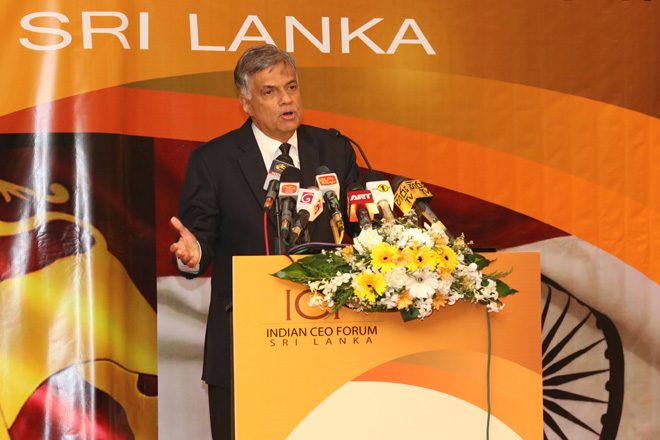
July 13, 2016 (LBO) – Sri Lanka will unleash a new incentive structure for specific investment sectors coupled with a simplified tax system in the coming weeks, Prime Minister Ranil Wickremesinghe said.
Wickremesinghe said the government has already identified specific sectors that generate high employment opportunities to offer new incentives.
“I want to encourage both Sri Lankan and foreign investments through new set of incentives and a simplified system of taxation,” Wickremesinghe said.
“We already finalized and discussed it with the IMF and with the help of the World Bank we are identifying the specific sectors which would require more incentives.”
Prime Minister was speaking at the Indian Chief Executive Officers’ Forum held at hotel Taj Samudra yesterday.
He said there are some ventures such as Hilton and Lanka Hospitals which will be divested by the end of this year.
Prime Minister addressing the Indian CEO’s emphasized that he wants ETCA to succeed as it will make Sri Lanka and southern India the fastest growing sub region in the South Asia.
- http://www.lankabusinessonline.com/new-incentive-structure-for-investments-in-coming-weeks-pm/
July 13, 2016 (LBO) – Sri Lanka will unleash a new incentive structure for specific investment sectors coupled with a simplified tax system in the coming weeks, Prime Minister Ranil Wickremesinghe said.
Wickremesinghe said the government has already identified specific sectors that generate high employment opportunities to offer new incentives.
“I want to encourage both Sri Lankan and foreign investments through new set of incentives and a simplified system of taxation,” Wickremesinghe said.
“We already finalized and discussed it with the IMF and with the help of the World Bank we are identifying the specific sectors which would require more incentives.”
Prime Minister was speaking at the Indian Chief Executive Officers’ Forum held at hotel Taj Samudra yesterday.
He said there are some ventures such as Hilton and Lanka Hospitals which will be divested by the end of this year.
Prime Minister addressing the Indian CEO’s emphasized that he wants ETCA to succeed as it will make Sri Lanka and southern India the fastest growing sub region in the South Asia.
- http://www.lankabusinessonline.com/new-incentive-structure-for-investments-in-coming-weeks-pm/


Green Valley ‘Township’ concept launched

The “Green Valley” Apartment which will be constructed according to a ‘Township’ concept was formally launched recently at the construction site in Homagama. This project was initiated under the Accelerated Program for the construction of 500,000 middle- income houses.
The project is a Private-Public-Partnership with Home Lands Skyline, Ministry of Housing & Construction and the National Housing and Development Authority to design, develop and construct a luxury apartment complex at affordable pricing Panagoda, between two popular cities Athurugiriya.
Branded as “Green Valley Apartments”, the new apartment blocks will be built according to a township concept. The key driving idea for the project was to make apartment type housing with modern amenities and facilities which has become so popular in Sri Lanka among urban upper income groups, affordable to a larger segment of the housing market.
Green Valley Apartments by Home Lands Skyline will present a modern, affordable yet luxury apartment complex in Panagoda located between Athurugiriya & Homagama with all the facilities such as swimming pools, gymnasiums, multi- functional halls plus a jogging track, day care center for children and minimart.
Ministry of Construction and NHDA selected Home Lands Skyline for this project in view of their reputation and excellent track record in the area of property development.
The apartment complex comprises of two types of apartments targeted at different market segments. 80% of the apartments (288 in total) will be 2 bed room apartment units which will be priced between Rs. 4.5 million to Rs. 5 million.
The balance 20% of the apartments will be three bedroom units each priced at Rs. 7.5 to Rs. 7.9 million.
The complex is equipped with 24 hour extended security at the gate. As the tripartite collaboration has made all these modern amenities and facilities affordable Home Lands Skyline believes that this project would redefine property development in Sri Lanka.
An ESCROW account (which is a state of the art online settlement portal) between all three parties have been established as an online transaction services and accounts that facilitate and accelerate e-commerce by assuring a secure settlement.
- http://www.dailynews.lk/?q=2016/07/20/business/87999

The “Green Valley” Apartment which will be constructed according to a ‘Township’ concept was formally launched recently at the construction site in Homagama. This project was initiated under the Accelerated Program for the construction of 500,000 middle- income houses.
The project is a Private-Public-Partnership with Home Lands Skyline, Ministry of Housing & Construction and the National Housing and Development Authority to design, develop and construct a luxury apartment complex at affordable pricing Panagoda, between two popular cities Athurugiriya.
Branded as “Green Valley Apartments”, the new apartment blocks will be built according to a township concept. The key driving idea for the project was to make apartment type housing with modern amenities and facilities which has become so popular in Sri Lanka among urban upper income groups, affordable to a larger segment of the housing market.
Green Valley Apartments by Home Lands Skyline will present a modern, affordable yet luxury apartment complex in Panagoda located between Athurugiriya & Homagama with all the facilities such as swimming pools, gymnasiums, multi- functional halls plus a jogging track, day care center for children and minimart.
Ministry of Construction and NHDA selected Home Lands Skyline for this project in view of their reputation and excellent track record in the area of property development.
The apartment complex comprises of two types of apartments targeted at different market segments. 80% of the apartments (288 in total) will be 2 bed room apartment units which will be priced between Rs. 4.5 million to Rs. 5 million.
The balance 20% of the apartments will be three bedroom units each priced at Rs. 7.5 to Rs. 7.9 million.
The complex is equipped with 24 hour extended security at the gate. As the tripartite collaboration has made all these modern amenities and facilities affordable Home Lands Skyline believes that this project would redefine property development in Sri Lanka.
An ESCROW account (which is a state of the art online settlement portal) between all three parties have been established as an online transaction services and accounts that facilitate and accelerate e-commerce by assuring a secure settlement.
- http://www.dailynews.lk/?q=2016/07/20/business/87999
World Bank grants Sri Lanka US$ 55 million to develop strategic cities
Wed, Jul 20, 2016, 07:39 pm SL Time, ColomboPage News Desk, Sri Lanka.
July 20, Colombo: The World Bank today signed a US$ 55 million loan agreement with Sri Lanka for the Strategic Cities Development Project to improve urban services, preserve cultural and environment assets, and improve livability in Jaffna, adding the city to an existing project to develop Galle and Kandy.

Secretary to the Treasury, Ministry of Finance Dr. R.H.S. Samaratunga and World Bank Country Director for Sri Lanka and the Maldives Françoise Clottes signed the credit agreement for the project today at the Ministry.
The credit will add development of rapidly urbanizing Jaffna to the existing Strategic Cities Development Project (SCDP), which is supported by the World Bank and was originally approved in 2014.
"Well planned cities can be centers of innovation and job creation as experienced in many parts of the world and this is an opportunity for Sri Lanka to connect people to prosperity," said Clottes. "There is substantial potential for economic growth in Jaffna, now that peace has returned. An improved urban environment is a favorable habitat for the developing enterprises that one day will become the engines of growth."
A recent World Bank study, "Sri Lanka: a Systematic Country Diagnostic (SCD)", identifies Jaffna as a rapidly growing, single-city agglomeration in the Northern Province of Sri Lanka. In the post-war era, the city has seen rapid growth and urban expansion and there are significant demands for improved municipal services. As communicated during recent consultations, the people of Jaffna see a priority in improving city functions and livability while preserving cultural heritage.
Guided by consultations with Jaffna�s citizens, the project will attempt to improve the road network and rehabilitate the drainage system while preserving the city�s ponds, which have played an important role in flood management and which could be key to climate change adaptation. In addition, the project aims to preserve cultural heritage assets such as public spaces and parks as well as encouraging cycling.
"Building trust among citizens and service providers is a challenge and an outcome we hope to achieve through the additional finance support to Jaffna through this project," said Zhiyu Jerry Chen, World Bank Senior Urban Development Specialist and Task Team Leader of the project. "A City Stakeholder forum will be used under this project for improved and continued citizen engagement to closely collaborate with the service providers in ensuring the project investments are put to profitable use for the people of Jaffna," he said.
The credit for this project is provided by the International Development Association (IDA), the World Bank
s grant and low interest arm, with a maturity of 25 years that includes a grace period of 5 years. The Ministry of Megapolis and Western Development is the lead responsible agency for the implementation of this project with active participation from Jaffna Municipal Council and other implementation partner agencies.
- http://www.colombopage.com/archive_16B/Jul20_1469023794CH.php
Wed, Jul 20, 2016, 07:39 pm SL Time, ColomboPage News Desk, Sri Lanka.
July 20, Colombo: The World Bank today signed a US$ 55 million loan agreement with Sri Lanka for the Strategic Cities Development Project to improve urban services, preserve cultural and environment assets, and improve livability in Jaffna, adding the city to an existing project to develop Galle and Kandy.

Secretary to the Treasury, Ministry of Finance Dr. R.H.S. Samaratunga and World Bank Country Director for Sri Lanka and the Maldives Françoise Clottes signed the credit agreement for the project today at the Ministry.
The credit will add development of rapidly urbanizing Jaffna to the existing Strategic Cities Development Project (SCDP), which is supported by the World Bank and was originally approved in 2014.
"Well planned cities can be centers of innovation and job creation as experienced in many parts of the world and this is an opportunity for Sri Lanka to connect people to prosperity," said Clottes. "There is substantial potential for economic growth in Jaffna, now that peace has returned. An improved urban environment is a favorable habitat for the developing enterprises that one day will become the engines of growth."
A recent World Bank study, "Sri Lanka: a Systematic Country Diagnostic (SCD)", identifies Jaffna as a rapidly growing, single-city agglomeration in the Northern Province of Sri Lanka. In the post-war era, the city has seen rapid growth and urban expansion and there are significant demands for improved municipal services. As communicated during recent consultations, the people of Jaffna see a priority in improving city functions and livability while preserving cultural heritage.
Guided by consultations with Jaffna�s citizens, the project will attempt to improve the road network and rehabilitate the drainage system while preserving the city�s ponds, which have played an important role in flood management and which could be key to climate change adaptation. In addition, the project aims to preserve cultural heritage assets such as public spaces and parks as well as encouraging cycling.
"Building trust among citizens and service providers is a challenge and an outcome we hope to achieve through the additional finance support to Jaffna through this project," said Zhiyu Jerry Chen, World Bank Senior Urban Development Specialist and Task Team Leader of the project. "A City Stakeholder forum will be used under this project for improved and continued citizen engagement to closely collaborate with the service providers in ensuring the project investments are put to profitable use for the people of Jaffna," he said.
The credit for this project is provided by the International Development Association (IDA), the World Bank
s grant and low interest arm, with a maturity of 25 years that includes a grace period of 5 years. The Ministry of Megapolis and Western Development is the lead responsible agency for the implementation of this project with active participation from Jaffna Municipal Council and other implementation partner agencies.
- http://www.colombopage.com/archive_16B/Jul20_1469023794CH.php
Similar threads
- Replies
- 58
- Views
- 2K

- Replies
- 7
- Views
- 461


- Replies
- 21
- Views
- 689


- Replies
- 1
- Views
- 184