


The WHO & CDC has issued warning on acute, severe hepatitis of unknown etiology among children.
As of 21 April 2022, at least 169 cases of acute hepatitis of unknown origin have been reported from 11 countries in the WHO European Region and one country in the WHO Region of the Americas. Cases have been reported in the United Kingdom of Great Britain and Northern Ireland (the United Kingdom) (114), Spain (13), Israel (12), the United States of America (9), Denmark (6), Ireland (<5), The Netherlands (4), Italy (4), Norway (2), France (2), Romania (1), and Belgium (1).
Last week this was updated by the ECDC (European Centre for Disease Control & Prevention) to nearly 200 cases. The outbreak was first reported this month in Britain - which has registered 111 cases, mostly in children under 10 - and has since been identified in at least 12 countries worldwide.
Unusually, the new cases do not feature the viruses typically responsible for acute liver inflammation – hepatitis A, B, C, D and E. According to the WHO, 17 children have needed liver transplants as a result of the recent cases, and one has died.
What's noticed so far is that in most of the cases an adenovirus was detected. The Human Adenovirus (HAdv) Type 41. The Adenovirus type 41 commonly causes pediatric acute gastroenteritis, which typically presents as diarrhea, vomiting, and fever; it can often be accompanied by respiratory symptoms .
While there have been case reports of hepatitis in immunocompromised children with adenovirus type 41 infection, adenovirus type 41 is not known to be a cause of hepatitis in otherwise healthy children.
The reasons for this is still unclear, Israeli physicians think it's related to Covid. Most of these had a record of previous Covid infection about 3 months before this problem surfaced.
But it's not the Covid vaccines as most of these kids were not even vaccinated, and any link with Covid vaccination has been ruled out.
There's a theory claiming that pandemic lockdowns may have weakened children's immunity because they were less exposed to common pathogens while in isolation for several years now. A more probable reason could be that the Ad41 virus itself got somehow mutated or there is a tandem effect along with Covid infection. The obvious common factor seems to be the Covid virus.
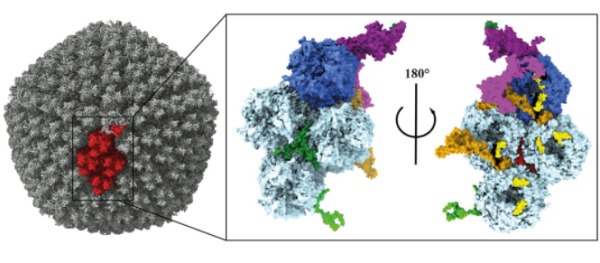
The structure of HAdV-F41
As of 21 April 2022, at least 169 cases of acute hepatitis of unknown origin have been reported from 11 countries in the WHO European Region and one country in the WHO Region of the Americas. Cases have been reported in the United Kingdom of Great Britain and Northern Ireland (the United Kingdom) (114), Spain (13), Israel (12), the United States of America (9), Denmark (6), Ireland (<5), The Netherlands (4), Italy (4), Norway (2), France (2), Romania (1), and Belgium (1).
Last week this was updated by the ECDC (European Centre for Disease Control & Prevention) to nearly 200 cases. The outbreak was first reported this month in Britain - which has registered 111 cases, mostly in children under 10 - and has since been identified in at least 12 countries worldwide.
Unusually, the new cases do not feature the viruses typically responsible for acute liver inflammation – hepatitis A, B, C, D and E. According to the WHO, 17 children have needed liver transplants as a result of the recent cases, and one has died.
What's noticed so far is that in most of the cases an adenovirus was detected. The Human Adenovirus (HAdv) Type 41. The Adenovirus type 41 commonly causes pediatric acute gastroenteritis, which typically presents as diarrhea, vomiting, and fever; it can often be accompanied by respiratory symptoms .
While there have been case reports of hepatitis in immunocompromised children with adenovirus type 41 infection, adenovirus type 41 is not known to be a cause of hepatitis in otherwise healthy children.
The reasons for this is still unclear, Israeli physicians think it's related to Covid. Most of these had a record of previous Covid infection about 3 months before this problem surfaced.
But it's not the Covid vaccines as most of these kids were not even vaccinated, and any link with Covid vaccination has been ruled out.
There's a theory claiming that pandemic lockdowns may have weakened children's immunity because they were less exposed to common pathogens while in isolation for several years now. A more probable reason could be that the Ad41 virus itself got somehow mutated or there is a tandem effect along with Covid infection. The obvious common factor seems to be the Covid virus.
The structure of HAdV-F41
Last edited:


