


All currently available lower-limb prosthetics are either unpowered or underpowered. For transfemoral (above-knee) amputees, the muscles and joints in the hip, back, and sound limb are tasked with providing all of the energy that would typically be provided by the amputated limb. This transfer of loads causes fatigue, pain and loss of mobility.
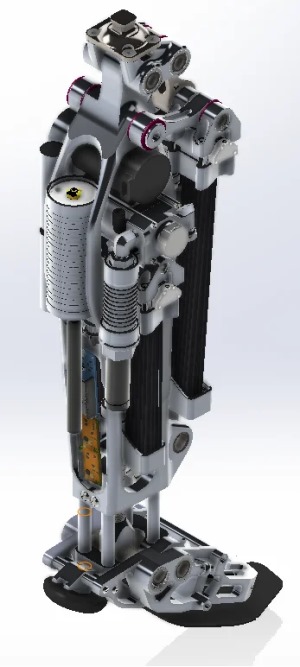
Adaract (US based) has just announced that they have developed the World's first Fully Powered prosthetic leg "The Atlanta". Although many attempts at highly functional powered prosthetics have been made, no one has been able to simultaneously overcome the barriers of weight, strength, power, and energy efficiency. Adaract seems to have overcome these issues.
Adaract’s synthetic/artificial muscle is a hydraulically powered, variable recruitment actuator. Each muscle “fiber” can be activated individually, allowing incredible adaptability and power efficiency. The way that these muscles contract is by pumping a pressurized fluid into them, causing each fiber to expand radially and contract axially. This type of contraction, coupled with an appropriate linkage system, allows the muscles to provide our device with a full range of motion in both the knee and ankle joints with approximately 250 lb-ft of joint torque – this is about twice the torque of a Toyota Corolla.
Adaract is planning to expand their core technology to powered orthotics and exoskeletons as soon as 2023.
PS: On another note - about Robotics -
The Hyundai Motor Group bought a controlling share in Boston Dynamics for US$ 800 Million back in 2020, impressed by the potential of its array of world-leading humanoid, quadrupedal and other robots. Now it's investing half that again (US$ 400 Million) to develop AI.
They are founding a new Boston Dynamics AI Institute, headquartered in Cambridge, Massachusetts. The Institute's core research areas will be athletic AI, organic hardware design and cognitive AI.
Adaract (US based) has just announced that they have developed the World's first Fully Powered prosthetic leg "The Atlanta". Although many attempts at highly functional powered prosthetics have been made, no one has been able to simultaneously overcome the barriers of weight, strength, power, and energy efficiency. Adaract seems to have overcome these issues.
Adaract’s synthetic/artificial muscle is a hydraulically powered, variable recruitment actuator. Each muscle “fiber” can be activated individually, allowing incredible adaptability and power efficiency. The way that these muscles contract is by pumping a pressurized fluid into them, causing each fiber to expand radially and contract axially. This type of contraction, coupled with an appropriate linkage system, allows the muscles to provide our device with a full range of motion in both the knee and ankle joints with approximately 250 lb-ft of joint torque – this is about twice the torque of a Toyota Corolla.
Adaract is planning to expand their core technology to powered orthotics and exoskeletons as soon as 2023.
PS: On another note - about Robotics -
The Hyundai Motor Group bought a controlling share in Boston Dynamics for US$ 800 Million back in 2020, impressed by the potential of its array of world-leading humanoid, quadrupedal and other robots. Now it's investing half that again (US$ 400 Million) to develop AI.
They are founding a new Boston Dynamics AI Institute, headquartered in Cambridge, Massachusetts. The Institute's core research areas will be athletic AI, organic hardware design and cognitive AI.


