


Scientists at Scripps Research, IAVI, the Ragon Institute and Moderna, Inc., have come together to make critical advances in developing an effective vaccine against HIV. It's a new vaccine approach that aims to prompt the creation of broadly neutralizing antibodies (bnAbs)—antibodies that are broad enough to fight and protect against many different variants of a virus.
Scientists have long studied how a small percentage of infected individuals with HIV are able to make bnAbs. Even when bnAbs do develop during infection in these cases, they arise too late to help block the virus. However, bnAbs can protect against the virus if they are present before a person gets infected with HIV.
This observation has led scientists to try to develop vaccines that induce bnAbs in healthy individuals, but designing such vaccines has proved difficult.
The researchers at Scripps Research, IAVI and Ragon have focused on bnAbs that bind to the apex of the HIV spike protein (analogous to the spike protein of SARS-CoV-2). These apex bnAbs employ extremely long loops (called HCDR3 loops) to pierce the spike protein like a spear. By binding to the apex of the HIV spike, the bnAbs prevent HIV from infecting human cells.
They have collaborated with with scientists from Moderna to successfully formulate their germline-targeting immunogens into mRNA vaccines (similar to the COVID-19 vaccines).
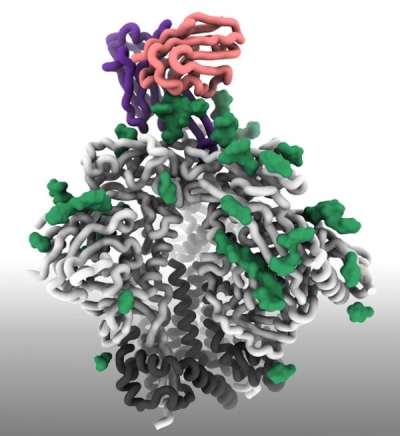
Pictured is the cryo-EM structure of the engineered priming immunogen (grey, black); a key feature of the HIV spike protein called glycans (green); and the precursor antibody (purple and pink) that it binds to with high affinity.
ⒸScripps Research
Scientists have long studied how a small percentage of infected individuals with HIV are able to make bnAbs. Even when bnAbs do develop during infection in these cases, they arise too late to help block the virus. However, bnAbs can protect against the virus if they are present before a person gets infected with HIV.
This observation has led scientists to try to develop vaccines that induce bnAbs in healthy individuals, but designing such vaccines has proved difficult.
The researchers at Scripps Research, IAVI and Ragon have focused on bnAbs that bind to the apex of the HIV spike protein (analogous to the spike protein of SARS-CoV-2). These apex bnAbs employ extremely long loops (called HCDR3 loops) to pierce the spike protein like a spear. By binding to the apex of the HIV spike, the bnAbs prevent HIV from infecting human cells.
They have collaborated with with scientists from Moderna to successfully formulate their germline-targeting immunogens into mRNA vaccines (similar to the COVID-19 vaccines).
Pictured is the cryo-EM structure of the engineered priming immunogen (grey, black); a key feature of the HIV spike protein called glycans (green); and the precursor antibody (purple and pink) that it binds to with high affinity.
ⒸScripps Research


