


The FDA announced May 3 that it had granted approval for an RSV vaccine made by GlaxoSmithKline to be used in people 60 and older. RSV ( Respiratory Syncytial Virus ) is a respiratory virus that causes cold-like symptoms for many people, but can cause serious illness, hospitalization and death for infants and older people.
There are no specific antiviral medications to combat RSV, and only one preventive treatment — a monoclonal antibody — is reserved for a small number of babies at high risk of severe disease.
The newly approved vaccine reduced the risk of developing lung infections by 82.6 percent compared with a placebo. The vaccine’s efficacy against severe lung infection was even better at 94.1 percent.
Three companies — Pfizer, GSK and Moderna — were in the race. Pfizer & GSK went on with proteins and Moderna went on with a mRNA vaccine. Also there's Bavarian Nordic who took a totally different approach. They used their vaccine against smallpox and monkey pox. That uses a live vaccinia virus, modified not to replicate.
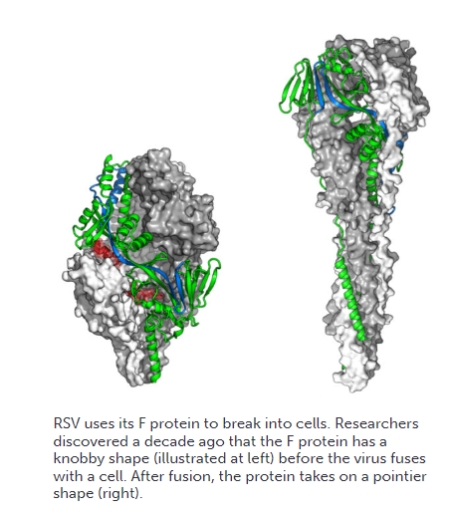
GSK & Pfizer have based their vaccines on one of RSV’s proteins. That protein, called the F protein, sits on the virus’s outer membrane and helps it fuse to human cells. The F protein is a shapeshifter. Before fusion, it looks like a rounded knob. After fusion, it resembles a needle or pointy tower.
A decade ago, researchers at the U.S. NIH figured out that locking the protein into its prefusion knob state causes the immune system to react more strongly than to the virus’ shapeshifting form. All three companies use some version of the F protein locked in the prefusion state in their vaccines.
But Codagenix, is working with the RSV virus itself, tinkering with its genetic instruction book to make the virus unable to cause disease. For its vaccine, the company’s researchers introduced more than 1,000 mutations in one gene to slow replication of the virus. These mutations change the virus’s RNA but don’t alter the amino acids in its proteins.
Only Pfizer is testing a vaccine to protect newborns. And it doesn’t give shots to babies. Instead, the company gave its vaccine candidate to more than 7,300 healthy pregnant women age 49 or younger. The idea is that the mother will produce antibodies against RSV that will transfer through the placenta to the baby. Those antibodies would give babies temporary protection against the virus in the especially vulnerable first six months of life.
The FDA is expected to approve an RSV vaccine made by Pfizer later in May.
There are no specific antiviral medications to combat RSV, and only one preventive treatment — a monoclonal antibody — is reserved for a small number of babies at high risk of severe disease.
The newly approved vaccine reduced the risk of developing lung infections by 82.6 percent compared with a placebo. The vaccine’s efficacy against severe lung infection was even better at 94.1 percent.
Three companies — Pfizer, GSK and Moderna — were in the race. Pfizer & GSK went on with proteins and Moderna went on with a mRNA vaccine. Also there's Bavarian Nordic who took a totally different approach. They used their vaccine against smallpox and monkey pox. That uses a live vaccinia virus, modified not to replicate.
GSK & Pfizer have based their vaccines on one of RSV’s proteins. That protein, called the F protein, sits on the virus’s outer membrane and helps it fuse to human cells. The F protein is a shapeshifter. Before fusion, it looks like a rounded knob. After fusion, it resembles a needle or pointy tower.
A decade ago, researchers at the U.S. NIH figured out that locking the protein into its prefusion knob state causes the immune system to react more strongly than to the virus’ shapeshifting form. All three companies use some version of the F protein locked in the prefusion state in their vaccines.
But Codagenix, is working with the RSV virus itself, tinkering with its genetic instruction book to make the virus unable to cause disease. For its vaccine, the company’s researchers introduced more than 1,000 mutations in one gene to slow replication of the virus. These mutations change the virus’s RNA but don’t alter the amino acids in its proteins.
Only Pfizer is testing a vaccine to protect newborns. And it doesn’t give shots to babies. Instead, the company gave its vaccine candidate to more than 7,300 healthy pregnant women age 49 or younger. The idea is that the mother will produce antibodies against RSV that will transfer through the placenta to the baby. Those antibodies would give babies temporary protection against the virus in the especially vulnerable first six months of life.
The FDA is expected to approve an RSV vaccine made by Pfizer later in May.


