


Many showed much interest on the Voyager -1 and someone mentioned about the Camera. Here are some facts about the Voyagers.
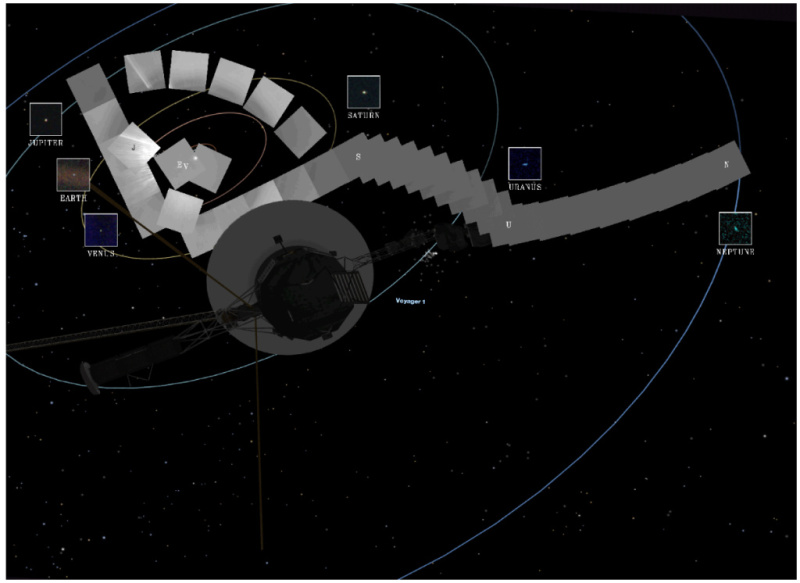
The Voyager -1 took it's last photo the "Solar System Family Portrait" in 14 February 1990. The Solar System "family portrait" is the final series of 60 images captured by NASA's Voyager 1 that show six of our solar system's planets. It remains the first and only time — so far — a spacecraft has attempted to photograph our home solar system.
The cameras were turned off to save power and memory for the instruments expected to detect the new charged particle environment of interstellar space. Mission managers removed the software from both spacecraft that controls the camera. Also the ground software was modified to accommodate the changes. The cameras could possibly be reactivated but whether it will work again is unknown as the heaters have been turned off.
Only three spacecraft have been capable of making such an observation from such a distance: Voyager 1, Voyager 2 and New Horizons.
The two Voyager spacecraft could remain in the range of the Deep Space Network through about 2036, depending on how much power the spacecraft still have to transmit a signal back to Earth.
Voyager 1 left the solar system aiming toward the constellation Ophiuchus. It left with a speed of about 3.5 AU per year, 35 degrees out of the ecliptic plane to the north.
In the year 40,272 AD, Voyager 1 will come within 1.7 light years of an obscure star in the constellation Ursa Minor (the Little Bear or Little Dipper) called AC+79 3888.
Voyager 2 escaped the solar system at a speed of about 3.1 AU per year, 48 degrees out of the ecliptic plane to the south toward the constellations of Sagittarius and Pavo. In about 40,000 years, Voyager 2 will come within about 1.7 light years of a star called Ross 248, a small star in the constellation of Andromeda.
The Voyager Description:
The Voyager spacecraft weight, including hydrazine, at launch was 815 kg or about 1797 pounds. It was almost the weight and size of a sub-compact car. The current approximate weight of Voyager 1 is 733 kg and Voyager 2 is 735 kg. The difference is in the amount of hydrazine remaining. Hydrazine is being used to control the spacecrafts' attitude.
The spacecraft, without the various booms could fit inside a cube that is about 4 meters on each side. The approximate measurements of the different structures follow:
There are three different computer types on the Voyager spacecraft and there are two of each kind. Total number of words among the six computers is about 32K.
The main functions of the FDS are to collect data from, and controls the operations of, the scientific instruments; and to format engineering and science data for on-board storage and/or real-time transmission. The FDS also keeps the spacecraft "time" and provides frequency references to the instruments and other spacecraft subsystems.
There is no clock chip, as such, in the spacecraft. The "clock" is really a counter, based on one of several electronically generated frequencies. These frequencies, based on a reference, generated by a very stable oscillator, are converted and fed to different locations in the spacecraft as synchronization signals, timers, counters, etc. The "clock" signal is part of the information telemetered to the ground. The master clock runs at 4 MHz but the CPU’s clock runs at only 250 KHz. A typical instruction takes 80 microseconds, that is about 8,000 instructions per second.
Voyager was built in-house at JPL; the computers were manufactured by General Electric to JPL specifications.
The Voyager -1 took it's last photo the "Solar System Family Portrait" in 14 February 1990. The Solar System "family portrait" is the final series of 60 images captured by NASA's Voyager 1 that show six of our solar system's planets. It remains the first and only time — so far — a spacecraft has attempted to photograph our home solar system.
The cameras were turned off to save power and memory for the instruments expected to detect the new charged particle environment of interstellar space. Mission managers removed the software from both spacecraft that controls the camera. Also the ground software was modified to accommodate the changes. The cameras could possibly be reactivated but whether it will work again is unknown as the heaters have been turned off.
Only three spacecraft have been capable of making such an observation from such a distance: Voyager 1, Voyager 2 and New Horizons.
The two Voyager spacecraft could remain in the range of the Deep Space Network through about 2036, depending on how much power the spacecraft still have to transmit a signal back to Earth.
Voyager 1 left the solar system aiming toward the constellation Ophiuchus. It left with a speed of about 3.5 AU per year, 35 degrees out of the ecliptic plane to the north.
In the year 40,272 AD, Voyager 1 will come within 1.7 light years of an obscure star in the constellation Ursa Minor (the Little Bear or Little Dipper) called AC+79 3888.
Voyager 2 escaped the solar system at a speed of about 3.1 AU per year, 48 degrees out of the ecliptic plane to the south toward the constellations of Sagittarius and Pavo. In about 40,000 years, Voyager 2 will come within about 1.7 light years of a star called Ross 248, a small star in the constellation of Andromeda.
The Voyager Description:
The Voyager spacecraft weight, including hydrazine, at launch was 815 kg or about 1797 pounds. It was almost the weight and size of a sub-compact car. The current approximate weight of Voyager 1 is 733 kg and Voyager 2 is 735 kg. The difference is in the amount of hydrazine remaining. Hydrazine is being used to control the spacecrafts' attitude.
The spacecraft, without the various booms could fit inside a cube that is about 4 meters on each side. The approximate measurements of the different structures follow:
- The high gain antenna is 3.7 meters across (diameter).
- The magnetometer boom is 13 meters long
- The two Planetary Radio Astronomy and Plasma Wave antenna are 10 meters long.
- The Radioisotope Thermoelectric Generator boom is 3.7 meters long
- The science instrument boom (near top of picture) is 3 meters long.
- The Bus Housing Electronics is about 1.8 meters in diameter.
There are three different computer types on the Voyager spacecraft and there are two of each kind. Total number of words among the six computers is about 32K.
- Computer Command System (CCS) - 18-bit word, interrupt type processors (2) with 4096 words each of plated wire, non-volatile memory.
- Flight Data System (FDS) - 16-bit word machine (2) with modular memories and 8198 words each
- Attitude and Articulation Control System (AACS) - 18-bit word machines (2) with 4096 words each.
The main functions of the FDS are to collect data from, and controls the operations of, the scientific instruments; and to format engineering and science data for on-board storage and/or real-time transmission. The FDS also keeps the spacecraft "time" and provides frequency references to the instruments and other spacecraft subsystems.
There is no clock chip, as such, in the spacecraft. The "clock" is really a counter, based on one of several electronically generated frequencies. These frequencies, based on a reference, generated by a very stable oscillator, are converted and fed to different locations in the spacecraft as synchronization signals, timers, counters, etc. The "clock" signal is part of the information telemetered to the ground. The master clock runs at 4 MHz but the CPU’s clock runs at only 250 KHz. A typical instruction takes 80 microseconds, that is about 8,000 instructions per second.
Voyager was built in-house at JPL; the computers were manufactured by General Electric to JPL specifications.


