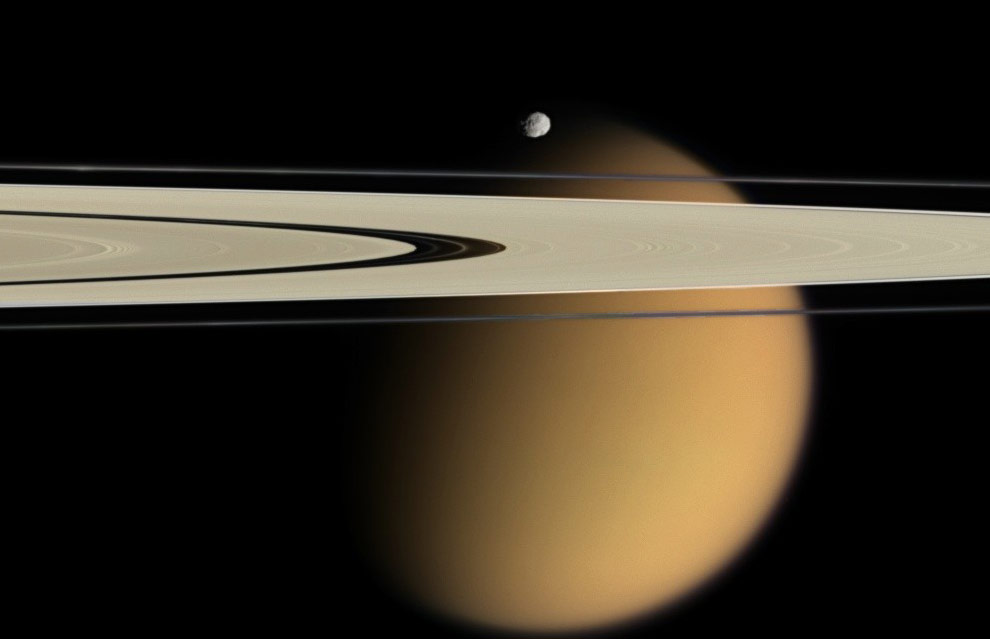
++ rep me if you like the pictures 
Checking in with NASA's Cassini spacecraft, our current emissary to Saturn, some 1.5 billion kilometers (932 million miles) distant from Earth, we find it recently gathering images of the Saturnian system at equinox. During the equinox, the sunlight casts long shadows across Saturn's rings, highlighting previously known phenomena and revealing a few never-before seen images. Cassini continues to orbit Saturn, part of its extended Equinox Mission, funded through through September 2010. A proposal for a further extension is under consideration, one that would keep Cassini in orbit until 2017, ending with a spectacular series of orbits inside the rings followed by a suicide plunge into Saturn on Sept. 15, 2017.

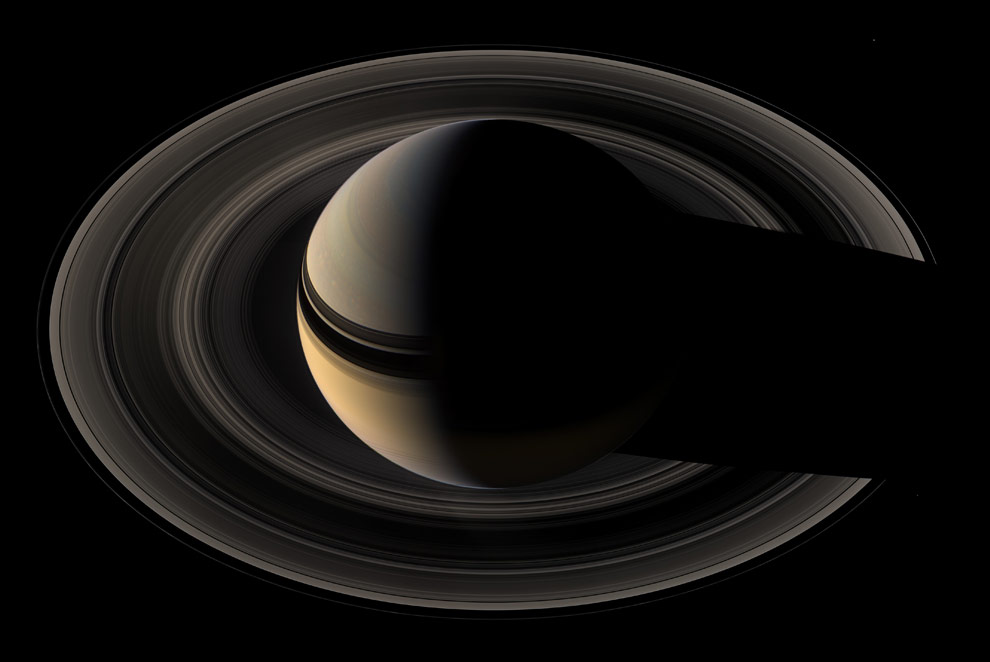
From 20 degrees above the ring plane, Cassini's wide angle camera shot 75 exposures in succession for this mosaic showing Saturn, its rings, and a few of its moons a day and a half after exact Saturn equinox, when the sun's disk was exactly overhead at the planet's equator. The images were taken on Aug. 12, 2009, at a distance of approximately 847,000 km (526,000 mi) from Saturn. (NASA/JPL/Space Science Institute)
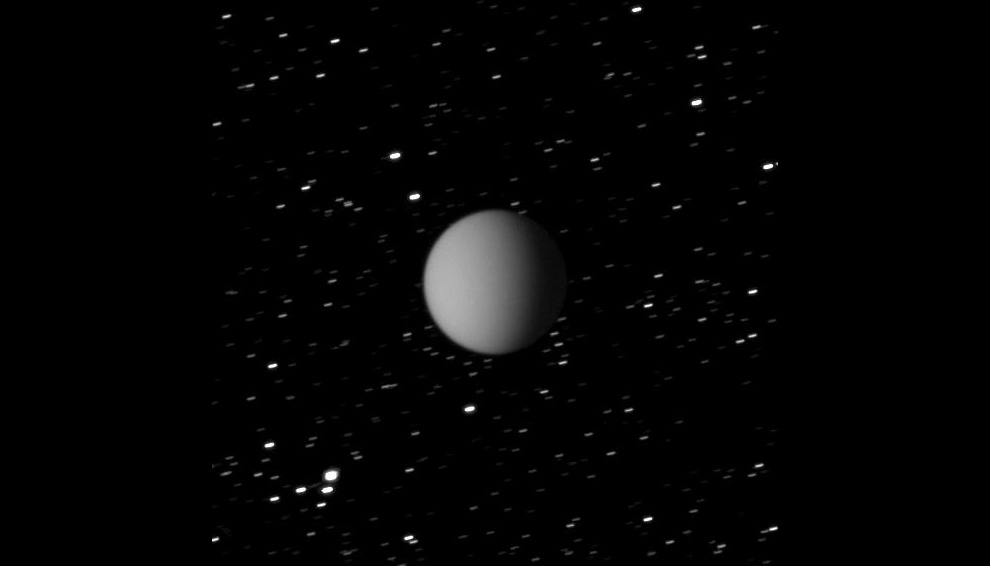
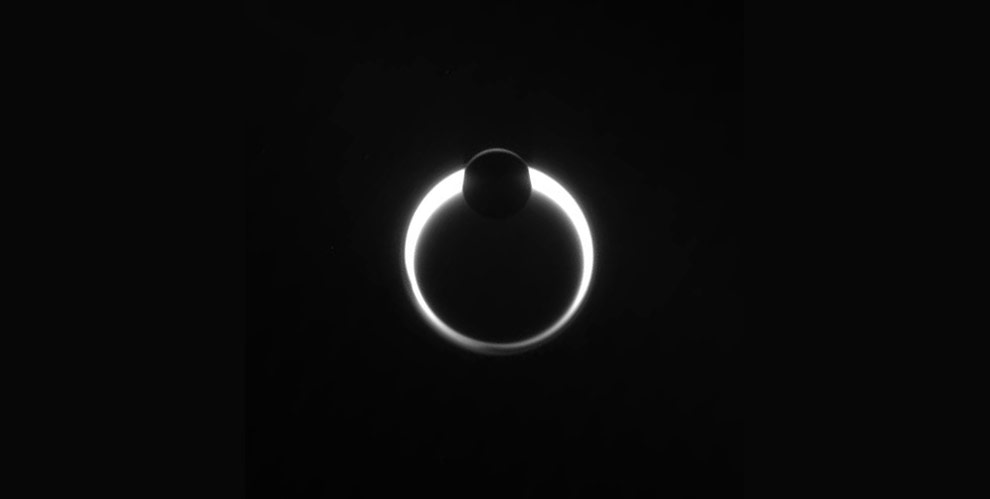
Cassini captured this image of a dimly lit Titan as Saturn's largest moon was eclipsed by the planet on May 7, 2009. Lit terrain seen here is on the Saturn-facing side of Titan. In Saturn's shadow, the southern hemisphere of Titan is lit by two sources: sunlight scattered through the planet's rings and refracted sunlight passing through the edge of Saturn's atmosphere. Stars in this image are smeared by the long camera exposure time of 560 seconds needed to capture the faint light on Titan. (NASA/JPL/Space Science Institute)
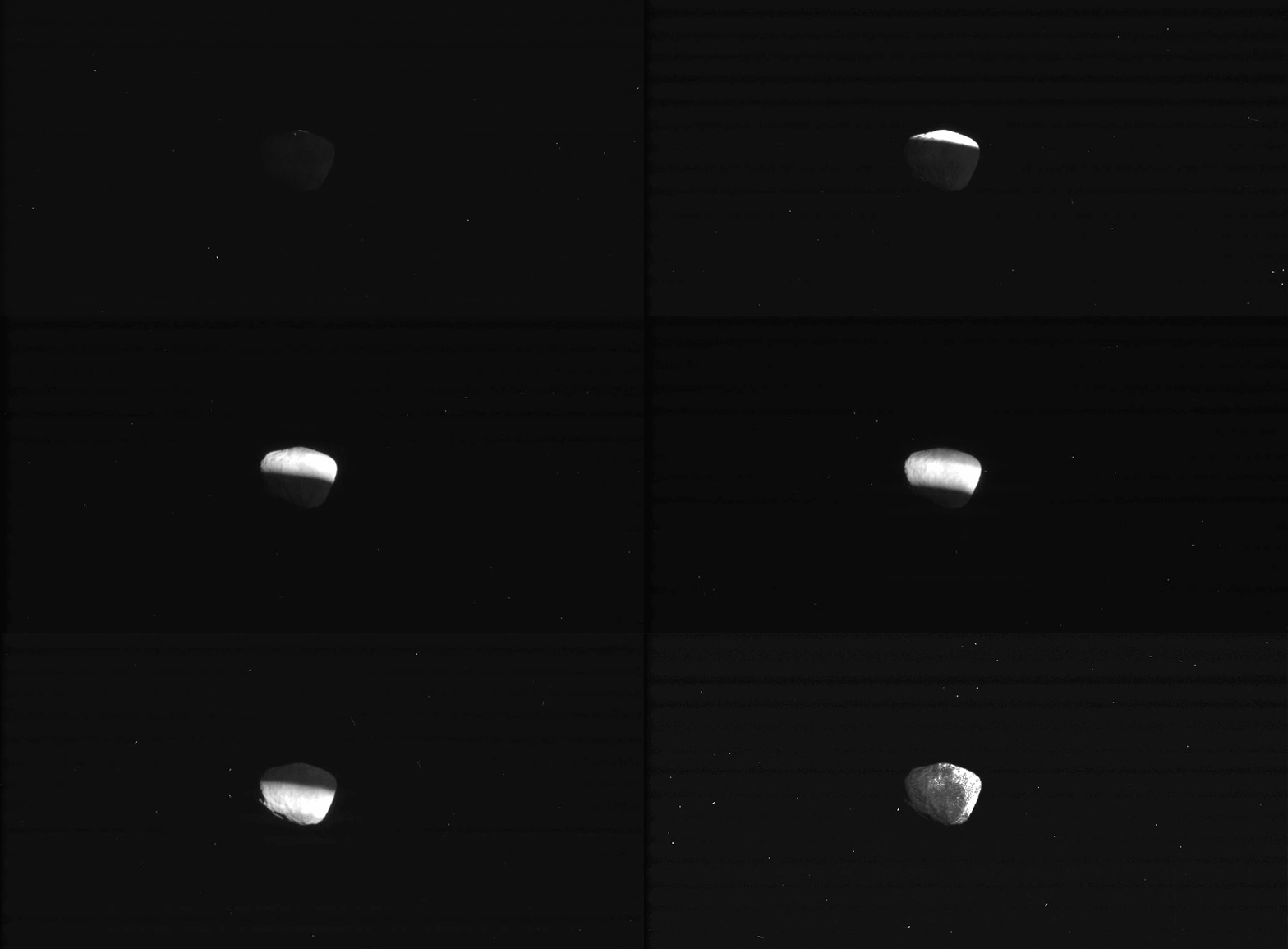
This series of images of Janus, one of Saturns's smaller moons, shows strips of light and shadow passing over its face. Janus is in the shadow of Saturn's rings, and is briefly lit by a stripe of sunlight as it passes behind a gap in the rings. Photos taken on August 27, 2009. (NASA/JPL/Space Science Institute)
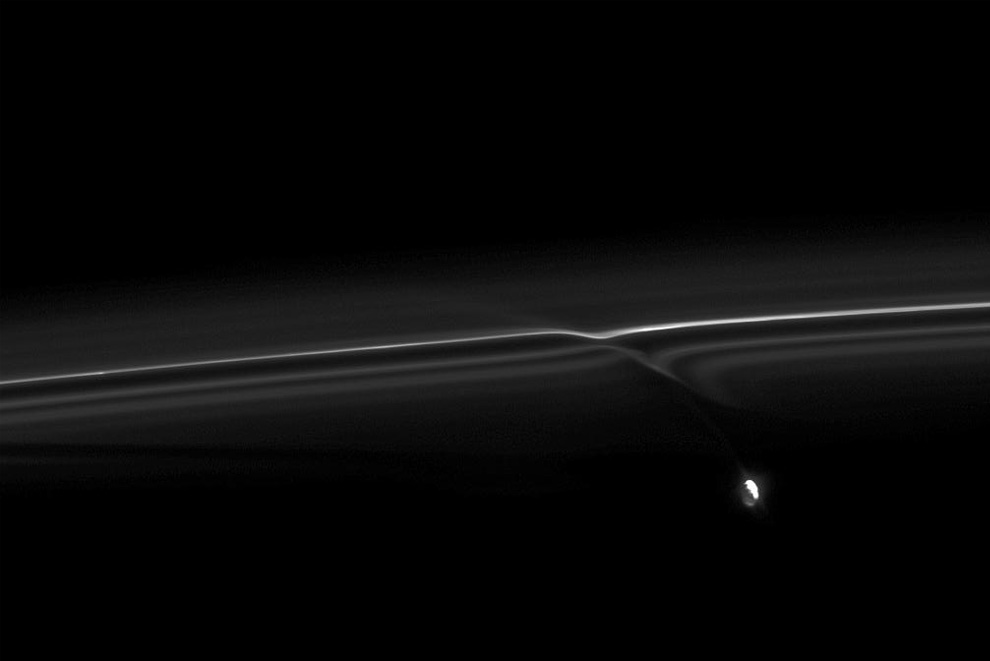
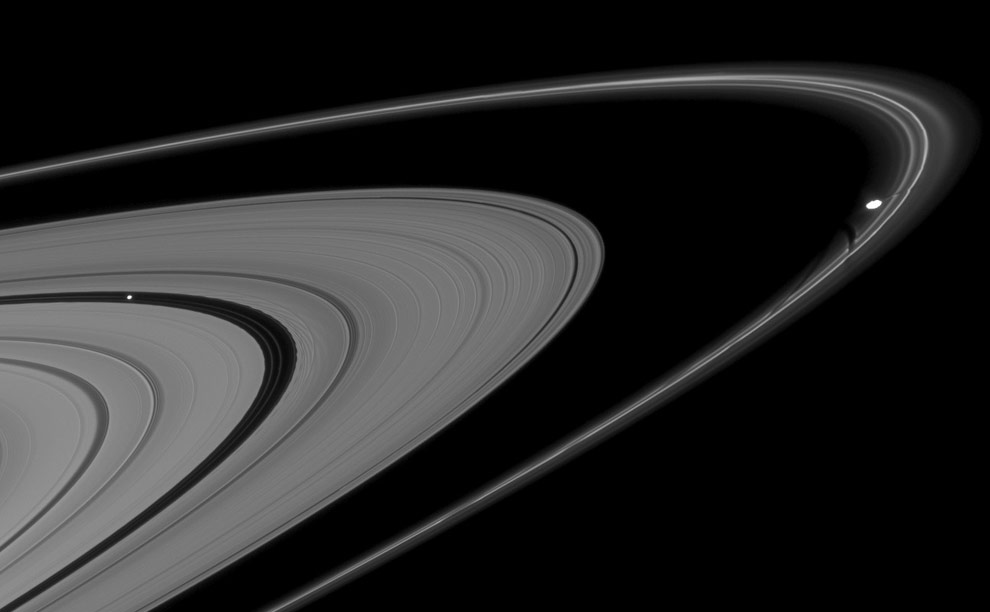
The moon Prometheus and its nearby disturbance of Saturn's F ring. Prometheus periodically gores the F ring, drawing out streamers of material from the ring. The image was taken in visible light at a distance of approximately 950,000 km (590,000 mi) from Saturn. (NASA/JPL/Space Science Institute)

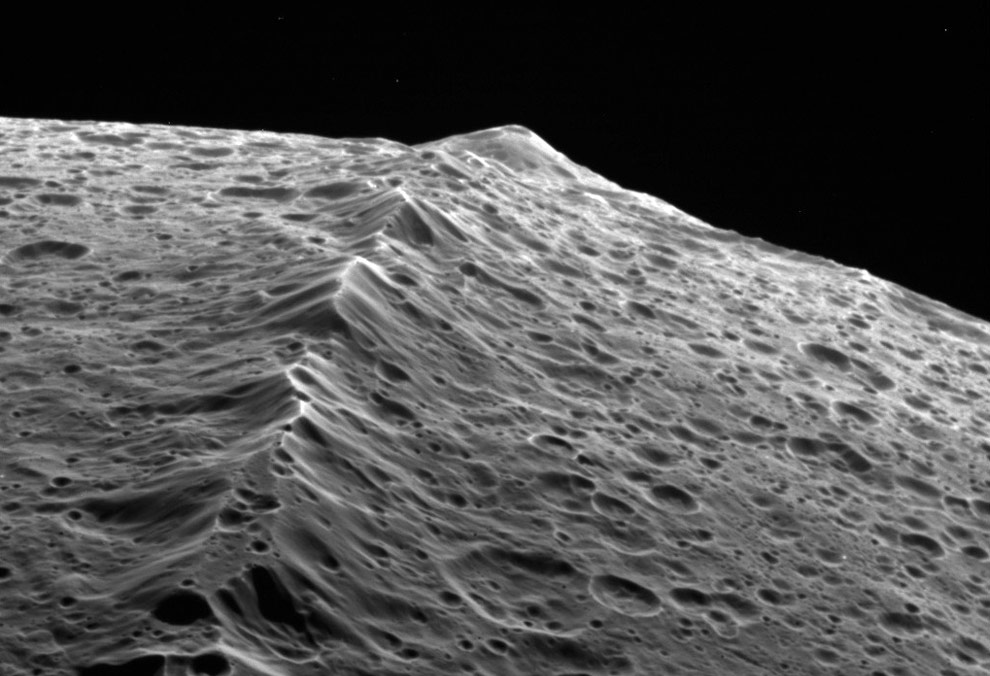
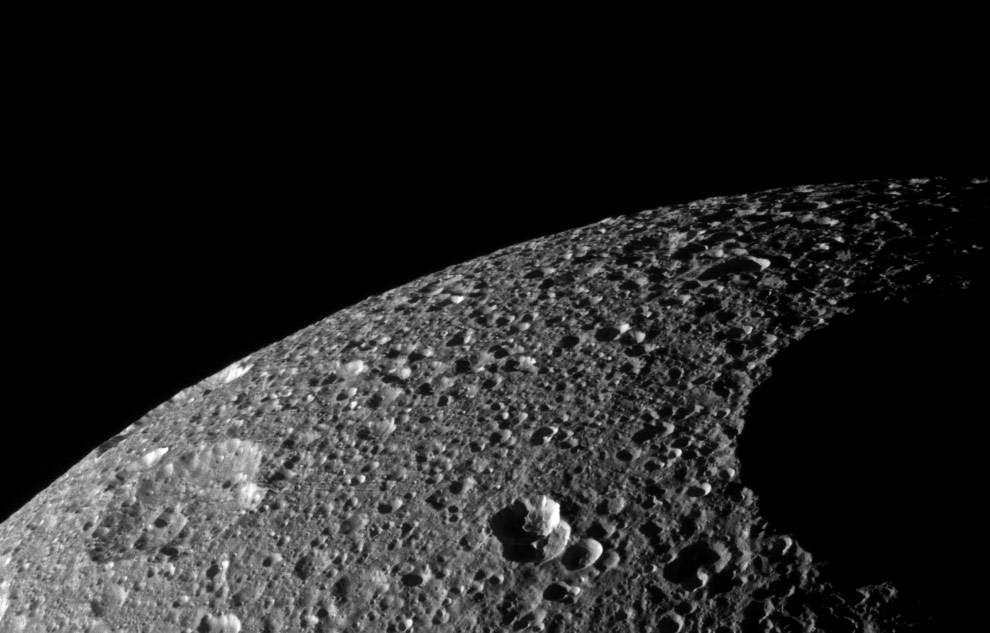
Cassini eyes a prominent crater on the moon Janus. The south pole lies on the terminator at the top right of the image. This view was acquired on July 26, 2009 at a distance of approximately 98,000 kilometers (61,000 miles) from Janus. (NASA/JPL/Space Science Institute)
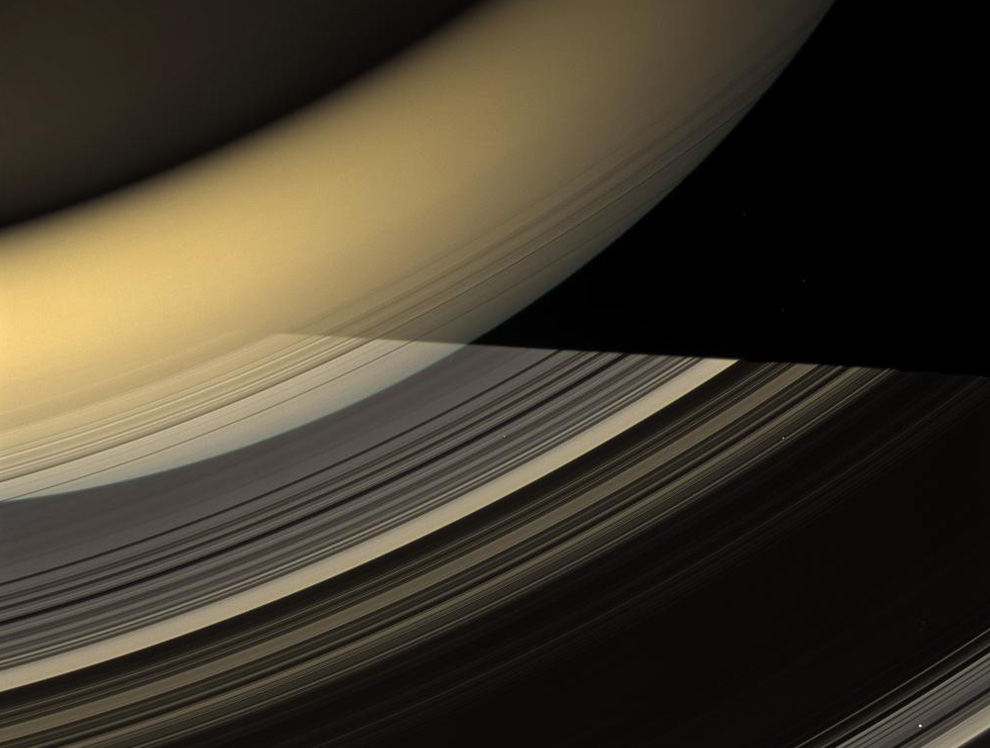
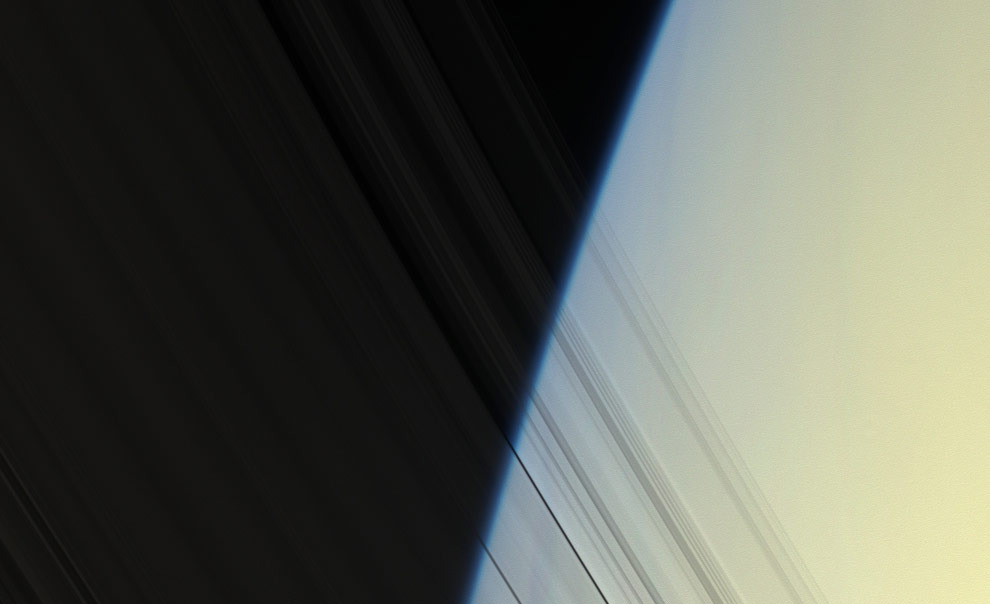
Rays of light from the sun have taken many different paths to compose this image of Saturn and its rings. This view looks toward the unilluminated (north) side of the rings and, at the top of the image, the night side of Saturn. Sunlight has been reflected off the illuminated side of the rings to light the planet's southern hemisphere, seen here as a bright band of yellow-orange. The northern hemisphere, in the top left corner of the image, is dimly lit by light diffusely scattered through the rings. The planet's shadow cuts across the rings, but light reflected off the southern hemisphere backlights parts of the C ring, making them visible in silhouette. (NASA/JPL/Space Science Institute)
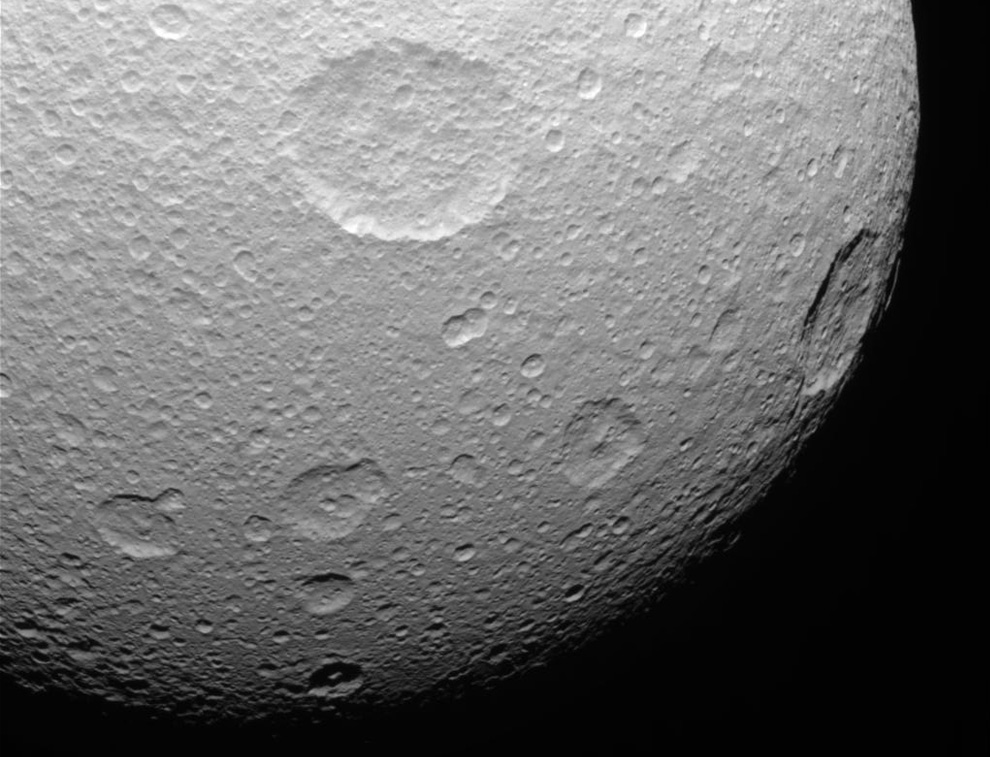
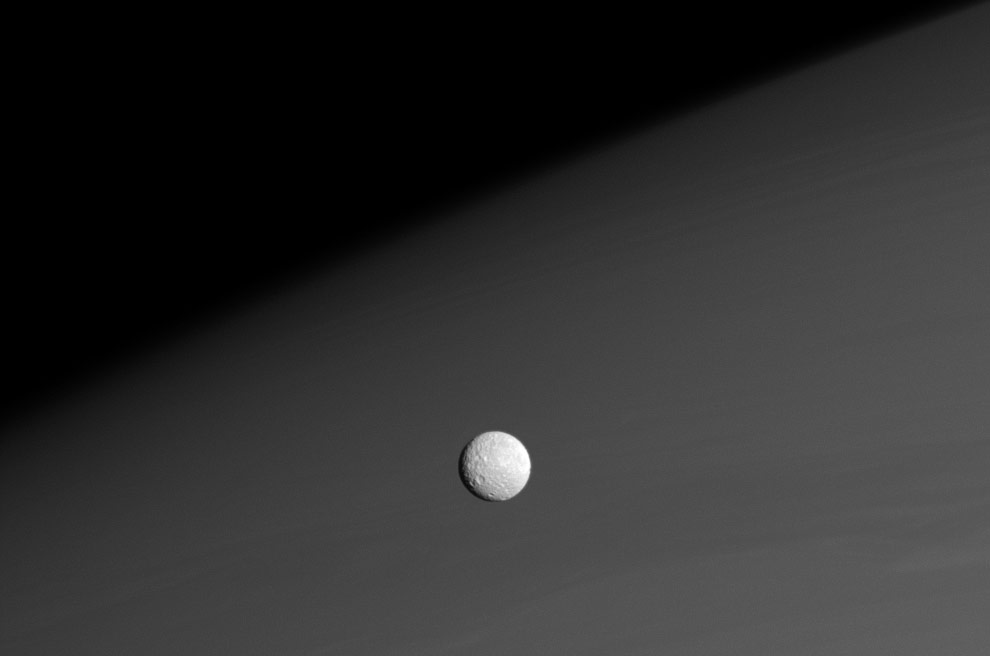
A view of Saturn's moon Tethys and its cratered surface, taken by Cassini on October 14, 2009. (NASA/JPL/Space Science Institute)
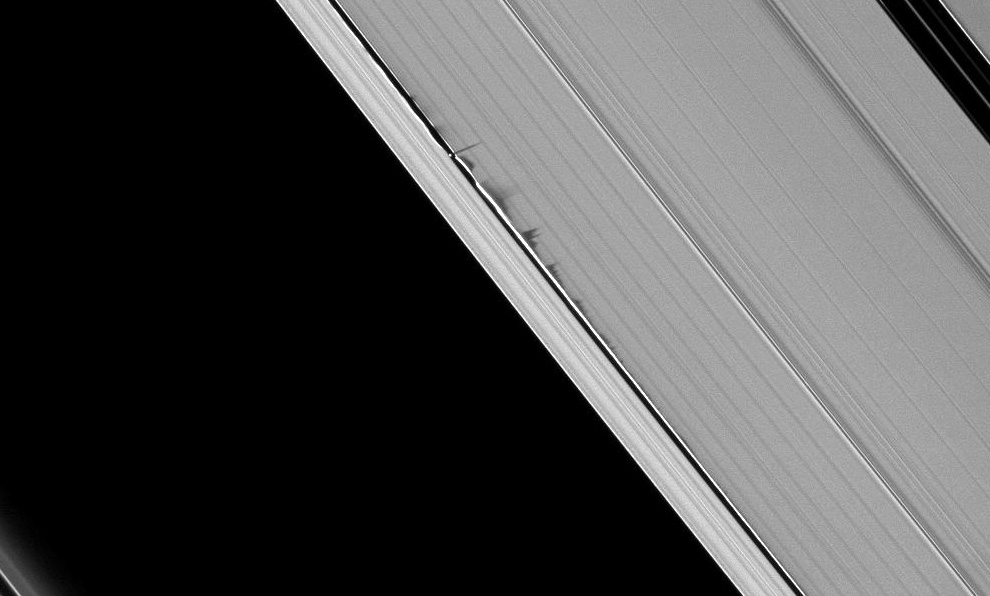
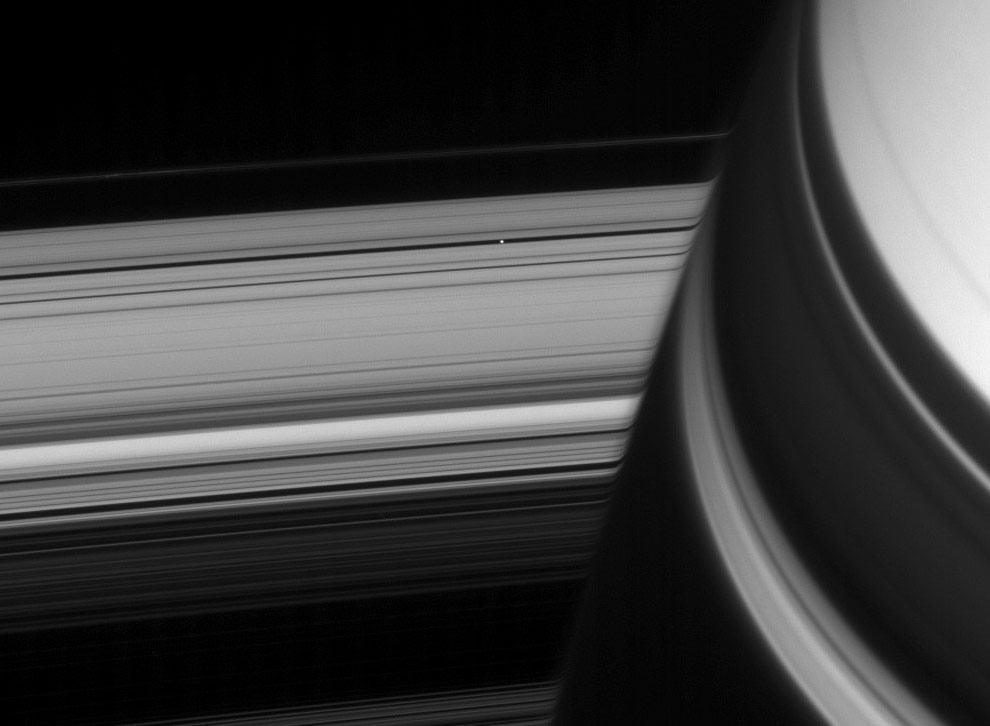
Jagged looking shadows stretch away from vertical structures of ring material created by the moon Daphnis, a bright dot (8 km, or 5 mi across) casting a thin shadow just to the left of the center of the image. The moon has an inclined orbit, and its gravitational pull perturbs the orbits of the particles of the A ring forming the Keeler Gap's edge and sculpting the edge into waves having both horizontal (radial) and out-of-plane components. These scenes are possible only during the few months before and after Saturn's equinox, which occurs only once in about 15 Earth years. This image was taken in visible light with the Cassini spacecraft narrow-angle camera on June 26, 2009, at a distance of approximately 823,000 km (511,000 mi) from Daphnis. (NASA/JPL/Space Science Institute)
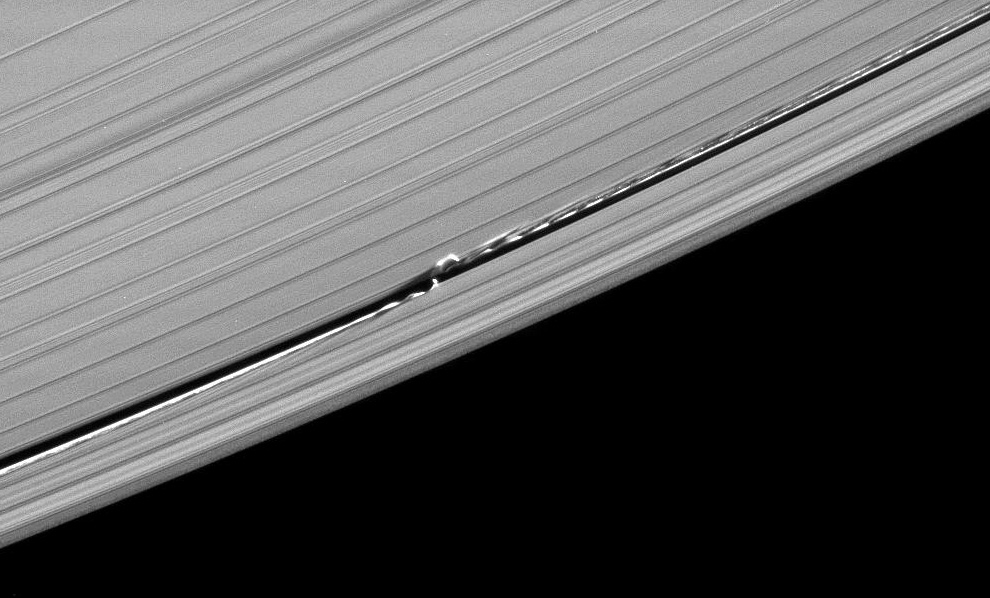
Another view of waves in the edges of the Keeler gap in Saturn's A ring, created by the embedded moon Daphnis. Image acquired on July 11, 2009, at a distance of approximately 496,000 km (308,000 mi) from Daphnis. (NASA/JPL/Space Science Institute)
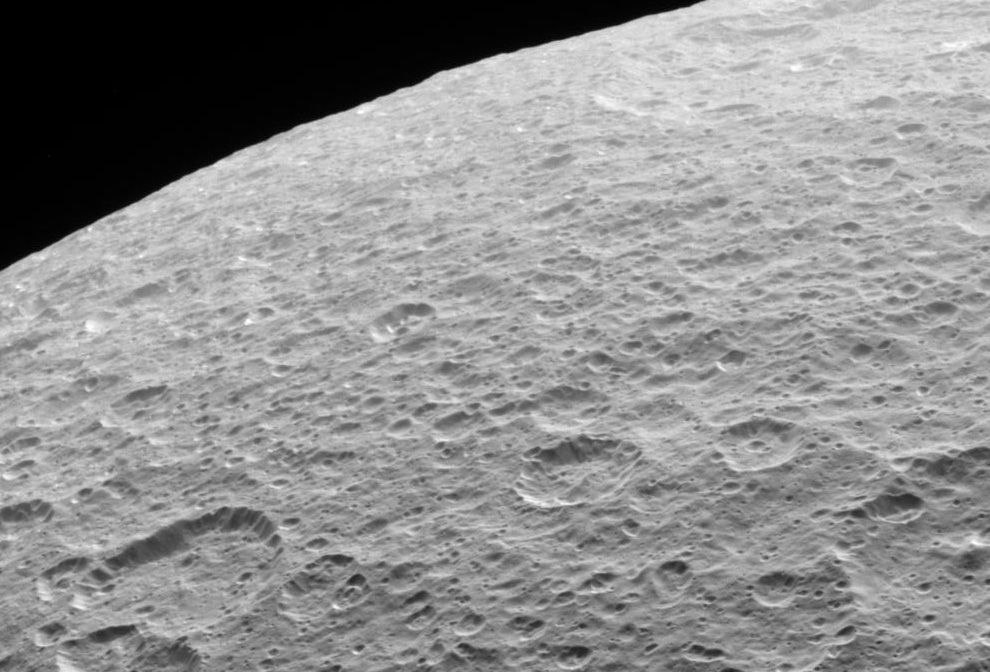
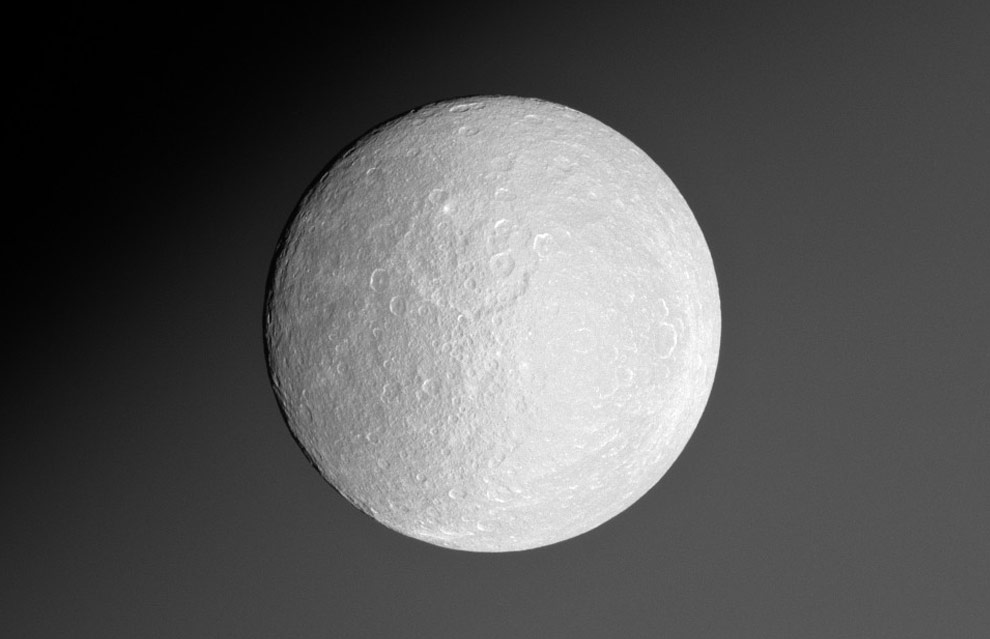
A close view of the surface of Saturn's large moon Rhea, as Cassini passes by on October 13, 2009. (NASA/JPL/Space Science Institute)
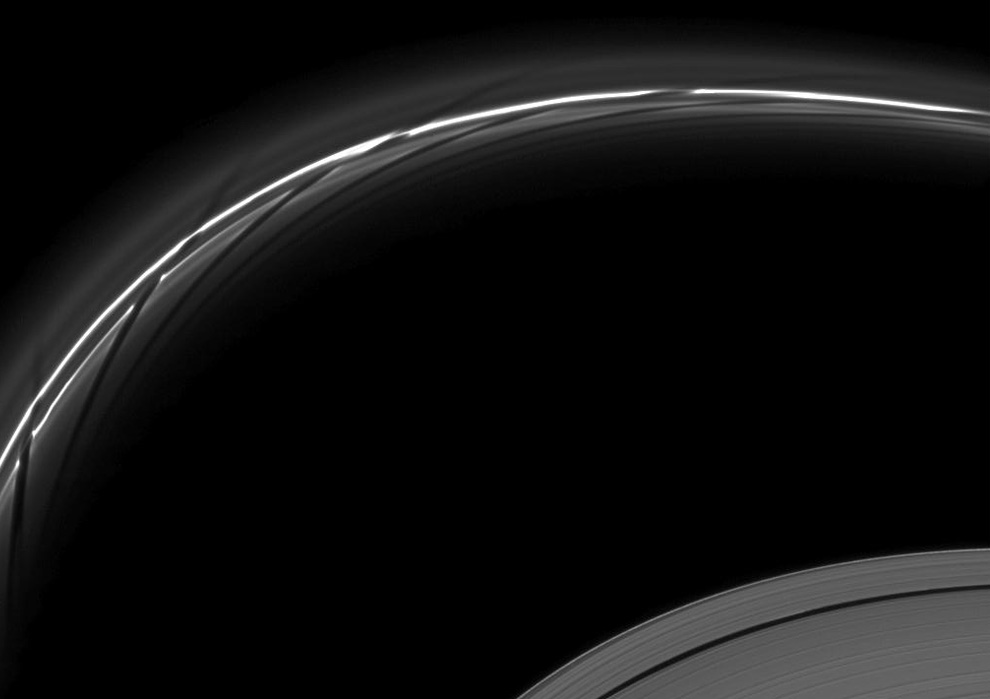
The gravity of potato-shaped Prometheus (86 km, or 53 mi across) periodically creates streamer-channels in the F ring. This view looks toward the unilluminated side of the rings from about 9 degrees above the ringplane. The image was taken in visible light with the Cassini spacecraft narrow-angle camera on May 26, 2009 from approximately 922,000 km (573,000 mi) from Saturn. (NASA/JPL/Space Science Institute)
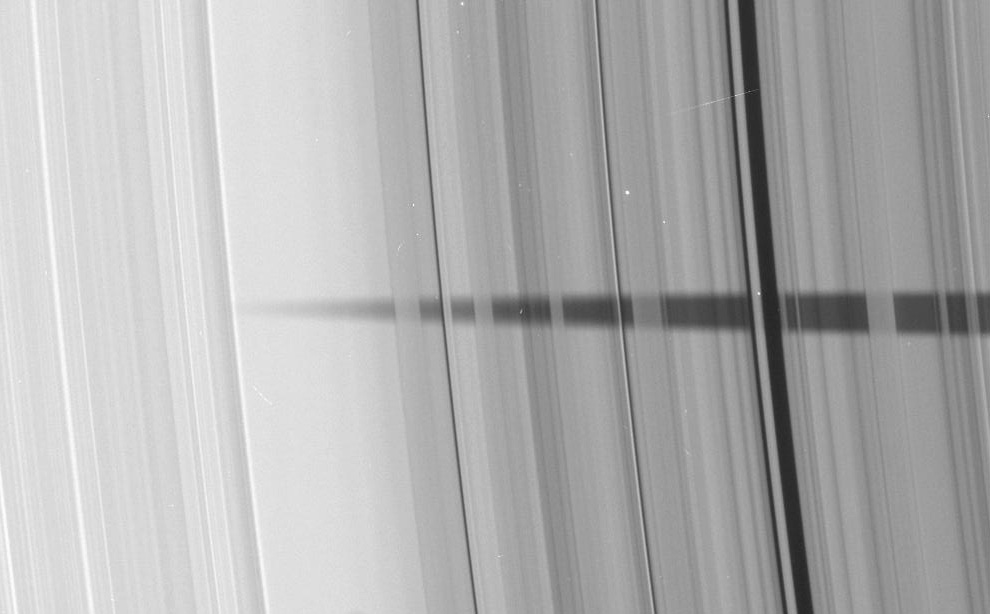
An unusual-looking moon shadow crosses Saturn's rings. The shadow appears to 'skip' certain ring bands in a photo taken looking at the unlit side of Saturn's rings. Reflected sunlight and variable ring transparencies appear to be responsble for the striped shadow. (NASA/JPL/Space Science Institute)
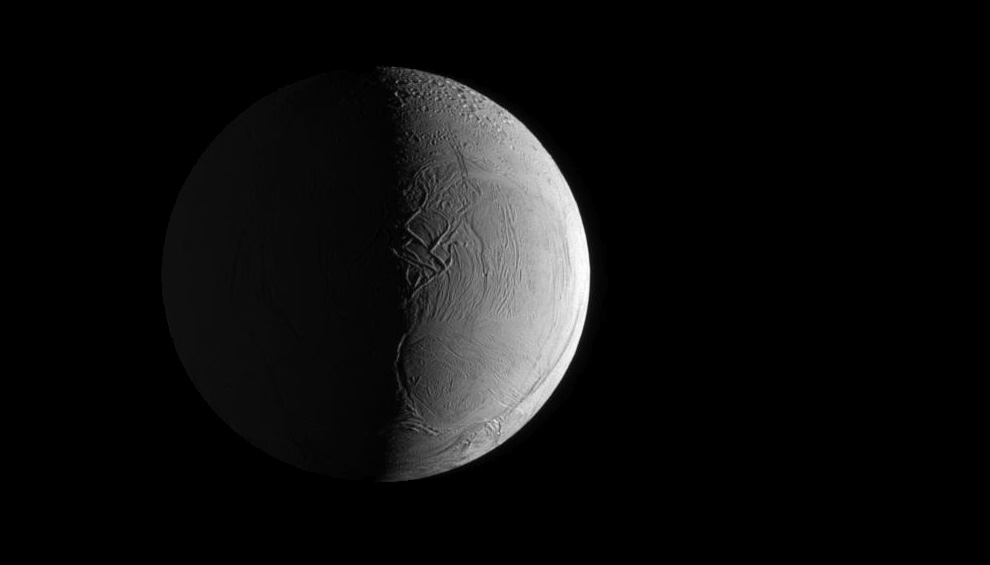
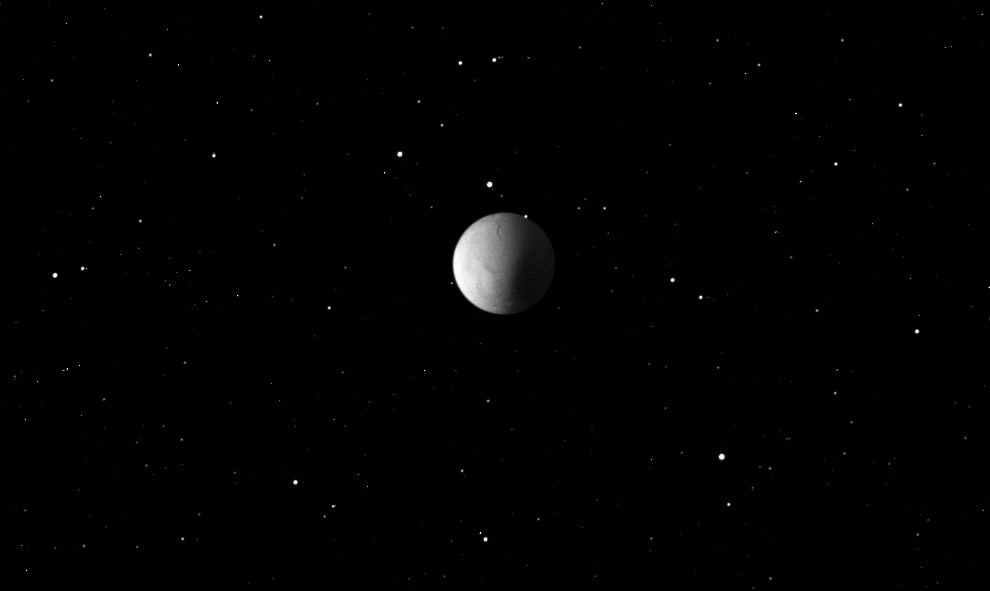
Two sources of light illuminate the textured surface of the moon Enceladus. On the right of the image, sunlight bathes the anti-Saturn side of this geologically active moon. Saturnshine dimly lights the Saturn-facing side of the moon on the left of the image. The moon's surface is scarred by fractures, folds, and ridges. This view looks toward the trailing hemisphere of Enceladus (504 kilometers, or 313 miles across). North on Enceladus is up. The image was taken on July 26, 2009, at a distance of approximately 199,000 kilometers (124,000 miles) from Enceladus. (NASA/JPL/Space Science Institute)
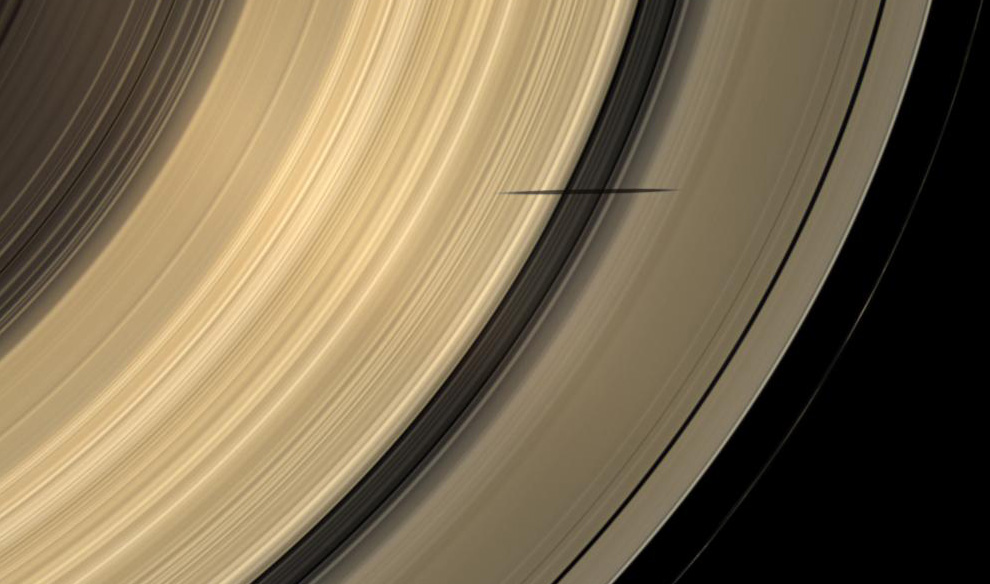
The shadow of Saturn's moon Mimas dips onto the planet's rings and straddles the Cassini Division in this natural color image taken as Saturn approaches its August 2009 equinox. Images taken using red, green and blue spectral filters were combined to create this natural color view. The images were obtained with the Cassini spacecraft wide-angle camera on April 8, 2009 at a distance of approximately 1.1 million km (684,000 mi) from Saturn. (NASA/JPL/Space Science Institute)

Cassini captured this image of a small object in the outer portion of Saturn's B ring casting a shadow on the rings as Saturn approaches its August 2009 equinox, on July 26, 2009. This new moonlet, situated about 480 km (300 mi) inward from the outer edge of the B ring, was found by detection of its shadow which stretches 41 km (25 mi) across the rings. The shadow length implies the moonlet is protruding about 200 meters, or 660 feet, above the ring plane. If the moonlet is orbiting in the same plane as the ring material surrounding it, which is likely, it must be about 400 meters, or 1,300 feet, across. (NASA/JPL/Space Science Institute)
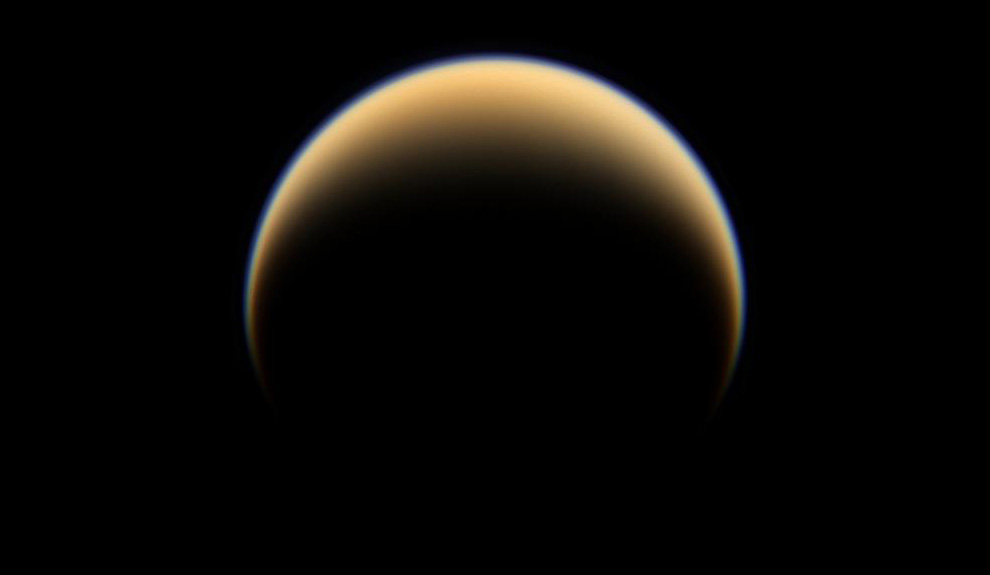
Cassini looks down on the north pole of Titan, showing night and day in the northern hemisphere of Saturn's largest moon. The north pole of Titan is rotated about 23 degrees to the left and it lies on the terminator above and to the left of the center of the image. Images taken using red, green and blue spectral filters were combined to create this natural color view of Titan (5,150 km, or 3,200 mi across). The images were obtained on June 6, 2009 at a distance of approximately 194,000 km (121,000 mi) from Titan. Image scale is 11 km (7 mi) per pixel. (NASA/JPL/Space Science Institute)
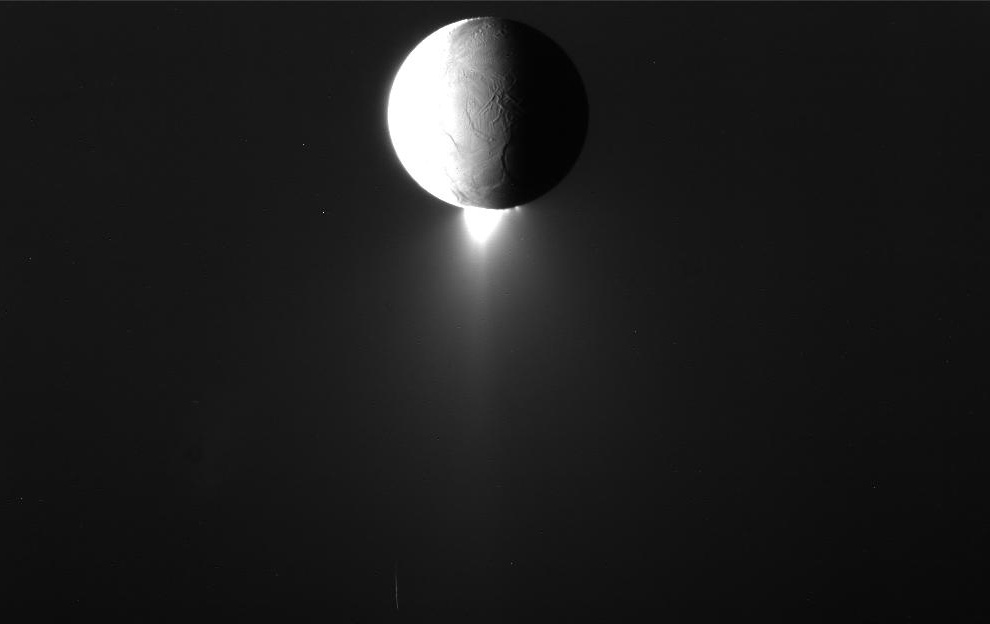
Plumes of tiny ice particles being ejected from the surface of the moon Enceladus are visible in the scattered sunlight in this image, acquired by Cassini on October 13, 2009. (NASA/JPL/Space Science Institute)

A big shadow from Saturn's largest moon, Titan, darkens the planet in the lower right of this image taken shortly after Saturn's August 2009 equinox. Saturn is overexposed in this image because the camera's long exposure time was set to show the rings which are dimly lit at equinox. Saturn's rings, which are 10 to 100 meters (30 to 300 feet) thick for the most part, cast a narrow shadow onto the planet. The image was taken on Aug. 19, 2009, at a distance of approximately 2.3 million km (1.4 million mi) from Saturn. (NASA/JPL/Space Science Institute)

Saturn's moon Tethys passes between Cassini and distant Titan in this image acquired on October 17, 2009. (NASA/JPL/Space Science Institute)

Cassini looks closely at the outer B ring and the Cassini Division, revealing clump-like structures in the outer edge of the B ring. The scrambled pattern in the B ring's outer edge is the result of the gravitational clumping of particles there. This image was taken with the Cassini spacecraft narrow-angle camera on July 10, 2009, at a distance of approximately 320,000 km (199,000 mi) from Saturn. (NASA/JPL/Space Science Institute)
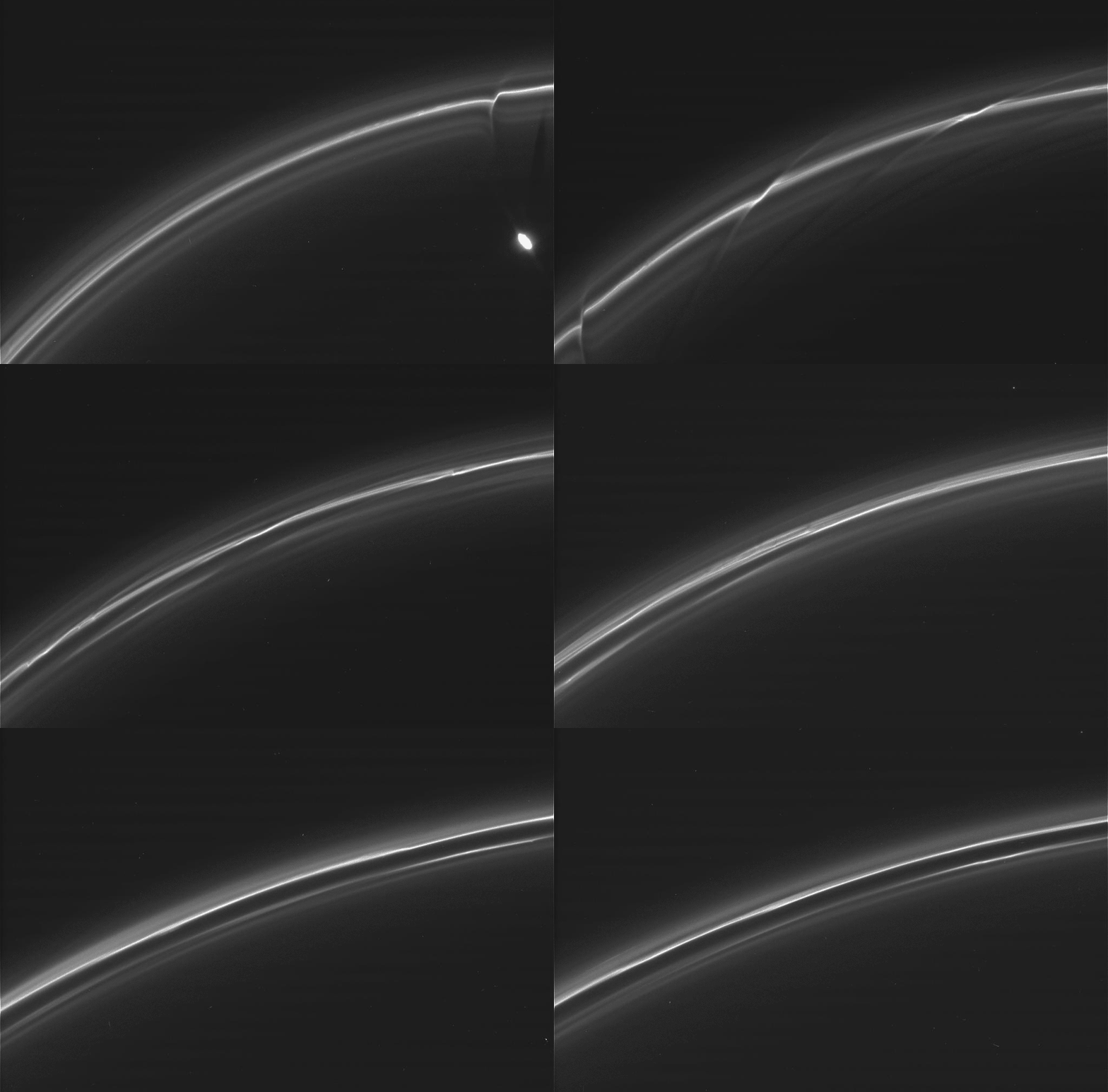
This animated series of images of Saturn's F Ring was acquired by Cassini on June 10, 2009. Shepherd moons Prometheus (inner) and Pandora (outer) pass by, alternately smoothing and disturbing the particles that make up the ring. Kinks, knots, wakes and disturbances are apparent in the thin ring as it rotates. (NASA/JPL/Space Science Institute)

The shadow of the moon Mimas has just slipped off Saturn's rings and onto the planet in this Cassini spacecraft image. The shadow is visible as a short dash below the rings' shadows on the planet. At this exposure setting, the rings are too dim to be seen easily. Images taken using red, green and blue spectral filters were combined to create this natural color view. The images were obtained on April 30, 2009 at a distance of approximately 1.4 million km (870,000 mi) from Saturn. (NASA/JPL/Space Science Institute)
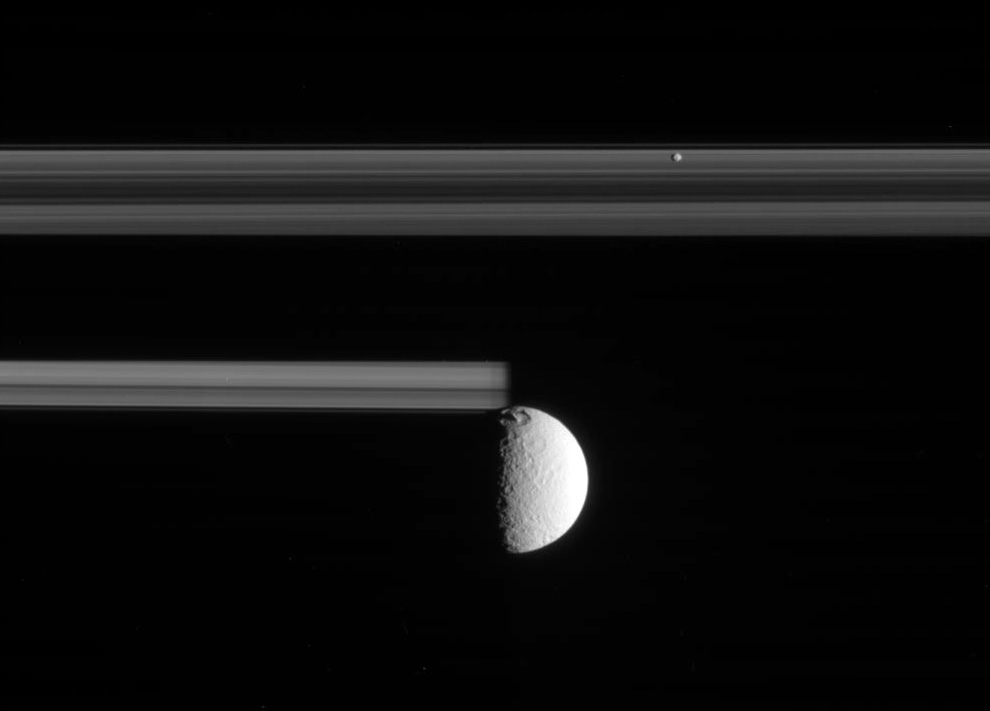
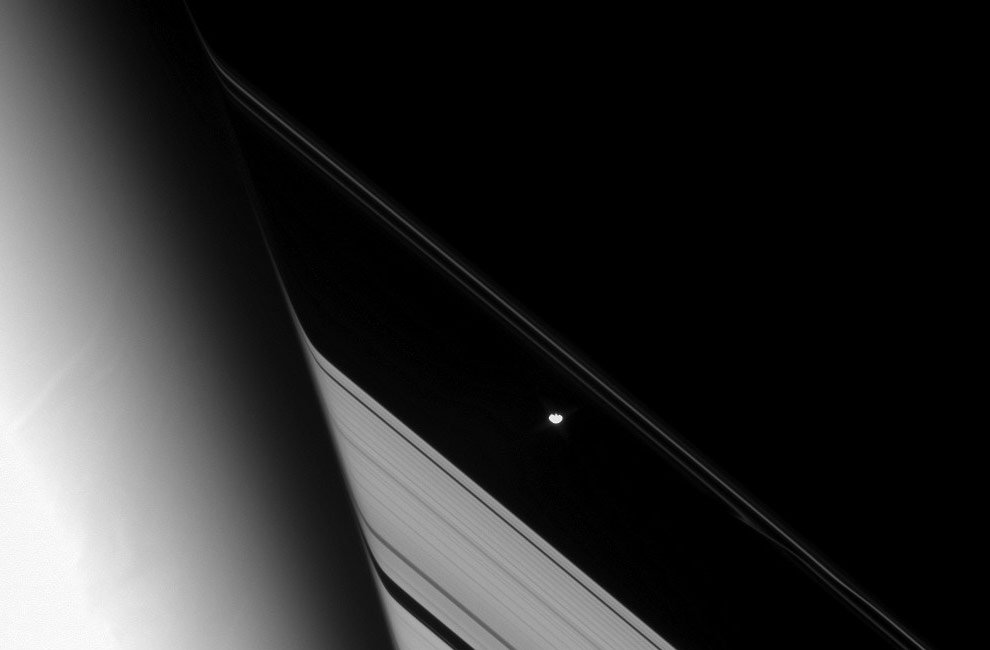
Saturn's large moon Tethys appears before Saturn's rings and a smaller moonlet on October 16, 2009. Just above Tethys, the far side of the rings can be seen disappearing behind Saturn's dark side, slightly fading along the edge seen through the upper atmosphere. (NASA/JPL/Space Science Institute)
Checking in with NASA's Cassini spacecraft, our current emissary to Saturn, some 1.5 billion kilometers (932 million miles) distant from Earth, we find it recently gathering images of the Saturnian system at equinox. During the equinox, the sunlight casts long shadows across Saturn's rings, highlighting previously known phenomena and revealing a few never-before seen images. Cassini continues to orbit Saturn, part of its extended Equinox Mission, funded through through September 2010. A proposal for a further extension is under consideration, one that would keep Cassini in orbit until 2017, ending with a spectacular series of orbits inside the rings followed by a suicide plunge into Saturn on Sept. 15, 2017.

From 20 degrees above the ring plane, Cassini's wide angle camera shot 75 exposures in succession for this mosaic showing Saturn, its rings, and a few of its moons a day and a half after exact Saturn equinox, when the sun's disk was exactly overhead at the planet's equator. The images were taken on Aug. 12, 2009, at a distance of approximately 847,000 km (526,000 mi) from Saturn. (NASA/JPL/Space Science Institute)
Cassini captured this image of a dimly lit Titan as Saturn's largest moon was eclipsed by the planet on May 7, 2009. Lit terrain seen here is on the Saturn-facing side of Titan. In Saturn's shadow, the southern hemisphere of Titan is lit by two sources: sunlight scattered through the planet's rings and refracted sunlight passing through the edge of Saturn's atmosphere. Stars in this image are smeared by the long camera exposure time of 560 seconds needed to capture the faint light on Titan. (NASA/JPL/Space Science Institute)
This series of images of Janus, one of Saturns's smaller moons, shows strips of light and shadow passing over its face. Janus is in the shadow of Saturn's rings, and is briefly lit by a stripe of sunlight as it passes behind a gap in the rings. Photos taken on August 27, 2009. (NASA/JPL/Space Science Institute)
The moon Prometheus and its nearby disturbance of Saturn's F ring. Prometheus periodically gores the F ring, drawing out streamers of material from the ring. The image was taken in visible light at a distance of approximately 950,000 km (590,000 mi) from Saturn. (NASA/JPL/Space Science Institute)

Cassini eyes a prominent crater on the moon Janus. The south pole lies on the terminator at the top right of the image. This view was acquired on July 26, 2009 at a distance of approximately 98,000 kilometers (61,000 miles) from Janus. (NASA/JPL/Space Science Institute)
Rays of light from the sun have taken many different paths to compose this image of Saturn and its rings. This view looks toward the unilluminated (north) side of the rings and, at the top of the image, the night side of Saturn. Sunlight has been reflected off the illuminated side of the rings to light the planet's southern hemisphere, seen here as a bright band of yellow-orange. The northern hemisphere, in the top left corner of the image, is dimly lit by light diffusely scattered through the rings. The planet's shadow cuts across the rings, but light reflected off the southern hemisphere backlights parts of the C ring, making them visible in silhouette. (NASA/JPL/Space Science Institute)
A view of Saturn's moon Tethys and its cratered surface, taken by Cassini on October 14, 2009. (NASA/JPL/Space Science Institute)
Jagged looking shadows stretch away from vertical structures of ring material created by the moon Daphnis, a bright dot (8 km, or 5 mi across) casting a thin shadow just to the left of the center of the image. The moon has an inclined orbit, and its gravitational pull perturbs the orbits of the particles of the A ring forming the Keeler Gap's edge and sculpting the edge into waves having both horizontal (radial) and out-of-plane components. These scenes are possible only during the few months before and after Saturn's equinox, which occurs only once in about 15 Earth years. This image was taken in visible light with the Cassini spacecraft narrow-angle camera on June 26, 2009, at a distance of approximately 823,000 km (511,000 mi) from Daphnis. (NASA/JPL/Space Science Institute)
Another view of waves in the edges of the Keeler gap in Saturn's A ring, created by the embedded moon Daphnis. Image acquired on July 11, 2009, at a distance of approximately 496,000 km (308,000 mi) from Daphnis. (NASA/JPL/Space Science Institute)
A close view of the surface of Saturn's large moon Rhea, as Cassini passes by on October 13, 2009. (NASA/JPL/Space Science Institute)
The gravity of potato-shaped Prometheus (86 km, or 53 mi across) periodically creates streamer-channels in the F ring. This view looks toward the unilluminated side of the rings from about 9 degrees above the ringplane. The image was taken in visible light with the Cassini spacecraft narrow-angle camera on May 26, 2009 from approximately 922,000 km (573,000 mi) from Saturn. (NASA/JPL/Space Science Institute)
An unusual-looking moon shadow crosses Saturn's rings. The shadow appears to 'skip' certain ring bands in a photo taken looking at the unlit side of Saturn's rings. Reflected sunlight and variable ring transparencies appear to be responsble for the striped shadow. (NASA/JPL/Space Science Institute)
Two sources of light illuminate the textured surface of the moon Enceladus. On the right of the image, sunlight bathes the anti-Saturn side of this geologically active moon. Saturnshine dimly lights the Saturn-facing side of the moon on the left of the image. The moon's surface is scarred by fractures, folds, and ridges. This view looks toward the trailing hemisphere of Enceladus (504 kilometers, or 313 miles across). North on Enceladus is up. The image was taken on July 26, 2009, at a distance of approximately 199,000 kilometers (124,000 miles) from Enceladus. (NASA/JPL/Space Science Institute)
The shadow of Saturn's moon Mimas dips onto the planet's rings and straddles the Cassini Division in this natural color image taken as Saturn approaches its August 2009 equinox. Images taken using red, green and blue spectral filters were combined to create this natural color view. The images were obtained with the Cassini spacecraft wide-angle camera on April 8, 2009 at a distance of approximately 1.1 million km (684,000 mi) from Saturn. (NASA/JPL/Space Science Institute)

Cassini captured this image of a small object in the outer portion of Saturn's B ring casting a shadow on the rings as Saturn approaches its August 2009 equinox, on July 26, 2009. This new moonlet, situated about 480 km (300 mi) inward from the outer edge of the B ring, was found by detection of its shadow which stretches 41 km (25 mi) across the rings. The shadow length implies the moonlet is protruding about 200 meters, or 660 feet, above the ring plane. If the moonlet is orbiting in the same plane as the ring material surrounding it, which is likely, it must be about 400 meters, or 1,300 feet, across. (NASA/JPL/Space Science Institute)
Cassini looks down on the north pole of Titan, showing night and day in the northern hemisphere of Saturn's largest moon. The north pole of Titan is rotated about 23 degrees to the left and it lies on the terminator above and to the left of the center of the image. Images taken using red, green and blue spectral filters were combined to create this natural color view of Titan (5,150 km, or 3,200 mi across). The images were obtained on June 6, 2009 at a distance of approximately 194,000 km (121,000 mi) from Titan. Image scale is 11 km (7 mi) per pixel. (NASA/JPL/Space Science Institute)
Plumes of tiny ice particles being ejected from the surface of the moon Enceladus are visible in the scattered sunlight in this image, acquired by Cassini on October 13, 2009. (NASA/JPL/Space Science Institute)

A big shadow from Saturn's largest moon, Titan, darkens the planet in the lower right of this image taken shortly after Saturn's August 2009 equinox. Saturn is overexposed in this image because the camera's long exposure time was set to show the rings which are dimly lit at equinox. Saturn's rings, which are 10 to 100 meters (30 to 300 feet) thick for the most part, cast a narrow shadow onto the planet. The image was taken on Aug. 19, 2009, at a distance of approximately 2.3 million km (1.4 million mi) from Saturn. (NASA/JPL/Space Science Institute)

Saturn's moon Tethys passes between Cassini and distant Titan in this image acquired on October 17, 2009. (NASA/JPL/Space Science Institute)

Cassini looks closely at the outer B ring and the Cassini Division, revealing clump-like structures in the outer edge of the B ring. The scrambled pattern in the B ring's outer edge is the result of the gravitational clumping of particles there. This image was taken with the Cassini spacecraft narrow-angle camera on July 10, 2009, at a distance of approximately 320,000 km (199,000 mi) from Saturn. (NASA/JPL/Space Science Institute)
This animated series of images of Saturn's F Ring was acquired by Cassini on June 10, 2009. Shepherd moons Prometheus (inner) and Pandora (outer) pass by, alternately smoothing and disturbing the particles that make up the ring. Kinks, knots, wakes and disturbances are apparent in the thin ring as it rotates. (NASA/JPL/Space Science Institute)

The shadow of the moon Mimas has just slipped off Saturn's rings and onto the planet in this Cassini spacecraft image. The shadow is visible as a short dash below the rings' shadows on the planet. At this exposure setting, the rings are too dim to be seen easily. Images taken using red, green and blue spectral filters were combined to create this natural color view. The images were obtained on April 30, 2009 at a distance of approximately 1.4 million km (870,000 mi) from Saturn. (NASA/JPL/Space Science Institute)
Saturn's large moon Tethys appears before Saturn's rings and a smaller moonlet on October 16, 2009. Just above Tethys, the far side of the rings can be seen disappearing behind Saturn's dark side, slightly fading along the edge seen through the upper atmosphere. (NASA/JPL/Space Science Institute)