


Around the year 1010 B.C.E., King David defeated the Jebusites in Jerusalem and decided to make the city his administrative capital. When he brought the Ark of the Covenant to the city, he stripped the Twelve Tribes of the spiritual source of their power and concentrated it in his own hands.
King David wanted to build a great Temple for God as a permanent resting place for the Ark of the Covenant. According to Jewish tradition, David was not permitted to build the Temple because he had been a warrior. The task was to fall to a man of peace, David's son, Solomon. The Temple would become the focus of Jewish veneration from that point to the present.
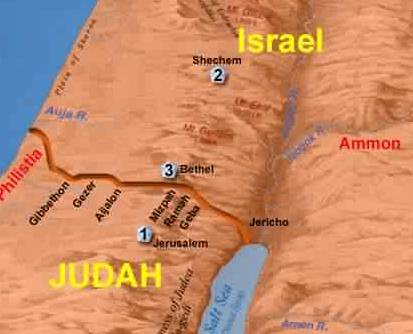
After Solomon died in 931 B.C.E., a civil war led to a split in the Israelite nation. Jerusalem became part of the southern kingdom of Judah, while ten of the northern tribes formed the new kingdom of Israel. That kingdom lasted until 722 B.C.E., when it was conquered by the Assyrians.
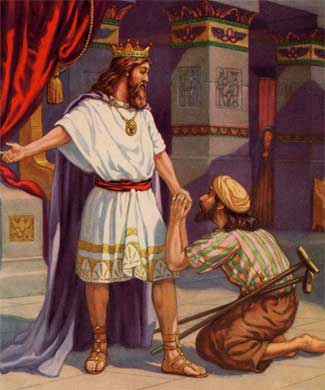
King David
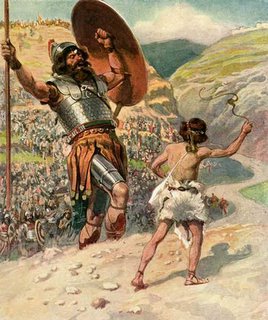
David defeated Goliath
Exile
Meanwhile, Judah staved off the Assyrians and other potential invaders until the Babylonian King, Nebuchadnezzar, led his army into Jerusalem and captured the city in 597 B.C.E. He deported thousands of Jews and appointed 21-year-old Zedekiah, a descendant of King David, to serve as king, expecting him to be a puppet ruler. Zedekiah had different ideas, however, and mounted a revolt. After an eighteen-month siege, Nebuchadnezzar razed Jerusalem. Most of the population was deported to Babylon in 586 B.C.E.
In 560 B.C.E. a new empire emerged, the Persians, led by Cyrus the Great. Cyrus conquered Palestine and then unexpectedly told the Jews they could return to their homeland. While he was probably motivated primarily by the desire to have someone else rebuild Palestine and to make it a source of income for the Persian Empire, the impact on the Jews was to reinvigorate their faith and stimulate them to reconstruct the Temple. The Second Temple was completed in 516 B.C. Over the next 150 years, Judea flourished as the Jews rebuilt Jerusalem and developed the surrounding areas.
In 332 B.C.E. a new power swept through the Middle East. This time it was Alexander the Great who became Palestine's ruler and introduced Greek culture and ideals -- Hellenism. Though many Jews had been seduced by the virtues of Hellenism, the extreme measures adopted over the years helped unite the people. When a Greek official tried to force a priest named Mattathias to make a sacrifice to a pagan god, the Jew murdered the man. Responding to Greek reprisals, the Jews rose up in 167 B.C.E. behind Mattathias and his five sons and fought for their liberation. Three years later, Jerusalem was recaptured from the Greeks by the Maccabees and the Temple purified, an event that gave birth to the holiday of Chanukah.
The last Jewish kingdom survived only 76 years. The grandsons of the Maccabees who had won Jewish independence lost it in large part because of their jealousy and greed. In all likelihood however, with their own empire expanding, the Romans would not have permitted the Jews to keep their kingdom much longer anyway. After three years of fighting, Herod's Roman-backed army wrested control of Jerusalem and the rest of Judea from the Jews in 63 B.C.E.
Rome Rebuilds the Temple
The most significant of Herod's projects was the rebuilding of the Second Temple in the first century B.C.E. It took 10,000 people and a thousand priests nine years to complete the project. The original Temple of King Solomon was a relatively small building on top of Mount Moriah. Herod doubled the area of the Temple Mount and surrounded it with four massive retaining walls. The western wall is the longest, about 1600 feet (485 meters), and includes the Jewish area of prayer known as the Kotel or Western Wall.

Kotel

More Kotel
In 66 A.D., after the procurator Florus provoked the Jews through a variety of activities that ranged from stealing silver from the Temple to desecrating the vestments of the High Priest, the Zealots started a revolt. The Jews initially met with success, routing Roman armies in Jerusalem, but the Romans returned with a larger force. The Jews hoped to hold off the Romans in fortified Jerusalem, but they began a fratricidal battle in which the Zealots murdered Jewish leaders who refused to go along with their rebellion. The Romans laid siege to the city and in the year 70 A.D. overwhelmed the remaining defenders and destroyed the Second Temple. Some of the Zealots escaped and made their last stand at Masada.
Though the mighty Romans had been held at bay for four years, their ultimate victory was never in doubt and the consequences of the Jews' defeat was devastating. Not only was the Temple destroyed, but perhaps as many as one million Jews were killed and many survivors enslaved.
After the suppression of the Jewish revolt, relative calm settled on the Holy Land for nearly 60 years. The Emperor Hadrian had even talked at one point of rebuilding the Temple. He did build a temple; however, it was in honor of Jupiter rather than the god of the Jews. He also renamed Jerusalem Aelia Capitolina and made it a Roman city.
This insult, along with other indignities that went along with being Roman subjects, provoked yet another rebellion beginning in 132 A.D., this time under the charismatic leadership of Simeon Bar-Kokhba. It took nearly three years for the Romans to pacify the country and, when they were done, roughly 600,000 Jews were dead (including Bar-Kokhba) and Judea had been devastated. The Emperor renamed the entire province Syria Palaestina, Jerusalem became a pagan city that Jews were forbidden to enter, and the persecution of Judaism became widespread.
After the destruction of the Second Temple, the center of Jewish life shifted from Jerusalem to Yavneh, where Yochanan ben Zakkai established an academy to train scholars. Meanwhile, the influence of Christianity began to grow in the region, culminating in 330 C.E. with Emperor Constantine's decision to move the capital of the empire from Rome to the city of Byzantium, which he renamed Constantinople (now Istanbul).

Constantinople
The Rise of Islam
The Islamic conquest of Palestine, which began in 633, was the beginning of a 1,300-year span during which more than ten different empires, governments, and dynasties were to rule in the Holy Land prior to the British occupation after World War I.
In 638, the Jews in Palestine assisted the Muslim forces in defeating the Persians who had reneged on an agreement to protect them and allow them to resettle in Jerusalem. As a reward for their assistance, the Muslims permitted the Jews to return to Jerusalem and to guard the Temple Mount.
The Muslims fended off their rivals until the end of the 11th century. In 1095, Pope Urban II called for Crusades to regain Palestine from the infidels. They succeeded in 1099 and celebrated by herding all the Jews into a synagogue and burning them alive. Non-Christians were subsequently barred from the city.
Saladin succeeded in expelling the Crusaders and recaptured Jerusalem for the Muslims in 1187. Two years later, the Christians mounted the Third Crusade to retake Jerusalem, but Saladin's forces repelled them.

Saladin
Here Come the Turks
The next important phase in the history of Jerusalem was the conquest of the Ottoman Turks at the beginning of the sixteenth century. The Turkish sultan then became responsible for Jerusalem. The Holy Land was important to the Turks only as a source of revenue; consequently, like many of their predecessors, they allowed Palestine to languish. They also began to impose oppressive taxes on the Jews.
Neglect and oppression gradually took their toll on the Jewish community and the population declined to a total of no more than 7,000 by the end of the seventeenth century. It wasn't until the nascent Zionist movement in Eastern Europe motivated Jews to return to Palestine that the first modern Jewish settlement was established -- in Petah Tikvah in 1878.
The Ottoman Empire held its own against rivals from Europe and Asia for roughly 400 years. They chose, however, to engage in a battle they could not win -- World War I -- and lost their empire. Palestine was captured by the British, who subsequently were awarded a mandate from the League of Nations to rule the country.
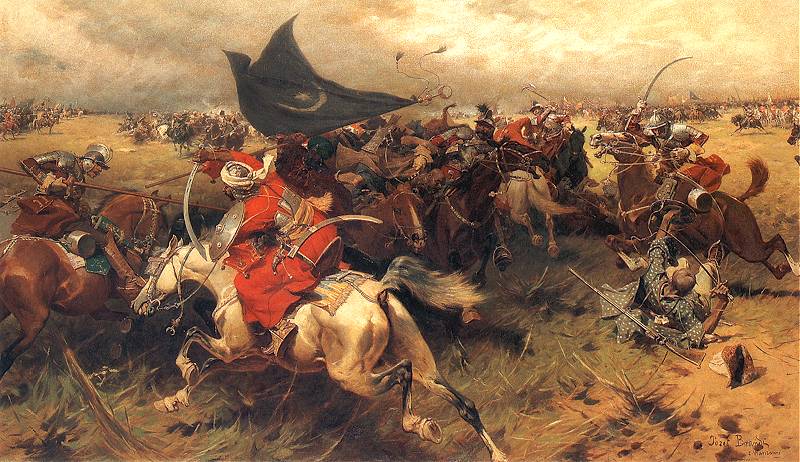
Ottoman Turks commence in battle against the Europeans
Politics & Religion Mix
Ever since King David made Jerusalem the capital of Israel 3,000 years ago, the city has played a central role in Jewish existence. The Western Wall in the Old City — the last remaining wall of the ancient Jewish Temple, the holiest site in Judaism — is the object of Jewish veneration and the focus of Jewish prayer. Three times a day for thousands of years Jews have prayed, “To Jerusalem, thy city, shall we return with joy,” and have repeated the Psalmist's oath: “If I forget thee, O Jerusalem, let my right hand forget her cunning.”
Jews have been living in Jerusalem continuously for nearly two millennia. They have constituted the largest single group of inhabitants there since the 1840's (map of Jerusalem in 1912). Today, the total population of Jerusalem is approximately 662,000. The Jewish population in areas formerly controlled by Jordan exceeds 160,000, outnumbering Palestinians in "Arab" East Jerusalem.
Muslims also revere the Holy City. According to Islam, the prophet Mohammed was miraculously transported from Mecca to Jerusalem, and it was from there that he made his ascent to heaven. Still, despite controlling the city for more than a thousand years, Jerusalem was never the capital of any Arab entity. In fact, it was a backwater for most of Arab history.
For Christians, Jerusalem is the place where Jesus lived, preached, died, and was resurrected. While it is the heavenly rather than the earthly Jerusalem that is emphasized by the Church, places mentioned in the New Testament as the sites of his ministry and passion have drawn pilgrims and devoted worshipers for centuries.

The doom of the rock

Inside the doom of the rock
A City Divided
When the United Nations took up the Palestine question in 1947, it recommended that all of Jerusalem be internationalized. The Jewish Agency, after much soul-searching, agreed to accept internationalization in the hope that in the short-run it would protect the city from bloodshed and the new state from conflict. The Arab states were as bitterly opposed to the internationalization of Jerusalem as they were to the rest of the partition plan. Prime Minister David Ben-Gurion, subsequently, declared that Israel would no longer accept the internationalization of Jerusalem.
In May 1948, Jordan invaded and occupied east Jerusalem, dividing the city for the first time in its history, and driving thousands of Jews — whose families had lived in the city for centuries — into exile. For the next 19 years, the city was split, with Israel establishing its capital in western Jerusalem and Jordan occupying the eastern section, which included the Old City and most religious shrines.
In 1950, Jordan annexed all the territory it occupied west of the Jordan River, including east Jerusalem. The other Arab countries denied formal recognition of the Jordanian move, and the Arab League considered expelling Jordan from membership. Eventually, a compromise was worked out by which the other Arab governments agreed to view all the West Bank and east Jerusalem as held "in trust" by Jordan for the Palestinians.
From 1948-67, the city was divided between Israel and Jordan. Israel made western Jerusalem its capital; Jordan occupied the eastern section. Because Jordan — like all the Arab states at the time — maintained a state of war with Israel, the city became two armed camps, replete with concrete walls and bunkers, barbed-wire fences, minefields and other military fortifications.
In violation of the 1949 Armistice Agreement, Jordan denied Israelis access to the Temple Wall and to the cemetery on the Mount of Olives, where Jews have been burying their dead for 2,500 years. Jordan actually went further and desecrated Jewish holy places. King Hussein permitted the construction of a road to the Intercontinental Hotel across the Mount of Olives cemetery. Hundreds of Jewish graves were destroyed by a highway that could have easily been built elsewhere. The gravestones, honoring the memory of rabbis and sages, were used by the engineer corps of the Jordanian Arab Legion as pavement and latrines in army camps. The ancient Jewish Quarter of the Old City was ravaged, 58 Jerusalem synagogues — some centuries old — were destroyed or ruined, others were turned into stables and chicken coops. Slum dwellings were built abutting the Western Wall.
Jews were not the only ones who found their freedom impeded. Under Jordanian rule, Israeli Christians were subjected to various restrictions, with only limited numbers allowed to visit the Old City and Bethlehem at Christmas and Easter. Because of these repressive policies, many Christians emigrated from Jerusalem, leading their numbers to dwindle from 25,000 in 1949 to less than 13,000 in June 1967.

cemetery on the Mount of Olives
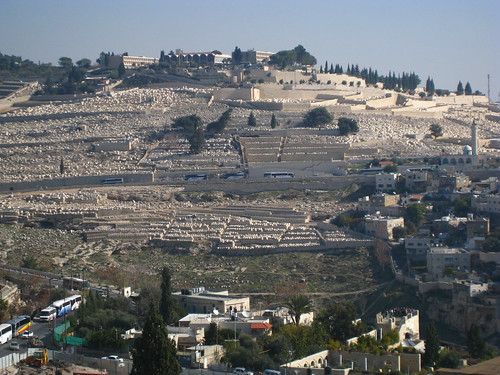
Mount of Olives
Jerusalem is Unified
In 1967, Jordan ignored Israeli pleas to stay out of the Six-Day War and attacked the western part of the city. The Jordanians were routed by Israeli forces and driven out of east Jerusalem, allowing the city's unity to be restored. Teddy Kollek, Jerusalem’s mayor for 28 years, called the reunification of the city "the practical realization of the Zionist movement's goals." Today, a museum devoted to promoting dialogue and coexistence, the Museum on the Seam, is located at the junction of East and West Jerusalem.

middle east
Freedom of Religion
After the war, Israel abolished all the discriminatory laws promulgated by Jordan and adopted its own tough standard for safeguarding access to religious shrines. "Whoever does anything that is likely to violate the freedom of access of the members of the various religions to the places sacred to them," Israeli law stipulates, is "liable to imprisonment for a term of five years." Israel also entrusted administration of the holy places to their respective religious authorities.
Muslim rights on the Temple Mount, the site of the Dome of the Rock and the Al-Aksa Mosque, have not been infringed, and the holy places are under the supervision of the Muslim Waqf. Although it is the holiest site in Judaism, Israel has left the Temple Mount under the control of Muslim religious authorities.
Since 1967, hundreds of thousands of Muslims and Christians — many from Arab countries that remain in a state of war with Israel — have come to Jerusalem to see their holy places. Arab leaders are free to visit Jerusalem to pray if they wish to, just as Egyptian President Anwar Sadat did at the El-Aksa mosque.
Along with religious freedom, Palestinian Arabs in Jerusalem have unprecedented political rights. Arab residents were given the choice of whether to become Israeli citizens. Most chose to retain their Jordanian citizenship. Moreover, regardless of whether they are citizens, Jerusalem Arabs are permitted to vote in municipal elections and play a role in the administration of the city.
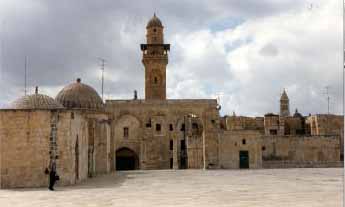
The temple mount

Southern Temple Mount


 Thankx ban


