ඉන්දීය වෘත්තිකයන් මෙහි එන්නේ නෑ: රනිල්

BINGU_PUTHA

Well-known member
  • Apr 26, 2013
    12,108
    5,915
    113
    canada
    අර කතාවක් තිබ්බේ මේ යන විදියට දෙනවයි කිව්ව රැකියා ලක්ෂ 10 යෙන් 1ක් අපිට, 9ක් ඉන්දිය්වට කියල. :rofl::rofl::rofl:

    "කාට රැකියා දුන්නහම මොකද? අපි කවුරුත් මනුස්සයෝ නේ මචන්" කියන ටෝයියනුත් එළකිරියේ හොයාගන්න අමාරු නැහැ

    :rofl::rofl::rofl::rofl:
     

    මරුසිරා

    Well-known member
  • Mar 5, 2012
    14,353
    1,577
    113
    out of the blue
    ඔව් ඉතින් ගල් කොල්ලන්ට පොනිල මොනව කිව්වත් ඇත්ත ...:angry:

    ඉන්දියන් උන් එන්නේ it කියල හැබැයි කරන්නේ කුලීවැඩ ..ලෝකේ හම්බයට පස්සේ ඉන්න ජරාම උන්තමා ඔය තමිල්නාදුවෙයි කෙරලෙයි ඉන්නේ (මලබාරියෝ ).ලෝකේ හැමතැනම ජොබ් මාකට් බැස්සුවේ මුන් .එකක් රින්ගුවොත් මුළු හත්මුතු පරපුරම ගේනවා .උඩට යන්නේ දක්ස කමට නෙමේ අනිත් එකාව කපල .කම්පැනි පිටින්ම අයිති කරගන්න මුන් නම්දරාපු ජාතියක් .

    සිංහලු හිතනවානම් මේකෙන් කෙලවෙන්නේ අයීට් උන්ට විතරයි කියල එක තමා ලෝකිඋම මෝඩකම .උබල හින්දි ෆිල්ම වල තියෙන ඔය උඩදාගෙන බලන උන්ගේ නාට්ටි වල තියෙන දේවල් නෙමේ උන් .

    ගිය තැන වනසල පස්සේ පුලුවන්නම් රටම අයිති කරගන්න ජාතියක් මුන් .:angry:
     

    jayanathek

    Well-known member
  • Dec 18, 2008
    9,585
    3,551
    113
    ඉට්කා එපා කීවම ටොයියන්ට මල පනින්නෙ ඇයි බන්.... උන් ඉන්දියන්ද
     

    monson

    Well-known member
  • May 7, 2007
    25,677
    28,719
    113
    The Ceylon Chamber of Commerce welcomes ETCA; urges consultations with private sector

    Ceylon-Chamber-of-Commerce.jpg


    Feb 25, 2016 (LBO) – The Ceylon Chamber of Commerce has hailed the proposed Economic and Technology Cooperation Agreement (ETCA) with India, but has urged Systematic Consultations with the Private Sector.

    The chamber said in a statement that any bilateral or regional agreement that Sri Lanka forges must be supportive of the country’s holistic economic interests rather than cater to individual business interests.

    “It must recognise size asymmetry of the economy; and must take a phased approach to liberalisation where domestic regulatory systems need updating.” the statement said.

    The full text is reproduced below.

    The Ceylon Chamber of Commerce welcomes ETCA, But Urges Systematic Consultations with the Private Sector

    The Ceylon Chamber of Commerce has consistently supported the expansion of Sri Lanka’s trade interests through signing mutually beneficial and well-designed trade agreements, and this has been clearly articulated in our ‘10 Principles’ on the economy.

    The Chamber believes that such agreements are an important tool in deepening trade and investment opportunities for our businesses, within a rules-based framework. The Ceylon Chamber welcomes the Hon. Prime Minister’s statement in Parliament this week explaining the Government of Sri Lanka’s (GoSL) stance on the proposed Economic and Technology Cooperation Agreement (ETCA) with India.

    This statement can help allay misperceptions around the proposed ETCA. The Chamber now urges the authorities involved in the ETCA process to build on this by adopting a systematic consultative and information sharing process with the private sector.

    Any bilateral or regional agreement that Sri Lanka forges must be supportive of the country’s holistic economic interests (rather than cater to individual business interests); must recognise size asymmetry of the economy; and must take a phased approach to liberalisation where domestic regulatory systems need updating (for instance, on movement of natural persons in professional services).

    Dialogue and Information

    An important element in the overall process of forging new agreements is transparent, systematic, and broad-based consultations with the private sector.

    The Chamber observed with concern the level of misinformed opposition proliferating in the media regarding the proposed ETCA, which can in part be attributed to the lack of robust information sharing and a systematic consultative process. We extend our support to the government to help more stakeholders in the private sector understand the gains and challenges of such a bilateral agreement.

    A dialogue process that is well structured and includes all relevant stakeholders can mitigate the risks of the current ETCA process suffering from the difficulties that the earlier proposed Comprehensive Economic Partnership Agreement (CEPA) suffered. We call on the government ministries and departments involved in the process to adopt a more systematic approach to private sector consultations, so that we may mobilize evidence-based representations from the private sector.

    The Chamber also encourages technical experts from the government (particularly the Department of Commerce) to play a more active role in educating the public, addressing queries/concerns of the private sector, and providing relevant information in a timely manner. While we recognize that the final text of an agreement cannot be made public due to the nature of bilateral trade negotiations, the GoSL can consider publishing a ‘White Paper’ on ‘Expanding trade in services, investment and economic cooperation with India’, which captures the GoSL thinking on the issue, and clarifies the approach to be taken. The Department of Commerce can consider setting up an ‘Inquiry Desk’ either in person or on a dedicated website where questions and clarifications on the ETCA can be directed.

    Assessing and Addressing Concerns


    Undoubtedly, there are valid concerns of an uneven playing field faced by Sri Lankan business in India. In order to build confidence, the Indian government should move quickly to clear some contentious issues facing Sri Lankan businesses that trade with India. Solving non-tariff barriers (NTBs)/Non-Tariff Measures (NTMs) should be given priority. The Chamber understands that the Framework agreement includes a chapter on ‘Early Harvest’ of barriers to trade in goods (including quota issues and NTBs). India must support this. The ETCA negotiation process can accelerate a Mutual Recognition Agreement for standards, and also establish an efficient and effective dispute resolution mechanism to resolve issues faced by business on both sides on a regular basis. This can build further confidence in the bilateral agreement.

    Meanwhile, opposition to the ETCA – and indeed further overall liberalization of trade in goods and services – citing ‘national interest concerns’ must be carefully examined alongside the potential gains to consumers and firms in Sri Lanka. The latter too is ultimately a matter of national interest. The Chamber urges GoSL to not entertain protectionism that may come under the guise of national interest concerns. It is important that GoSL looks beyond the narrow commercial interests of the few and instead focus on the broader economic imperatives of exports, investments, and job creation to set a course for the future prosperity of the economy.

    Expanding Sri Lanka ‘Openness’

    The Chamber also strongly endorses the Prime Minister’s comments in his recent statement that Sri Lanka needs to focus on expanding the markets for our exports and tap in to the growing middle class in emerging economies in Asia and Europe. Over the last decade and a half, the Sri Lankan economy has become more closed and more inward looking than before, resulting in a falling share of global exports and a declining exports-to-GDP ratio. As a small economy with a limited domestic market, trading more with the world and welcoming more business and investment partnerships from abroad is our only path to prosperity. In this, greater openness to trade in services cannot be ignored, owing to its strong and growing link to goods trade and investment. Services liberalization needs to be pursued, within a mutually-beneficial framework and following stakeholder discussions.

    Many of our Chamber’s members produce world-class products and services, are winning in competitive market niches abroad, and have high quality management practices, and environmental and labour credentials. Opening up to the world would only sharpen these competencies, and also provide new channels for the best firms to make a stronger mark overseas.

    Building Confidence in the Process

    In conclusion, the Ceylon Chamber reaffirms our fullest support towards an agreement that widens and deepens our economic engagement with India, while reiterating the need for systematic stakeholder consultations, clear and coherent communications, and firm commitment to tackling issues faced by businesses. While it is governments that sign trade agreements, they ultimately impact – positively and negatively – on consumers and businesses. The trust and confidence of the private sector in new trade agreements the government may forge in the future necessarily depends on how the ongoing ETCA process is handled.

    - http://www.lankabusinessonline.com/etca-can-be-a-wake-up-call-for-sri-lankans-professionals/
     
    Last edited:

    monson

    Well-known member
  • May 7, 2007
    25,677
    28,719
    113
    ETCA can be a wake up call for Sri Lankans: professionals

    Feb 25, 2016 (LBO) – Sri Lankan professionals say integration with India through the Economic and Technical Cooperation Agreement (ETCA) is a must for the islands future development.

    “Yes, ETCA is needed. We have labour problem and if Sri Lankans can’t do it and we don’t have the people then we have to bring them from elsewhere,” Reyaz Mihular, Managing Partner, KPMG Sri Lanka said at a recent forum.

    “I don’t see the IT sector and marine engineers fighting this. Why is it that only the Government Medical Officers Association (GMOA) who are making an issue?” he asked.

    “If we have Megapolis then we need to have the expertise.”

    Mihular says that Sri Lanka has nearly one million three wheeler drivers and this is an unproductive workforce.

    “They should look for better skilled jobs.”

    “Due to intense competition we find it hard to keep a qualified IT youth in the same job as they are grabbed by other companies.”

    Another senior professional said that integration with India will be a key if the island is to move towards developed country status.

    “When you look at integration, the ASEAN Region is at 35 percent while South Asia is only at 5.3 percent,” Rohantha Athukorala, Chairman, Lanka Sathosa, Ministry of Trade and Commerce said.

    “If we (Sri Lanka) want to ride the wave of the developed countries then we have to come up with a partnership like ETCA. There is no doubt.”

    However, he stressed on the point of stakeholder participation and transparency.

    “Yes, we need stakeholder participation but we need to take decisions that are good for the country in the long-term. ETCA needs to move on but the document needs to be made public and ensure a degree of transparency.”

    Nithya Partners Partner, Neomal Goonewardane said that many of Sri Lanka’s young professionals aspire to go overseas and that this creates a vacuum.

    “I think ETCA is necessary – It will be a good wake-up call, as our people need to work harder as if not there will be no future for the younger generation,”

    “All professionals between the ages of 30-40 years don’t want to work in Sri Lanka. They want to work overseas in place like Australia, Canada other places.”

    He also said that Sri Lanka has to create innovative new jobs for the youth similar to Singapore which has mobile BPO Law Desks for India targeting big law firms.

    “This is very successful and is a model that could be adopted in Sri Lanka.”

    Sri Lanka’s Deputy Minister of Foreign Affairs, Harsha de Silva, told LBO recently that there is no formal document with regard to ETCA yet and that the government will have consultations with local stakeholders before finalizing a draft.

    “Opening up of the services sector will not result in Sri Lanka being flooded by Indian professionals and the agreement will not be going in for Mode 4 of the General Agreement on Trade in Services which allows movement of “natural persons”.”

    Entry will be allowed only in IT and ship building, he said.


    - http://www.lankabusinessonline.com/etca-can-be-a-wake-up-call-for-sri-lankans-professionals/
     

    monson

    Well-known member
  • May 7, 2007
    25,677
    28,719
    113
    ඉන්දියානු භීතිකාව

    වික්ටර් අයිවන්

    මිනිසුන් අතර ලොකු භීතියක් ඇති කොට ඒ ඇතිවන්නට යන ව්‍යසනයෙන් මිනිසුන් ගලවා ගැනීමේ හැකියාව තමන්ට ඇති බව පෙන්නුම් කිරීම නායකයකුට අනුගාමිකයන් දිනාගැනීම සඳහා යොදාගත හැකි පහසු මාර්ගයක් ලෙස සැලකිය හැකිය. මාගේ ගැටවර කාලයේදී මමද විජේවීරගේ දේශපාලන අනුගාමිකයෙක් වීමි. 1970ට පෙර ඔහු අප වැනි අයට භීතිකා දෙකක් මවා පෑවේය. එකක් ඇමරිකන් භීතිකාවය. අනෙක ඉන්දියානු භීතිකාවය. මේ රටවල් දෙකම ඔහු චිත‍්‍රවත් කළේ ලංකාව ග‍්‍රහණයට ගැනීමට දත් විලිස්සාගෙන සිටින බිහිසුණු රකුසන් දෙදෙනකු ලෙසය. 1970ට පෙර ඔහු මෙම රකුසන් දෙදෙනා අතුරින් ප‍්‍රමුඛ රකුසා ලෙස සලකන ලද්දේ ඇමරිකාවය. ඔහු දෙවැනි කැරැුල්ලේදී ප‍්‍රමුඛයා ලෙස ගත්තේ ඉන්දියාවය.

    රෝහණ විජේවීර

    ඔහු 1970ට පෙර අපට අවධාරණයෙන්ම කියා සිටියේ බලයේ සිටින එක්සත් ජාතික පක්ෂ ආණ්ඩුව 1970දී මැතිවරණයක් නොපවත්වන බවය. ඇමරිකන් වුවමනාව මත හමුදා ආණ්ඩුවක් ඇති කිරීමට අවශ්‍ය සියලූ සැලසුම් සකස් කොට තිබෙන බවය. ඔහු ඒ සඳහා නිදර්ශනය කොට ගත්තේ ඉන්දුනීසියාවය. සුකර්ණෝගේ ආණ්ඩුව හමුදා කුමන්ත‍්‍රණයක් මගින් පෙරලා දමා බිහිවූ සුහර්තෝගේ හමුදා ආණ්ඩුව ඇති කළ මහා ජීවිත විනාශය පෙන්වාදී ලංකාවේද ඒ හා සමාන තත්ත්වයක් ඇතිවන්නට නියමිත බවද කියා සිටියේය. හමුදා ආණ්ඩුවක් ඇති කිරීම සඳහා වන මහා සූදානමක් ඇති බව පෙන්නුම් කිරීම සඳහා ඔහු බෙන්තොට බීච් හෝටලයද නිදර්ශනයක් කොට ගත්තේය.
    ඒ කාලයේ අද මෙන් ලොකු විදේශ සංචාරක හෝටල් නොතිබුණේය. බෙන්තොට බීච් හෝටලය ඉදිකෙරෙමින් තිබුුණේ ඒ කාලයේදීය. විජේවීර අපට කීවේ එය සංචාරක හෝටලයක් නොවන බවත් ඇමරිකන් බලකොටුවක් බවත්ය. ඔහු වැඩිදුරටත් කීවේ සංචාරක හෝටලයකට ඒ සා විශාල ගල් තාප්පයක් අවශ්‍ය නොවන බවත් එය සංචාරක හෝටලයක් මුවාවෙන් ඉදිකෙරෙමින් තිබෙන ඇමරිකන් බලකොටුවක් වන බවත්ය. ඔහු එම හෝටලයට දෙන ලද අර්ථකථනය සේ ම ඇමරිකානු වුවමනාව මත හමුදා ආණ්ඩුවක් ඇති කිරීමට සැලසුම් කර තිබෙන බවට ඔහු කරන ලද විවරණයට ඔහුගේ අනුගාමිකයන් බවට පත්ව සිටි අප සියලූදෙනා තරයේ විශ්වාස කළා පමණක් නොව ඒ සියලූදෙනා එක් ආකාරයකින් හෝ තවත් ආකාරයකින් ඇතිවන්නට යන හමුදා ආණ්ඩුවක් පිළිබඳව ඇති කරගත් බිය මුල් කරගත් සාමූහික උමතුවකින් ක‍්‍රියාකරන පිරිසක් බවටද පත්වූයේයැ’යි කිව හැකිය.

    ඉන්දියානු විරෝධය

    ඔහු දෙවැනි කැරැල්ලේදී ප‍්‍රධාන හතුරා ලෙස කරළියට ගත්තේ ඇමරිකාව නොව ඉන්දියාවය. පළමු කැරැුල්ල කාලයේදී ද ඔහුට ඉන්දියානු ව්‍යාප්තවාදය පිළිබඳ පන්තියක් තිබුණි. එය ඉන්දියාව හා චීනය අතර දේශසීමා යුද්ධයක් පැවති කාලයේදී චීනය විසින් පළකරන ලද ලිපි දෙකක එන කරුණු පදනම් කොටගෙන සකස් කරන ලද විග‍්‍රහයක් විය. දෙවැනි කැරැුල්ලේදී මා ඔහුගේ දේශපාලන අනුගාමිකයකු නොවීම නිසා ඔහු විසින් කරමින් තිබුණු බිහිසුණු අත්හදා බැලීම පිටස්තර විචාරකයකු ලෙස බලාසිටීමේ හැකියාව මට ලැබුණි. වඩමාරච්චි අරගලය, පරිප්පු ආක‍්‍රමණය හා යෝජිත ඉන්දු ලංකා ගිවිසුම ආශ‍්‍රයෙන් රටේ ඇතිව තිබූ උද්වේගකර වටාපිටාව ප‍්‍රයෝජනයට ගනිමින් ඔහු සිය දෙවැනි කැරැුල්ල කරළියට ගත්තේ ඉන්දියානු ආක‍්‍රමණයට එරෙහිව පීතෘ භූමියේ නිදහස වෙනුවෙන් කරන දේශපේ‍්‍රමී යුද්ධයක් යන තේමාව යටතේය. ඒ කාලයේදී ඉන්දියානු භාණ්ඩ විකිණීම හා මිලදී ගැනීම පවා මරණ දඬුවම ලැබිය යුතු වරදක් බව ප‍්‍රකාශ කර තිබුණි.
    පසුකලකදී යශෝධා ව්‍යාපාරයේ අධිපති යසසිරි කස්තුරිආරච්චිගෙන් ඒ කාලයේදී දේවල් සිදුවූ නියම ස්වරූපය පෙන්නුම් කරන අපූරු කතාවක් මට අසන්නට ලැබුණි. ඒ බිහිසුණු කාලයේදී ඔහුද ආරක්ෂාව සඳහා ජවිපෙ අනුගාමිකයකු බවට පත්ව සිටියේය. ඔහු ජවිපෙ නායකයන්ට වැදගත් වන්නට ඇත්තේ ඔහුට අගමැති ඞී.බී. විජේතුංගට තිබුණු සමීප සම්බන්ධය නිසා විය යුතුය. ඔහුගේ කොළඹ නිවස ජවිපෙ දේශපාලන මණ්ඩල රැස්වීම් පවත්වන ස්ථානයක් බවට පත්ව තිබුණි. විජේවීර එහි පැමිණි කිසියම් දිනකදී යශෝධාට තිබෙන ප‍්‍රශ්න මොනවාදැයි ඔහුගෙන් අසන ලදුව ඔහු විජේවීරට කියා තිබෙන්නේ දේශීය ව්‍යාපාරිකයන්ගේ සීනි වෙළෙඳාමට ලංකාවේ ඉන්දියානු වෙළෙඳුන්ගෙන් ලොකු තර්ජනයක් තිබෙන බවය. ඉන් දින කිහිපයකට පසුව පිටකොටුවේදී ඉන්දියානු සීනි ආනයනය කරන ප‍්‍රධාන පෙළේ වෙළෙන්දෙකුට වෙඩි තබා මරා දමන ලද බවත් එතැන් සිට ලංකාවේ ලොකුම සීනි ආනයනකරු බවට පත්වීමේ හැකියාව තමන්ට ලැබුණු බවත් ඔහු මට කීවේය.
    එම විශේෂ අවස්ථාවේදී ඉන්දියානු හමුදා ලංකාවට නොඑන්නට සිංහල දකුණේ විජේවීරගේ කැරැුල්ල සේ ම උතුරේ ප‍්‍රභාකරන්ගේ කැරැුල්ලද ජයග‍්‍රාහී වන්නට ඉඩ තිබුණි. ඒ අවස්ථාවේදී ඒ කැරලි දෙකම ජයගන්නට නොහැකි වූයේ ඉන්දියානු හමුදාව නිසාය. ලංකාවට ආ ඉන්දියානු හමුදා කවදාවත් ආපසු නොයනු ඇති බවට ඒ කාලයේ ප‍්‍රකාශ වූ කතාද සනාථ වූයේ නැත. අවසානයේ ඉන්දියානු විරෝධය අවසන් වූයේ විජේවීරගේ ජීවිතය පමණක් නොව රටට වැදගත් කාර්යභාරයක් ඉටුකිරීමේ හැකියාව තිබූ විශාල තරුණ පිරිසකගේද ජීවිත විනාශ කරමිනි.

    ආර්ථිකය විවෘත කිරීම

    ජනාධිපති ජේ.ආර්. ජයවර්ධන ආර්ථිකය විවෘත කළ අවස්ථාවේදීද ඒ නිසා දේශීය ව්‍යවසායකයන් නැත්තටම නැතිවී යනු ඇතැ’යි කියන බොරු මතයක් එදා රටේ ගොඩනැගී තිබුණි. ඒ අවස්ථාවේදී මා කල්පනා කළේද ඊට සමාන ආකාරයටය. එහෙත් ඒ නිසා සිදුවූයේ දේශීය ව්‍යවසායකයන් නැත්තටම නැතිවීම නොව එම ව්‍යවසායකයන් පවත්වා ගෙන ගිය ව්‍යාපාර නූතන අවශ්‍යතාවන්ට ගැළපෙන ලෙස නවීකරණය වී තිබුණු තත්ත්වයට වඩා ප‍්‍රබල තත්ත්වයක් හිමිකර ගැනීමය. ඒ නිසා සමහර නිෂ්පාදනවල බිඳවැටීමක් ඇතිවූ බව සැබෑය. අත්යන්ත‍්‍ර පේෂ කර්මාන්තය ඒ සඳහා දැක්විය හැකි නිදසුනකි. එම කර්මාන්තයෙන් වැඩි වශයෙන් ජීවත් වූයේ ග‍්‍රාමීය ප‍්‍රදේශවල අවවරප‍්‍රසාදිත හා පීඩිත කුලවල ජනයාය. එහෙත් ඒ වෙනුවට එම ජනයාට වඩා විශාල පිරිසකට රැුකියා ලැබෙන, වඩා හොඳ ආදායම් ලැබෙන නවීන හා ප‍්‍රමාණයෙන් අතිවිශාල ඇඟලූම් කර්මාන්තයක් හිමිවිය. ඉන්පසු අත්යන්ත‍්‍ර පේෂකර්මාන්තයද නවීන වී එය ධනවතුන්ට පමණක් පරිහරණය කළ හැකි මිල අධික ඇඳුම් විශේෂයක් බවට පත්විය.
    අනෙකුත් කර්මාන්ත අංශවලද ඇතිවූයේ ප‍්‍රගතියකි. ඒ කාලයේ පාවහන් නිෂ්පාදනයේදී ප‍්‍රමුඛත්වය හිමිකරගෙන සිටියේ බාටා සමාගමය. එහෙත් ආර්ථිකය විවෘත කිරීමෙන් පසු බාටා සමාගම යටපත් කොට ගෙන නැගී සිටීමට ඞීඑස්අයි වැනි දේශීය කර්මාන්තවලට හැකිවිය. මූලික කාර්මික නිෂ්පාදන කිහිපයකට සීමාවී තිබුණු ජිනසේන සමාගම ජෙට් ගුවන් යානාවලට ටයර් සපයන ප‍්‍රධාන සැපයුම්කරුවකු බවට පත්විය. අයිස්ක‍්‍රීම් කර්මාන්තය, පැණි බීම කර්මාන්තය, බිස්කට් කර්මාන්තය, චොක්ලට් කර්මාන්තය වැනි කර්මාන්තයන් අන්තර් ජාතික වශයෙන් එම පිළිගැනීමට හේතුවන තත්ත්වයකට වර්ධනය විය. අවසාන විග‍්‍රහයේදී ආර්ථිකය විවෘත කිරීම නිසා එකතැන පල්වෙන තත්ත්වයක තිබූ ආර්ථිකයේ වේගවත් ප‍්‍රසාරණයක් ඇතිවිය. ජන ජීවිතයේද විශාල දියුණුවක් ඇති කිරීමට හේතුවිය.

    ඉන්දියානු වෙළෙඳපොළ

    දිවයිනක් ලෙස ලංකාව පිහිටා තිබෙන්නේ ජනගහනයේ විශාලත් වයෙන් චීනයට පමණක් දෙවැනි වන රට ලෙස සැලකිය හැකි ඉන්දියාවේ කට ළඟය. ඉන්දියාව ළඟම හා ලංකාවට සිටින එකම අසල්වැසියාය. දකුණෙන්, බටහිරින් හෝ නැගෙනහිරින් අපට ළඟ වෙනත් අසල්වැසි රටවල් නැත. ලංකාව දකුණු ඉන්දියාවෙන් වෙන්ව තිබෙන්නේද සැතපුම් 22ක් පමණ වන පටු මුහුදු තීරයකිනි. ඉන්දියානු සාගරයේ පිහිටා තිබෙන දිවයිනක් ලෙස ලංකාවට ලැබෙන ඊළඟ වැදගත්කම වනුයේ මධ්‍යධරණී ලෝකය හා නැගෙනහිර ආසියාව යා කරන මුහුදු මාර්ගයක වැදගත් සන්ධිස්ථානයක පිහිටා තිබීමය.
    ශ‍්‍රී ලංකාවේ දේශීය වෙළෙඳපොළට ආවේණික පුංචිකම නිසාම ශ‍්‍රී ලංකාවේ වෙළෙඳපොළ සඳහා පමණක් භාණ්ඩ නිපදවීමට කිසිදු ලොකු ආයෝජකයකු ලංකාවට එන්නේ නැත. ලොකු ආයෝජකයන් ලංකාවට එනවා නම් එනු ඇත්තේ ලංකාවේ වෙළෙඳපොළට අතිරේකව ප‍්‍රධාන කොට ඉන්දියානු වෙළෙඳපොළට භාණ්ඩ නිපදවා පහසුකම් ඇතිව එහි යැවීමේ හැකියාව ඇත්නම් පමණය. ඉන්දියාව සමග සහයෝගයෙන් වැඩ කිරීම අවශ්‍යවන්නේ ඒ සඳහා ශක්තිමත් පදනමක් ගොඩනගා ගැනීම සඳහාය. ලංකාවේ වෙළෙඳපොළට අතිරේකව ඉන්දියානු වෙළෙඳපොළ ඉලක්ක කොටගෙන විදේශීය ආයෝජකයන් ලංකාවේ කර්මාන්ත ආරම්භ කරන්නේ නම් ඉන් ලංකාවට ලැබෙන ලාභය සුළුපටු නැත. එහෙත් එවැනි ආයෝජකයන් ලංකාවට එනවා නම් එනු ඇත්තේ ලංකාවේ නිපදවන භාණ්ඩවලට විශේෂ සහන ඇතිව ඉන්දියානු වෙළෙඳපොළට යැවීමේ හැකියාව ඇත්නම් පමණය. අපට එවැනි නිදහස් අවකාශයක් ලැබෙනු ඇත්තේ අපේ වෙළෙඳපොළ සඳහා වන එම නිදහස් අවකාශය අප ඉන්දියාවටද ලබාදෙන්නේ නම් පමණය. මෙවැනි ක‍්‍රමයක් තුළ සමහර අංශවලින් අපට පාඩු සිදුවිය හැකි අතර තවත් සමහර අංශවලින් ලාභ සිදුවිය හැකිය. වැදගත් කොට සැලකිය යුත්තේ අවසාන විග‍්‍රහයේදී අපට ලැබෙන්නේ පාඩුවක්ද ලාභයක්ද යන කාරණයයි. එහිදී අපට ඉන්දියානු වෙළෙඳපොළ සැබෑ ලෙසම නිදහස්වන්නේ නම් අපට විවෘත වන වෙළෙඳපොළේ ප‍්‍රමාණය අතිවිශාලය. ඔවුන්ට විවෘත වන වෙළෙඳපොළේ ප‍්‍රමාණය ඉන්දියාවේ ප‍්‍රාන්තයක වෙළෙඳපොළ තරම් කුඩාය.

    ඉන්දියාව හා චීනය

    ඉන්දියාව කලාපීය බලවතා වනවාට අතිරේකව මහා බලවතකුගේ තත්ත්වය කරා වේගයෙන් ගමන් කරමින් තිබෙන රටක් ලෙස සැලකිය හැකිය. ඉන්දියාව හා චීනය අතර තරගයේදී මේ වනවිට ඉදිරියෙන් සිටින්නේ චීනය වුවත් ඉදිරියට ඒමට වැඩි අනාගත අවකාශයක් තිබෙන්නේ ඉන්දියාවටය.
    චීනය සමග ගත් විට ඉන්දියාව තිබෙන දේශපාලන පදනම ඉතාමත් ශක්තිමත්ය. චීනයේ තිබෙන්නේ ඒකාධිපති ක‍්‍රමයකි. ඉන්දියාවේ තිබෙන්නේ ප‍්‍රජාතන්ත‍්‍රවාදී ක‍්‍රමයකි. ලෝකයේ සියලූ ප‍්‍රජාතන්ත‍්‍රවාදී රටවල් එකට ගත්තද ඒ සියලූ රටවල ජනගහනයට වඩා ඉන්දියාවේ ජනගහනය විශාලය. ඒ අර්ථයෙන් ලෝකයේ ලොකුම ප‍්‍රජාතන්ත‍්‍රවාදී රට බවට පත්ව තිබෙනුයේද ඉන්දියාවය.
    චීනයේ මධ්‍යම පන්තියේ ඇතිවෙමින් තිබෙන වර්ධනය තුළ ප‍්‍රජාතන්ත‍්‍රවාදී අයිතිවාසිකම් දිනාගැනීම සඳහා කෙරෙන අරගල ඉක්මනින් චීනයේ ඇතිවිය හැකිය. ඒ අරගල නිසා තාවකාලික වශයෙන් හෝ චීනයේ දේශපාලන ස්ථාවරභාවයේ කඩා වැටීමක් ඇතිවිය හැකිය. එහෙත් ඉන්දියාවට එවැනි අභියෝගයක් නැතිව ඉදිරියට යෑමේ හැකියාව පවතී. ඉන්දියාවට තිබෙන ඊළඟ වාසිය වනුයේ ඊළඟ දශක දෙකේදී චීනය මහලූ මිනිසුන්ගේ රටක් වන විට ඉන්දියාව තරුණයන්ගේ රටක් බවට පත්වීමය. චීනයට නැති ඉන්දියාවට ඇති තවත් වාසිදායක සාධකයක් වනුයේ අපනයන ආදායම හෝ ආනයන වියදම ආර්ථිකය කෙරෙහි තීරණාත්මක බලපෑමක් ඇති කළ හැකි තත්ත්වයක නොතිබීමය. තාමත් ඉන්දියාව ප‍්‍රධාන කොට නිපදවන්නේ අපනයනය සඳහා නොව ඉන්දියානු වෙළෙඳපොළ සඳහාය. ලෝක ආර්ථිකයේ ඇති කරන අර්බුදයක් ඉන්දියාවට ඇති කරන බලපෑම චීනයට ඇති කරන බලපෑමට වඩා අඩුය.
    මහින්ද රාජපක්ෂ පාලන කාලයේදී ලංකාව දැඩි ඉන්දියානු විරෝධී හා බටහිර විරෝධී ප‍්‍රතිපත්තියක්ද දැඩි චීන ගැති ප‍්‍රතිපත්තියක්ද අනුගමනය කරමින් තිබෙන අවස්ථාවකදී එම ප‍්‍රතිපත්තියේ ඇති මනෝරාජික හා විනාශකාරී ස්වරූප ගැන මම අවස්ථා දෙකකදී දීර්ඝ ලිපි දෙකක් ලියා ඇත්තෙමි. මහින්දගේ එම ප‍්‍රතිපත්තිය කෙරෙහි බලපෑ න්‍යායවාදීන් කිහිපදෙනෙක් සිටියෝය. ඒ සියලූදෙනාගේ කල්පනාව වී තිබුණේ චීනය ආර්ථික ශක්තියෙන් ඇමරිකාව අබිබවා ගිය තත්ත්වයක් අත්පත් කරගනිමින් සිටින තත්ත්වය තුළ මහා බලවතා වීමේ හැකියාව තිබෙන්නේ චීනයට නිසා චීනය සමග සිටින තාක් කල් ලංකාව ඇමරිකාවට බටහිර බලවතුන්ට හා ඉන්දියාවට බියවිය යුතු නැති බවය. මහින්ද රාජපක්ෂ ජනාධිපතිවරයා ඇමරිකාව හා බටහිර බලවතුන් සමග රණ්ඩු කරන තැනකට ගියේ ඒ චින්තනයේ ප‍්‍රතිඵලයක් වශයෙනි.
    රටක ආර්ථිකයේ තරම මහා බලවතා තීන්දු කරන එකම සාධකය ලෙස සැලකිය නොහැකිය. මහා බලවතා සමග කිට්ටු සහයෝගයකින් ක‍්‍රියාකරන අනෙකුත් රාජ්‍යයන්ගේ ආර්ථික බලවත්කමේ තරමද ඒ කෙරෙහි බලපායි. ඊට අතිරේකව මහා බලවතාට යුද්ධමය හා තාක්ෂණික අර්ථයෙන් තිබෙන ශක්තියේ තරමද ඒ කෙරෙහි බලපායි. ඒ සියල්ල ගත් කල චීනය සිටියේ ඉක්මනින් ඇමරිකාව පරාජය කළ හැකි තැනක නොව ඊට වඩා හුඟාක් පසුපසිනි. බටහිර කඳවුරට තිබෙන ශක්තියේ ලොකු පිරිහීමක් ඇතිවූ අවස්ථාවකදී පවා ඊළඟ මහා බලවතා තීරණය වනු ඇත්තේ එම බටහිර කඳවුර ඔවුන් පිළිගන්නා ඊළඟ බලවතා කවුද යන පදනම මතය. එහිදී විකල්ප බලවතුන් ලෙස ඉස්මතු වී සිටින්නේ චීනය හා ඉන්දියාව නම් බටහිර කඳවුරේ සහයෝගය ලැබෙනු ඇත්තේ චීනයට නොව ඉන්දියාවටය. හේතුව චීනය මෙන් නොව ඉන්දියාව පිළිගන්නා වටිනාකම් බටහිර වටිනාකම් නිසාය. ඒ අර්ථයෙන්ද එම තරගයේදී ඉදිරියෙන් ඉන්නේ චීනය නොව ඉන්දියාවය.

    ඉන්දියාව හා ලංකාව


    ශ‍්‍රී ලංකාවට වැඩිම ඥාතිත්වයක් තිබෙන රට ලෙස සැලකිය හැක්කේ ඉන්දියාවය. ලංකාවේ සිංහල හා දෙමළ මුල් ජනයාගේ මුල් නිජබිම වූයේ ඉන්දියාවය. බුද්ධාගම හා හින්දු යන ආගම් දෙකම ලංකාවට ලැබුණේද ඉන්දියාවෙනි. සිංහල හා දෙමළ භාෂා ලංකාවට ලැබුණේද ඉන්දියාවෙනි. ලංකාවේ සිංහල හා දෙමළ ජනයාගේ සංස්කෘතියේ මූලිකාංග ලැබුණේද ඉන්දියාවෙනි. රටවල් ආක‍්‍රමණය කිරීම හා රටවල්වලට කඩා වැදී වස්තුව කොල්ලකෑම නම්බුකාර දෙයක් ලෙස මුළු ලෝකයම සලකන යුගයකදී දකුණු ඉන්දියානු සමාජ කණ්ඩායම් හා දකුණු ඉන්දියාවේ සමහර රාජ්‍යයන් ලංකාව ආක‍්‍රමණය කොට කෙටිකාලීන වශයෙන් බලය ලබාගත් අවස්ථා සේ ම වස්තුව කොල්ලකෑමේ අවස්ථාද තිබෙන්නේය. ලංකාවද බලවත් තත්ත්වයක් හිමිකරගත් අවස්ථා කිහිපයකදී දකුණු ඉන්දියාවේ සමහර රාජ්‍යයක් ආක‍්‍රමණය කර තිබෙන අතර එම රාජ්‍යයන්ගේ වස්තුව කොල්ලකාගත් අවස්ථාද තිබෙන්නේය. එහෙත් මේ ආකාරයෙන් සිදුවූ ගැටුම් නිසා මේ දෙරට අතර තිබුණු ආධ්‍යාත්මික සම්බන්ධයේ මුළුමනින් බිඳවැටීමක් ඇතිවූයේ නැත.
    එළාරට එරෙහිව දුටුගැමුණු කරන ලද යුද්ධයේදී දුටුගැමුණුගේ දස මහා යෝධයන්ගෙන් කෙනෙකු වූ ථේරපුත්තාභය යුද්ධයේ ජයග‍්‍රහණයෙන් පසු මහණවීම සඳහා තෝරාගත්තේ චෝල රටය. ලංකාවේ බෞද්ධ සාහිත්‍යයෙහි ඉතා වැදගත් හා ප‍්‍රමුඛ අංගයක් ලෙස සැලකිය හැකි අටුවා සාහිත්‍යයත් ගොඩනැංවීමට දායක වූ අටුචාවාර්යවරුන්ගෙන් වැඩිදෙනෙක් දකුණු ඉන්දියානු හිමිවරු වූහ. ලංකාව ඉන්දියාවේ කට ළඟ තිබෙන රටක් වී තිබියදී හා ඉන්දියානු සමාජ දේශපාලන හා සංස්කෘතික මහා ප‍්‍රවාහය තුළ ජීවත්වූ දිවයිනක්ව තිබියදී ලංකාව මුළුමනින් යටත් කරගනු ලැබූ රටක් බවට හෝ ඉන්දියානු මහා සමාජ-දේශපාලන සංස්කෘතික ප‍්‍රවාහය විසින් මුළුමනින් ගිලගනු ලැබූ රටක් බවට පත්වූයේ නැත. ලංකාව සිය අනන්‍යතාව ආරක්ෂා කරගැනීමට සමත් විය. ඒ හැකියාව ලංකාවට තිබුණේය. අතීතයේ එසේ වූයේ නැතිනම් වර්තමානයේ එසේවීමට ඉඩක් ඇත්තේම නැති තරම්ය.

    එක්ව නැඟී සිටීම

    අපට මේ රටේ පිහිටීම වෙනස් කළ නොහැකිය. ඉන්දියාව අපට සිටින ළඟම අසල්වැසියා වනවා සේ ම අපට සිටින එකම ළඟ අසල්වැසියාද වේ. අප ඉන්දියාව ඉදිරියේ දණින් වැටී ජීවත් වන රටක් බවට පත්විය යුතු නැත. එසේම ඉන්දියාවේ සතුරකු විය යුතුද නැත. ලංකාවේ යහපතට හේතුවනු ඇත්තේ ඉන්දියාව සමග අවබෝධයෙන් හා සහයෝගයෙන් ක‍්‍රියාකරන ප‍්‍රතිපත්තියකි. ඉන්දියාවට මහා බලවතකු ලෙස නැගී සිටීමට ලැබී තිබෙන ඓතිහාසික අවස්ථාවෙන් අපද ප‍්‍රයෝජනය ගත යුතුය. එය අපටද නැගී සිටීමට ලැබී තිබෙන ඓතිහාසික අවස්ථාවක් ලෙස සලකා ඉන් නිසි ප‍්‍රයෝජන ගත යුතුය.
    ඉන්දියාව හා චීනය වෙළෙඳපොළ අර්ථයෙන් ගත්විට ලෝකයේ තිබෙන ලොකුම වෙළෙඳපොළ දෙක ලෙස සැලකිය හැකිය. මේ රටවල් දෙක වේගවත් ආර්ථික වර්ධනයක් පෙන්නුම් කර තිබෙන රටවල් දෙකක් බවට පත්ව තිබෙනවා සේ ම මධ්‍යම පන්තියේ වේගවත් ප‍්‍රසාරණයක් පෙන්නුම් කරන රටවල් දෙකක් ලෙසද සැලකිය හැකිය. භාණ්ඩ නිෂ්පාදනයේදී ඉතා දුර බැහැර රටවල් පවා මේ රටවල් දෙකට ප‍්‍රමුඛ වැදගත්කමක් ලබාදී තිබෙන විට ඉන්දියාවේ කට ළඟ තිබෙන රටක් වශයෙන් ලංකාවේ ඉන්දියාවේ තිබෙන එම ඉඩප‍්‍රස්ථා සැලකිල්ලට නොගන්නේ නම් එය අවාසනාවන්ත තත්ත්වයක් බව අමුතුවෙන් කිවයුතු නැත. අපට ඉන්දියානු වෙළෙඳපොළට අවශ්‍ය කරන භාණ්ඩ නිපදවීමට අවශ්‍ය කරන කර්මාන්ත ආරම්භ කිරීමට ප‍්‍රාග්ධන ශක්තියක් නැතිනම් ඒ සඳහා ශක්තිය ඇති ආයෝජකයන් ලංකාවට ගෙන්වා ගැනීමට අප උත්සාහ කළ යුතුය. ඒ හැකියාව අපට ලබාගත හැකිවනු ඇත්තේ ඉන්දියාව සමග නිදහස් වෙළෙඳාමක් පවත්වාගෙන යෑමට අවශ්‍ය කරන පුළුල් අවකාශය හිමිකර ගැනීමට අප සමත්වේ නම් පමණය.

    වාණිජ මධ්‍යස්ථාන සිහිනය

    මීට පෙරද සඳහන් කර තිබෙන පරිදි ලංකාව ඉන්දියාව කට ළඟ පිහිටි දිවයිනක් වනවා පමණක් නොව මධ්‍යධරණීය ලෝකය හා නැගෙනහිර ආසියාව සම්බන්ධ කරන ප‍්‍රධාන මුහුදු මාර්ගයක සංධිස්ථානයක පිහිටි දිවයිනක්ද වෙයි. ඒ මගින් වාණිජ අර්ථයෙන් ලංකාවට තිබෙන වටිනාකම අතිවිශාලය. ඒ අර්ථයෙන් ලංකාව මෙම කලාපයේ වැදගත් වාණිජ මධ්‍යස්ථානයක් බවට පත්කිරීම අළලා අගමැතිවරයා දකිමින් තිබෙන සිහිනය අවශ්‍ය නම් සැබෑ කරගත හැකි සිහිනයක් ලෙස සැලකිය හැකිය. එහෙත් අවාසනාවන්ත දේ අගමැතිවරයා තමන් දකින එම සිහිනය ජනතාවට හොඳින් පැහැදිලි කරදීමට සමත් නොවී තිබීමය. ECTA යන කෙටි නාමයෙන් හැඳින්වෙන ඉන්දියාව හා ලංකාව අතර ආර්ථික හා තාක්ෂණ සහයෝගය සඳහා වන ගිවිසුමක් තවමත් සකස් කරගෙන නැතත් ඒ සඳහා පළවී තිබෙන අදහස් වෛද්‍යවරුන්, ඉංජිනේරු වන් හා වෙනත් වෘත්තිකයන් අතර බියජනක හැඟීමක් ඇති කිරීමට හේතුවී තිබේ නම් එය අස්වාභාවික දෙයක් ලෙස සැලකිය නොහැකිය. ඔවුන් අතර එවැනි බියක් ඇතිවී තිබේ නම් එය නැති කළ යුතුව තිබෙන්නේ ඔවුන් තුළ හරි අවබෝධයක් ඇති කිරීමෙනි. ඒ සඳහා වන සිහිනයට ඔවුන්ටද එකතු කරගැනීමෙනි.

    ගෝලීයකරණය

    ඇතිවී තිබෙන ගෝලීයකරණය හා තවදුරටත් එම ක‍්‍රියාවලිය තුළ ඇතිවෙන්නට නියමිත වෙනස්කම් හොඳින් සැලකිල්ලට ගත් ප‍්‍රවේශයක් ලංකාවට නැතිකමද රටේ පසුගාමී ආකල්ප කෙරෙහි බලපා තිබෙන වැදගත් සාධකයක් ලෙස සැලකිය හැකිය. මනුෂ්‍ය වර්ගයාගේ ආරම්භයේ සිට වර්තමානය දක්වා ඇතිවී තිබෙන මහා විපර්යාසයක් හා ඒවාහි වේගය පිළිබඳව ඉතා වැදගත් පොත් කිහිපයක් ලියා තිබෙන එල්වින් ටොෆ්ලර්ට අනුව මනුෂ්‍ය වර්ගයාගේ අවුරුදු 50,000ක් තරම් වන ඉතිහාසයෙන් අවුරුදු 40,000ක් තරම් කාලයක් ගතකර ඇත්තේ ගල්ගුහාවලය. ඉතිරි අවුරුදු 10000න් අවුරුදු 9800ක්ම ගෙවා ඇත්තේ ගොවිතැන් කරමින් හා සතුන් ඇති කරමින් කෘෂිකාර්මිකයන් වශයෙනි. ඉන්පසු 18 වන සියවසේ සිදුවන කාර්මික විප්ලවයේ සිට එහිම අතුරු ඵලයක් වශයෙන් දැන් සිදුවෙමින් පවතින සුපිරි තාක්ෂණික විප්ලවය සඳහා ගෙවී ඇති කාලය අවුරුදු 200ක් පමණය. පළමු විප්ලවය ඇතිවන්නට අවුරුදු 40,000ක් ගියේය. දෙවැනි විප්ලවය ඇතිවන්නට අවුරුදු 9800ක් ගතවිය. තුන්වැනි විප්ලවයේ කාලය තවමත් ගතවී ඇත්තේ අවුරුදු 200ක් පමණය.
    මුලදී වෙනස්කම් ඇතිවූයේ ඉතාමත් හෙමින් හෙමින්ය. පළමුවෙන් ලොකු වෙනසක් ඇතිවීමට අවුරුදු 40,000ක් හෙවත් ජීවිත කාල 645ක් ගතවිය. ඊළඟට ලොකු වෙනසක් ඇතිවීමට අවුරුදු 9800ක් හෙවත් ජීවිත කාල 158ක් ගතවිය. වර්තමානයේ අප භුක්ති විඳින සියලූ නවීන දේවල් සොයාගෙන ඇත්තේ අවුරුදු 200ක් හෙවත් ජීවිත කාල 3ක් තරම් වන කෙටි කාලපරාසයක් තුළය.
    ගෝලීයකරණය රටවල් අතර තිබුණු දුරස්ථභාවය නැති කර තිබෙන අතර දේශසීමාවලට, දේශී යත්වයට, ජාතික ස්වාධිපත්‍යයට, දේශීය නීතියට හා දේශීය වෙළෙඳපොළට තිබූ වැදගත්කම හීන කර තිබෙන්නේය. දේශීය වශයෙන් උපදින මිනිසුන්ගෙන් විශාල පිරිසක් රැකියා සඳහා සේ ම ස්ථිර පදිංචිය සඳහාද විදේශ ගතවීම නූතන ලෝකයට ආවේණික වැදගත්ම ලක්ෂණයක් ලෙස සැලකිය හැකිය. මීට වසර 50කට පෙර රැකියා සඳහා හෝ ස්ථිර පදිංචිය සඳහා හෝ ලංකාවෙන් පිටස්තර විදේශ රටවල සිටි පිරිස 10000කටත් වඩා අඩුවිය හැකිය. එහෙත් වර්තමානයේ එය රටේ ශ‍්‍රම බලකායෙන් සියයට 15ක් 20ක් තරම් විශාලය. මෙම ප‍්‍රවණතාව තවදුරටත් වර්ධනය වනු නොවැළැක්විය හැකිය.

    වෙනස්වීමේ වැදගත්කම

    ගොඩනැගෙමින් තිබෙන මෙම නවලෝක වටාපිටාව තුළ අප අපේ රටේ දරුවන්ට අධ්‍යාපනය වශයෙන් ලබාදිය යුත්තේ ලෝකයේ ඕනෑම රටකට වලංගු පිළිගැනීමට හේතුවන අධ්‍යාපනයකි. ඔවුන්ට ගුණධර්ම වශයෙන් පුහුණු කළයුත්තේ මේ රටට වැදගත් වටිනාකම් නොව ලෝකයට වැදගත් වන වටිනාකම්ය. දේශීය භාෂා උගන්වන අතර ලෝක භාෂාවන්ටද ලොකු වැදගත්කමක් ලබාදිය යුතුය. මිනිසුන් පුහුණු කළ යුත්තේද දේශීය රැකියා වෙළෙඳපොළ අරමුණු කරගෙන නොව ලෝක රැුකියා වෙළෙඳපොළ අරමුණු කරගෙනය. උප්පැන්න, අධ්‍යාපන හෝ පුහුණු සහතික නිකුත් කළයුත්තේ ලෝකයේ වෙනත් ඕනෑම රටක පාවිච්චි කළ හැකි ආකාරයටය.
    අපේ ශ‍්‍රම බලකායෙන් විශාල පංගුවක් විදේශ රටවල රැකියාවලට යන විට එහි ප‍්‍රතිඵලයක් වශයෙන් මෙහි ඇතිවන පුරප්පාඩු පිරවෙනු ඇත්තේ විදේශිකයන්ගෙනි. එම යථාර්ථය කල් තියා තේරුම් ගැනීමට සමත් විය යුතුය. දැනටම උතුරු මැද පළාතේ ගොයම් කපන හා කුඹුරු වපුරන කාලවලට දකුණු ඉන්දියාවෙන් උතුරුමැද පළාතට ශ‍්‍රමිකයෝ එති. හේතුව ඒ කාලවලට එහි ලොකු ශ‍්‍රම හිඟයක් තිබෙන නිසාය. ඉතා ඉක්මනින් මේසන් වැඩවලට හා වඩුවැඩවලටද ශිල්පීන් පිටරටවලින් ගෙන්වා ගැනීමට ලංකාවට සිදුවිය හැකිය. එම වැදගත් වෘත්තීන්ට නිසි ගෞරවය ලබාදීමට ලංකාව අසමත්වීම තුළ තරුණ තරුණියන් එම රැුකියාවලට යොමුවීමෙන් වැළකී සිටින තත්ත්වයක් ඇතිවෙමින් පවතී.
    ලංකාවේ තරුණ ජනයාගේ අපේක්ෂා තේරුම් ගැනීමට ප‍්‍රයෝජනවත් තොරතුරකින් මෙම ලිපිය අවසන් කිරීම සුදුසුය. එම තොරතුරු ලබාගෙන ඇත්තේ කොළඹ විශ්වවිද්‍යාලය ජර්මන් පදනමත් සමග හවුලේ කරන ලද තරුණ සමීක්ෂණයකිනි. ඊට අනුව ජනවාර්ගික භේදයකින් තොරව රටේ තරුණ පරපුරෙන් සියයට 47ක් ලංකාවේ නොව විදේශ රටවල රැුකියා කිරීමට අපේක්ෂා කරයි. ඊටත් වඩා වැදගත් දේ වනුයේ ලංකාවේ දෙමළ තරුණයන්ගෙන් සියයට 46.7ක්ද, මුස්ලිම් තරුණයන්ගෙන් සියයට 50ක්ද සිංහල තරුණයන්ගෙන් සියයට 24ක්ද අවස්ථාවක් ලැබේ නම් මුළුමනින් රට අතහැර ස්ථිර පදිංචිය සඳහා විදේශ රටක් තෝරාගැනීමට කැමැත්තෙන් සිටීමය. Youth and Social Transformation යන මාතෘකාව යටතේ මෙම සමීක්ෂණ වාර්තාව පළකර තිබෙන්නේ 2014 වසරේදීය.


    - http://ravaya.lk/?p=12278
     

    monson

    Well-known member
  • May 7, 2007
    25,677
    28,719
    113
    Sri Lanka should tap global unbundling opportunities of services under ETCA

    The need for wide public consultation when trade agreements are signed


    The first article in this series warned against the secrecy surrounding the Economic and Technology Cooperation Agreement, now Untitled-1known as ETCA, which the Government says that it would enter into with India shortly (available at: http://www.ft.lk/article/525181/Sri-Lanka-faces-crucial-tests-ahead-with-growing-opposition-to-ETCA).

    The article noted that all those who are concerned about ETCA – both supporters and opponents – have been kept in the dark as to what it constitutes and what benefits it would bring to the country. Darkness breeds fear and fear leads to suspicion. That suspicion has caused the country’s professionals, now loosely formed into a United Professionals’ Movement or UPM, to launch a massive protest campaign against ETCA.

    The fear harboured by these protesting professionals has been, the article noted, that if ETCA is implemented, there would be a massive inflow of Indian professionals to Sri Lanka displacing the country’s professionals from their jobs. Such fears need be allayed through full disclosure of facts about ETCA.

    Since no economic policy could be implemented with protesting professionals all around, the article concluded that the Government should break its information-silence in the name of good economic policy governance and generate wide consultation among all parties.

    ETCA is not CEPA, but fears should be allayed

    The second article in the series dealt with the long-drawn process involved in finalising bilateral trade agreements between countries (available at: http://www.ft.lk/article/526676/ETC...--but-it-should-be-made-public-to-allay-fears).

    The article noted that ETCA was not CEPA since it has been proposed, as the latest draft reveals, to exclude the provisions relating to the ‘migration of natural persons’. Thus, there is no free entry of Indian professionals to Sri Lanka’s job market through ETCA, though they still could provide services to Sri Lanka without crossing the borders under normal conditions.

    Hence, it stressed that the objections to ETCA were still premature on the ground that it would lead Indian professionals to flood the Sri Lanka’s job markets. However, it highlighted the need for developing a mechanism to generate effective consultation with all the stakeholders in order to allay the fears which the professionals have harboured among themselves. It, therefore, suggested that the government run an interactive web – known as 2.0 webs – or use popular social media to explain its position and get feedbacks from the critics.

    It warned against resorting to bring people to the street, as announced by the Government, to fight with the rebellious professional groups since it would simply lead to an escalation of unproductive street protests by both sides.

    Benefits of opening the services sector need be examined

    Today’s article analyses the criticisms for and against opening the services sector in Sri Lanka for preferential trade with India and the validity of fears expressed by a section of professionals that such an opening would pave the way for Indian professionals to flood Sri Lanka’s limited job markets especially in the ICT and engineering sectors.

    Along with development, the services sector too expands

    Economic history of countries which have transformed themselves from poor to rich has shown one unique development. That is, the share of wealth created by traditional agriculture and manufacturing has declined along with economic prosperity, while that of services has increased.

    This trend has been predominantly observable in developed countries. For instance, in the UK, in 1960, services accounted for 53% of GDP. But in 2014, it has increased to 78%. In USA, the two comparable figures were 58% and 78% and in Japan, 42% and 72%. In the case of India, it has increased from 30% in 1960 to 52% in 2014.

    A dramatic change has recorded in the case of Sri Lanka where services sector’s contribution to GDP has increased from 48% in 1960 to 62% in 2014. However, a country which has lagged behind has been China. In its case, services sector contributed only a puny 20% to GDP in 1960. Even as late as 2014, the comparable share was just 48%, pretty much below its independent territory, Hong Kong, which had a share of 93%.

    Untitled-358.jpg


    Unfair criticism against services

    The triumph of the services over the hardcore agriculture and manufacturing that produce a visible good in this manner has led many to question the wisdom of promoting services over agriculture and manufacturing as a sustainable economic strategy.

    The argument presented by them is simple: agriculture and industry produce a real good which people can enjoy by consuming; services do not produce such a ‘final consumption good’, but only facilitate the consumption of real goods. Hence, services derive their income out of visible goods and if services grow overly, they become a burden to both the producers and consumers of visible goods.

    This criticism is levelled against only one aspect of services such as when they function as middlemen as in the case of trade and commerce. There again, without the service of the hated middleman, both producers and consumers have to reach each other at great costs and inconveniences.

    But many services such as healthcare, education, banking, shipping, transport, telecommunication etc, produce a ‘final consumption good’ and without them, the life of people will simply become less joyful. Hence, services are also an integral part of human consumption and, therefore, when income increases, the demand for such services too grows.

    Services have to be produced in larger volumes within the economy for use by people inside as well as for sale to those outside the economy who are willing to pay for them. Hence, international trade in services has become an integral part of the global economy today. Thus, countries that sell their services to the rest of the world enjoy a higher welfare and prosperity as the countries that sell their visible goods in the form of exports to other countries.

    Services are essential for visible goods too

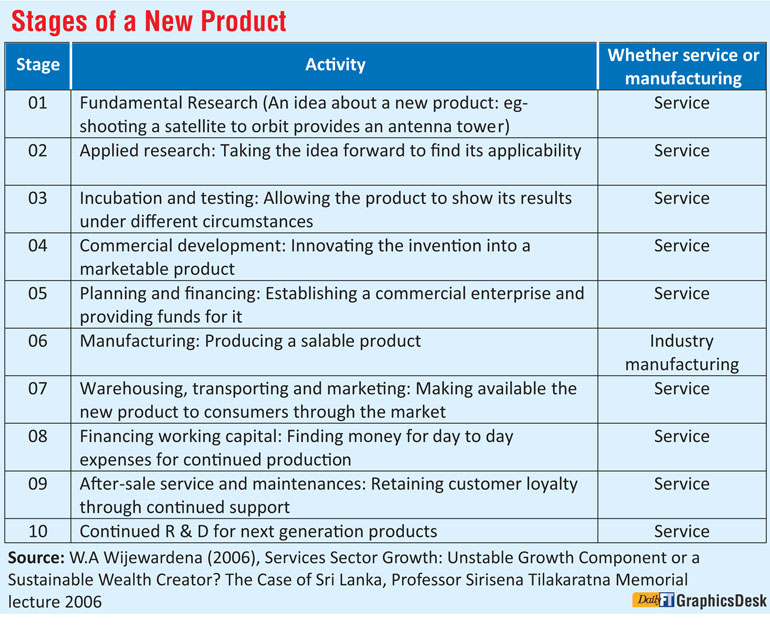
    Services are also important for economies that produce visible goods for use by their own citizens as well as by those outside. This could be easily gauged by breaking a manufactured product into its different stages as given in the table.

    Nine out of ten stages of a visible product constitute services

    A manufactured product first starts as an ‘idea’ in the mind of a visionary called fundamental or basic research. Sir Arthur C. Clarke’s visionary prediction in 1946 that a satellite shot into the orbit can function as an antenna receiving and transmitting radio signals is such an idea.

    These basic ideas are then carried forward by scientists and engineers through what is known as ‘applied research’. Once such applied research produces a visible product, it is tested for reliability and allowed to go through an incubation period. Then, it is commercially developed, financing arranged and manufactured in a factory that comes into being through an entrepreneurial arrangement.

    It then requires working capital financing, warehousing, marketing, distributing, and making available to final consumers through sales. Once it is sold, the consumers have to be looked after through ‘after-sale services’ for maintenance and trouble-shooting.

    Since a particular manufactured product can become obsolete pretty soon, it is necessary to engage in research and development for producing the next generation products. Every manufactured product has to go through these different stages and, of them, all represent services except the actual manufacturing of the product in a factory arrangement.

    Though services are discounted by anti-services groups, they are essential components of producing visible goods. In today’s globalised economy, fast and rapid transportation, advancements in information and communication technology and collaboration among services personnel located in far away different countries have enabled the global economy to ‘unbundle’ these different stages and get the best services from the best experts in the field living throughout the globe.

    Importance of joining the global supply chains

    Hence, in today’s globalised economy where production stages have been unbundled, no nation or a producer can claim ownership to a product, though they may carry the tag that they have been manufactured in a certain country.

    A good example is iPhone or iPad of which research has come from California and Israel, sub components from South Korea, Taiwan, Japan, Malaysia, Singapore and Thailand and final assembly done in the Foxconn Factory owned by Taiwanese and located in China. Hence, the production tag that it is made in China is a misnomer. Economists call the logistics involved in this type of global production ‘the supply chain’.

    In this connection, a very powerful supply chain has already been established in the Asian region called the Asian Supply Chain. Hence, no country today can remain isolated from the rest of the world as mere ‘islands of production’. Unless they jump onto the bandwagon of the supply chain already developed in the region, they cannot think of expanding their economies on a sustainable basis creating wealth and prosperity for their citizens.

    India has signed CEPAs or CECAs with important members of Asian supply chain

    India, having realised this important requirement, has signed a number of Comprehensive Economic Partnership Agreements or CEPAs and Comprehensive Economic Cooperation Agreements or CECAs with all the important countries in the Asian supply chain.

    It has signed CEPAs with South Korea, Japan and Singapore and CECA with Malaysia. It is now in the process of negotiating a CEPA with Thailand. The objective of India to do so is to get market access for visible goods and invisible services and join the Asian Supply Chain.

    It is important to note here that though India is a big economy, it has successfully signed CEPAs or CECAs with small economies like Singapore and Malaysia. No professionals in those countries have made any protests against such an asymmetrical marriage.

    Sri Lanka’s Colombo Dockyard has used unbundled services

    A good example of the use of unbundled supply chain in the recent past has been provided by Sri Lanka’s flagship shipbuilder, the Colombo Dockyard. As reported in its website (available at: http://www.cdl.lk/latest/colombo-do...s-the-biggest-vessel-ever-built-in-sri-lanka/ ; http://www.cdl.lk/latest/colombo-dockyard-delivers-the-largest-passenger-ship-mv-lagoons/ ), Colombo Dockyard has built two customised craft for India’s Lakshadweep Administration named ‘MV Corals’ and ‘MV Lagoons’. The vessels have been designed by Norway’s Global Maritime Brevik AS; the detailed engineering of the vessels has been designed by India’s Neilsoft Limited.

    For Dockyard to perform this marvel, technology has come from Japan, inputs from both Japan and South Korea and marketing by both Indian and Sri Lankan marketers. That arrangement has helped Sri Lanka’s professionals to acquire experience, skills and competence.

    This is a classic example of producing an engineering marvel by a creative and innovative Sri Lankan firm by using the facilities available in the unbundled global supply chain. Hence, if a Sri Lankan company is creative enough, it can always earn big dividends by jumping onto the bandwagon of India’s fledgling supply chain.

    Sri Lanka’s professionals are migrating in numbers for greener pastures

    There has been a fear expressed by many that signing a cooperation agreement such as ETCA with India will allow low quality unemployed Indian professionals produced in numbers by equally substandard Indian professional and educational institutions to invade Sri Lanka’s job markets. This argument has a fundamental flaw with respect to international migration of professionals.

    Professionals will move from one country to another in search of greener pastures; Sri Lanka by any standard is not such a ‘greener pasture’ and as such, migration of professionals is not into Sri Lanka but out of Sri Lanka.

    This has been demonstrated by the migration of engineers, accountants, IT specialists, physicians, scientists and academics in large numbers practically to all the countries in the world. Their destinations include the rich countries in North America, Europe and Australia and New Zealand; not so rich countries like the Middle East and poor countries in Africa and Oceania like Fiji Islands. There has not been a reverse migration from these countries to Sri Lanka.

    At present, about 100 Sri Lankan students graduate in engineering subjects from the Asian Institute of Technology or AIT in Thailand every year. After graduation, all these budding Sri Lankan engineers start looking for job opportunities in Thailand and, if they fail to secure jobs there, in the neighbouring countries. They have no wish to return to Sri Lanka upon graduation. The reason? Remunerations are several times higher in those greener pastures than in Sri Lanka.

    Hence, the fear that Indian IT specialists and similar professionals will flood Sri Lanka’s job markets is not in line with accepted economic laws. It is not the country that would hire such specialists; it is the business firms that would do so. A simple question which a probing mind should ask is why should a profit maximising business firm hire a substandard specialist from India knowing the low productivity of the hired specialist concerned? There is no reason unless there is stupidity in the decision making in such business firms.

    Professionals should improve their standards or face extinction

    Hence, even if migration of natural persons is included in the proposed ETCA, there is no threat to Sri Lanka’s professionals from India. But there is a threat to Sri Lankan professionals in all the fields including those in the medical field if they do not upgrade their standards in a continuing learning program.

    For anyone to provide his professional service to another country, he need not locate himself in that country today. Advanced ICT has enabled him to do so from wherever he is located in the globe.

    This opportunity has already been exploited in a big way by Indians who have started giving tuition to students in North America over the internet, as reported by Thomas L Friedman in his ‘The World is Flat’.

    Sri Lanka’s professionals who do not improve themselves in line with the changing global environment are likely to lose their privileges and facilities in an unbundled global economy whether there is ETCA or not.

    (W.A. Wijewardena, a former Deputy Governor of the Central Bank of Sri Lanka, can be reached at [email protected])
    See more at: http://www.ft.lk/article/527941/Man...bundling-opportunities-of-services-under-ETCA
     

    pavithra_uk

    Well-known member
  • Oct 6, 2009
    53,552
    22,250
    113
    Gotland
    මේක හරියට මහින්දගේ කාලේ මහින්ද අබේසුන්දරගේ විමසුම වගේ නේ ඕයි
     

    anbawi

    Junior member
  • Aug 12, 2013
    62
    5
    8
    CEPA goda hithin karath nam Lankawata godak wasi ganna puluwan. But ape politicco sure nethi nisa monawa weida danne ne.