


මහින්දගේ අභිරහස් ගමන
Columns - Political ColumnQuestions galore over MR’s sudden visit to US
To most, including those in the top echelons of the government and the Colombo-based diplomatic community, perhaps with one or two exceptions, they were caught by complete surprise. Hours later, telephone lines buzzed with the question - where was President Rajapaksa headed? In a country where rumour takes over when reality is obscure, there were many theories.
Normally, when a head of state or government embarks on an overseas visit, i.e. leaves the shores of his country, the citizenry are kept informed of his whereabouts and the purpose of his visit. They are told if he is on a state visit, a private visit or a semi-official visit as the case may be. Of late, especially during the tenure of former President Chandrika Kumaratunga these niceties were not observed. They were often put frivolously on 'security grounds', but what excuse is there now.
Adding to the guessing game was the fact that Rajapaksa had no plans for overseas travel this week. He had just cut short a visit to the Jaffna peninsula on Monday where he attended some public ceremonies including a visit to the Nallur Hindu kovil and Nagadeepa to attend the funeral of Ranjit Senanayake, father of UPFA MP Vasantha in Colombo. On Wednesday evening, at 5 p.m. he was scheduled to meet one of Pakistan's most powerful men, Army Commander General Ashfaq Kayani. The Islamic nation's 14th Army Commander, he succeeded General Pervaiz Musharaff. He rose to the highest office after joining the Army as a soldier and hails from Jhelum in Punjab - known for its only product, soldiers. The reputed General has been responsible many a time for personally expediting military requirements to Sri Lanka when security forces fought Tiger (LTTE) guerrillas.
Prime Minister D.M. Jayaratne had to stand in for President Rajapaksa during a courtesy call. On the last occasion, when the President of Pakistan Asif Ali Zardari was on an official visit to Sri Lanka, Rajapaksa took off to Britain before the Pakistani leader had departed from Colombo. This was for the now infamous non-address to the Oxford Union, which was scuttled by pro-LTTE protestors.
It was hours later on Thursday that it became known that Rajapaksa and his entourage were headed for the United States. Accompanying him were External Affairs Minister G.L. Peiris, Presidential Secretary Lalith Weeratunge and the official photographer. The security contingent to accompany him were made up of only Police personnel assigned to the Presidential Security Division (PSD) and headed by Deputy Inspector General (DIG) S.M. Wickremesinghe. The absence of Army officers, it appeared, was to avoid any controversy this time amidst allegations of 'war crimes' by western nations. Presidential spokesperson Bandula Jayasekera told media, after Rajapaksa had left and upon inquiry by the media, that the visit was "private" but did not elaborate.
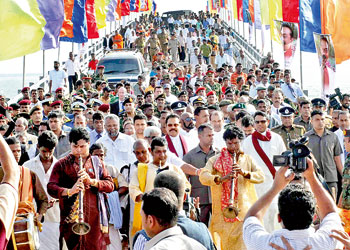 President Rajapaksa inaugurated the Sangupiddy Bridge in Jaffna with all pomp and ceremony on Sunday, January 16, and thereafter left for the US. Pic by Sudath SilvaEven the customary debate in Parliament to extend the ongoing State of Emergency was advanced. This is to enable Rajapaksa to sign the proclamation before he left for the US. Usually the subject is taken up for discussion in the first week of every month. The opposition parties agreed at a meeting with the Speaker, Chamal Rajapaksa, to pass the Regulations and have a debate later.
Yet, many remained curious. If indeed the visit was 'private,' some argued why the Minister of External Affairs should accompany Rajapaksa. It is customary for a head of state, even on private visits, to have his minister responsible for the conduct of foreign policy beside him. More so, since the Sunday Times learnt that Rajapaksa has plans to interact with the Sri Lankan Diaspora during the eight-day visit. Other versions spoke of Rajapaksa having back-channel talks with intermediaries and were headed for US as a result - a claim that was hotly denied in diplomatic circles. There were also claims, unconfirmed of course, that a close relative in Houston was ill. One local web site claimed Rajapaksa had travelled to the US for astrological reasons.
Columns - Political ColumnQuestions galore over MR’s sudden visit to US
- No army officers in security contingent; but AI reacts fast by calling for investigation
- Vital Supreme Court ruling on Tuesday may make or break DNA and decide Fonseka's future
To most, including those in the top echelons of the government and the Colombo-based diplomatic community, perhaps with one or two exceptions, they were caught by complete surprise. Hours later, telephone lines buzzed with the question - where was President Rajapaksa headed? In a country where rumour takes over when reality is obscure, there were many theories.
Normally, when a head of state or government embarks on an overseas visit, i.e. leaves the shores of his country, the citizenry are kept informed of his whereabouts and the purpose of his visit. They are told if he is on a state visit, a private visit or a semi-official visit as the case may be. Of late, especially during the tenure of former President Chandrika Kumaratunga these niceties were not observed. They were often put frivolously on 'security grounds', but what excuse is there now.
Adding to the guessing game was the fact that Rajapaksa had no plans for overseas travel this week. He had just cut short a visit to the Jaffna peninsula on Monday where he attended some public ceremonies including a visit to the Nallur Hindu kovil and Nagadeepa to attend the funeral of Ranjit Senanayake, father of UPFA MP Vasantha in Colombo. On Wednesday evening, at 5 p.m. he was scheduled to meet one of Pakistan's most powerful men, Army Commander General Ashfaq Kayani. The Islamic nation's 14th Army Commander, he succeeded General Pervaiz Musharaff. He rose to the highest office after joining the Army as a soldier and hails from Jhelum in Punjab - known for its only product, soldiers. The reputed General has been responsible many a time for personally expediting military requirements to Sri Lanka when security forces fought Tiger (LTTE) guerrillas.
Prime Minister D.M. Jayaratne had to stand in for President Rajapaksa during a courtesy call. On the last occasion, when the President of Pakistan Asif Ali Zardari was on an official visit to Sri Lanka, Rajapaksa took off to Britain before the Pakistani leader had departed from Colombo. This was for the now infamous non-address to the Oxford Union, which was scuttled by pro-LTTE protestors.
It was hours later on Thursday that it became known that Rajapaksa and his entourage were headed for the United States. Accompanying him were External Affairs Minister G.L. Peiris, Presidential Secretary Lalith Weeratunge and the official photographer. The security contingent to accompany him were made up of only Police personnel assigned to the Presidential Security Division (PSD) and headed by Deputy Inspector General (DIG) S.M. Wickremesinghe. The absence of Army officers, it appeared, was to avoid any controversy this time amidst allegations of 'war crimes' by western nations. Presidential spokesperson Bandula Jayasekera told media, after Rajapaksa had left and upon inquiry by the media, that the visit was "private" but did not elaborate.
Yet, many remained curious. If indeed the visit was 'private,' some argued why the Minister of External Affairs should accompany Rajapaksa. It is customary for a head of state, even on private visits, to have his minister responsible for the conduct of foreign policy beside him. More so, since the Sunday Times learnt that Rajapaksa has plans to interact with the Sri Lankan Diaspora during the eight-day visit. Other versions spoke of Rajapaksa having back-channel talks with intermediaries and were headed for US as a result - a claim that was hotly denied in diplomatic circles. There were also claims, unconfirmed of course, that a close relative in Houston was ill. One local web site claimed Rajapaksa had travelled to the US for astrological reasons.


