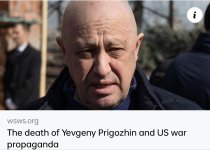
On August 23, the billionaire Russian oligarch Yevgeny Prigozhin died in a crash of his private jet under unexplained circumstances. The crash also killed a significant section of the senior leadership of the Wagner Group, the Russian private military contractor which Prigozhin headed, including its military commander, Dmitry Utkin.
Prigozhin’s airplane was leaving Moscow for St. Petersburg and had been underway for 30 minutes when it experienced a catastrophic failure resembling an explosion, causing the aircraft to plummet from the sky.
Formed in 2014, the Wagner Group has played a major role in Russian military and diplomatic operations, providing not only fighters for the wars in Syria and Ukraine, but also private military services for governments throughout Africa and the Middle East. Prigozhin and Wagner led the successful Russian effort to capture the Ukrainian city of Bakhmut, known in Russian as Artyomovsk, in May.
Two months before the crash, Prigozhin, previously a long-time ally of Vladimir Putin, had carried out a coup attempt of his Wagner forces, marching from Ukraine and occupying the city of Rostov-on-Don before wheeling toward Moscow and demanding the dismissal of the army leadership. Prigozhin’s coup attempt was the most open expression so far of ongoing, intense infighting within the Russian state apparatus and ruling class.
To start with the obvious, no one knows at this point why the plane crashed or who was responsible. There are as many possibilities as one would find in an Agatha Christie novel. Even the cause of the crash has not been established. However, given who Prigozhin was, it is reasonable to weigh one’s assumptions toward the conclusion that this was not an accident.
Assuming that the crash was the product of deliberate action, this then raises the more complex question of who was responsible. The US media and government immediately rushed to proclaim that Prigozhin was assassinated by Russian President Vladimir Putin. Following a tried and true method, an anonymous UK government official told the Wall Street Journal that the “most likely suspect” was the Russian government. Other major newspapers, including the New York Times and the Washington Post, proclaimed this supposition as an established fact.
US President Joe Biden declared that he was “not surprised” at the death of Prigozhin, adding, “There’s not much in Russia that Putin doesn’t have a hand in.”
Of course, this is not a possibility that can be discounted out of hand. It cannot be excluded that the crash that killed Prigozhin is the aftershock of what occurred in the attempted coup exactly two months ago.
But the question must be asked, if Putin sought to eliminate Prigozhin, why would he do it in this way?
While publicly denouncing the leaders of the coup as traitors, Putin engineered a rapprochement with Prigozhin, dropping criminal charges and appearing alongside him at public diplomatic functions.
Why kill him with a bomb on a plane, along with 10 other individuals, rather than simply arrest and prosecute him? If Putin was so concerned about the possibility of a second coup, why did he allow Prigozhin to move about freely between Moscow and St. Petersburg, and even leave the country and direct his forces in Africa, where they aided in the military coup in Niger?
Even considering the possibility that a Russian actor was involved, Putin would hardly be the only suspect. Prigozhin had many enemies, both in the regular military, whose leadership he had targeted in the coup attempt, and among the Russian billionaire oligarchs.
But if one asks the question, “who benefits?” there are many other non-Russian suspects, from Ukraine to the United States, or even France and Britain. Over the past several years, the Wagner Group’s operations in both Ukraine and Africa have seriously undermined the geopolitical interests of the imperialist powers.
------ Post added on Aug 29, 2023 at 4:14 PM
Prigozhin’s airplane was leaving Moscow for St. Petersburg and had been underway for 30 minutes when it experienced a catastrophic failure resembling an explosion, causing the aircraft to plummet from the sky.
Formed in 2014, the Wagner Group has played a major role in Russian military and diplomatic operations, providing not only fighters for the wars in Syria and Ukraine, but also private military services for governments throughout Africa and the Middle East. Prigozhin and Wagner led the successful Russian effort to capture the Ukrainian city of Bakhmut, known in Russian as Artyomovsk, in May.
Two months before the crash, Prigozhin, previously a long-time ally of Vladimir Putin, had carried out a coup attempt of his Wagner forces, marching from Ukraine and occupying the city of Rostov-on-Don before wheeling toward Moscow and demanding the dismissal of the army leadership. Prigozhin’s coup attempt was the most open expression so far of ongoing, intense infighting within the Russian state apparatus and ruling class.
To start with the obvious, no one knows at this point why the plane crashed or who was responsible. There are as many possibilities as one would find in an Agatha Christie novel. Even the cause of the crash has not been established. However, given who Prigozhin was, it is reasonable to weigh one’s assumptions toward the conclusion that this was not an accident.
Assuming that the crash was the product of deliberate action, this then raises the more complex question of who was responsible. The US media and government immediately rushed to proclaim that Prigozhin was assassinated by Russian President Vladimir Putin. Following a tried and true method, an anonymous UK government official told the Wall Street Journal that the “most likely suspect” was the Russian government. Other major newspapers, including the New York Times and the Washington Post, proclaimed this supposition as an established fact.
US President Joe Biden declared that he was “not surprised” at the death of Prigozhin, adding, “There’s not much in Russia that Putin doesn’t have a hand in.”
Of course, this is not a possibility that can be discounted out of hand. It cannot be excluded that the crash that killed Prigozhin is the aftershock of what occurred in the attempted coup exactly two months ago.
But the question must be asked, if Putin sought to eliminate Prigozhin, why would he do it in this way?
While publicly denouncing the leaders of the coup as traitors, Putin engineered a rapprochement with Prigozhin, dropping criminal charges and appearing alongside him at public diplomatic functions.
Why kill him with a bomb on a plane, along with 10 other individuals, rather than simply arrest and prosecute him? If Putin was so concerned about the possibility of a second coup, why did he allow Prigozhin to move about freely between Moscow and St. Petersburg, and even leave the country and direct his forces in Africa, where they aided in the military coup in Niger?
Even considering the possibility that a Russian actor was involved, Putin would hardly be the only suspect. Prigozhin had many enemies, both in the regular military, whose leadership he had targeted in the coup attempt, and among the Russian billionaire oligarchs.
But if one asks the question, “who benefits?” there are many other non-Russian suspects, from Ukraine to the United States, or even France and Britain. Over the past several years, the Wagner Group’s operations in both Ukraine and Africa have seriously undermined the geopolitical interests of the imperialist powers.
------ Post added on Aug 29, 2023 at 4:14 PM
 The death of Yevgeny Prigozhin and US war propaganda
 Image
Image