


All eyes on Betelgeuse: The astronomers used the Weihai Echelle Spectrograph (WES) on the 1m telescope at Weihai Observatory, Shandong University, China to observe Betelgeuse in early 2020. (Courtesy: Shandong University)
Early last year, the astronomy world was abuzz with speculation that Betelgeuse, a red giant star in the constellation Orion, might be about to go nova. This speculation was prompted by observations that Betelgeuse, which is normally one of the brightest stars in the sky, had dropped from magnitude +0.5 down to a mere +1.64 in a matter of months – something that could have been the precursor to a supernova of a magnitude not witnessed on Earth since the creation of the Crab Nebula in 1054.
As fun as that speculation was (and we indulged in a bit of it ourselves), the real explanation was always likely to be more mundane – and so it proved. By March 2020, Betelgeuse’s dimming had gone into reverse. Ironically, the star got back to normal just as life here on Earth was going haywire.
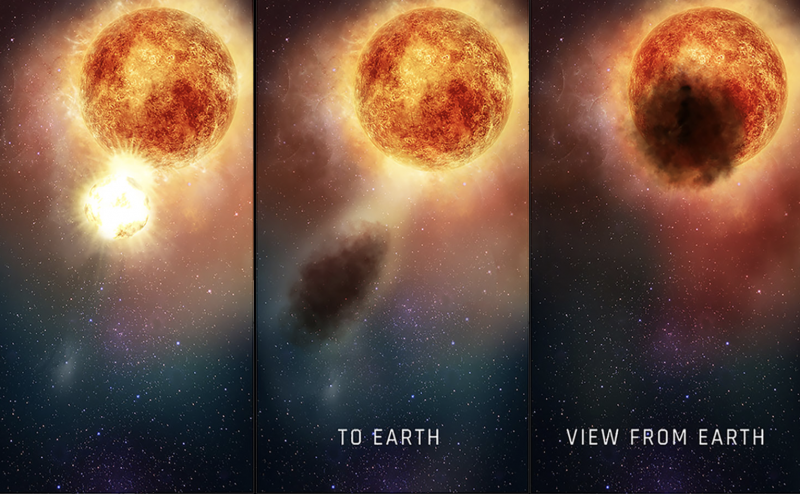

In June 2021, we got the first detailed explanation of what was going on. In a study published in Nature, Miguel Montargès and colleagues used observations from the SPHERE instrument on the Very Large Telescope in Chile to show that Betelgeuse’s dimming was confined to its southern hemisphere. According to the group’s simulations, this localized dimming occurred because a cool patch that appeared in Betelgeuse’s outer layer caused a dust clump to form in the vicinity of the star – a neat combination of two non-supernova-based speculations put forward to explain the star’s anomalous dip in output.
Now, the second group of astronomers has produced an independent study that both corroborates that result and adds to it. This group, led by Sofya Alexeeva and Gang Zhao of the Chinese Academy of Science Key Laboratory of Optical Astronomy in Beijing, used the Weihai Observatory at Shandong University to obtain detailed spectra of Betelgeuse on four nights in early 2020.

These spectra show that while the star’s effective temperature dropped by at least 170 K during its dimming episode, the chemical abundances of various indicator elements (including carbon, nitrogen and oxygen as well as metals like titanium, iron and strontium) remained stable over time once temperature variations were taken into consideration. This, the astronomers say, supports the theory that the dimming of Betelgeuse was caused by a dark spot emerging on the star’s surface, not by a dust cloud that happened to pass between Betelgeuse and Earth or by a change in the way the star pulses.
I suspect this latest study, which appears in Nature Communications, won’t be quite the last word on the subject. Apart from anything else, the explanation “Betelgeuse got dimmer because a dark spot appeared on its surface” is just begging for a follow-up: okay, so what caused the dark spot? Still, it’s nice to see that the answers to some complex scientific questions are within our grasp – even when the objects in question are hundreds of light-years away.
Source: physicsworld.com
What is Betelgeuse
Betelgeuse, also called Alpha Orionis, is the second brightest star in the constellation Orion, marking the eastern shoulder of the hunter. Its name is derived from the Arabic word bat al-jawzāʾ, which means “the giant’s shoulder.” Betelgeuse is one of the most luminous stars in the night sky. It is a variable star and usually has an apparent magnitude of about 0.6. However, in late 2019 it began dimming to an apparent magnitude of 1.6 by early 2020; it returned to its original brightness later that year. This “Great Dimming” was caused by a giant ejection of gas that condensed into dust when it cooled. Betelgeuse is easily discernible to even the casual observer, not only because of its brightness and position in the brilliant Orion but also because of its deep reddish colour. The star is approximately 724 light-years from Earth.
Betelgeuse, a red supergiant star roughly 950 times as large as the Sun, is one of the largest stars known. For comparison, the diameter of Mars’s orbit around the Sun is 328 times the Sun’s diameter. Infrared studies from spacecraft have revealed that Betelgeuse is surrounded by immense shells of material evidently shed by the star during episodes of mass loss over the past 100,000 years. The largest of these shells has a radius of nearly 7.5 light-years.


