


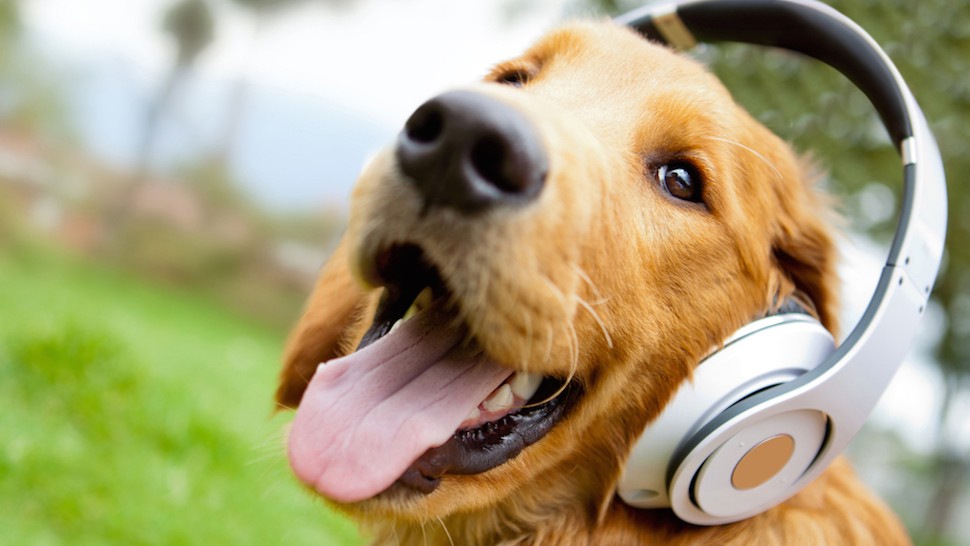
Dogs may appear to have selective hearing when it comes to commands but research suggests they are paying attention to human chit-chat. Researchers – who arranged for headphone-wearing dogs to listen to excerpts from the novella The Little Prince – revealed the brains of our canine companions can tell the difference between speech and non-speech when listening to human voices, and show different responses to speech in an unfamiliar language.
The team said the findings supported other studies that suggest animals may share some human skills. “Our capacities to process speech and languages are not necessarily unique in all the ways we like to think they are,” said Dr. Attila Andics, senior author of the study at Eötvös Loránd University in Hungary. The research involved 18 dogs of various ages and breeds that were trained to lie in an MRI scanner without restraint or sedation, but with headphones on. They were then played recordings either of humans reading excerpts from The Little Prince by Antoine De Saint-Exupéry or those same recordings cut up into small pieces and put back together in a different order so it sounded unnatural.
The results, published in the journal NeuroImage, reveal the dogs’ brains showed a different activity pattern in the primary auditory cortex for speech compared with non-speech, with the findings similar regardless of whether the language used – Hungarian or Spanish – was familiar. Curiously, the longer the dog’s head was, the better their brain could distinguish speech from non-speech.

The team also found the activity pattern was stronger for non-speech. “In humans, you typically see the stronger response to the speech,” Andics told the Guardian, adding it appears a different mechanism is at play in dogs and they are not “tuned in” to speech. “Probably what they detect is that the normal, natural speech sounds natural. And the other one sounds surprising, strange, not the typical pattern we hear,” he said. The research also revealed familiar and unfamiliar languages gave rise to different responses in the secondary auditory cortex and precruciate gyrus – but only for speech. That was important, said Andics, as it suggested the ability to distinguish between languages was not simply down to the speakers being different.
Instead, the team said, the differences seen between languages for speech are probably down to exposure to the familiar language and a sensitivity to language-specific regularities. “This is also supported by the observation that older dogs show the stronger differentiation between the two languages,” said Andics. He said it made sense to explore the response to human speech in dogs since they shared our environment. But questions remained.
“Whether this is something that only dog brains can do or not, or whether dogs indeed became better at detecting speech as a result of certain brain changes during these tens of thousands of years of domestication, we are not sure,” he said. Sophie Scott, professor of cognitive neuroscience at University College London, said she welcomed the research. “[It is a] very nice demonstration of just how much dogs are listening to our voices and how much information they’re pulling out, even if that is not necessarily speech that is directed to them or containing words they might recognize,” she said.
“Almost everything that you can find about human speech and human language and you say, ‘ah this is unique to humans’, you find an animal somewhere that can do it.”
Source: theguardian.com


