10 amazing Rainbows
Classic Rainbows


Most everyone has seen a classic, garden-variety rainbow – sometimes in their gardens while watering their plants with a misting spray.
Natural rainbows are made up of 6 colors: red, orange, yellow, green, blue and violet. The intensity of each color may vary due to atmospheric conditions and the time of day (more on that later).
Circular Rainbows


The rainbows most of see are actually arcs of perfect circles (with radii of exactly 42 degrees, according to Descartes), though viewing a complete rainbow is difficult as the ground has a habit of getting in the way.

The advent of powered flight and aerial photography has enabled the magnificence of circular rainbows to be revealed to an awestruck public. Of course, if an airplane isn’t available a really high mountain will do.
Secondary Rainbows


Primary rainbows are often accompanied by secondary rainbows that are usually thinner and dimmer than the main rainbow. Here’s a bit of trivia that may come in handy at parties or around the water cooler: the area between primary and secondary rainbows that appears darker than the surrounding sky is called “Alexander’s Band”.

Secondary rainbows are remarkable for one particular characteristic: they display the spectrum in reverse order from that of a primary rainbow. It’s not something most people are familiar with, as is seen in the photoshop rendering above. Though sketched from the artist’s memory of an actual event, the repeated structure of both rainbows shows that it’s not an accurate portrayal.
Red Rainbows

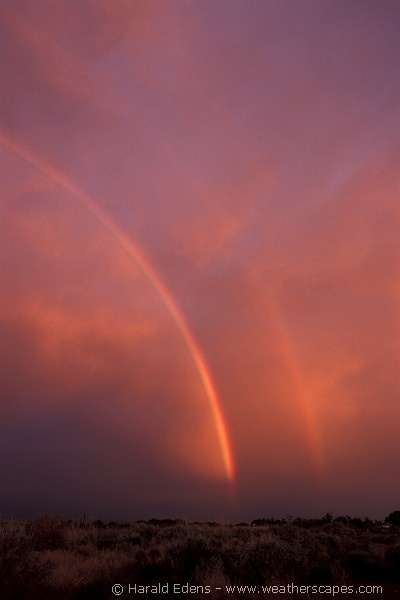
Red rainbows are usually seen at sunrise or sunset when the thickness of the earth’s atmosphere filters out blue light leaving more red or orange light for water droplets to reflect and refract. The result is a rainbow with the more reddish end of the spectrum greatly enhanced.
Sundogs & Moondogs


Sundogs are not rainbows per se, but share many of their visible attributes. Most commonly seen low in the sky on a bright winter’s day, sundogs are created when sunlight shines through ice crystals high in the atmosphere. Sundogs are red on the inside and violet on the outside with the rest of the spectrum crammed in between. The thicker the concentration of ice crystals in the air, the more defined the structure of a sundog and its associated arcs becomes.

Moonlight can be acted on by ice crystals to form – you guessed it – “moondogs”. The image above was taken in Antarctica where, due to frigid air temperatures and blowing snow, sundogs and moondogs are extremely common.
Fogbows


Fogbows are much rarer than rainbows because certain narrow parameters must align to create them. For one, the light source must be behind the observer and low to the ground. Also, any fog to the rear of the observer must be very thin so that sunlight can shine through to the thicker fog in front.

Many fogbows display paler colors compared to rainbows and some are mainly white. This is due to the fog being composed of exceedingly fine water droplets.
Waterfall Rainbows


Waterfalls kick a constant stream of mist into the air and the atmospheric saturation goes on constantly, regardless of the weather. This makes waterfalls excellent photographic companions to rainbows! The above selection of images pairs some of the world’s most famous waterfalls with some equally stunning rainbows.
A variation of waterfall rainbows are “spray bows”, formed on sunny days when wind kicks up ocean or lake waves and the air becomes saturated with mist and moisture.
Fire Rainbows


Fire rainbows are not actually rainbows and have no connection with fires. The true name for this exquisitely beautiful optical effect is “circumhorizontal arc”.
The phenomenon can only be viewed under certain precise conditions: the cirrus clouds that act as prisms must be at least 20,000 feet high and the sun must strike them when it is at an elevation of 58 to 68 degrees. Fire rainbows are never seen at locations situated more than 55 degrees north or south.
Moonbows

Moonbows, like moondogs, are the lunar counterpart to rainbows. They’re also much more difficult to witness due to the requirement of a passing rainstorm and, ideally, a bright full moon unblocked by clouds.
In the spectacular image above, the photographer used a 30-second exposure at 4:34am in the morning, the moon being nearly full. The bright star under the moonbow is the orange supergiant Arcturus.
Unearthly Rainbows

Are rainbows strictly a terrestrial phenomenon? No reason why they should be – the laws of physics (and optics) are universal after all. So far, however, the only off-earth rainbows we’ve glimpsed have come as the result of wishful thinking or through the visionary illustrations of science fiction artists. Pity… wouldn’t it be cool if the Bay of Rainbows on the Moon (above, top of image) actually had rainbows?

A rainbow on Saturn? Not quite – what appears to be a rainbow on the brightest part of Saturn’s magnificent rings is merely an “artifact” of the Cassini spacecraft’s imaging system.

There is one place in the vicinity of Saturn where rainbows of the classic variety may be found, however, and that is on it’s largest moon, Titan. Observations have confirmed the existence of liquid in the form of methane rain and lakes on the cloudy, chilly moon though a methane rainbow might look a little different than the ones we know here on Earth. Someday, someone will be the first to see one!
(Content Source -webecoist.com)

Classic Rainbows


Most everyone has seen a classic, garden-variety rainbow – sometimes in their gardens while watering their plants with a misting spray.
Natural rainbows are made up of 6 colors: red, orange, yellow, green, blue and violet. The intensity of each color may vary due to atmospheric conditions and the time of day (more on that later).
Circular Rainbows


The rainbows most of see are actually arcs of perfect circles (with radii of exactly 42 degrees, according to Descartes), though viewing a complete rainbow is difficult as the ground has a habit of getting in the way.

The advent of powered flight and aerial photography has enabled the magnificence of circular rainbows to be revealed to an awestruck public. Of course, if an airplane isn’t available a really high mountain will do.
Secondary Rainbows


Primary rainbows are often accompanied by secondary rainbows that are usually thinner and dimmer than the main rainbow. Here’s a bit of trivia that may come in handy at parties or around the water cooler: the area between primary and secondary rainbows that appears darker than the surrounding sky is called “Alexander’s Band”.

Secondary rainbows are remarkable for one particular characteristic: they display the spectrum in reverse order from that of a primary rainbow. It’s not something most people are familiar with, as is seen in the photoshop rendering above. Though sketched from the artist’s memory of an actual event, the repeated structure of both rainbows shows that it’s not an accurate portrayal.
Red Rainbows

Red rainbows are usually seen at sunrise or sunset when the thickness of the earth’s atmosphere filters out blue light leaving more red or orange light for water droplets to reflect and refract. The result is a rainbow with the more reddish end of the spectrum greatly enhanced.
Sundogs & Moondogs


Sundogs are not rainbows per se, but share many of their visible attributes. Most commonly seen low in the sky on a bright winter’s day, sundogs are created when sunlight shines through ice crystals high in the atmosphere. Sundogs are red on the inside and violet on the outside with the rest of the spectrum crammed in between. The thicker the concentration of ice crystals in the air, the more defined the structure of a sundog and its associated arcs becomes.

Moonlight can be acted on by ice crystals to form – you guessed it – “moondogs”. The image above was taken in Antarctica where, due to frigid air temperatures and blowing snow, sundogs and moondogs are extremely common.
Fogbows


Fogbows are much rarer than rainbows because certain narrow parameters must align to create them. For one, the light source must be behind the observer and low to the ground. Also, any fog to the rear of the observer must be very thin so that sunlight can shine through to the thicker fog in front.

Many fogbows display paler colors compared to rainbows and some are mainly white. This is due to the fog being composed of exceedingly fine water droplets.
Waterfall Rainbows


Waterfalls kick a constant stream of mist into the air and the atmospheric saturation goes on constantly, regardless of the weather. This makes waterfalls excellent photographic companions to rainbows! The above selection of images pairs some of the world’s most famous waterfalls with some equally stunning rainbows.
A variation of waterfall rainbows are “spray bows”, formed on sunny days when wind kicks up ocean or lake waves and the air becomes saturated with mist and moisture.
Fire Rainbows


Fire rainbows are not actually rainbows and have no connection with fires. The true name for this exquisitely beautiful optical effect is “circumhorizontal arc”.
The phenomenon can only be viewed under certain precise conditions: the cirrus clouds that act as prisms must be at least 20,000 feet high and the sun must strike them when it is at an elevation of 58 to 68 degrees. Fire rainbows are never seen at locations situated more than 55 degrees north or south.
Moonbows

Moonbows, like moondogs, are the lunar counterpart to rainbows. They’re also much more difficult to witness due to the requirement of a passing rainstorm and, ideally, a bright full moon unblocked by clouds.
In the spectacular image above, the photographer used a 30-second exposure at 4:34am in the morning, the moon being nearly full. The bright star under the moonbow is the orange supergiant Arcturus.
Unearthly Rainbows

Are rainbows strictly a terrestrial phenomenon? No reason why they should be – the laws of physics (and optics) are universal after all. So far, however, the only off-earth rainbows we’ve glimpsed have come as the result of wishful thinking or through the visionary illustrations of science fiction artists. Pity… wouldn’t it be cool if the Bay of Rainbows on the Moon (above, top of image) actually had rainbows?

A rainbow on Saturn? Not quite – what appears to be a rainbow on the brightest part of Saturn’s magnificent rings is merely an “artifact” of the Cassini spacecraft’s imaging system.

There is one place in the vicinity of Saturn where rainbows of the classic variety may be found, however, and that is on it’s largest moon, Titan. Observations have confirmed the existence of liquid in the form of methane rain and lakes on the cloudy, chilly moon though a methane rainbow might look a little different than the ones we know here on Earth. Someday, someone will be the first to see one!
(Content Source -webecoist.com)