


The emergence of dysautonomia after Covid infection is becoming quite prevalent. 
Dysautonomia is a general term for a group of disorders that share a common problem – that is, an autonomic nervous system (ANS) that doesn’t function as it should. The ANS is the part of the nervous system that controls involuntary body functions (functions you don’t consciously control) like your heart rate, blood pressure, breathing, digestion, body and skin temperature, hormonal function, bladder function, sexual function and many other functions.
Some of the conditions caused by primary dysautonomia are:
Neurocardiogenic syncope (NCS): NCS is the most common form of dysautonomia. It can cause fainting spells that happen once or twice in your lifetime or multiple times every day. NCS is also called situational syncope or vasovagal syncope.
Postural orthostatic tachycardia syndrome (POTS): A disorder that causes problems with circulation (blood flow), POTS can cause your heart to beat too fast when you stand up. It can lead to fainting, chest pain and shortness of breath.
Familial dysautonomia (FD): People inherit this type of dysautonomia from their genetic relatives. It can cause decreased pain sensitivity, lack of eye tears and trouble regulating body temperature.
Multiple system atrophy (MSA): A life-threatening form of dysautonomia, multiple system atrophy develops in people over 40 years old. It can lead to heart rate issues, low blood pressure, erectile dysfunction and loss of bladder control.
Pure autonomic failure: People with this form of dysautonomia experience a fall in blood pressure upon standing and have symptoms including dizziness, fainting, visual problems, chest pain and tiredness. Symptoms are sometimes relieved by lying down or sitting.
Long Covid lasting say over a month is referred to as PASC (Post-Acute Sequelae of COVID 19) and is highly associated with POTS. (Postural orthostatic tachycardia syndrome). A recent study shows that it's not not always connected to the severity of acute COVID-19. They say -
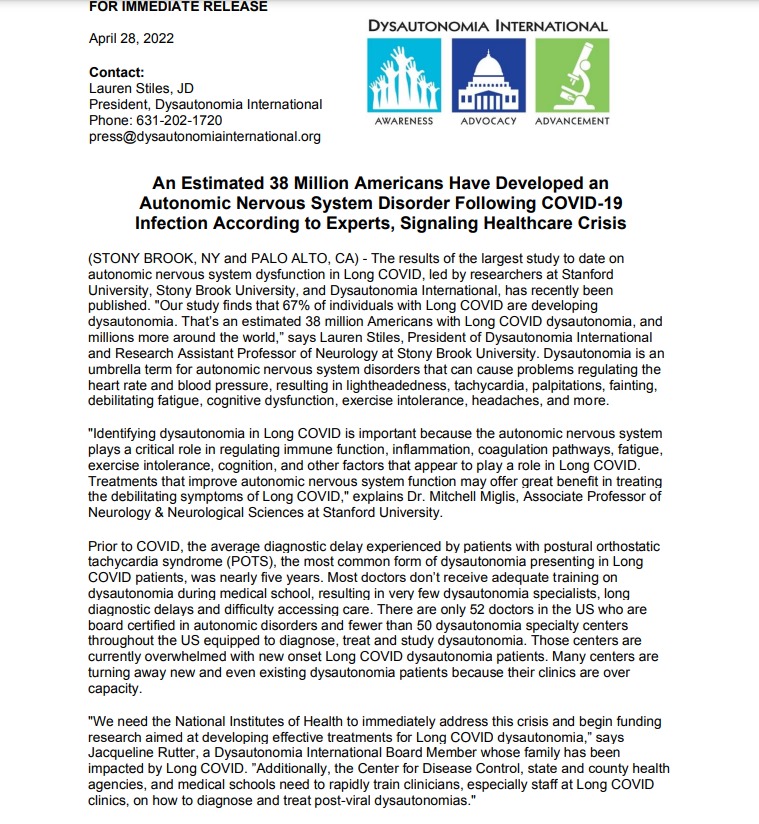
"Our study finds that 67% of individuals with Long COVID are developing dysautonomia. That’s an estimated 38 million Americans with Long COVID dysautonomia, and millions more around the world.”
Lauren Stiles, President of Dysautonomia International and Research Assistant Professor of Neurology at Stony Brook University.
"Identifying dysautonomia in Long COVID is important because the autonomic nervous system plays a critical role in regulating immune function, inflammation, coagulation pathways, fatigue, exercise intolerance, cognition, and other factors that appear to play a role in Long COVID. Treatments that improve autonomic nervous system function may offer great benefit in treating the debilitating symptoms of Long COVID."
Dr. Mitchell Miglis, Associate Professor of Neurology & Neurological Sciences at Stanford University.
Here's a Press Release...
Dysautonomia is a general term for a group of disorders that share a common problem – that is, an autonomic nervous system (ANS) that doesn’t function as it should. The ANS is the part of the nervous system that controls involuntary body functions (functions you don’t consciously control) like your heart rate, blood pressure, breathing, digestion, body and skin temperature, hormonal function, bladder function, sexual function and many other functions.
Some of the conditions caused by primary dysautonomia are:
Neurocardiogenic syncope (NCS): NCS is the most common form of dysautonomia. It can cause fainting spells that happen once or twice in your lifetime or multiple times every day. NCS is also called situational syncope or vasovagal syncope.
Postural orthostatic tachycardia syndrome (POTS): A disorder that causes problems with circulation (blood flow), POTS can cause your heart to beat too fast when you stand up. It can lead to fainting, chest pain and shortness of breath.
Familial dysautonomia (FD): People inherit this type of dysautonomia from their genetic relatives. It can cause decreased pain sensitivity, lack of eye tears and trouble regulating body temperature.
Multiple system atrophy (MSA): A life-threatening form of dysautonomia, multiple system atrophy develops in people over 40 years old. It can lead to heart rate issues, low blood pressure, erectile dysfunction and loss of bladder control.
Pure autonomic failure: People with this form of dysautonomia experience a fall in blood pressure upon standing and have symptoms including dizziness, fainting, visual problems, chest pain and tiredness. Symptoms are sometimes relieved by lying down or sitting.
Long Covid lasting say over a month is referred to as PASC (Post-Acute Sequelae of COVID 19) and is highly associated with POTS. (Postural orthostatic tachycardia syndrome). A recent study shows that it's not not always connected to the severity of acute COVID-19. They say -
"Our study finds that 67% of individuals with Long COVID are developing dysautonomia. That’s an estimated 38 million Americans with Long COVID dysautonomia, and millions more around the world.”
Lauren Stiles, President of Dysautonomia International and Research Assistant Professor of Neurology at Stony Brook University.
"Identifying dysautonomia in Long COVID is important because the autonomic nervous system plays a critical role in regulating immune function, inflammation, coagulation pathways, fatigue, exercise intolerance, cognition, and other factors that appear to play a role in Long COVID. Treatments that improve autonomic nervous system function may offer great benefit in treating the debilitating symptoms of Long COVID."
Dr. Mitchell Miglis, Associate Professor of Neurology & Neurological Sciences at Stanford University.
Here's a Press Release...


