


Hand Grenades

36M Mills bomb
A hand grenade is an anti-personnel weapon that explodes a short time after release. The French military term grenade probably comes from the shape of the pomegranate fruit, which is also called grenade in French.
Grenadiers were originally soldiers who specialized in throwing grenades. Today, some grenades are fired from rifles or from purpose-designed grenade launchers.
The first grenades appeared in the Byzantine Empire, not long after the reign of Leo III (717-741). Byzantine soldiers learned that Greek fire, a Byzantine invention of the previous century, could not only be thrown by flamethrowers at the enemy, but also in stone and ceramic jars. Later, glass containers were employed. Byzantine hand grenades with Greek fire in the 10th to 12th centuries are on display in the National Museum at Athens. The use of Greek fire, or rather variants thereof, spread to Muslim armies in the Near East, from where it reached China by the 10th century.
Some medieval petards were small enough to be employed against enemy troops and be considered as primitive hand grenades.

Hand grenades filled with Greek fire; surrounded by caltrops. (10th-12th c. National Historical Museum, Athens, Greece.)
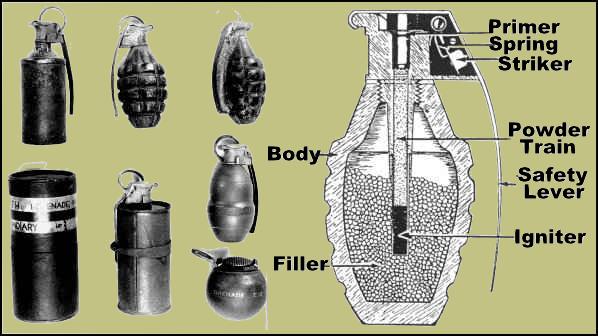
Most grenades explode, projecting shrapnel, i.e. pieces of the casing, serrated wire, or an incendiary material. Some, such as smoke grenades, merely burn, releasing smoke for masking, marking, or signaling. Grenades are filled with explosive or chemical filler and have a hole into which a fuse is inserted. In modern hand grenades, the fuse is lit by an internal device rather than an external flame.
Hand grenades have five characteristics
1. Their employment range is short.
2. Their effective kill radius is small, roughly 5 meters.
3. Their effective casualty radius is large. Approximately 15 meters.
4. Their delay element permits safe throwing;
5. Their hard shell enables grenades to ricochet off hard
surfaces, like walls, before detonating.
Types of Grenades
Fragmentation
The fragmentation grenade (commonly known as a frag) is an anti-personnel weapon that is designed to disperse shrapnel upon exploding. The body is made of hard plastic or steel. Flechettes, notched wire, ball bearings or the case itself provide the fragments. When the word grenade is used without specification, and context does not suggest otherwise, it is generally assumed to refer to a fragmentation grenade.
These grenades were sometimes classed as defensive grenades because the effective casualty radius of some matched or exceeded the distance they could be thrown, thus necessitating them being thrown from behind cover. The Mills bomb or F1 grenade are examples of defensive grenades where the 30–45 m casualty radius matched or exceeded the 30 m that a grenade could reasonably be thrown.
Modern fragmentation grenades such as the United States M67 grenade have a wounding radius of 15 m (half that of older style grenades which may still be encountered) and can be thrown about 40 m. Fragments may travel more than 200m.

MK2 Frag
Concussion
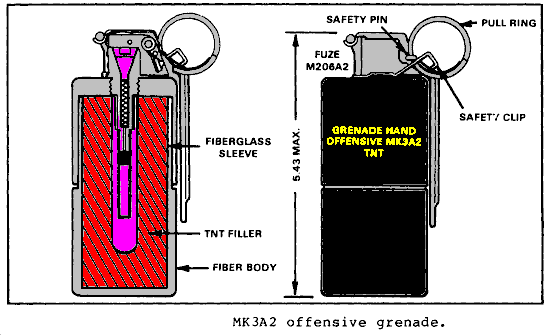
The concussion grenade is an anti-personnel device that is designed to damage its target with explosive power alone. Compared to fragmentation grenades, the explosive filler is usually of a greater weight and volume. The case is far thinner and is designed to fragment as little as possible. The overpressure produced by this grenade when used in enclosed areas is greater than that produced by the fragmentation grenade. Therefore, it is especially effective in enclosed areas.
These grenades are usually classed as offensive weapons because the effective casualty radius is smaller than the distance it can be thrown. The concussion effect is more lethal than fragmentation, but its power drops more rapidly with range as well.
The US MK3A2 concussion grenade is filled with TNT and has a body made of tarred cardboard.
The term concussion is often erroneously applied to stun grenades. This is not descriptive of the effects caused by the grenade. The term concussion is used because the grenade relies on its explosive power to create casualties.

MK3A2 Grenade
Percussion
A percussion grenade detonates upon impact with the target. Classic examples of percussion grenades are the British Gammon bomb and No 69 grenade. Timed fuse grenades are generally preferred to hand-thrown percussion grenades because their fuzing mechanisms are safer and more robust than those used in percussion grenades. Some percussion grenades have a conventional pyrotechnic fuse fitted as a backup detonation device.

French Percussion Grenade
Smoke Grenade
Smoke grenades are used as ground-to-ground or ground-to-air signaling devices, target or landing zone marking devices, and screening devices for unit movement. The body is a sheet-steel cylinder with emission holes in the top and bottom. These allow the smoke to be released when the grenade is ignited. Two main types exist, colored smoke (for signaling) and screening smoke. In colored smoke grenades, the filler consists of 250 to 350 grams of colored smoke mixture (mostly potassium chlorate, lactose and a dye). Screening smoke grenades usually contain HC (hexachloroethane/zinc) smoke mixture or TA (terephthalic acid) smoke mixture. HC smoke is harmful to breathe, since it contains hydrochloric acid. Whilst not intended as a primary effect, these grenades can generate enough heat to scald or burn unprotected skin and the spent casing should not be touched until it has cooled.


Stun Grenade
A stun grenade, also known as a flashbang, is a nonlethal weapon. The first devices like this were created in the 1960s at the order of the British Special Air Service as an incapacitant.
These grenades are used to temporally neutralize the combat effectiveness of enemies by usually disorienting their senses.
The flash of light momentarily activates all light sensitive cells in the eye, making vision impossible for approximately five seconds until the eye restores itself to its normal, unstimulated state. The incredibly loud blast produced by the grenade adds to its incapacitating properties by disturbing the fluid in the ear.
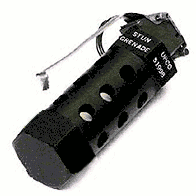
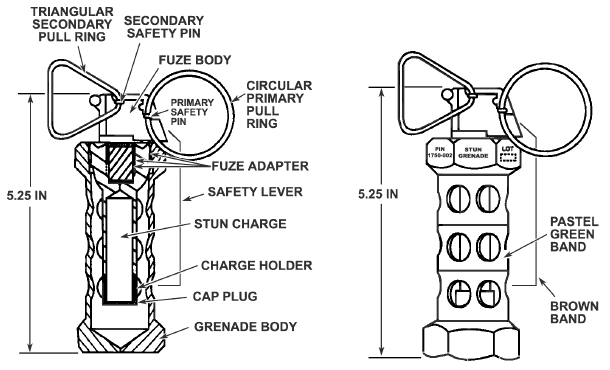
When detonated, the fuse/grenade body assembly remains intact. The body is a tube with holes along the sides which allow an explosion of light and sound to be produced. This is done to avoid injury from shrapnel but it is still possible to be burned, and injuries resulting from the concussive blast of the detonation can occur, the heat created can ignite flammable materials such as fuel. The fires that occurred during the Iranian Embassy Siege in London were caused by stun grenades. The filler consists of about 4.5 grams of a pyrotechnic metal-oxidant mix of magnesium or aluminium and an oxidizer such as ammonium perchlorate or potassium perchlorate.
M84 Stun Grenade
Anti-tank Grenade
The first anti-tank grenades were improvised devices. The Germans were the first during World War One to come up with an improvised anti-tank grenade, taking their stick ("potato masher") grenade and taping three to two of the explosive heads less the sticks to one complete grenade. In combat, after arming, the grenade was thrown on top of the slowly advancing tank where the armor was thin.
During World War Two, various nations made improvised antitank grenades by putting a number of defensive high explosive grenades into a sandbag. Due to their weight, these were normally thrown from very close range or directly placed in vulnerable spots onto an enemy vehicle. Another method used by the British Home Guard in 1940 was to place dynamite or some other high explosive in a thick sock and cover the lower part with axle grease and then place the grease covered part in a suitable size tin can. The antitank sock was pulled out, the fuse lit and the sock thrown against the side of the tank turret, which it was hoped would stick and on explosion cause internal spalling of the armor plate, killing or injuring the tank crew inside. It is not known if this type of improvised anti-tank grenade was ever successfully employed in combat. By late 1940, the British had brought into production a purpose-built adhesive anti-tank grenade - known as the "Sticky bomb".
During World War II, when tanks overran entrenchments, hand grenades could be and were used by infantry as improvised anti-tank mines by placing or throwing them in the path of a tank in the hope of disabling a track. While this method was used in desperation, it usually proved more dangerous to the soldier on the ground than to the crew of the tank. During the Italian-Ethiopian War, according to the Italians, the Ethiopians used sections of railroad rail pushed between the tank's tracks and running wheels.
Purpose-designed anti-tank grenades invariably use the shaped charge principle to penetrate tank armor. In military terminology, warheads employing shape charges are referred to as HEAT warheads, meaning high explosive anti-tank. Because of the manner in which shaped charges function, the grenade has to hit the vehicle at an exact right angle for the effect to work most efficiently. This is achieved by the grenade deploying a small drogue parachute or fabric streamers after being thrown.


36M Mills bomb
A hand grenade is an anti-personnel weapon that explodes a short time after release. The French military term grenade probably comes from the shape of the pomegranate fruit, which is also called grenade in French.
Grenadiers were originally soldiers who specialized in throwing grenades. Today, some grenades are fired from rifles or from purpose-designed grenade launchers.
The first grenades appeared in the Byzantine Empire, not long after the reign of Leo III (717-741). Byzantine soldiers learned that Greek fire, a Byzantine invention of the previous century, could not only be thrown by flamethrowers at the enemy, but also in stone and ceramic jars. Later, glass containers were employed. Byzantine hand grenades with Greek fire in the 10th to 12th centuries are on display in the National Museum at Athens. The use of Greek fire, or rather variants thereof, spread to Muslim armies in the Near East, from where it reached China by the 10th century.
Some medieval petards were small enough to be employed against enemy troops and be considered as primitive hand grenades.

Hand grenades filled with Greek fire; surrounded by caltrops. (10th-12th c. National Historical Museum, Athens, Greece.)
Most grenades explode, projecting shrapnel, i.e. pieces of the casing, serrated wire, or an incendiary material. Some, such as smoke grenades, merely burn, releasing smoke for masking, marking, or signaling. Grenades are filled with explosive or chemical filler and have a hole into which a fuse is inserted. In modern hand grenades, the fuse is lit by an internal device rather than an external flame.
Hand grenades have five characteristics
1. Their employment range is short.
2. Their effective kill radius is small, roughly 5 meters.
3. Their effective casualty radius is large. Approximately 15 meters.
4. Their delay element permits safe throwing;
5. Their hard shell enables grenades to ricochet off hard
surfaces, like walls, before detonating.
Types of Grenades
Fragmentation
The fragmentation grenade (commonly known as a frag) is an anti-personnel weapon that is designed to disperse shrapnel upon exploding. The body is made of hard plastic or steel. Flechettes, notched wire, ball bearings or the case itself provide the fragments. When the word grenade is used without specification, and context does not suggest otherwise, it is generally assumed to refer to a fragmentation grenade.
These grenades were sometimes classed as defensive grenades because the effective casualty radius of some matched or exceeded the distance they could be thrown, thus necessitating them being thrown from behind cover. The Mills bomb or F1 grenade are examples of defensive grenades where the 30–45 m casualty radius matched or exceeded the 30 m that a grenade could reasonably be thrown.
Modern fragmentation grenades such as the United States M67 grenade have a wounding radius of 15 m (half that of older style grenades which may still be encountered) and can be thrown about 40 m. Fragments may travel more than 200m.

MK2 Frag
Concussion
The concussion grenade is an anti-personnel device that is designed to damage its target with explosive power alone. Compared to fragmentation grenades, the explosive filler is usually of a greater weight and volume. The case is far thinner and is designed to fragment as little as possible. The overpressure produced by this grenade when used in enclosed areas is greater than that produced by the fragmentation grenade. Therefore, it is especially effective in enclosed areas.
These grenades are usually classed as offensive weapons because the effective casualty radius is smaller than the distance it can be thrown. The concussion effect is more lethal than fragmentation, but its power drops more rapidly with range as well.
The US MK3A2 concussion grenade is filled with TNT and has a body made of tarred cardboard.
The term concussion is often erroneously applied to stun grenades. This is not descriptive of the effects caused by the grenade. The term concussion is used because the grenade relies on its explosive power to create casualties.

MK3A2 Grenade
Percussion
A percussion grenade detonates upon impact with the target. Classic examples of percussion grenades are the British Gammon bomb and No 69 grenade. Timed fuse grenades are generally preferred to hand-thrown percussion grenades because their fuzing mechanisms are safer and more robust than those used in percussion grenades. Some percussion grenades have a conventional pyrotechnic fuse fitted as a backup detonation device.

French Percussion Grenade
Smoke Grenade
Smoke grenades are used as ground-to-ground or ground-to-air signaling devices, target or landing zone marking devices, and screening devices for unit movement. The body is a sheet-steel cylinder with emission holes in the top and bottom. These allow the smoke to be released when the grenade is ignited. Two main types exist, colored smoke (for signaling) and screening smoke. In colored smoke grenades, the filler consists of 250 to 350 grams of colored smoke mixture (mostly potassium chlorate, lactose and a dye). Screening smoke grenades usually contain HC (hexachloroethane/zinc) smoke mixture or TA (terephthalic acid) smoke mixture. HC smoke is harmful to breathe, since it contains hydrochloric acid. Whilst not intended as a primary effect, these grenades can generate enough heat to scald or burn unprotected skin and the spent casing should not be touched until it has cooled.


Stun Grenade
A stun grenade, also known as a flashbang, is a nonlethal weapon. The first devices like this were created in the 1960s at the order of the British Special Air Service as an incapacitant.
These grenades are used to temporally neutralize the combat effectiveness of enemies by usually disorienting their senses.
The flash of light momentarily activates all light sensitive cells in the eye, making vision impossible for approximately five seconds until the eye restores itself to its normal, unstimulated state. The incredibly loud blast produced by the grenade adds to its incapacitating properties by disturbing the fluid in the ear.
When detonated, the fuse/grenade body assembly remains intact. The body is a tube with holes along the sides which allow an explosion of light and sound to be produced. This is done to avoid injury from shrapnel but it is still possible to be burned, and injuries resulting from the concussive blast of the detonation can occur, the heat created can ignite flammable materials such as fuel. The fires that occurred during the Iranian Embassy Siege in London were caused by stun grenades. The filler consists of about 4.5 grams of a pyrotechnic metal-oxidant mix of magnesium or aluminium and an oxidizer such as ammonium perchlorate or potassium perchlorate.
M84 Stun Grenade
Anti-tank Grenade
The first anti-tank grenades were improvised devices. The Germans were the first during World War One to come up with an improvised anti-tank grenade, taking their stick ("potato masher") grenade and taping three to two of the explosive heads less the sticks to one complete grenade. In combat, after arming, the grenade was thrown on top of the slowly advancing tank where the armor was thin.
During World War Two, various nations made improvised antitank grenades by putting a number of defensive high explosive grenades into a sandbag. Due to their weight, these were normally thrown from very close range or directly placed in vulnerable spots onto an enemy vehicle. Another method used by the British Home Guard in 1940 was to place dynamite or some other high explosive in a thick sock and cover the lower part with axle grease and then place the grease covered part in a suitable size tin can. The antitank sock was pulled out, the fuse lit and the sock thrown against the side of the tank turret, which it was hoped would stick and on explosion cause internal spalling of the armor plate, killing or injuring the tank crew inside. It is not known if this type of improvised anti-tank grenade was ever successfully employed in combat. By late 1940, the British had brought into production a purpose-built adhesive anti-tank grenade - known as the "Sticky bomb".
During World War II, when tanks overran entrenchments, hand grenades could be and were used by infantry as improvised anti-tank mines by placing or throwing them in the path of a tank in the hope of disabling a track. While this method was used in desperation, it usually proved more dangerous to the soldier on the ground than to the crew of the tank. During the Italian-Ethiopian War, according to the Italians, the Ethiopians used sections of railroad rail pushed between the tank's tracks and running wheels.
Purpose-designed anti-tank grenades invariably use the shaped charge principle to penetrate tank armor. In military terminology, warheads employing shape charges are referred to as HEAT warheads, meaning high explosive anti-tank. Because of the manner in which shaped charges function, the grenade has to hit the vehicle at an exact right angle for the effect to work most efficiently. This is achieved by the grenade deploying a small drogue parachute or fabric streamers after being thrown.


