


NVIDIA Launches GeForce RTX 3050 and RTX 3090 Ti
https://www.techpowerup.com/290525/nvidia-launches-geforce-rtx-3050-and-rtx-3090-ti

NVIDIA today launched the GeForce RTX 3050 desktop graphics card, positioned a notch below the RTX 3060. It is based on the same 8 nm "GA106" silicon as the RTX 3060, but with a third of its streaming multiprocessors (SMs) disabled. While the "GA106" physically has 3,840 CUDA cores, only 2,560 of them are enabled on the RTX 3050. The RTX 3060 doesn't max it out, either, featuring 3,584. Another key differentiator between the RTX 3050 and the RTX 3060 is memory. The new kid on the block features 8 GB of GDDR6 memory across a 128-bit wide memory bus, while the RTX 3060 has 12 GB of it across 192-bit.
The reference-spec sees the RTX 3050 GPU clock boost up to 1780 MHz. With a typical board power if 130 W, the card can make do with even a 6-pin PCIe connector, however, NVIDIA made 8-pin the standard. The typical use-case for the RTX 3050 would be 1080p gaming with RTX ray tracing enabled, but with DLSS also added to the mix. Without ray tracing, it should be able to handle AAA titles at 1080p with fairly high settings. Available from January 27, 2022, the RTX 3050 starts at $249.
The RTX 3090 Ti maxes out NVIDIA's largest "Ampere" GeForce silicon, codenamed "GA102." This means all 10,752 CUDA cores, 84 RT cores, 336 Tensor cores, are enabled. On closer look of the specs, you'll notice that the CUDA core count isn't that much higher than the 10.496 of the RTX 3090 to warrant the massive increase in power. It's because NVIDIA also upgraded the memory sub-system. While the memory amount is unchanged at 24 GB, the company is using faster 21 Gbps-rated GDDR6X memory chips, while the RTX 3090 uses 19.5 Gbps-rated ones. The third area of development, which we believe is the largest contributor to the power draw, is the GPU Boost frequency, which is now 1860 MHz, compared to 1695 MHz on the RTX 3090. NVIDIA is expected to launch the RTX 3090 Ti within January 2022, the company is yet to finalize pricing.
AMD Announces Radeon RX 6500 XT and Radeon RX 6400
https://www.techpowerup.com/290520/...and-radeon-rx-6400-graphics-cards-at-ces-2022

AMD today via its CES livestream announced a couple of new graphics cards to be added to its desktop Radeon lineup. The Radeon RX 6500 XT and RX 6400 slot in just below the already-released RX 6600 graphics card and its virtual MSRP of $329, and bring RDNA2 and ray tracing support to a much more affordable $199 MSRP. Both cards are manufactured in TSMC's 6 nm process, bringing about a reduction in die area and improved power consumption characteristics. According to AMD, these target high settings AAA and eSports gaming on 1080p resolution, and would be most interesting for gamers still packing a GeForce GTX 1650 or Radeon RX 470 graphics card (or lower performance options). This is also made possible on account of AMD's Fidelity FX Super Resolution (FSR) and the newly-announced RSR, with these image upscaling technologies severely increasing pure performance output of these relatively small discrete GPUs.
The RX 6500 XT with its $199 price tag has been confirmed for a January 19th release via AIB partner cards only (of which the company showed as many as 14 different models from a range of partners, which you can see after the break). For $199, the RX 6500 XT offers an exact halving of the RX 6600 XT, packing 16 RDNA2 CUs, 4 GB of GDDR6 RAM, a 2,610 MHz game clock, and a 2,815 MHz boosted clock, while drawing 107 W of power. The 4 GB memory pool may seem limiting, but may be a smart decision from AMD, effectively cutting off these cards from Ethereum mining workloads (these require 8 GB of VRAM). And 16 RDNA2 CUs gives us 1,024 shading units and only 16 RT cores: it's likely the card would run out of shader performance before it would be able to properly take advantage of a larger VRAM pool. No word yet on when should we expect the RX 6400.
AMD Socket AM5 "Raphael" Ryzen Processor
https://www.techpowerup.com/290505/amd-socket-am5-raphael-ryzen-processor-confirmed-for-h2-2022-launch
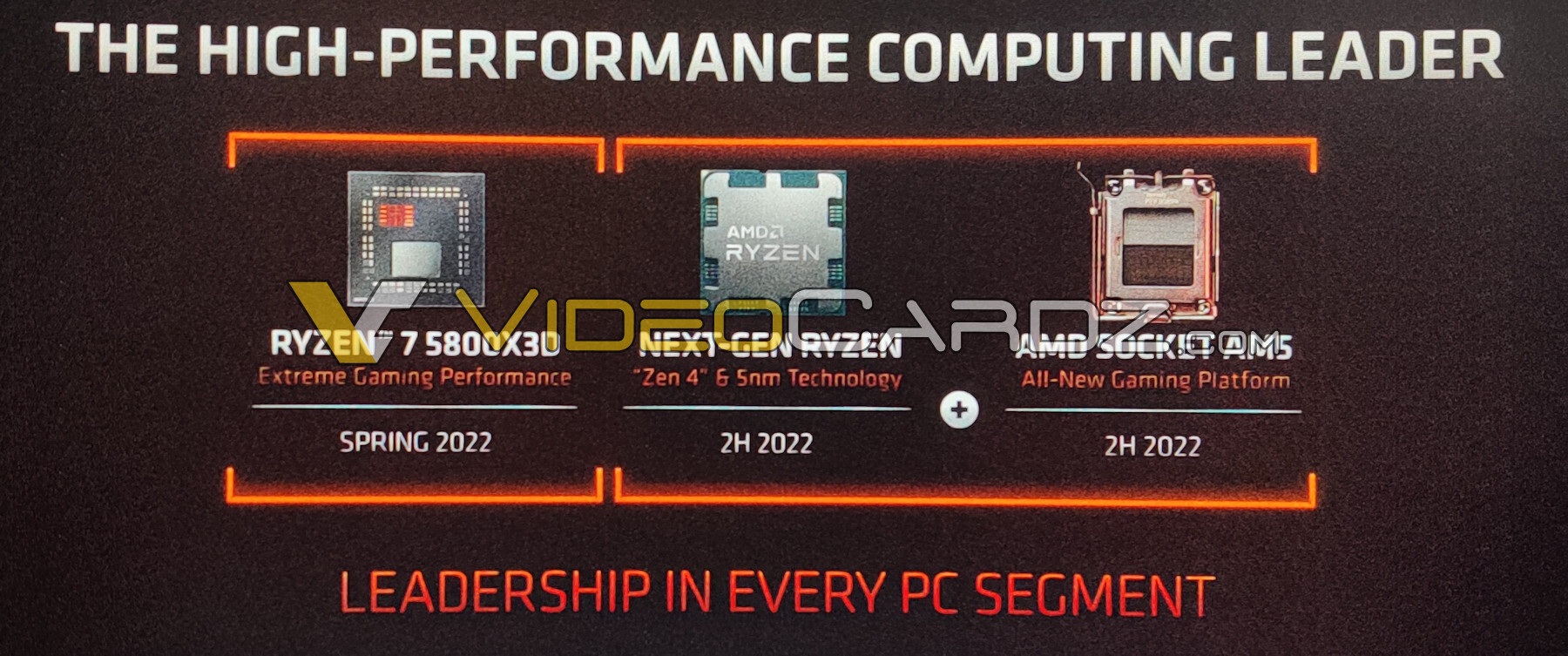
AMD's next-generation Ryzen "Raphael" processor could launch only in the second half of 2022, confirms a leaked company slide scored by VideoCardz. The slide points to a Ryzen 5000X3D series product-stack update within the 1H-2022. These are Socket AM4 processors that leverage the company's updated "Zen 3(+)" CPU core die (CCD), which features 64 MB of 3D Vertical cache memory in addition to 32 MB of L3. AMD claims that 3DV Cache technology significantly improves performance akin to a generational update (anywhere between 5% to 25% depending on the application). The company is targeting "Spring" 2022 for launch, which would put this around early-Q2.
The "Raphael" Socket AM5 processor is sure to catch much of the attention, as it's the company's true next-gen desktop product. It heralds Socket AM5, a new LGA-based socket; and next-generation connectivity that includes DDR5 memory and PCI-Express Gen 5. The CCDs of these processors are built on the TSMC N5 (5 nm) silicon fabrication node, and are based on the "Zen 4" microarchitecture. The leaked slide shows the first grainy picture of Socket AM5, with a retention mechanism not unlike what we're used to, on the Intel platform. We're hearing rumors that AM5 will somehow manage cooler-compatibility with AM4 despite the radical redesign to the socket. An H2-2022 launch would put "Raphael" close to Intel's 13th Gen Core "Raptor Lake" launch, as team blue hopes to return to an annual IPC-uplift cadence, with up to 8 "Raptor Cove" P-cores, and 16 "Gracemont" E-cores.
https://www.techpowerup.com/290525/nvidia-launches-geforce-rtx-3050-and-rtx-3090-ti

NVIDIA today launched the GeForce RTX 3050 desktop graphics card, positioned a notch below the RTX 3060. It is based on the same 8 nm "GA106" silicon as the RTX 3060, but with a third of its streaming multiprocessors (SMs) disabled. While the "GA106" physically has 3,840 CUDA cores, only 2,560 of them are enabled on the RTX 3050. The RTX 3060 doesn't max it out, either, featuring 3,584. Another key differentiator between the RTX 3050 and the RTX 3060 is memory. The new kid on the block features 8 GB of GDDR6 memory across a 128-bit wide memory bus, while the RTX 3060 has 12 GB of it across 192-bit.
The reference-spec sees the RTX 3050 GPU clock boost up to 1780 MHz. With a typical board power if 130 W, the card can make do with even a 6-pin PCIe connector, however, NVIDIA made 8-pin the standard. The typical use-case for the RTX 3050 would be 1080p gaming with RTX ray tracing enabled, but with DLSS also added to the mix. Without ray tracing, it should be able to handle AAA titles at 1080p with fairly high settings. Available from January 27, 2022, the RTX 3050 starts at $249.
The RTX 3090 Ti maxes out NVIDIA's largest "Ampere" GeForce silicon, codenamed "GA102." This means all 10,752 CUDA cores, 84 RT cores, 336 Tensor cores, are enabled. On closer look of the specs, you'll notice that the CUDA core count isn't that much higher than the 10.496 of the RTX 3090 to warrant the massive increase in power. It's because NVIDIA also upgraded the memory sub-system. While the memory amount is unchanged at 24 GB, the company is using faster 21 Gbps-rated GDDR6X memory chips, while the RTX 3090 uses 19.5 Gbps-rated ones. The third area of development, which we believe is the largest contributor to the power draw, is the GPU Boost frequency, which is now 1860 MHz, compared to 1695 MHz on the RTX 3090. NVIDIA is expected to launch the RTX 3090 Ti within January 2022, the company is yet to finalize pricing.
AMD Announces Radeon RX 6500 XT and Radeon RX 6400
https://www.techpowerup.com/290520/...and-radeon-rx-6400-graphics-cards-at-ces-2022

AMD today via its CES livestream announced a couple of new graphics cards to be added to its desktop Radeon lineup. The Radeon RX 6500 XT and RX 6400 slot in just below the already-released RX 6600 graphics card and its virtual MSRP of $329, and bring RDNA2 and ray tracing support to a much more affordable $199 MSRP. Both cards are manufactured in TSMC's 6 nm process, bringing about a reduction in die area and improved power consumption characteristics. According to AMD, these target high settings AAA and eSports gaming on 1080p resolution, and would be most interesting for gamers still packing a GeForce GTX 1650 or Radeon RX 470 graphics card (or lower performance options). This is also made possible on account of AMD's Fidelity FX Super Resolution (FSR) and the newly-announced RSR, with these image upscaling technologies severely increasing pure performance output of these relatively small discrete GPUs.
The RX 6500 XT with its $199 price tag has been confirmed for a January 19th release via AIB partner cards only (of which the company showed as many as 14 different models from a range of partners, which you can see after the break). For $199, the RX 6500 XT offers an exact halving of the RX 6600 XT, packing 16 RDNA2 CUs, 4 GB of GDDR6 RAM, a 2,610 MHz game clock, and a 2,815 MHz boosted clock, while drawing 107 W of power. The 4 GB memory pool may seem limiting, but may be a smart decision from AMD, effectively cutting off these cards from Ethereum mining workloads (these require 8 GB of VRAM). And 16 RDNA2 CUs gives us 1,024 shading units and only 16 RT cores: it's likely the card would run out of shader performance before it would be able to properly take advantage of a larger VRAM pool. No word yet on when should we expect the RX 6400.
AMD Socket AM5 "Raphael" Ryzen Processor
https://www.techpowerup.com/290505/amd-socket-am5-raphael-ryzen-processor-confirmed-for-h2-2022-launch
AMD's next-generation Ryzen "Raphael" processor could launch only in the second half of 2022, confirms a leaked company slide scored by VideoCardz. The slide points to a Ryzen 5000X3D series product-stack update within the 1H-2022. These are Socket AM4 processors that leverage the company's updated "Zen 3(+)" CPU core die (CCD), which features 64 MB of 3D Vertical cache memory in addition to 32 MB of L3. AMD claims that 3DV Cache technology significantly improves performance akin to a generational update (anywhere between 5% to 25% depending on the application). The company is targeting "Spring" 2022 for launch, which would put this around early-Q2.
The "Raphael" Socket AM5 processor is sure to catch much of the attention, as it's the company's true next-gen desktop product. It heralds Socket AM5, a new LGA-based socket; and next-generation connectivity that includes DDR5 memory and PCI-Express Gen 5. The CCDs of these processors are built on the TSMC N5 (5 nm) silicon fabrication node, and are based on the "Zen 4" microarchitecture. The leaked slide shows the first grainy picture of Socket AM5, with a retention mechanism not unlike what we're used to, on the Intel platform. We're hearing rumors that AM5 will somehow manage cooler-compatibility with AM4 despite the radical redesign to the socket. An H2-2022 launch would put "Raphael" close to Intel's 13th Gen Core "Raptor Lake" launch, as team blue hopes to return to an annual IPC-uplift cadence, with up to 8 "Raptor Cove" P-cores, and 16 "Gracemont" E-cores.


