
Latest ads
-
BlackWall V2ray servers
- hu KANNA
- Updated:
-
 Peppa Pig Family Plush Toy Set – 5 Characters
- anil1961
- Updated:
-
Express VPN PC - 1 Year Rs. 600.00
- Sanathbh
- Updated:
-
Capcut Pro 7 Days Team Plan - Rs. 3️⃣0️⃣0️⃣
- Sanathbh
- Updated:
-
 Singapore V2ray VPN for Tunneling
- hu KANNA
- Updated:
AMD Threadripper beats Intel new processer to dust. Finally AMD did it!HahHa!!!!!!!!!
- Thread starter ibnanv
- Start date
You are using an out of date browser. It may not display this or other websites correctly.
You should upgrade or use an alternative browser.
You should upgrade or use an alternative browser.

AMD Ryzen Threadripper: Everything we know so far about this monster CPU
Updated July 14: A small but huge detail lost in the noise: Threadripper can support 1TB of RAM. Repeat. 1 Terabyte of system RAM in a consumer PC. Still, the big news came on July 13 when AMD finally dropped the other shoe and announced jaw-droppingly good prices for its 16-core and 12-core Threadripper CPUs. Threadripper’s clock speeds and August release window were also revealed
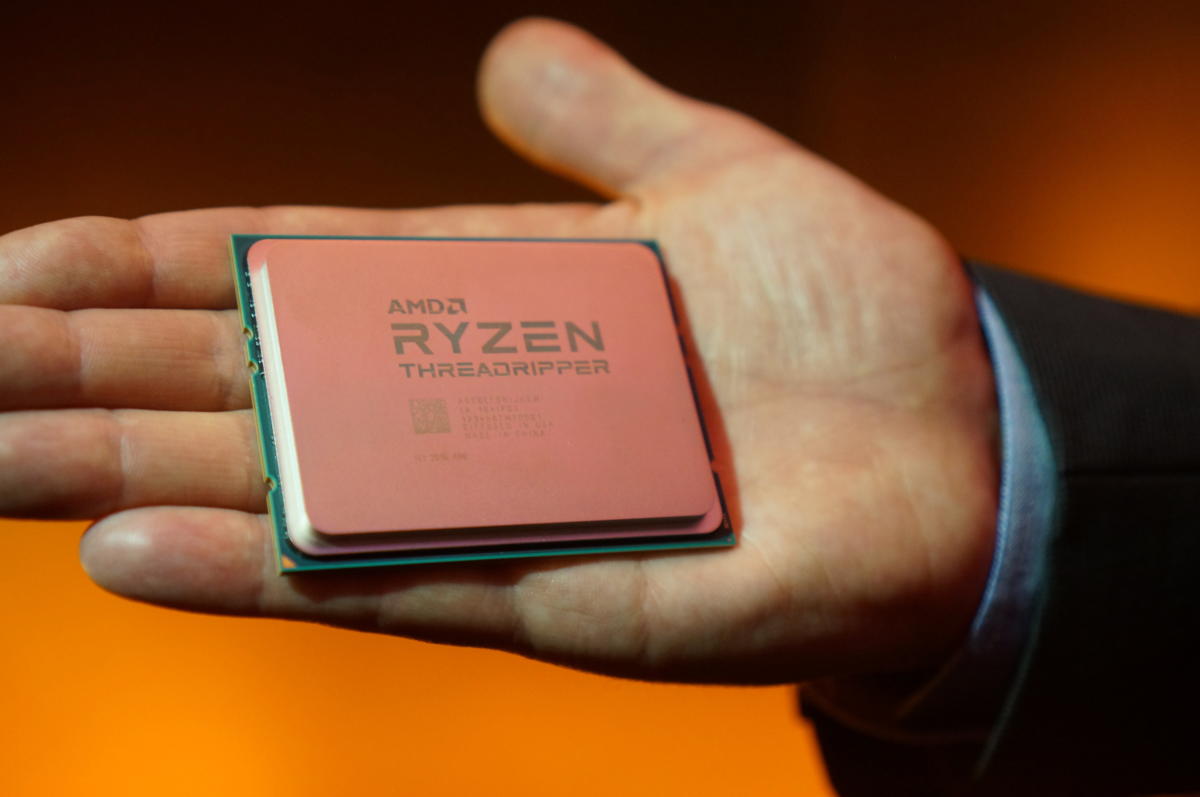
AMD’s Ryzen Threadripper chips could very well be the most powerful consumer CPU ever introduced when it releases in August. With up to 16 cores and 32 threads, Threadripper gives the high-performance Intel products currently dominating high-end desktops something to worry about.
The mega-core CPU battle is now quickly turning into an arms race. Check back here for all the latest information about Threadripper as more details become available.
The specs we know
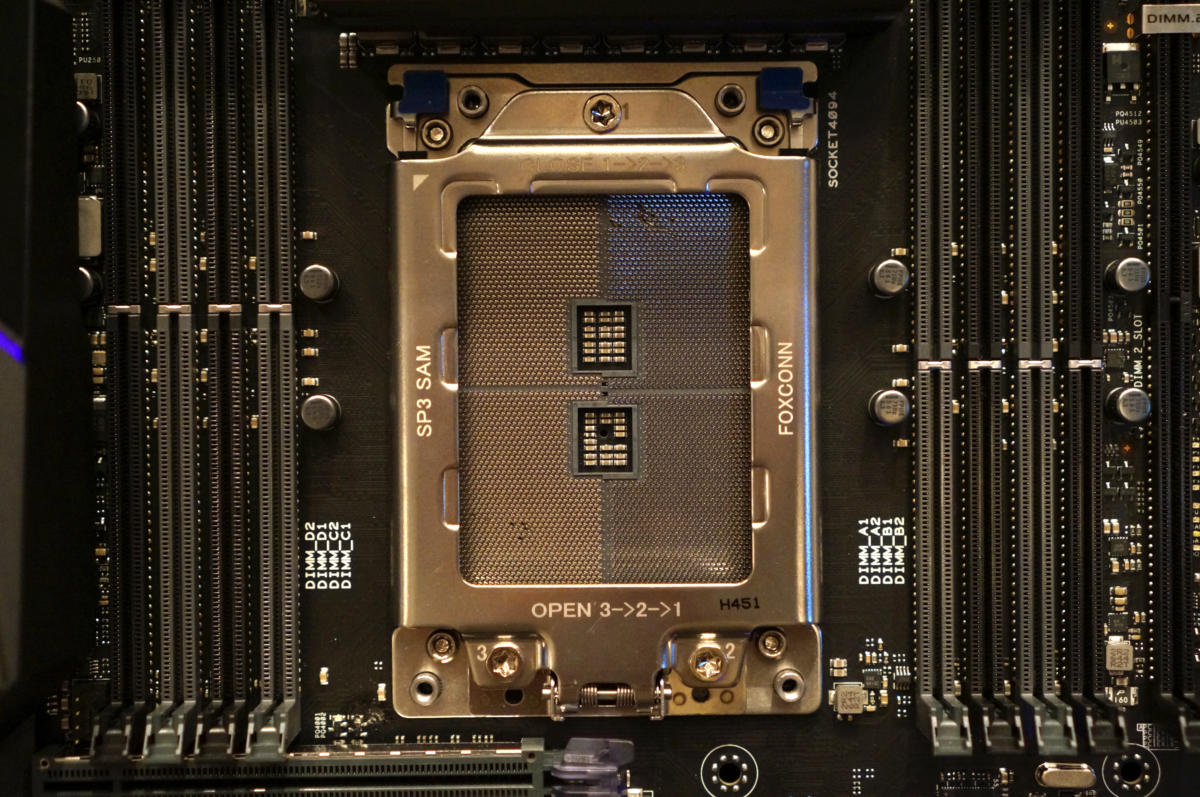 Here’s the new TR4 socket where Threadripper will live.
How much will Threadripper cost?
We’ve said AMD’s plan this year is to be as disruptive as possible and Threadripper looks positioned to do just that. The 16-core Ryzen Threadripper 1950X will cost $1,000, while the 12-core Ryzen Threadripper 1920X will cost $800.
How disruptive is that? Well, with Intel’s 16-core Core i9-7960X pegged at $1,700 and it’s 12-core Core i9-7920X priced at $1,200, it’s easy to see Threadripper will likely be as disruptive to Core i9 as Ryzen 5 and Ryzen 7 were to Intel’s Core i5 and Core i7.
What do we know about Threadripper’s performance?
We won’t know the full effect of Ryzen Threadripper’s 16 cores and 32 threads until we test it. Meanwhile, our reviews of Ryzen 7 and Ryzen 5 can give you insights into the strengths and weaknesses of the Ryzen family.
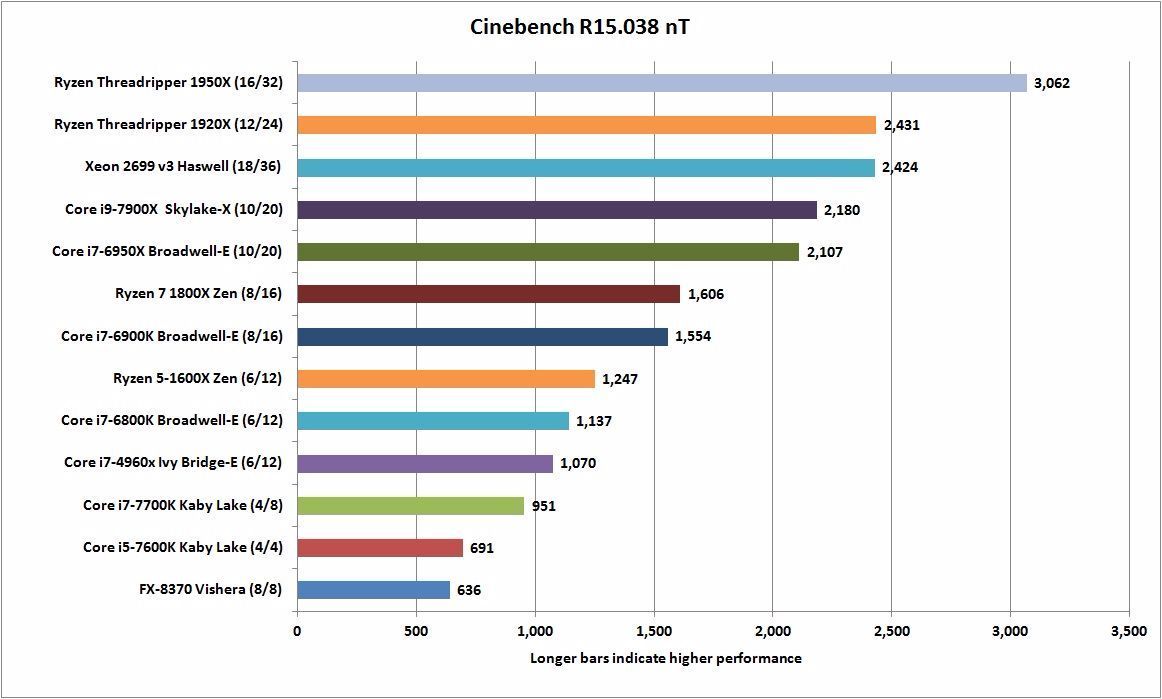
AMD, however, has given us a taste of just fast the chip will be in multi-threaded tasks. In a controlled demo from an AMD lab, AMD CEO Lisa Su showed off the 12-core Threadripper 1920X socking the 10-core Core i9-7900X with a Cinebench R15 score of 2,431 to 2,167. The real beatdown came from the 16-core Threadripper 1950X though, with a score of 3,062.
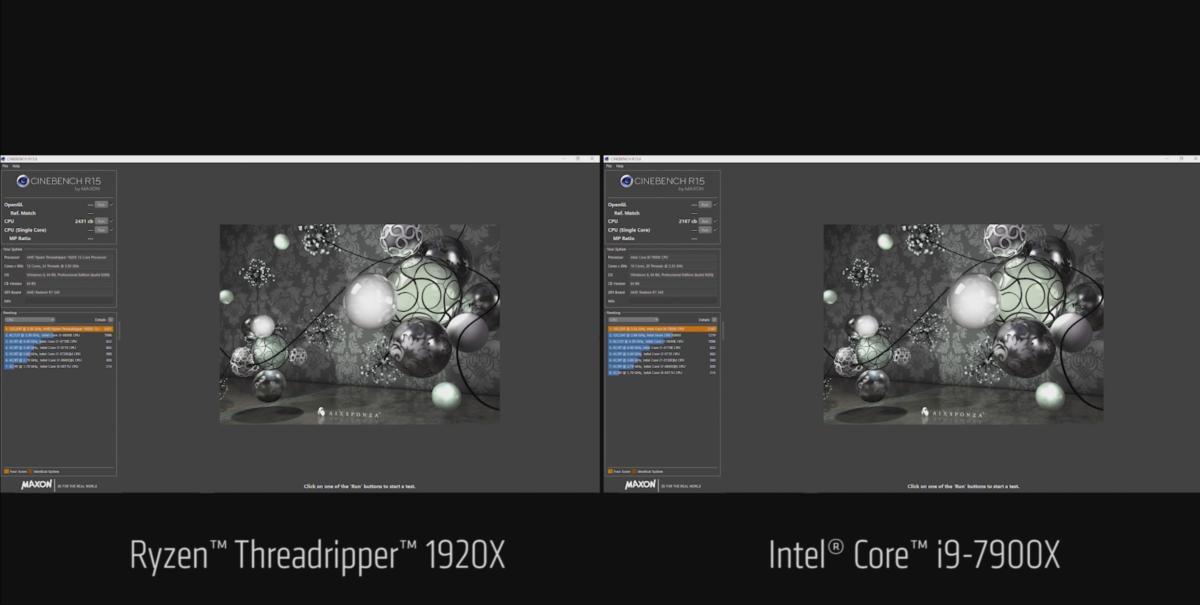 AMD AMD’s results pitting the $800, 12-core Threadripper 1920X against Intel’s $1,000, 10-core Core i9-7900X in Cinebench R15.
Keep in mind that we don’t know details about the configurations of the test PCs. The machines were also in the control of AMD, which always sets off conspiracy theories, but AMD’s previous Ryzen performance demonstrations matched the final parts, so this is likely a true predictor of
Threadripper’s performance in 3D rendering in Cinebench.
We’ll go out on a limb by saying that AMD’s disclosure of the base clock speeds promise decent performance for most tasks. The 16-core Threadripper 1950X features a base clock of 3.4GHz, while the 12-core is slightly higher at 3.5GHz. Both will hit higher boost clocks of course, but the guaranteed minimum base clock is quite promising for performance considering how many CPU cores the chips have.
Bigger chips tend to be difficult to scale to high clock speeds due to the thermal and power limits. For example, Intel’s 16-core Xeon E5-4660 v4 has a base clock of 2.2GHz with a boost of 3GHz, while the new 3.3GHz Core i9-7900X has earned a reputation as being a hot head, especially if you overclock it.
This horse race really won’t be answered until we have all the players on the field of battle so stay tuned for more.
It will support up to 1TB of RAM
No, we're not kidding. Threadripper shows its server roots and will be able to support up to 1TB of RAM if you populate all 8-DIMM slots with 128GB LR-DIMMs or Load Reduced DIMMs. Unlike today's Registered DIMMs that use a chip to redrive some of the signals to the memory directly from the CPU an LR-DIMM uses a memory buffer to re-drive all of the data and instruction sets.
None of this comes cheap though. A single 32GB LR-DIMM DDR4/2133 module costs $1,100, so you can imagine how much a 128GB LR-DIMM will cost when available.
And yup, if you guessed, the typical person doesn't need 1TB of RAM, but in the "look what I could if I wanted to category," it's a major bragging point.
This factoid was actually noticed by Anandtech in a video Alienware published last month.
What about the 14 and 10-core versions?
With 16-core and 12-core Threadripper chips now out in the open, people expecting 14- and 10-core Threadripper CPUs (and full parity with Intel’s Core i9 selection) might be disappointed. AMD hasn’t said boo about any further Threadrippers yet despite earlier leaks indicating a fuller lineup, and AMD executives have told PCWorld it’s not even clear they feel they have to match Intel’s offerings.
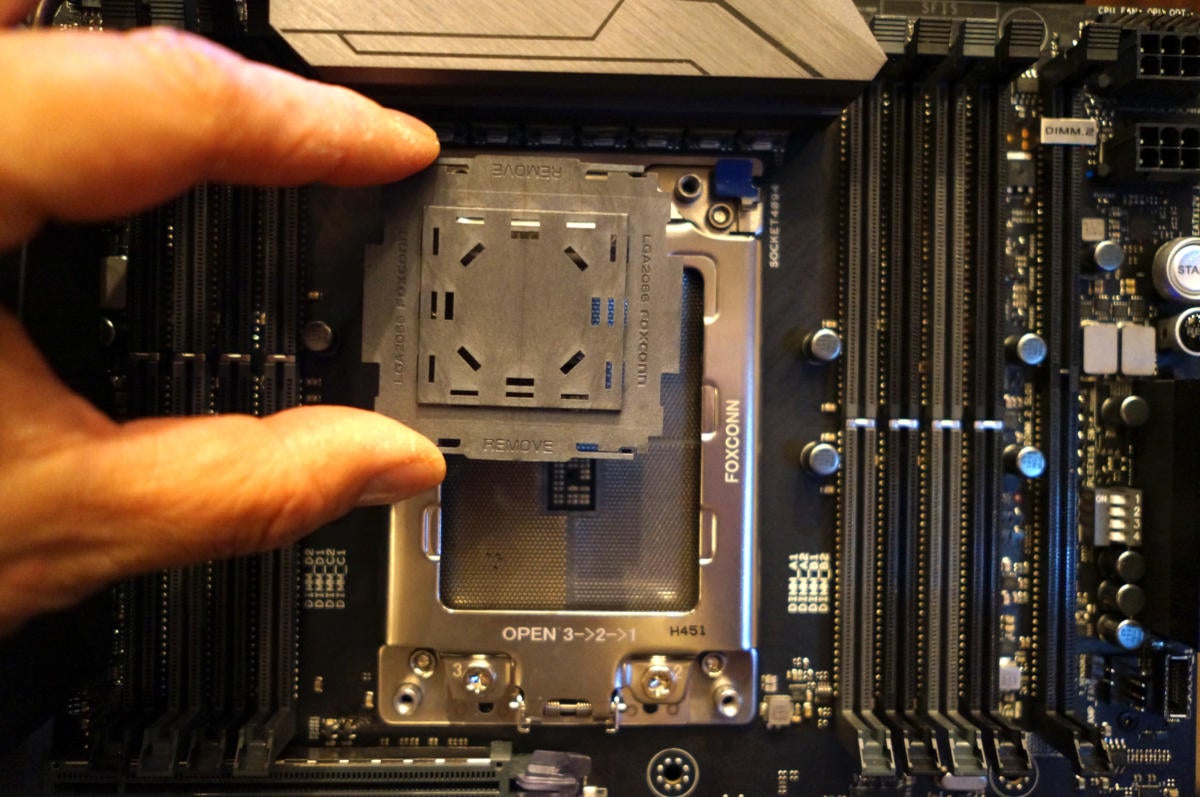 Threadripper isn’t huge, it’s yuge. In fact, that’s the plastic load plate protector of a Core i9 hovering over a Threadripper TR4 socket
What about the X399 chipset and other specs?
At Computex, AMD revealed that all Threadripper CPUs will feature 64 PCI-E lanes and quad-channel RAM support on the X399 chipset, but other hard details of the chipset aren’t known. What do know is that the new chips TR4 socket is yuge.
Threadripper is also AMD’s first consumer chip to move away from the older pin grid array (PGA) design to the same land grid array (LGA) as Intel’s chips. In other words, Threadripper’s pins are in the motherboard socket, not on the chip itself. That means you can’t bend pins on your AMD chip anymore. Hurray! The bad news? You can bend the pins on the motherboard and trash that instead.
The other detail AMD slipped out is what the maximum thermal budget is for the chip and it's a doozy. The company said both chips have a TDP of 180 watts vs the Core i9 7900X's 140 watt TDP.
Before you scream that it'll be too hot to cool, one thing you remember is that Intel and AMD haven't always used the same definition of what a Thermal Design Point is. Intel's Core i9 is also getting a pretty bad reputation for being too hot to handle as it is.
Even more insane is this fact: The 16-core Ryzen Threadripper 1950X's 180 watt TDP is still 40 watts less than the AMD 8-core FX 9590 CPU which had a 220 watt TDP.
What about Core i9?
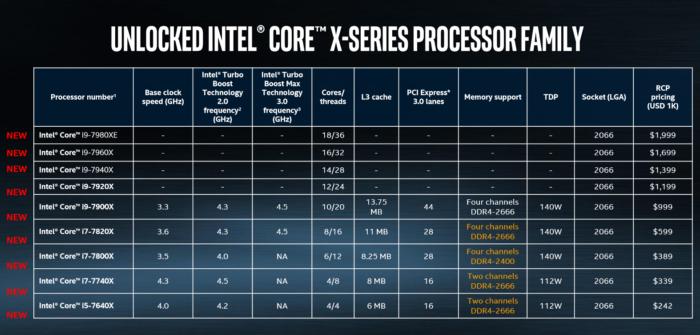 The Intel X-series and Core i9 lineup.
AMD isn’t the only company working on monster CPU for consumers. With Intel’s Skylake X or Core i9 finally breaking from cover, the battle is joined. Well, kinda. As you can see in PCWorld’s Core i9 review, Intel’s new HEDT chips are indeed fast—but there are caveats to that performance. Far worse for Intel though are the combatants it can put against Threadripper immediately.
Threadripper’s coming in early August. The best Intel can muster is a 12-core Core i9 chip also slated for an August launch. The 14, 16 and 18-core chips? They won’t enter the fray until at least October, which means Threadripper is likely to be unopposed for a couple of months.
Our CPU hounds debated and dished on Core i9 vs. Threadripper during our “Full Nerd” show. They also took bets on the pricing, so see if someone has to eat paper in this video.
Core i9 uses a new X299 chipset, and the top-of-the-line Core i9-7900X features 44 PCIe lanes and quad-channel memory support. You need to spend at least $1,000 on a 10-core Core i9 chip to get more than 28 PCI-E lanes, though.
Will you really benefit from that many cores?
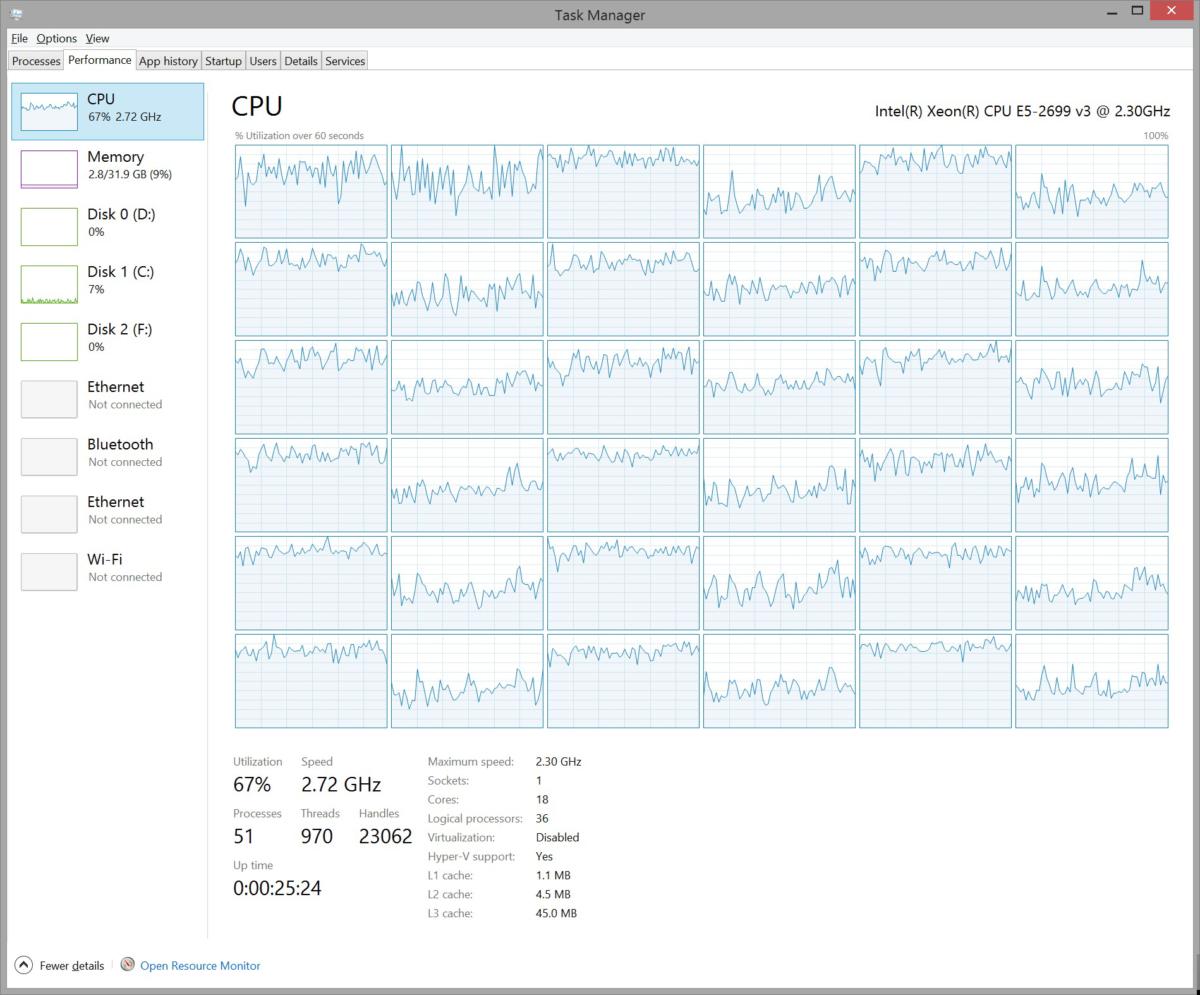 IDG Even Handbrake can’t use all the resources of an 18-core, 36-thread CPU, so buy a mega-core CPU only if you can really use it properly.
With Intel and AMD waging a fierce a core war this summer, you’d assume that more cores means better performance. The truth is more nuanced.
How many cores you need really depends on what you do. If you primarily play games, a mega-core PC isn’t likely to yield the performance you’d expect. If, however, you edit video, render 3D, and run other intensive workstation-like tasks, more cores generally means less waiting. Having an embarrassing number of cores can also aid in heavy-duty multitasking. You know, like simultaneously rendering 3D, video, audio, and playing games.
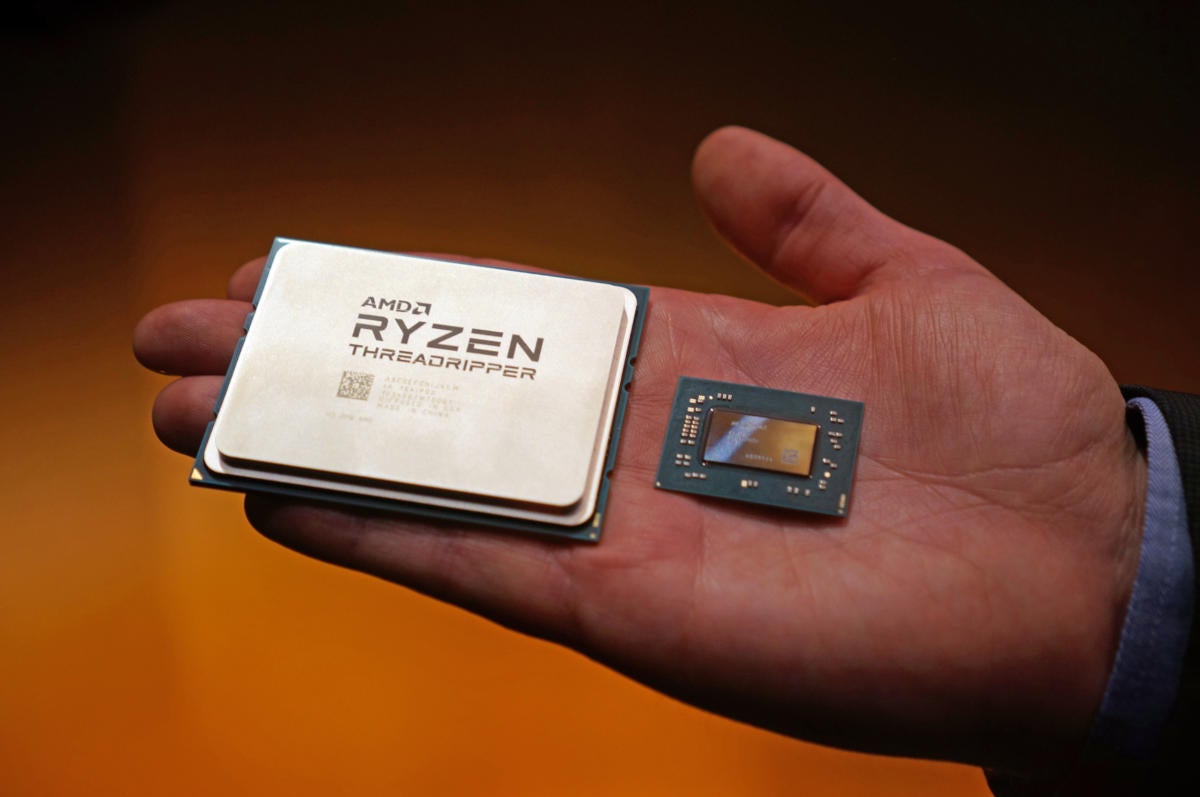 IDG/Gordon Mah Ung AMD’s new 16-core Ryzen Threadripper (left) dwarfs the 4-core Ryzen mobile chip (right).
Updated July 14: A small but huge detail lost in the noise: Threadripper can support 1TB of RAM. Repeat. 1 Terabyte of system RAM in a consumer PC. Still, the big news came on July 13 when AMD finally dropped the other shoe and announced jaw-droppingly good prices for its 16-core and 12-core Threadripper CPUs. Threadripper’s clock speeds and August release window were also revealed
AMD’s Ryzen Threadripper chips could very well be the most powerful consumer CPU ever introduced when it releases in August. With up to 16 cores and 32 threads, Threadripper gives the high-performance Intel products currently dominating high-end desktops something to worry about.
The mega-core CPU battle is now quickly turning into an arms race. Check back here for all the latest information about Threadripper as more details become available.
The specs we know
- The Ryzen Threadripper 1950X features 16 cores with simultaneous multi-threading (SMT) for 32 threads of compute power. The base clock speed of the chip is 3.4GHz, with a 4GHz boost speed.
- The Ryzen Threadripper 1920X will feature 12 cores with SMT for 24 threads of compute power. The base clock speed of the chip is 3.5GHz with a 4GHz boost speed.
- Both chips pack a whopping 64 PCI-E lanes
- Memory: Quad-channel DDR4
- Platform: X399 with a new TR4 socket that is incompatible with existing Ryzen chips.
- Both chips are unlocked for overclocking adventures.
- Can’t be “delided” easily as it uses a solder thermal interface material.
- Release date: Threadripper PCs will be available for sale on July 27. CPUs and the motherboards to put them in will hit “early August.”
- Alienware has the worldwide exclusive on Threadripper systems among large PC manufacturers, but many U.S. boutique builders will offer it as well.
- Both parts will be 180 watt TDP chips.
- Ryzen Threadripper CPUs will support up to 1TB of RAM when 128GB LR-DIMMs are used.
How much will Threadripper cost?
We’ve said AMD’s plan this year is to be as disruptive as possible and Threadripper looks positioned to do just that. The 16-core Ryzen Threadripper 1950X will cost $1,000, while the 12-core Ryzen Threadripper 1920X will cost $800.
How disruptive is that? Well, with Intel’s 16-core Core i9-7960X pegged at $1,700 and it’s 12-core Core i9-7920X priced at $1,200, it’s easy to see Threadripper will likely be as disruptive to Core i9 as Ryzen 5 and Ryzen 7 were to Intel’s Core i5 and Core i7.
What do we know about Threadripper’s performance?
We won’t know the full effect of Ryzen Threadripper’s 16 cores and 32 threads until we test it. Meanwhile, our reviews of Ryzen 7 and Ryzen 5 can give you insights into the strengths and weaknesses of the Ryzen family.
AMD, however, has given us a taste of just fast the chip will be in multi-threaded tasks. In a controlled demo from an AMD lab, AMD CEO Lisa Su showed off the 12-core Threadripper 1920X socking the 10-core Core i9-7900X with a Cinebench R15 score of 2,431 to 2,167. The real beatdown came from the 16-core Threadripper 1950X though, with a score of 3,062.
Keep in mind that we don’t know details about the configurations of the test PCs. The machines were also in the control of AMD, which always sets off conspiracy theories, but AMD’s previous Ryzen performance demonstrations matched the final parts, so this is likely a true predictor of
Threadripper’s performance in 3D rendering in Cinebench.
We’ll go out on a limb by saying that AMD’s disclosure of the base clock speeds promise decent performance for most tasks. The 16-core Threadripper 1950X features a base clock of 3.4GHz, while the 12-core is slightly higher at 3.5GHz. Both will hit higher boost clocks of course, but the guaranteed minimum base clock is quite promising for performance considering how many CPU cores the chips have.
Bigger chips tend to be difficult to scale to high clock speeds due to the thermal and power limits. For example, Intel’s 16-core Xeon E5-4660 v4 has a base clock of 2.2GHz with a boost of 3GHz, while the new 3.3GHz Core i9-7900X has earned a reputation as being a hot head, especially if you overclock it.
This horse race really won’t be answered until we have all the players on the field of battle so stay tuned for more.
It will support up to 1TB of RAM
No, we're not kidding. Threadripper shows its server roots and will be able to support up to 1TB of RAM if you populate all 8-DIMM slots with 128GB LR-DIMMs or Load Reduced DIMMs. Unlike today's Registered DIMMs that use a chip to redrive some of the signals to the memory directly from the CPU an LR-DIMM uses a memory buffer to re-drive all of the data and instruction sets.
None of this comes cheap though. A single 32GB LR-DIMM DDR4/2133 module costs $1,100, so you can imagine how much a 128GB LR-DIMM will cost when available.
And yup, if you guessed, the typical person doesn't need 1TB of RAM, but in the "look what I could if I wanted to category," it's a major bragging point.
This factoid was actually noticed by Anandtech in a video Alienware published last month.
What about the 14 and 10-core versions?
With 16-core and 12-core Threadripper chips now out in the open, people expecting 14- and 10-core Threadripper CPUs (and full parity with Intel’s Core i9 selection) might be disappointed. AMD hasn’t said boo about any further Threadrippers yet despite earlier leaks indicating a fuller lineup, and AMD executives have told PCWorld it’s not even clear they feel they have to match Intel’s offerings.
What about the X399 chipset and other specs?
At Computex, AMD revealed that all Threadripper CPUs will feature 64 PCI-E lanes and quad-channel RAM support on the X399 chipset, but other hard details of the chipset aren’t known. What do know is that the new chips TR4 socket is yuge.
Threadripper is also AMD’s first consumer chip to move away from the older pin grid array (PGA) design to the same land grid array (LGA) as Intel’s chips. In other words, Threadripper’s pins are in the motherboard socket, not on the chip itself. That means you can’t bend pins on your AMD chip anymore. Hurray! The bad news? You can bend the pins on the motherboard and trash that instead.
The other detail AMD slipped out is what the maximum thermal budget is for the chip and it's a doozy. The company said both chips have a TDP of 180 watts vs the Core i9 7900X's 140 watt TDP.
Before you scream that it'll be too hot to cool, one thing you remember is that Intel and AMD haven't always used the same definition of what a Thermal Design Point is. Intel's Core i9 is also getting a pretty bad reputation for being too hot to handle as it is.
Even more insane is this fact: The 16-core Ryzen Threadripper 1950X's 180 watt TDP is still 40 watts less than the AMD 8-core FX 9590 CPU which had a 220 watt TDP.
What about Core i9?
AMD isn’t the only company working on monster CPU for consumers. With Intel’s Skylake X or Core i9 finally breaking from cover, the battle is joined. Well, kinda. As you can see in PCWorld’s Core i9 review, Intel’s new HEDT chips are indeed fast—but there are caveats to that performance. Far worse for Intel though are the combatants it can put against Threadripper immediately.
Threadripper’s coming in early August. The best Intel can muster is a 12-core Core i9 chip also slated for an August launch. The 14, 16 and 18-core chips? They won’t enter the fray until at least October, which means Threadripper is likely to be unopposed for a couple of months.
Our CPU hounds debated and dished on Core i9 vs. Threadripper during our “Full Nerd” show. They also took bets on the pricing, so see if someone has to eat paper in this video.
Core i9 uses a new X299 chipset, and the top-of-the-line Core i9-7900X features 44 PCIe lanes and quad-channel memory support. You need to spend at least $1,000 on a 10-core Core i9 chip to get more than 28 PCI-E lanes, though.
Will you really benefit from that many cores?
With Intel and AMD waging a fierce a core war this summer, you’d assume that more cores means better performance. The truth is more nuanced.
How many cores you need really depends on what you do. If you primarily play games, a mega-core PC isn’t likely to yield the performance you’d expect. If, however, you edit video, render 3D, and run other intensive workstation-like tasks, more cores generally means less waiting. Having an embarrassing number of cores can also aid in heavy-duty multitasking. You know, like simultaneously rendering 3D, video, audio, and playing games.
Last edited:
AMD muscles in on Xeon’s turf as it unveils Epyc
AMD muscles in on Xeon’s turf as it unveils Epyc
Multiply a Ryzen by four and all of a sudden Intel has some real competition.
AUSTIN—Today, AMD unveiled the first generation of Epyc, its new range of server processors built around its Zen architecture. Processors will range from the Epyc 7251—an eight-core, 16-thread chip running at 2.1 to 2.9GHz in a 120W power envelope—up to the Epyc 7601: a 32-core, 64-thread monster running at 2.2 to 3.2GHz, with a 180W design power.
AMD initially revealed its server chips, codenamed "Naples," earlier this year. Since then, we've known the basics of the new chips: they'll have 128 PCIe lanes and eight DDR4 memory controllers and will support one or two socket configurations. With today's announcement, we now know much more about how the processors are put together and what features they'll offer.
The basic building block of all of AMD's Zen processors, both Ryzen on the desktop and Epyc in the server, is the eight-core, 16-thread chip. Ryzen processors use one of these; the Threadripper high-end desktop chips use two; and Epyc uses four. Each chip includes two memory controllers, a bunch of PCIe lanes, power management, and, most important of all, Infinity Fabric, AMD's high-speed interconnect that is derived from coherent HyperTransport.
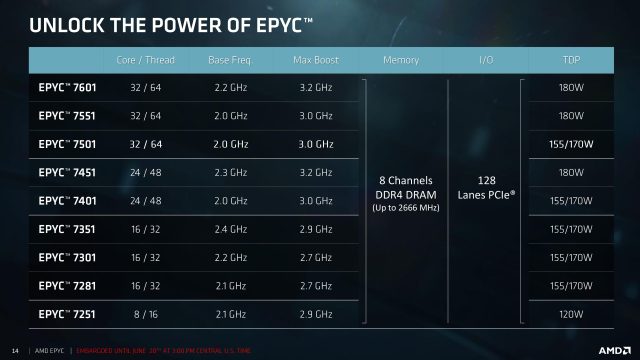 Most of the Epyc SKUs.
From our look at Ryzen, we already know that Infinity Fabric (IF) is used to connect two blocks of four cores (called "core complexes," CCXes) within each eight-core chip. IF is also used both to connect the chips within the multi-chip module (MCM), and, in two processor configurations, to connect the two sockets.
Within the processor, each chip has three IF links, one to each of the other three chips. Each link runs at up to 42GB/s in each direction. The speed of these links matches the 42GB/s of memory bandwidth offered by the two channels of
2,667MHz DDR4 memory that each individual chip supports, and what this means is that any one chip within the Epyc MCM can use the full memory bandwidth of the entire processor without bottlenecks. Accessing memory that's connected to a different chip will incur somewhat higher latency than accessing memory that's directly connected, but it comes at no bandwidth penalty.
In two socket configurations, there are four IF links between the sockets. Each chip in one socket is paired with a chip in the other socket, for four pairs total, with one IF link between each pair. This design means that accessing remote memory has, at most, a two-hop penalty and that there are multiple routes that data can use to move from a chip on one socket to a chip on the other. The cross-socket IF links are slightly slower than the internal ones, operating at 38GB/s bidirectional. This is because these links have higher error-checking overhead, which uses up some of their bandwidth.
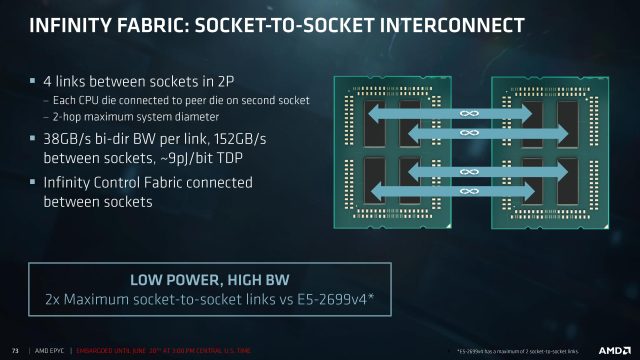 Infinity Fabric interconnects.
Both the internal and external IF connections are power managed. If not much traffic is going across the links, the processor will cut back its performance and hence energy usage. Power not used on the links can instead be used for the cores themselves, with AMD saying that this power management can provide as much as an eight-percent improvement in performance per watt.
In total, each processor offers 128 I/O channels. In two socket configurations, 64 channels from each processor are used for Infinity Fabric connectivity, leaving an aggregate of 128 I/O channels still available. As such, both one socket and two socket configurations offer nearly identical I/O options. The main thing the I/O channels can be used for is PCIe connectivity, with up to eight PCIe 3.0x16 connections per system.
These can be subdivided all the way down to 128 PCIe 3.0 x1 links, and there's a good degree of flexibility to the possible configurations of PCIe lanes. Each chip can use eight of its links as SATA connections, too. This is one of the few areas where a two-socket system will give you more I/O capabilities; with two sockets, the chips would support a total of 16 SATA connections.
Epyc is designed as a system-on-chip. Many features that would typically need additional components on the motherboard have been integrated into what AMD calls the Server Controller Hub (SCH) within the Epyc processor itself. This includes four USB 3.0 controllers, serial port controllers, clock generation, and low-speed interfaces such as I2C. The one notable I/O component not in the processor is Ethernet; for that, you'll need a PCIe card or motherboard-integrated interface.
A scaled-up Ryzen?
In most other regards, Epyc is little different from a scaled-up Ryzen—not altogether surprising, given the common heritage. Ryzen features, such as individually adjusting the voltage on a per-core basis, are found in Epyc, for example.
Some of these features have an Epyc twist, however. Like Ryzen, Epyc can boost clock speeds depending on usage levels. The top-end 7601 part, for example, has a base speed of 2.2GHz, with an all-cores boost of 2.7GHz and a maximum boost of 3.2GHz. Ryzen's maximum boost is very limited, only applying with one or two cores active. Epyc's is a bit more versatile; that 3.2GHz can be reached with up to 12 cores active.
Epyc chips also offer two modes, set at boot time, that let you pick between consistent performance and consistent power usage. In performance mode, the chip will offer repeatable, consistent clock speeds and boosting, drawing more power as required. In power mode, the chip will tightly stick to an upper bound for power usage and cut performance, if necessary, to stay within that envelope. This isn't available on the desktop chips, where power constraints are relatively lax and governed more by the cooling system than anything else. But it is valuable in densely packed server racks, where the overall power draw of a rack is often constrained.
The on-chip power management will also strive to detect certain workload patterns and reduce clock speed accordingly. In workloads that cause bursts of activity followed by idle periods, Epyc will reduce the clock speed during those activity bursts. This will make them take a little longer and cut down the idle time. Because power usage tends to scale with the cube of the clock speed, AMD argues that this behavior can cause a net reduction in power usage; at maximum speed, any power saved during idle is more than offset by the extra power used during the activity bursts. So cutting that peak power draw will lead to an overall reduction in power usage, even if a core is idling less.
This stands in contrast to the normal "race to idle" behavior that's often used to reduce power usage, wherein a processor runs as fast as it can as briefly as it can, because idling is so overwhelmingly superior from a power-usage perspective. It might also have some latency impact since each burst of work will take a little longer to complete.
For Epyc, AMD is also promoting some features that appear to also be available in Ryzen (at least, there are firmware options to control them) but only make a great amount of sense in server configurations. For example, Epyc supports encrypted system memory. Each memory controller has an encryption engine, and it can transparently decrypt and encrypt everything it reads and writes from RAM. This can operate in two modes; a global mode, in which all memory is encrypted using keys generated by the processor, and a software-controlled mode that enables, for example, memory belonging to different virtual machines to use different encryption keys.
Epyc also supports data poisoning. Typically, when ECC memory finds an uncorrectable error, the default operating-system behavior is to bring down the entire machine. With data poisoning, the operating system can instead choose to crash only the process or virtual machine that contained the error, leaving the rest of the machine unaffected.
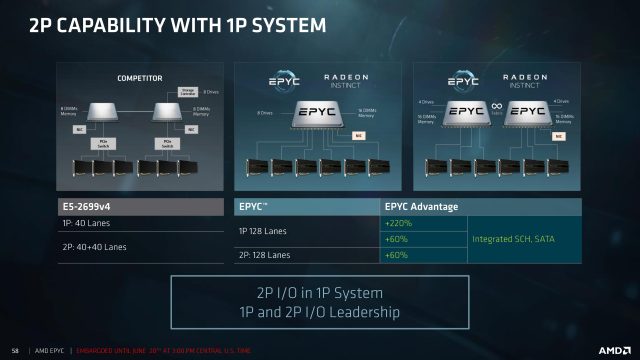 Epyc has tons of I/O.
Compared to the Broadwell-based Xeons that are currently on the market, Epyc looks very compelling. It offers considerably more I/O than Intel's chips (which only offer 40 PCIe lanes per chip), and it offers considerably more cores per socket. AMD's line-up is also much more consistent, with the same set of features available across the entire range (with some small exceptions; the company will have three single-socket-only chips, with model numbers ending in P).
The low-end parts don't omit any reliability or security features found in the high-end parts, making the only choice the number of cores and clock speeds that you need or can afford. In the very limited benchmarks AMD has demonstrated, Epyc 7601 handily beats a pair of Xeon E5-2699A v4 processors, Intel's fastest two-socket Xeons.
But Intel's new generation of Xeons built around the Skylake SP core are right around the corner. AMD says that it built Epyc not simply to beat Broadwell, but also Skylake. That comparison looks like it's going to be far more complex. AMD will certainly offer more memory bandwidth—Skylake-SP has only six memory channels to Epyc's eight—and AMD will likely offer more cores and threads per socket than Intel. But Skylake-SP's single-threaded performance is better than
Zen's, and Intel's use of monolithic dies, rather than multi-chip modules, should give Intel's chips lower latency access to memory. Skylake-SP also includes new features such as AVX512, which may provide a healthy boost to number-crunching applications.
How this will all turn out remains to be seen; until Skylake-SP hits the market we have no benchmarks between the two, and we might well expect to see different winners depending on the workload being run.
Either way, though, one thing is clear: Intel has a level of competition that it hasn't had for a while. Epyc may not be the best choice for every workload, but it's sure to be the right option for many. While pricing hasn't been announced yet, we expect AMD to continue its trend of undercutting its larger competitor. Just as Ryzen has done on the desktop, Epyc is creating options in the server room.
AMD muscles in on Xeon’s turf as it unveils Epyc
Multiply a Ryzen by four and all of a sudden Intel has some real competition.
AUSTIN—Today, AMD unveiled the first generation of Epyc, its new range of server processors built around its Zen architecture. Processors will range from the Epyc 7251—an eight-core, 16-thread chip running at 2.1 to 2.9GHz in a 120W power envelope—up to the Epyc 7601: a 32-core, 64-thread monster running at 2.2 to 3.2GHz, with a 180W design power.
AMD initially revealed its server chips, codenamed "Naples," earlier this year. Since then, we've known the basics of the new chips: they'll have 128 PCIe lanes and eight DDR4 memory controllers and will support one or two socket configurations. With today's announcement, we now know much more about how the processors are put together and what features they'll offer.
The basic building block of all of AMD's Zen processors, both Ryzen on the desktop and Epyc in the server, is the eight-core, 16-thread chip. Ryzen processors use one of these; the Threadripper high-end desktop chips use two; and Epyc uses four. Each chip includes two memory controllers, a bunch of PCIe lanes, power management, and, most important of all, Infinity Fabric, AMD's high-speed interconnect that is derived from coherent HyperTransport.
From our look at Ryzen, we already know that Infinity Fabric (IF) is used to connect two blocks of four cores (called "core complexes," CCXes) within each eight-core chip. IF is also used both to connect the chips within the multi-chip module (MCM), and, in two processor configurations, to connect the two sockets.
Within the processor, each chip has three IF links, one to each of the other three chips. Each link runs at up to 42GB/s in each direction. The speed of these links matches the 42GB/s of memory bandwidth offered by the two channels of
2,667MHz DDR4 memory that each individual chip supports, and what this means is that any one chip within the Epyc MCM can use the full memory bandwidth of the entire processor without bottlenecks. Accessing memory that's connected to a different chip will incur somewhat higher latency than accessing memory that's directly connected, but it comes at no bandwidth penalty.
In two socket configurations, there are four IF links between the sockets. Each chip in one socket is paired with a chip in the other socket, for four pairs total, with one IF link between each pair. This design means that accessing remote memory has, at most, a two-hop penalty and that there are multiple routes that data can use to move from a chip on one socket to a chip on the other. The cross-socket IF links are slightly slower than the internal ones, operating at 38GB/s bidirectional. This is because these links have higher error-checking overhead, which uses up some of their bandwidth.
Both the internal and external IF connections are power managed. If not much traffic is going across the links, the processor will cut back its performance and hence energy usage. Power not used on the links can instead be used for the cores themselves, with AMD saying that this power management can provide as much as an eight-percent improvement in performance per watt.
In total, each processor offers 128 I/O channels. In two socket configurations, 64 channels from each processor are used for Infinity Fabric connectivity, leaving an aggregate of 128 I/O channels still available. As such, both one socket and two socket configurations offer nearly identical I/O options. The main thing the I/O channels can be used for is PCIe connectivity, with up to eight PCIe 3.0x16 connections per system.
These can be subdivided all the way down to 128 PCIe 3.0 x1 links, and there's a good degree of flexibility to the possible configurations of PCIe lanes. Each chip can use eight of its links as SATA connections, too. This is one of the few areas where a two-socket system will give you more I/O capabilities; with two sockets, the chips would support a total of 16 SATA connections.
Epyc is designed as a system-on-chip. Many features that would typically need additional components on the motherboard have been integrated into what AMD calls the Server Controller Hub (SCH) within the Epyc processor itself. This includes four USB 3.0 controllers, serial port controllers, clock generation, and low-speed interfaces such as I2C. The one notable I/O component not in the processor is Ethernet; for that, you'll need a PCIe card or motherboard-integrated interface.
A scaled-up Ryzen?
In most other regards, Epyc is little different from a scaled-up Ryzen—not altogether surprising, given the common heritage. Ryzen features, such as individually adjusting the voltage on a per-core basis, are found in Epyc, for example.
Some of these features have an Epyc twist, however. Like Ryzen, Epyc can boost clock speeds depending on usage levels. The top-end 7601 part, for example, has a base speed of 2.2GHz, with an all-cores boost of 2.7GHz and a maximum boost of 3.2GHz. Ryzen's maximum boost is very limited, only applying with one or two cores active. Epyc's is a bit more versatile; that 3.2GHz can be reached with up to 12 cores active.
Epyc chips also offer two modes, set at boot time, that let you pick between consistent performance and consistent power usage. In performance mode, the chip will offer repeatable, consistent clock speeds and boosting, drawing more power as required. In power mode, the chip will tightly stick to an upper bound for power usage and cut performance, if necessary, to stay within that envelope. This isn't available on the desktop chips, where power constraints are relatively lax and governed more by the cooling system than anything else. But it is valuable in densely packed server racks, where the overall power draw of a rack is often constrained.
The on-chip power management will also strive to detect certain workload patterns and reduce clock speed accordingly. In workloads that cause bursts of activity followed by idle periods, Epyc will reduce the clock speed during those activity bursts. This will make them take a little longer and cut down the idle time. Because power usage tends to scale with the cube of the clock speed, AMD argues that this behavior can cause a net reduction in power usage; at maximum speed, any power saved during idle is more than offset by the extra power used during the activity bursts. So cutting that peak power draw will lead to an overall reduction in power usage, even if a core is idling less.
This stands in contrast to the normal "race to idle" behavior that's often used to reduce power usage, wherein a processor runs as fast as it can as briefly as it can, because idling is so overwhelmingly superior from a power-usage perspective. It might also have some latency impact since each burst of work will take a little longer to complete.
For Epyc, AMD is also promoting some features that appear to also be available in Ryzen (at least, there are firmware options to control them) but only make a great amount of sense in server configurations. For example, Epyc supports encrypted system memory. Each memory controller has an encryption engine, and it can transparently decrypt and encrypt everything it reads and writes from RAM. This can operate in two modes; a global mode, in which all memory is encrypted using keys generated by the processor, and a software-controlled mode that enables, for example, memory belonging to different virtual machines to use different encryption keys.
Epyc also supports data poisoning. Typically, when ECC memory finds an uncorrectable error, the default operating-system behavior is to bring down the entire machine. With data poisoning, the operating system can instead choose to crash only the process or virtual machine that contained the error, leaving the rest of the machine unaffected.
Compared to the Broadwell-based Xeons that are currently on the market, Epyc looks very compelling. It offers considerably more I/O than Intel's chips (which only offer 40 PCIe lanes per chip), and it offers considerably more cores per socket. AMD's line-up is also much more consistent, with the same set of features available across the entire range (with some small exceptions; the company will have three single-socket-only chips, with model numbers ending in P).
The low-end parts don't omit any reliability or security features found in the high-end parts, making the only choice the number of cores and clock speeds that you need or can afford. In the very limited benchmarks AMD has demonstrated, Epyc 7601 handily beats a pair of Xeon E5-2699A v4 processors, Intel's fastest two-socket Xeons.
But Intel's new generation of Xeons built around the Skylake SP core are right around the corner. AMD says that it built Epyc not simply to beat Broadwell, but also Skylake. That comparison looks like it's going to be far more complex. AMD will certainly offer more memory bandwidth—Skylake-SP has only six memory channels to Epyc's eight—and AMD will likely offer more cores and threads per socket than Intel. But Skylake-SP's single-threaded performance is better than
Zen's, and Intel's use of monolithic dies, rather than multi-chip modules, should give Intel's chips lower latency access to memory. Skylake-SP also includes new features such as AVX512, which may provide a healthy boost to number-crunching applications.
How this will all turn out remains to be seen; until Skylake-SP hits the market we have no benchmarks between the two, and we might well expect to see different winners depending on the workload being run.
Either way, though, one thing is clear: Intel has a level of competition that it hasn't had for a while. Epyc may not be the best choice for every workload, but it's sure to be the right option for many. While pricing hasn't been announced yet, we expect AMD to continue its trend of undercutting its larger competitor. Just as Ryzen has done on the desktop, Epyc is creating options in the server room.
Last edited:


Similar threads

- Replies
- 3
- Views
- 118
- Replies
- 6
- Views
- 416


- Replies
- 6
- Views
- 524


- Replies
- 0
- Views
- 315