


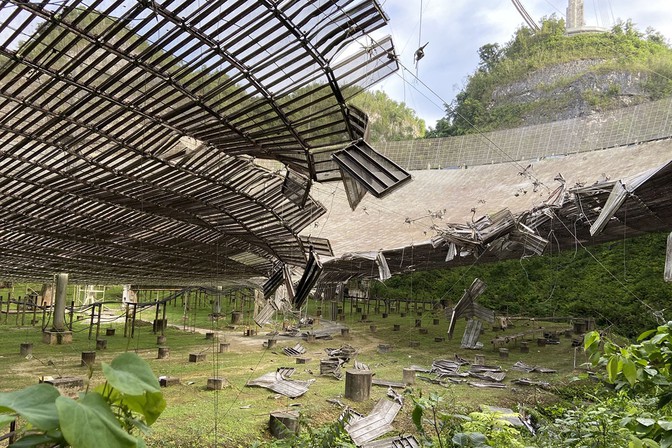
The legendary Arecibo Radio-Telescope in Puerto-Rico is destined to be closed down due to unprecedented damage. The movies "Contact" & "GoldenEye" was filmed in here.
With a dish size of 1000ft (305m), it was one of the most powerful telescopes in the world, built in 1963.
The trouble began in August. A metal support cable weighing thousands of pounds slipped out of its socket and plummeted into the cavernous, 1,000-foot-wide radio dish in the middle of the night. The cable, installed in the 1990s, was considered fairly new for an observatory that began operations in 1963, and the incident confounded Arecibo’s stewards. The cable “definitely should not have failed in the way it did,” Ashley Zauderer, the Arecibo program director at the National Science Foundation,which owns the telescope, said during a press conference.
Before this year, the last major cable problems at the observatory were in January 2014, when a magnitude-6.4 earthquake caused damage to another of the main cables, which engineers repaired. The ageing structure has suffered other shocks in recent years, including damage to an antenna and the dish caused by Hurricane Maria in 2017.
Many astronomers are saddened at the news and all near Earth asteroid studies will grind into a halt. They all depended on the pinging of the asteroids using the Arecibo telescope to estimate the shape & spin characteristics.
China built a massive telescope, 1640 ft, called FAST (Five-hundred meter Aperture Spherical Telescope). FAST's nickname is Tianyan, which means "Eye of the Sky" or "Eye of Heaven" But it's goal is to study Pulsars. Also planned to be used for very long baseline interferometry (VLBI) network. It was built in 2016 and currently still undergoing test & commissioning.
It can only use 300m at any time - any 300m segment can be focused onto the main receiver.
Sadly it currently lacks the radar studies that was possible at Arecibo. Much of the work conducted at Arecibo, however, could be done only with its unique array of astronomical instrumentation. “The Arecibo Telescope is irreplaceable,” said a statement from two major US radio-astronomy organizations, the National Radio Astronomy Observatory in Charlottesville, Virginia, and the Green Bank Observatory in West Virginia.
Also the Hubble, another famed telescope, is operating with fewer working parts than it launched with 30 years ago and is on the way out.
With a dish size of 1000ft (305m), it was one of the most powerful telescopes in the world, built in 1963.
The trouble began in August. A metal support cable weighing thousands of pounds slipped out of its socket and plummeted into the cavernous, 1,000-foot-wide radio dish in the middle of the night. The cable, installed in the 1990s, was considered fairly new for an observatory that began operations in 1963, and the incident confounded Arecibo’s stewards. The cable “definitely should not have failed in the way it did,” Ashley Zauderer, the Arecibo program director at the National Science Foundation,which owns the telescope, said during a press conference.
Before this year, the last major cable problems at the observatory were in January 2014, when a magnitude-6.4 earthquake caused damage to another of the main cables, which engineers repaired. The ageing structure has suffered other shocks in recent years, including damage to an antenna and the dish caused by Hurricane Maria in 2017.
Many astronomers are saddened at the news and all near Earth asteroid studies will grind into a halt. They all depended on the pinging of the asteroids using the Arecibo telescope to estimate the shape & spin characteristics.
China built a massive telescope, 1640 ft, called FAST (Five-hundred meter Aperture Spherical Telescope). FAST's nickname is Tianyan, which means "Eye of the Sky" or "Eye of Heaven" But it's goal is to study Pulsars. Also planned to be used for very long baseline interferometry (VLBI) network. It was built in 2016 and currently still undergoing test & commissioning.
It can only use 300m at any time - any 300m segment can be focused onto the main receiver.
Sadly it currently lacks the radar studies that was possible at Arecibo. Much of the work conducted at Arecibo, however, could be done only with its unique array of astronomical instrumentation. “The Arecibo Telescope is irreplaceable,” said a statement from two major US radio-astronomy organizations, the National Radio Astronomy Observatory in Charlottesville, Virginia, and the Green Bank Observatory in West Virginia.
Also the Hubble, another famed telescope, is operating with fewer working parts than it launched with 30 years ago and is on the way out.


