


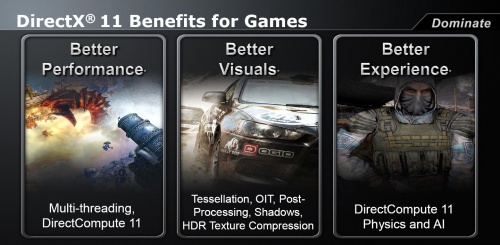
Following a successful run with the codenamed R700 family of GPUs, which was originally released back in June 2008 as the Radeon HD 4000 series, AMD is launching the highly anticipated R800. Debuting to no one's surprise as the ATI Radeon HD 5000 series, on our test bed today we have a reference HD 5870 graphics card packing some 2150 million transistors and produced on a 40nm process. The new Radeon HD 5000 series is said to deliver around 2x more performance than previous generation Radeon cards, and brings DirectX 11 support to desktops for the first time. Even while Nvidia is downplaying the latter, AMD sees it as a great advantage and expects DX11-capable games to start shipping before the end of the year.
Nvidia will also support DirectX 11 on future hardware of course, but the way things are going it looks as though we'll still have to wait a few months before their response to the new Radeon HD line arrives.
AMD's pricing strategy with the Radeon HD 5000 series will be quite interesting too, as for the first time in a long while the company will be looking to take the performance crown from Nvidia. Previous generation ATI graphics cards have been unable to compete with the fastest Nvidia solutions, forcing AMD to heavily discount their products in an effort to deliver better value.
In the end the Radeon HD 4850 was competing with the much older GeForce 9800 GTX, while the Radeon HD 4870 ran somewhat unopposed at $299. At this price point the 4870 delivered an impressive level of performance, though it was overshadowed by improved GeForce GTX graphics cards over the next 12 months.
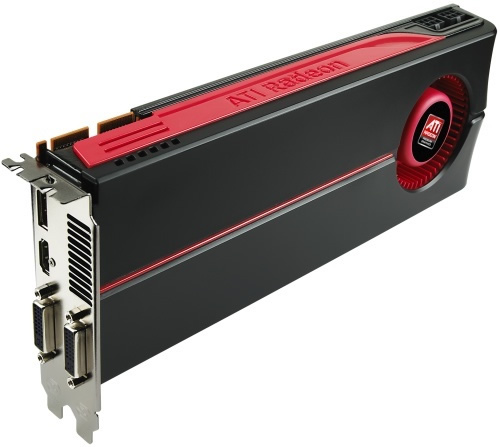
The new Radeon HD 5870 is in a very different position, though. This time around it looks like AMD is not going to be forced into a pricing war as easily -- at least not yet anyway. So for now the HD 5870 makes its debut with an MSRP of $380, while the Radeon HD 5850 is also arriving today priced at around $260.
This makes the Radeon HD 5870 roughly $120 cheaper than today's undisputable performance champ, the GeForce GTX 295. It also makes it almost twice as costly as the Radeon HD 4890, however, which begs the question: is the Radeon HD 5870 really that much faster? Today we finally get to find out, as we will be comparing AMD's latest and greatest against every single high-end graphics card released over the past year.
Way back in 1965, Intel co-founder Gordon E. Moore released a paper stating that the number of transistors that can be placed economically on an integrated circuit would double approximately every two years. This was later named Moore's Law, and it accurately describes a driving force of technological and social change in the late 20th and early 21st centuries.
While the trend has continued for more than half a century and is not expected to stop until 2015 or even later, with the introduction of the Radeon HD 5870 graphics card claims they are breaking Moore's Law -- and rightly so. Specifically, they are going from a transistor count of roughly 956 million to a staggering 2150 million within a 15 month period between 2008 and 2009.

There have also been some notable improvements in terms of efficiency over the past few years. The Radeon X1800XT released in late 2005 provided just 1.07 GFLOPS/W, for example, while in early 2006 the X1900XTX was capable of 2.01 GFLOPS/W. Progress then seemed to stall for some time, coincidentally around the time of the AMD/ATI merger, as 18 months down the road the Radeon HD 2900 Pro reached 2.21 GFLOPS/W.
Finally a few months later the Radeon HD 3870 was released featuring a die shrink which improved efficiency to 4.50 GFLOPS/W. Then along came the Radeon HD 4870 providing 7.50 GFLOPS/W, and now we have the Radeon HD 5870 with an efficiency rating of 14.47 GFLOPS/W.
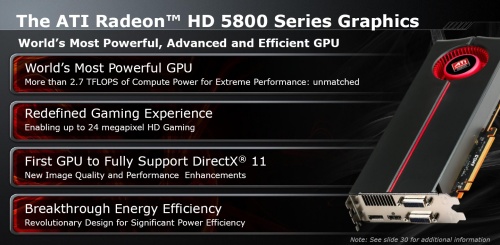
Behind this massive leap is the 40nm design of the new “Cypress XT” GPU, which also allowed for a very complex configuration. Putting things into perspective, while the Radeon HD 4870 featured 800 SPUs along with 40 TAUs (Texture Address Units) and 16 ROPs (Rasterization Operator Units), the new and improved 5870 boasts double everything -- 1600 SPUs, 80 TAUs and 32 ROPs. This has bumped compute power from 1.2 TFLOPs to an insane 2.72 TFLOPs out of a single GPU.
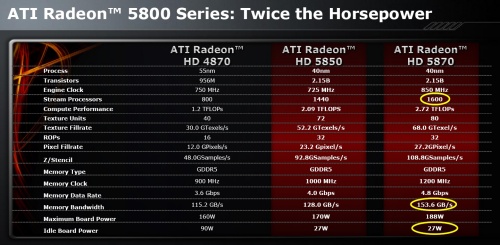
The core clock speed has also been increased from 750MHz to 850MHz compared to the Radeon HD 4870, instead matching the 4890 variant. The Radeon HD 5870 still utilizes GDDR5 memory, which is now clocked at 1200MHz, allowing for a memory bandwidth of 153.6GB/s, or a whopping 33% more than the 4870.


 Don't talk to others like than


