Before Muslims Invade Iran ... you'll be amazed how beautiful it was ...

tarson

Well-known member
  • Feb 25, 2009
    8,429
    5,520
    113
    Before Muslims Invade Iran ... you'll be amazed how beautiful it was ... how much freedom the females had .. now nothing ... :P:P:yes::yes: , Iran once was a Buddhist country, I have many muslim friends but, you destroyed this country.

    Iran Before 1979 , the era of the Phallavi Dynasty

    ඉරානය .. මුස්ලිම් ආක්‍රමණයට පෙර ... පල්ලවී රාජ වංශය පැවතුණු වකවානුව ... රට කොච්චර ලස්සනද ඒ කාලේ ... :love::love:


    :P:P


    මේ දැන් තිබෙන තත්වය ... :frown::frown:

    iran_female_ninjas.jpg

     
    Last edited:
    • Like
    Reactions: bhashi2

    amilaxp

    Member
    Dec 1, 2006
    2,370
    302
    0
    The world would be a far more better & beautiful place without disgusting Muslims!
    90% of the worlds problems will be over if Muslims are not there!
    Islam is the cancer of the world!
    Fuck Islam! Fuck Allah!!
     

    mano3989

    Well-known member
  • Mar 25, 2011
    7,844
    839
    113
    mehetath wenne okama thama ban,un 10% aduwen idala dana sadde kohomada,50% kittu kaladata apita mehe inna wenne naha
     
    Jun 7, 2013
    40
    1
    0
    http://en.wikipedia.org/wiki/Iran#Early_History

    Middle Ages (652–1501)

    The prolonged Roman-Persian wars, as well as social conflict within the Empire opened the way for an Islamic invasion of Iran in the 7th century.[64][65] Initially defeated by the Rashidun Caliphate, Iran later came under the rule of their successors the Ummayad and Abbasid Caliphates. The process of conversion of Iranians to Islam which followed was a prolonged and gradual process. Under the new Arab elite of the Rashidun and later Ummayad Caliphates Iranians, both Muslim (mawali) and non-Muslim (Dhimmi), were discriminated, being excluded from government and military, and having to pay a special tax.[66][67] In 750 the Abbasids succeeded in overthrowing the Ummayad Caliphate, mainly due to the support from dissatisfied Iranian mawali.[68] The mawali formed the majority of the rebel army, which was led by the Iranian general Abu Muslim.[69][70][71] After two centuries of Arab rule semi-independent and independent Iranian kingdoms (such as the Tahirids, Saffarids, Samanids and Buyids) began to appear on the fringes of the declining Abbasid Caliphate. By the Samanid era in the 9th and 10th centuries Iran's efforts to regain its independence had been well solidified

    The arrival of the Abbasid Caliphs saw a revival of Persian culture and influence, and a move away from Arabic culture. The role of the old Arab aristocracy was slowly replaced by a Persian bureaucracy.[73] The blossoming Persian literature, philosophy, medicine, and art became major elements in the forming of a Muslim civilization during the Islamic Golden Age.[74][75] The Islamic Golden Age reached its peak in the 10th and 11th centuries, during which Persia was the main theatre of scientific activity.[76] After the 10th century, Persian, alongside Arabic, was used for scientific, philosophical, historical, mathematical, musical, and medical works, as important Iranian writers such as Nasir al-Din al-Tusi, Avicenna, Qotb al-Din Shirazi, Naser Khusraw and Biruni made contributions to Persian scientific writing.
    The cultural revival that began in the Abbasid period led to a resurfacing of Iranian national identity, and so earlier attempts of Arabization never succeeded in Iran. The Iranian Shuubiyah movement became a catalyst for Iranians to regain their independence in their relations with the Arab invaders.[77] The most notable effect of the movement was the continuation of the Persian language attested to the epic poet Ferdowsi, now regarded as the most important figure in Persian literature.
    The 10th century saw a mass migration of Turkic tribes from Central Asia into the Iranian plateau.[78] Turkic tribesmen were first used in the Abbasid army as slave-warriors (Mamluks), replacing Persian and Arab elements within the army.[69] As a result the Mamluks gained significant political power. In 999, Iran came under the rule of Ghaznavid dynasty, whose rulers were of Mamluk Turk origin, and later under the Turkish Seljuk and Khwarezmian Empires. These Turks had been Persianised and had adopted Persian models of administration and rulership.[78] The result of the adoption and patronage of Persian culture by Turkish rulers was the development of a distinct Turko-Persian tradition.

    In 1219-21 the Khwarezmian Empire suffered a devastating invasion by Genghis Khan's Mongol army. Mongol violence and depredations killed up to three-fourths of the population of the Iranian Plateau, possibly 10 to 15 million people. Some historians have estimated that Iran's population did not again reach its pre-Mongol levels until the mid-20th century.[79] Following the fracture of the Mongol Empire in 1256 Hulagu Khan, Genghis Khan's grandson, established the Ilkhanate dynasty in Iran. In 1370 yet another conqueror, Timur, commonly known as Tamerlane in the West, followed Hulagu's example, establishing the Timurid Dynasty which lasted for another 156 years. In 1387, Timur ordered the complete massacre of Isfahan, reportedly killing 70,000 citizens.[80] Hulagu, Timur and their successors soon came to adopt the ways and customs of the Persians, choosing to surround themselves with a culture that was distinctively Persian

    Dynasties (1501–1979)

    At the start of the 16th century, Shah Ismail I (1500-1525), the founder of the Safavid Dynasty, established himself as ruler of western Persia and Azerbaijan.[78] He subsequently extended his authority over all of Persia. Ismail is also known for instigating a religious revolution in Iran, forcefully converting the predominantly Sunni population to the state religion of Shi'a Islam.[82] There was an intense rivalry between Safavid Persia and the Ottoman Empire, leading to the Ottoman–Persian Wars.[79] During the Safavid era Iran once again became a centre for high civilisation and wealth, peaking in the reign of the brilliant soldier, statesman and administrator Shah Abbas I (1587-1629).[27][79] Under his rule the state became highly centralized, the army was reorganized and modernized, and a distinct style of architecture was developed in his new capital at Isfahan. However, following a slow decline in the late 17th and early 18th centuries, the Safavid dynasty was instead ended by Pashtun rebels who besieged Isfahan and defeated Soltan Hosein in 1722.
    In 1729, a Khorasan chieftain, Nader Shah, successfully drove out, then conquered the Pashtun invaders. He repeatedly defeated the Turks and, by 1735, had regained territory lost to the Ottoman and Russian Empires. In 1738-9 he made a very profitable incursion into the Mughal Empire. His military successes on all fronts earned him the nickname "Napoleon of Persia" or "the second Alexander". Following a brief period of civil war and turmoil, sparked by Nader Shah's assassination, Karim Khan came to power in 1750, giving himself the title Vakil e-Ra'aayaa (Representative of the People), and bringing a period of relative peace and prosperity.[79]
    Another civil war ensued after Karim Khan's death in 1779, out of which Aga Muhammad Khan emerged victorious, founding the Qajar Dynasty in 1794 and establishing Tehran as his capital. This cruel and brutal ruler was assassinated in 1797. Qajar rule was marked by its inadequate response to change and its failure to maintain Iranian territorial integrity and sovereignty, and is consequently characterised by over a century of misrule.[78] The Great Persian Famine of 1870–1871 is believed to have caused the death of 1.5 million persons, or 20–25% of Persia's population.[83] Whilst resisting efforts to be colonised, Iran suffered in the 19th century as a result of Russian and British empire-building, known as 'The Great Game', losing much of its territory in the Russo-Persian and the Anglo-Persian Wars. A series of protests took place in response to the sale of concessions to foreigners by Nasser al-Din Shah and Mozaffar ad-Din Shah between 1872 and 1905, the last of which resulted in the Iranian Constitutional Revolution and establishment of Iran's first national parliament (majles) in 1906. The corrupt and despotic Mohammad Ali Shah, rescinded the constitution, bombed the majles building and abolished parliament in 1908. A Russian army helped him to suppress the revolt in 1909. However, the struggle continued until 1911, when Mohammad Ali was defeated and forced to abdicate. On the pretext of restoring order, the Russians occupied northern Iran in 1911. During World War I, the British occupied much of western Iran, not fully withdrawing until 1921.

    In 1921 Reza Khan, Prime Minister of Iran and former general of the Persian Cossack Brigade, overthrew the incompetent and corrupt Qajar Dynasty and became Shah. An ardent nationalist, Reza Shah initiated policies of military, administrative and financial modernisation and centralization. He quickly persuaded the Russians to withdraw their forces from Iran.[78] Industrialization, the construction of the Trans-Iranian Railway and the establishment of a national education system can be named as some of his reforms. However, in 1941 he had been forced to abdicate in favour of his son, Mohammad Reza Pahlavi, by Britain and the USSR, who were both fearful of Reza Shah's nascent ties to Germany and in need of supply lines for the Allied war effort in the form of the new Trans-Iranian Railway.[84] During World War II, Iran was once again subject to British and Russian occupation, until their full withdrawal in 1946 following Iran's official complaint to the newly-formed United Nations Security Council. Pahlavi increased his political power by convening the Iran Constituent Assembly, 1949, which finally formed the Senate of Iran—a legislative upper house allowed for in the 1906 constitution but never brought into being. The new senators were largely supportive of Pahlavi, as he had intended.

    In 1951, after the assassination of prime minister Ali Razmara, Dr. Mohammad Mosaddegh was elected prime minister by a parliamentary vote which was then ratified by the Shah. As prime minister, Mosaddegh became enormously popular in Iran after he nationalized Iran's petroleum industry and oil reserves. In response, the British government, headed by Winston Churchill, embargoed Iranian oil and successfully enlisted the United States to join in a plot to depose the democratically elected government of Mosaddegh. In 1953 US President Dwight D. Eisenhower authorized Operation Ajax. The operation, supported by the Shah, was successful, and Mosaddegh was arrested on 19 August 1953. The coup was the first time the US had openly overthrown an elected, civilian government of another sovereign state.

    After Operation Ajax, Shah Mohammad Reza Pahlavi favoured American and British oil interests and his rule became increasingly autocratic. With American support, the Shah was able to rapidly modernize the Iranian infrastructure and military. However, his rule was also corrupt and repressive. Arbitrary arrests and torture by his secret police, SAVAK, were used to crush all forms of political opposition. Ayatollah Ruhollah Khomeini became an active critic of the Shah's White Revolution and publicly denounced the government.
    Khomeini was arrested and imprisoned for 18 months. After his release in 1964, Khomeini publicly criticized the United States government. The Shah sent him into exile. He went first to Turkey, then to Iraq and finally to France. While in exile, Khomeini continued to denounce the Shah.

    as a pakistani....i know sri lankans are pure idiots ....so please don't show this in public
    i know ......these idiots are believing that whole Arabic countries were Buddhist....and whole Europe & America were Buddhist.....ha haaaa
     
    Last edited:

    tarson

    Well-known member
  • Feb 25, 2009
    8,429
    5,520
    113
    پاکستان زندہ باد;15120234 said:
    http://en.wikipedia.org/wiki/Iran#Early_History


    as a pakistani....i know sri lankans are pure idiots ....so please don't show this in public
    i know ......these idiots are believing that whole Arabic countries were Buddhist....and whole Europe & America were Buddhist.....ha haaaa

    You get your sources from WIKIPEDIA ? LOL, sometimes you might don't know, it's editable, that's why universities don't allow and restrict Wikipedia as a reference, What is your educational level. Iran once was a Buddhist country. Please at least go to school, don't ruin your country's name... it's natural that you get hurt, we'll happily send you some medicine ... :rofl::rofl: , thanks for bumping this thread up .. please comment more, I just need more bumps ...
     
    Last edited:

    mano3989

    Well-known member
  • Mar 25, 2011
    7,844
    839
    113
    پاکستان زندہ باد;15120234 said:
    i know ......these idiots are believing that whole Arabic countries were Buddhist....and whole Europe & America were Buddhist.....ha haaaa

    The Maurya Empire under Emperor Aśoka was the world's first major Buddhist state. It established free hospitals and free education and promoted human rights.

    Maurya_Dynasty_in_265_BCE.jpg


    Buddhist proselytism at the time of Emperor Aśoka (260–218 BCE), according to the edicts of Aśoka.

    File:Asoka_Kaart.gif


    Expansion of Mahāyāna Buddhism between the 1st and 10th centuries CE.

    File:MahayanaMap.gif


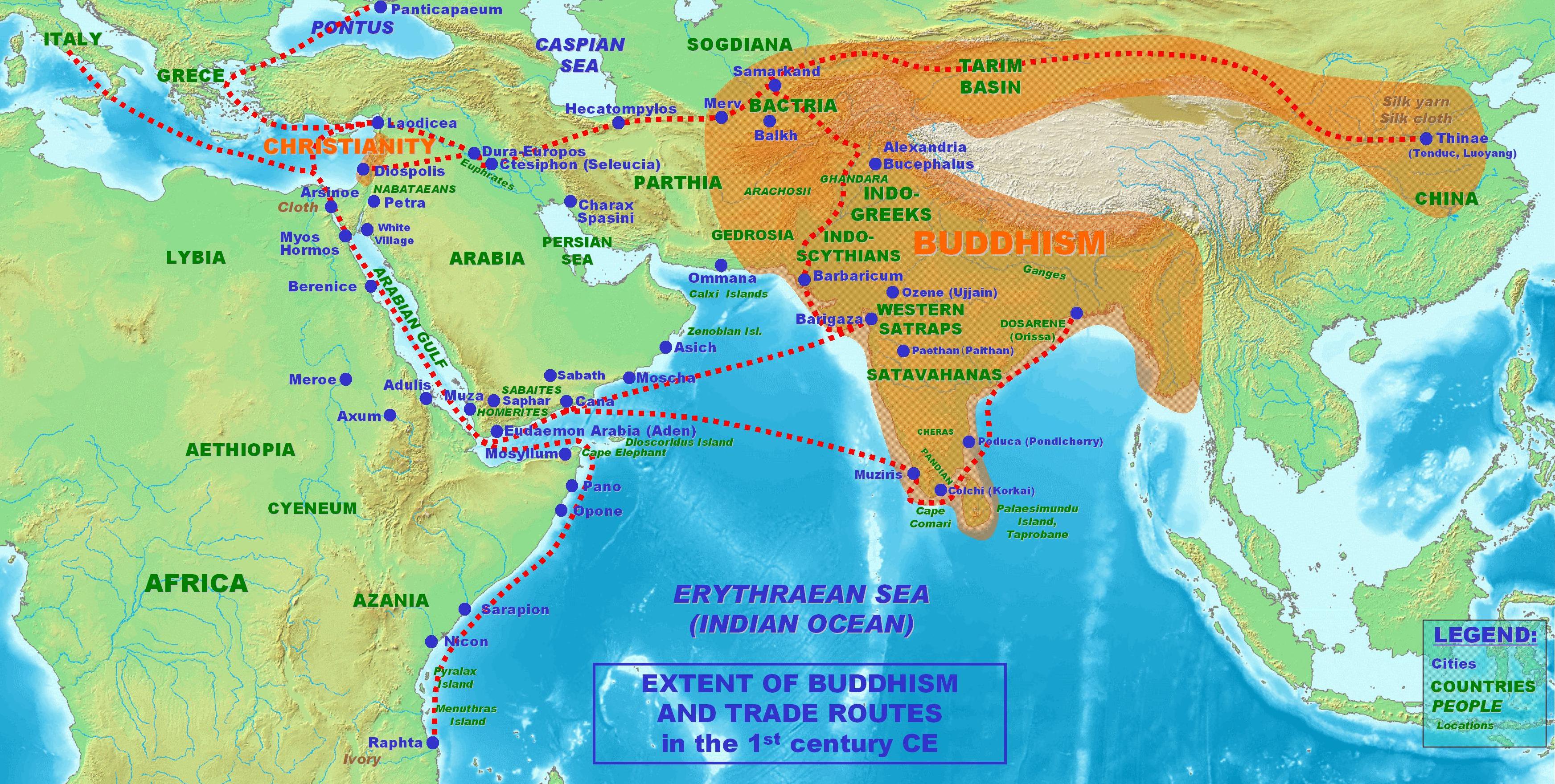
    Extent of Buddhism and trade routes in the 1st century CE.


    ExtentOfBuddhismAndTrade.jpg
     

    tarson

    Well-known member
  • Feb 25, 2009
    8,429
    5,520
    113
    mama hithanne godak aya kamathi issara wage gahanu tika than deka eliyata dagena hitiyanam ne............:P:P:P


    සිදුනද සත්තරනේ .. :lol:.. Bump කිරීම වෙනුවෙන් මුස්ලිම් මහතාට ස්තුතිය ... :yes: , මේකටත් රිප්ලයි එකක් දාපන් , මට bump අවශ්‍යයි ...
     

    mil rox

    Member
    Oct 8, 2012
    3,453
    451
    0
    colombo
    සිදුනද සත්තරනේ .. :lol:.. Bump කිරීම වෙනුවෙන් මුස්ලිම් මහතාට ස්තුතිය ... :yes: , මේකටත් රිප්ලයි එකක් දාපන් , මට bump අවශ්‍යයි ...

    as per your request,,,,,

    bump machan...............​
    ;););););)
     

    gtkisaru

    Well-known member
  • Dec 30, 2007
    10,265
    656
    113
    Los Ratmalanos.
    پاکستان زندہ باد;15120234 said:
    http://en.wikipedia.org/wiki/Iran#Early_History

    Middle Ages (652–1501)

    The prolonged Roman-Persian wars, as well as social conflict within the Empire opened the way for an Islamic invasion of Iran in the 7th century.[64][65] Initially defeated by the Rashidun Caliphate, Iran later came under the rule of their successors the Ummayad and Abbasid Caliphates. The process of conversion of Iranians to Islam which followed was a prolonged and gradual process. Under the new Arab elite of the Rashidun and later Ummayad Caliphates Iranians, both Muslim (mawali) and non-Muslim (Dhimmi), were discriminated, being excluded from government and military, and having to pay a special tax.[66][67] In 750 the Abbasids succeeded in overthrowing the Ummayad Caliphate, mainly due to the support from dissatisfied Iranian mawali.[68] The mawali formed the majority of the rebel army, which was led by the Iranian general Abu Muslim.[69][70][71] After two centuries of Arab rule semi-independent and independent Iranian kingdoms (such as the Tahirids, Saffarids, Samanids and Buyids) began to appear on the fringes of the declining Abbasid Caliphate. By the Samanid era in the 9th and 10th centuries Iran's efforts to regain its independence had been well solidified

    The arrival of the Abbasid Caliphs saw a revival of Persian culture and influence, and a move away from Arabic culture. The role of the old Arab aristocracy was slowly replaced by a Persian bureaucracy.[73] The blossoming Persian literature, philosophy, medicine, and art became major elements in the forming of a Muslim civilization during the Islamic Golden Age.[74][75] The Islamic Golden Age reached its peak in the 10th and 11th centuries, during which Persia was the main theatre of scientific activity.[76] After the 10th century, Persian, alongside Arabic, was used for scientific, philosophical, historical, mathematical, musical, and medical works, as important Iranian writers such as Nasir al-Din al-Tusi, Avicenna, Qotb al-Din Shirazi, Naser Khusraw and Biruni made contributions to Persian scientific writing.
    The cultural revival that began in the Abbasid period led to a resurfacing of Iranian national identity, and so earlier attempts of Arabization never succeeded in Iran. The Iranian Shuubiyah movement became a catalyst for Iranians to regain their independence in their relations with the Arab invaders.[77] The most notable effect of the movement was the continuation of the Persian language attested to the epic poet Ferdowsi, now regarded as the most important figure in Persian literature.
    The 10th century saw a mass migration of Turkic tribes from Central Asia into the Iranian plateau.[78] Turkic tribesmen were first used in the Abbasid army as slave-warriors (Mamluks), replacing Persian and Arab elements within the army.[69] As a result the Mamluks gained significant political power. In 999, Iran came under the rule of Ghaznavid dynasty, whose rulers were of Mamluk Turk origin, and later under the Turkish Seljuk and Khwarezmian Empires. These Turks had been Persianised and had adopted Persian models of administration and rulership.[78] The result of the adoption and patronage of Persian culture by Turkish rulers was the development of a distinct Turko-Persian tradition.

    In 1219-21 the Khwarezmian Empire suffered a devastating invasion by Genghis Khan's Mongol army. Mongol violence and depredations killed up to three-fourths of the population of the Iranian Plateau, possibly 10 to 15 million people. Some historians have estimated that Iran's population did not again reach its pre-Mongol levels until the mid-20th century.[79] Following the fracture of the Mongol Empire in 1256 Hulagu Khan, Genghis Khan's grandson, established the Ilkhanate dynasty in Iran. In 1370 yet another conqueror, Timur, commonly known as Tamerlane in the West, followed Hulagu's example, establishing the Timurid Dynasty which lasted for another 156 years. In 1387, Timur ordered the complete massacre of Isfahan, reportedly killing 70,000 citizens.[80] Hulagu, Timur and their successors soon came to adopt the ways and customs of the Persians, choosing to surround themselves with a culture that was distinctively Persian

    Dynasties (1501–1979)

    At the start of the 16th century, Shah Ismail I (1500-1525), the founder of the Safavid Dynasty, established himself as ruler of western Persia and Azerbaijan.[78] He subsequently extended his authority over all of Persia. Ismail is also known for instigating a religious revolution in Iran, forcefully converting the predominantly Sunni population to the state religion of Shi'a Islam.[82] There was an intense rivalry between Safavid Persia and the Ottoman Empire, leading to the Ottoman–Persian Wars.[79] During the Safavid era Iran once again became a centre for high civilisation and wealth, peaking in the reign of the brilliant soldier, statesman and administrator Shah Abbas I (1587-1629).[27][79] Under his rule the state became highly centralized, the army was reorganized and modernized, and a distinct style of architecture was developed in his new capital at Isfahan. However, following a slow decline in the late 17th and early 18th centuries, the Safavid dynasty was instead ended by Pashtun rebels who besieged Isfahan and defeated Soltan Hosein in 1722.
    In 1729, a Khorasan chieftain, Nader Shah, successfully drove out, then conquered the Pashtun invaders. He repeatedly defeated the Turks and, by 1735, had regained territory lost to the Ottoman and Russian Empires. In 1738-9 he made a very profitable incursion into the Mughal Empire. His military successes on all fronts earned him the nickname "Napoleon of Persia" or "the second Alexander". Following a brief period of civil war and turmoil, sparked by Nader Shah's assassination, Karim Khan came to power in 1750, giving himself the title Vakil e-Ra'aayaa (Representative of the People), and bringing a period of relative peace and prosperity.[79]
    Another civil war ensued after Karim Khan's death in 1779, out of which Aga Muhammad Khan emerged victorious, founding the Qajar Dynasty in 1794 and establishing Tehran as his capital. This cruel and brutal ruler was assassinated in 1797. Qajar rule was marked by its inadequate response to change and its failure to maintain Iranian territorial integrity and sovereignty, and is consequently characterised by over a century of misrule.[78] The Great Persian Famine of 1870–1871 is believed to have caused the death of 1.5 million persons, or 20–25% of Persia's population.[83] Whilst resisting efforts to be colonised, Iran suffered in the 19th century as a result of Russian and British empire-building, known as 'The Great Game', losing much of its territory in the Russo-Persian and the Anglo-Persian Wars. A series of protests took place in response to the sale of concessions to foreigners by Nasser al-Din Shah and Mozaffar ad-Din Shah between 1872 and 1905, the last of which resulted in the Iranian Constitutional Revolution and establishment of Iran's first national parliament (majles) in 1906. The corrupt and despotic Mohammad Ali Shah, rescinded the constitution, bombed the majles building and abolished parliament in 1908. A Russian army helped him to suppress the revolt in 1909. However, the struggle continued until 1911, when Mohammad Ali was defeated and forced to abdicate. On the pretext of restoring order, the Russians occupied northern Iran in 1911. During World War I, the British occupied much of western Iran, not fully withdrawing until 1921.

    In 1921 Reza Khan, Prime Minister of Iran and former general of the Persian Cossack Brigade, overthrew the incompetent and corrupt Qajar Dynasty and became Shah. An ardent nationalist, Reza Shah initiated policies of military, administrative and financial modernisation and centralization. He quickly persuaded the Russians to withdraw their forces from Iran.[78] Industrialization, the construction of the Trans-Iranian Railway and the establishment of a national education system can be named as some of his reforms. However, in 1941 he had been forced to abdicate in favour of his son, Mohammad Reza Pahlavi, by Britain and the USSR, who were both fearful of Reza Shah's nascent ties to Germany and in need of supply lines for the Allied war effort in the form of the new Trans-Iranian Railway.[84] During World War II, Iran was once again subject to British and Russian occupation, until their full withdrawal in 1946 following Iran's official complaint to the newly-formed United Nations Security Council. Pahlavi increased his political power by convening the Iran Constituent Assembly, 1949, which finally formed the Senate of Iran—a legislative upper house allowed for in the 1906 constitution but never brought into being. The new senators were largely supportive of Pahlavi, as he had intended.

    In 1951, after the assassination of prime minister Ali Razmara, Dr. Mohammad Mosaddegh was elected prime minister by a parliamentary vote which was then ratified by the Shah. As prime minister, Mosaddegh became enormously popular in Iran after he nationalized Iran's petroleum industry and oil reserves. In response, the British government, headed by Winston Churchill, embargoed Iranian oil and successfully enlisted the United States to join in a plot to depose the democratically elected government of Mosaddegh. In 1953 US President Dwight D. Eisenhower authorized Operation Ajax. The operation, supported by the Shah, was successful, and Mosaddegh was arrested on 19 August 1953. The coup was the first time the US had openly overthrown an elected, civilian government of another sovereign state.

    After Operation Ajax, Shah Mohammad Reza Pahlavi favoured American and British oil interests and his rule became increasingly autocratic. With American support, the Shah was able to rapidly modernize the Iranian infrastructure and military. However, his rule was also corrupt and repressive. Arbitrary arrests and torture by his secret police, SAVAK, were used to crush all forms of political opposition. Ayatollah Ruhollah Khomeini became an active critic of the Shah's White Revolution and publicly denounced the government.
    Khomeini was arrested and imprisoned for 18 months. After his release in 1964, Khomeini publicly criticized the United States government. The Shah sent him into exile. He went first to Turkey, then to Iraq and finally to France. While in exile, Khomeini continued to denounce the Shah.

    as a pakistani....i know sri lankans are pure idiots ....so please don't show this in public
    i know ......these idiots are believing that whole Arabic countries were Buddhist....and whole Europe & America were Buddhist.....ha haaaa

    lol a fucking muzrat in the house ... :lol: what made u think that we are going to read ur long bullshit ?
     

    hancok

    Well-known member
  • Aug 16, 2008
    36,592
    19,043
    113
    පිළි-ඇඳි-දොළ
    پاکستان زندہ باد;15120234 said:
    as a pakistani....i know sri lankans are pure idiots ....so please don't show this in public
    i know ......these idiots are believing that whole Arabic countries were Buddhist....and whole Europe & America were Buddhist.....ha haaaa

    no we wish all those countries would get rid of fucking islam some day.
    shitty countries like yours doesn't deserve buddhism