


Alpacas are kept in herds that graze on the level heights of the Andes of Ecuador, southern Peru, northern Bolivia, and northern Chile at an altitude of 3500 to 5000 meters above sea-level, throughout the year. Alpacas are considerably smaller than llamas, and unlike llamas, alpacas are not used as beasts of burden but are valued only for their fiber. Alpaca fiber is used for making knitted and woven items, much as sheep's wool is. These items include blankets, sweaters, hats, gloves, scarves, a wide variety of textiles and ponchos in South America, and sweaters, socks, coats and bedding in other parts of the world. The fiber comes in more than 52 natural colors as classified in Peru, 12 as classified in Australia and 16 as classified in the United States. Alpacas and llamas differ in that alpacas have straight ears and llamas have banana-shaped ears. Aside from these differences, llamas are on average 1-2 feet taller and proportionally bigger than alpacas.
In the textile industry, "alpaca" primarily refers to the hair of Peruvian alpacas, but more broadly it refers to a style of fabric originally made from alpaca hair but now often made from similar fibers, such as mohair, Icelandic sheep wool, or even high-quality English wool. In trade, distinctions are made between alpacas and the several styles of mohair and luster.
The Angora rabbit

The Angora rabbit is a variety of domestic rabbit bred for its long, soft hair. The Angora is one of the oldest types of domestic rabbit, originating in Ankara, Turkey, along with the Angora cat and Angora goat. The rabbits were popular pets with French royalty in the mid 1700s, and spread to other parts of Europe by the end of the century. They first appeared in the United States in the early 1900s. They are bred largely for their long angora wool, which may be removed by shearing, Combing, or plucking (gently pulling loose wool).
There are many individual breeds of Angora rabbits, four of which are ARBA recognized. Such breeds include French, German, Giant, English, Satin, Chinese, Swiss and Finnish, to name a few.
The Axolotl
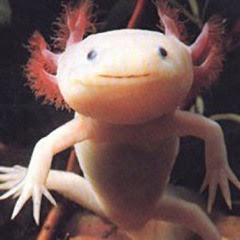
The Axolotl (Ambystoma mexicanum) is the best-known of the Mexican neotenic mole salamanders belonging to the Tiger Salamander complex. Larvae of this species fail to undergo metamorphosis, so the adults remain aquatic and gilled. The species originates from the lake underlying Mexico City. Axolotls, also known as ajolote (ajolote is incorrect) are used extensively in scientific research due to their ability to regenerate most body parts, ease of breeding, and large embryos. They are commonly kept as pets in the United States, Great Britain (under the spelling axlotl), Australia, Japan (where they are sold under the name wooper rooper (ウーパールーパー, Ūpā Rūpā?), and other countries.
Axolotls should not be confused with waterdogs, the larval stage of the closely related Tiger Salamanders (Ambystoma tigrinum and Ambystoma mavortium), which is widespread in much of North America which also occasionally become neotenic, nor with mudpuppies (Necturus spp.), fully-aquatic salamanders which are unrelated to the axolotl but which bear a superficial resemblance.
The Aye-aye

The Aye-aye (Daubentonia madagascariensis) is a strepsirrhine native to Madagascar that combines rodent-like teeth with a long, thin middle finger to fill the same ecological niche as a woodpecker. It is the world's largest nocturnal primate, and is characterized by its unique method of finding food; it taps on trees to find grubs, then gnaws holes in the wood and inserts its elongated middle finger to pull the grubs out.
Daubentonia is the only genus in the family Daubentoniidae and infraorder Chiromyiformes. The Aye-aye is the only extant member of the genus (although it is currently an endangered species); a second species, Daubentonia robusta, appears to have become extinct at some point within the last 1000 years.
The Blobfish
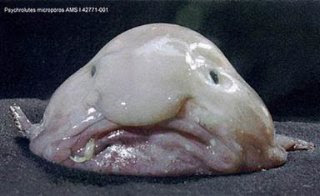
The Blobfish (Psychrolutes marcidus) is a fish that inhabits the deep waters off the coasts of Australia and Tasmania. Due to the inaccessibility of its habitat, it is rarely seen by humans.
Blobfish are found at depths where the pressure is several dozens of times higher than at sea level, which would likely make gas bladders inefficient. To remain buoyant, the flesh of the blobfish is primarily a gelatinous mass with a density slightly less than water; this allows the fish to float above the sea floor without expending energy on swimming. The relative lack of muscle is not a disadvantage as it primarily swallows edible matter that floats by in front of it. It is often caught by bottom trawling with nets.
Dumbo octopus

The octopuses of the genus Grimpoteuthis are also known as "Dumbo octopuses" from the ear-like fins protruding from the top of their head-like bodies, resembling the ears of Walt Disney's flying elephant. They are benthic creatures, living at extreme depths: 300-400 meters, and are some of the rarest of the Octopoda species. They can flush the transparent layer of their skin at will, and are pelagic animals, as with all other cirrate octopuses, and unlike many other incirrate octopuses.
They hover above the sea floor, searching for worms, bivalves, pelagic copepods, and other crustaceans. They move by pulsing their arms, shooting water through their funnel, or by waving their ear-like fins. They can use each of these techniques separately or all simultaneously. The males and females are different in their size and sucker patterns. The females lay eggs consistently, with no distinct breeding season.
The Emperor Tamarin
 The Emperor Tamarin (Saguinus imperator) is a tamarin allegedly named for its resemblance to the German emperor Wilhelm II. It lives in the southwest Amazon Basin, in east Peru, north Bolivia and in the west Brazilian states of Acre and Amazonas.
This primate inhabits tropical rain forests, living deep in the forest and also in open tree-covered areas. This diurnal species walks or runs quadrupedally through the forest, spending the majority of its days in the trees with quick, safe movements and broad jumps among the limbs.
The Emperor Tamarin lives together in groups of two to eight animals. The oldest female leads the group above several mature males. Mutual grooming plays an important role for bonding and socializing. The Emperor Tamarin is known to form mixed-species associations with the Brown-mantled Tamarin (Saguinus fuscicollis). It has various cries which help them to promptly recognize interlopers.The diet of the Emperor Tamarin is similar to that of other tamarins. It is an omnivore, primarily eating fruits, insects and sap. When feeding on sap, the Emperor Tamarin latches on to the tree vertically with its claws dug into the bark of the tree. It also eats bird eggs and small vertebrates (such as tree frogs). Due to its small weight it can reach food at the far end of branches, which are not accessible to heavier animals.
The Emperor Tamarin lives a polyandrous life, i.e. the mature female mates with all of the males of her harem. Gestation is 140 to 145 days, and births are typically twins (although triplets happen on occasion) as is typical of tamarins. All the males, father or not, help with the birth, care, and support of the young, carrying them and bringing them to the mother to nurse. At approximately three months they are weaned, and toward the end of the second year they are fully mature. The Emperor Tamarin's life expectancy is over 15 years. Very little is known about the population of Emperor Tamarin in the wild.
The Frill-necked Lizard
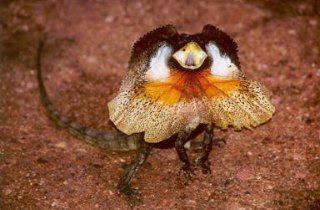

The Frill-necked Lizard, or Frilled Lizard also known as the Frilled Dragon, (Chlamydosaurus kingii) is so called because of the large ruff of skin which usually lies folded back against its head and neck. The neck frill is supported by long spines of cartilage, and when the lizard is frightened, it gapes its mouth showing a bright pink or yellow lining, and the frill flares out, displaying bright orange and red scales. The frill may also aid in thermoregulation.
Hagfish
 Hagfish are marine craniates of the class Myxini, also known as Hyperotreti. Myxini is the only class in the clade Craniata that does not also belong to the subphylum Vertebrata. That is, they are the only animals which have a skull but not a vertebral column.
Despite their name, there is some debate about whether they are strictly fish (as there is for lampreys), since they belong to a much more primitive lineage than any other group that is commonly defined fish (Chondrichthyes and Osteichthyes). Their unusual feeding habits and slime-producing capabilities have led members of the scientific and popular media to dub the hagfish as the most "disgusting" of all sea creatures. Although hagfish are sometimes called "slime eels," they are not eels at all.
The Komondor dog


The Komondor (lat. Canis familiaris pastorialis villosus hungaricus) is a livestock guardian dog breed originally from Hungary. The plural is in Hungarian "Komondorok"
 The origin of the Komondor is debated. Some believe the Komondor were a dog of the Magyars, while others believe it to be a dog of the Sumerians. According to the most probable explanation, Komondors were brought to Hungary by Cumans, the Turkish speaking, nomadic people who settled Hungary during the 12th and 13th century. The name "quman-dur" means "belonging to the Cumans" or "the dog of the Cumans," thus distinguishing it from a similar Hungarian sheepdog breed which later merged with the Komondor. The name Komondor is found for the first time written in 1544 in the History of King Astiagis by Kákonyi Péter, in Hungarian. Later in 1673 Amos Comenius mentions the Komondor in one of his works.
The unique dreadlock appearance gives a hint of common origin with the Puli and the Bergamasco. There might also be a link between the Komondor and the big, white Russian livestock dogs, the South Russian Ovcharka. The dreadlock coat must have developed under a dry and extreme temperature climate as it provides superb protection against cold and hot weather, but is not too comfortable in wet weather. The origin of the Komondor is debated. Some believe the Komondor were a dog of the Magyars, while others believe it to be a dog of the Sumerians. According to the most probable explanation, Komondors were brought to Hungary by Cumans, the Turkish speaking, nomadic people who settled Hungary during the 12th and 13th century. The name "quman-dur" means "belonging to the Cumans" or "the dog of the Cumans," thus distinguishing it from a similar Hungarian sheepdog breed which later merged with the Komondor. The name Komondor is found for the first time written in 1544 in the History of King Astiagis by Kákonyi Péter, in Hungarian. Later in 1673 Amos Comenius mentions the Komondor in one of his works.
The Komondor is built for livestock guarding. It is big, strong, and armored with a thick coat. The coat provides protection against wild animals and the weather and vegetation, the coat of the dog looks similar to that of a sheep so it can easily blend into a flock and camouflage itself giving it an advantage when predators such as wolves attack. The coat is the trademark of the breed.
Today the Komondor is a fairly common breed in Hungary, its country of origin. Many Komondors were killed during World War II and local stories say that this is because when the Germans (and then the Russians) invaded, they had to kill the dog before they could capture a farm or house that it guarded.
The Narwhal


The Narwhal (Monodon monoceros) is an Arctic species of cetacean. It is a creature rarely found south of latitude 70°N. It is one of two species of white whale in the Monodontidae family (the other is the Beluga whale).
The most conspicuous characteristic of the male narwhal is its single, extraordinarily long tusk. It is an incisor tooth that projects from the left side of the upper jaw and forms a left-handed helix. The tusk can be up to three metres (nearly 10 ft) long (compared with a body length of 4-6 m [13-16 ft]) and weigh up to 10 kg (22 lbs). About one in 500 males has two tusks, which occurs when the right incisor, normally small, also grows out. A female narwhal may also produce a tusk, and there is a single recorded case of a female with dual tusks.
The purpose of the tusk is unknown, though various explanations have been proposed. One explanation suggested that the tusk was used to pierce the ice covering the narwhal's Arctic Sea habitat.Another suggested the tusk was used in echolocation. Other hypothesized uses include courting females, defense, and foraging for food. In yet another theory, the tusk is primarily used for showmanship and for dominance: males with larger tusks are more likely to successfully attract a mate. This hypothesis was suggested by the activity of "tusking", in which two males rub tusks).
However, recent work by a research team suggests that the tusk may in fact be a sensory organ. Electron micrographs of tusks revealed ten million tiny, deep tubules extending from the tusk's surface, apparently connecting to the narwhal's nervous system. While such tubules are present in the teeth of many species, they do not typically extend to the surface of healthy teeth. The exact sensory purpose of the tusk remains unknown, but scientists now hypothesize that it may detect temperature, salinity, pressure, or particulate makeup of the water environment.
Male narwhals weigh up to 1,600 kg (3,500 lb), and the females weigh around 1,000 kg (2,200 lb). Most of the body is pale with brown speckles in color, though the neck, head and edges of the flippers and fluke are nearly black. Older animals are usually more brightly colored than younger animals.
The Pink Fairy Armadillo burrows small holes near ant colonies in dry dirt. It feeds mainly on ants and ant larvae near its burrow. Occasionally it feeds on worms, snails, insects and larvae, or various plant and root material.
The most conspicuous characteristic of the male narwhal is its single, extraordinarily long tusk. It is an incisor tooth that projects from the left side of the upper jaw and forms a left-handed helix. The tusk can be up to three metres (nearly 10 ft) long (compared with a body length of 4-6 m [13-16 ft]) and weigh up to 10 kg (22 lbs). About one in 500 males has two tusks, which occurs when the right incisor, normally small, also grows out. A female narwhal may also produce a tusk, and there is a single recorded case of a female with dual tusks.
The purpose of the tusk is unknown, though various explanations have been proposed. One explanation suggested that the tusk was used to pierce the ice covering the narwhal's Arctic Sea habitat.Another suggested the tusk was used in echolocation. Other hypothesized uses include courting females, defense, and foraging for food. In yet another theory, the tusk is primarily used for showmanship and for dominance: males with larger tusks are more likely to successfully attract a mate. This hypothesis was suggested by the activity of "tusking", in which two males rub tusks).
However, recent work by a research team suggests that the tusk may in fact be a sensory organ. Electron micrographs of tusks revealed ten million tiny, deep tubules extending from the tusk's surface, apparently connecting to the narwhal's nervous system. While such tubules are present in the teeth of many species, they do not typically extend to the surface of healthy teeth. The exact sensory purpose of the tusk remains unknown, but scientists now hypothesize that it may detect temperature, salinity, pressure, or particulate makeup of the water environment.
Male narwhals weigh up to 1,600 kg (3,500 lb), and the females weigh around 1,000 kg (2,200 lb). Most of the body is pale with brown speckles in color, though the neck, head and edges of the flippers and fluke are nearly black. Older animals are usually more brightly colored than younger animals.
The Pink Fairy Armadillo
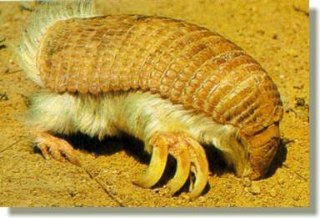
The Pink Fairy Armadillo (Chlamyphorus truncatus) or Pichiciago is the smallest species of armadillo (mammals of the family Dasypodidae, mostly known for having a bony armor shell). It is approximately 90-115 mm (3½-4½") long excluding the tail, and is pale rose or pink in color. It is found in central Argentina where it inhabits dry grasslands and sandy plains with thorn bushes and cacti. It has the ability to bury itself completely in a matter of seconds if frightened.
The Pink Fairy Armadillo burrows small holes near ant colonies in dry dirt. It feeds mainly on ants and ant larvae near its burrow. Occasionally it feeds on worms, snails, insects and larvae, or various plant and root material.


