Black-Hole and Time machine

cj4ever

Well-known member
  • Sep 9, 2007
    11,799
    272
    83
    funkoluwa said:
    No machan its possible if we can travel faster dan light we can go to future but i dont know about traveling to da past

    nivun dennek ek vagema
    ekkenek me loke idala ekek thava kenek space hitiyoth meavudu 20 beluvoth space vala kenetavada me loke kena vayasata yanava thiyenava

    hebeyi kavuda kivvekiyala mathaka nehe
     
    Last edited:

    funkoluwa

    Active member
  • May 28, 2007
    4,081
    16
    38
    Yokohama Japan
    mutantlast said:

    I think you don't know machan that Theory..

    According to it.. When some one travel faster than light, his mass increases to the infinity. To travel a object with infinite mass, needs infinite energy..

    According to the energy theories, there is no infinite energy in the universe..

    That is why we can't travel faster than the light and can not go to the past or future..


    i dont think humans thirst for speed has limits. at 50's scientists believe dat da human could only survive up to 3 G force but now days pilots experiencing more dan 15 G's

    and hav u heard of BIG BANG Machine in dat machine Beams of protons would be hurled together at 99.9999999% of the speed of light. its a big step isnt it? making something travel as fast as light

    it may seem impossible now with these evidences i think its possible in da future
     
    Last edited:

    dj_95

    Member
    May 1, 2008
    840
    0
    0
    RodneyGraham%20TimeMachine-723654.JPG


    may mokakk da????????????????
     

    suppa malinda

    Member
    Jul 13, 2007
    1,392
    2
    0
    සිර ගෙදර...
    ra1 said:
    Black-Hole and Time machine gana oyalaga adahasa mokadda ?

    monawada oyala dannee ?

    Black Hole යනු කලු හිල....:rofl: :rofl: අභ්*යවකාශයේ පවතින හිල් වර්ගයකි
    Time machine යනු කාල යන්ත්*රය... මාදන්නා පරිදි මෙය ඔරලෝසුවයි:lol: :lol:
     

    mutantlast

    Member
    Jul 25, 2008
    3,165
    9
    0
    Manu lowa Minisun Athara
    funkoluwa said:
    i dont think humans thirst for speed has limits. at 50's scientists believe dat da human could only survive up to 3 G force but now days pilots experiencing more dan 15 G's

    and hav u heard of BIG BANG Machine in dat machine Beams of protons would be hurled together at 99.9999999% of the speed of light. its a big step isnt it? making something travel as fast as light

    it may seem impossible now with these evidences i think its possible in da future
    It's only a imagine bro..

    I request you to study Quantum theories and
    Albert Einstein's theories about time and space. Then you will understand this.

    If not so, your idea is a personal sense only..


    mutantlast

    Member
    Jul 25, 2008
    3,165
    9
    0
    Manu lowa Minisun Athara
    suppa malinda said:
    Black Hole යනු කලු හිල....:rofl: :rofl: අභ්*යවකාශයේ පවතින හිල් වර්ගයකි
    Time machine යනු කාල යන්ත්*රය... මාදන්නා පරිදි මෙය ඔරලෝසුවයි:lol: :lol:


    mara joke ekak machan.. bada palenda hina yanawa.. :lol::lol::lol::lol::lol::lol::lol::lol::lol::lol:
     

    Kalegana

    Well-known member
  • Sep 23, 2007
    31,455
    67,001
    113
    Kuwait-Galle
    dinesh4u said:
    black hole kiyanne light eliyaka unath adala ganna thanak luneda ? ethanin eha paththe thawath samanthara lokayak thieynawa kiyanawalu.
    not even light,,,,,, "TIME" also drawn into the black hole as they say...........have u ever watch discovery channel about this????
     

    funkoluwa

    Active member
  • May 28, 2007
    4,081
    16
    38
    Yokohama Japan
    mutantlast said:
    It's only a imagine bro..

    I request you to study Quantum theories and
    Albert Einstein's theories about time and space. Then you will understand this.

    If not so, your idea is a personal sense only..


    R u thinking "Big Bang Machine" is a Imagination ohh bro just Google it n see
    and also time traveling is a theory of Einstein it aint ma personal sense its all about positiveness
     

    mutantlast

    Member
    Jul 25, 2008
    3,165
    9
    0
    Manu lowa Minisun Athara
    Presumably, Brian’s goal is to be able to travel nearly instantaneously between any two points in the galaxy. The problem is that there are physical laws we have to obey; we don’t have a choice. One of them is special relativity, which tells us that the maximum speed any object can move through space is c, or the speed of light in a vacuum, also known as 299,792,458 meters-per-second. Furthermore, only things with zero mass can ever travel even that fast (and even then only in a vacuum); everything with a mass always, by the laws of physics, has to travel slower than that.


    batlight.jpg
    First off, why is that the case? The easiest explanation is that light always travels at the speed of light. Well, duh, you might say, that’s by its definition! But this is actually profound. What it means is that, no matter how quickly you move, light will always move relative to you at the same speed! Let’s say I shine a light at BatmanTM, and Batman and I are both standing still. We can both measure the speed of that light, and we’ll both get the same value: c. On the other hand, what if I move towards Batman? If it were anything other than light, like a baseball, a bullet, or an electron (even electrons have mass), Batman and I would measure different velocities. Here’s why; let’s say I throw a baseball at 100 mi/hr, and I run towards Batman at 20 mi/hr. I would measure the baseball to be moving at 100 mi/hr, but Batman would measure the baseball at 120 mi/hr.
    slr.JPG
    But this doesn’t happen the same way with light; regardless of how fast I’m moving or how fast Batman moves, we both always measure the light beam to be moving at the same speed, c, or 670,000,000 mi/hr. If I take something with a mass, like my baseball, into a rocket, and I fly at 400,000,000 mi/hr towards Batman and launch the baseball at 400,000,000 mi/hr, will he observe the baseball moving at 800,000,000 mi/hr? No. Special Relativity tells us that velocities don’t work like that close to the speed of light, and Batman would see the baseball actually moving at 580,000,000 mi/hr, or less than the speed of light in a vacuum. Lots of funny things happen close to the speed of light, but this really boils down to three things:
    1. Clocks run slower.
    2. Lengths contract.
    3. Masses appear to increase.
    relativisticcurve.gif
    This last one explains why something with a mass can never move faster than c. No matter how much energy I put into something with a mass, trying to accelerate it faster and faster, I wind up making it heavier close to the speed of light, making it harder to accelerate. It gets so hard as I approach the speed of light, that to actually reach c, anything with a mass requires an infinite amount of energy! And that is why it’s impossible for anything with a mass to travel even as fast as the speed of light in a vacuum.
     

    mutantlast

    Member
    Jul 25, 2008
    3,165
    9
    0
    Manu lowa Minisun Athara
    funkoluwa said:
    R u thinking "Big Bang Machine" is a Imagination ohh bro just Google it n see
    and also time traveling is a theory of Einstein it aint ma personal sense its all about positiveness

    I did not tell you that big bang machine is not a reality. I know about it..

    I tolled you about being fast than light..

    You can travel in light speed, Only if you have 0 mass. It is the theory..

    PLS study more about time and space theories like this..

    then you will understand about this..

    eference frames, coordinates and the Lorentz transformation

    Lorentz_transform_of_world_line.gif
    Diagram 1. Changing views of spacetime along the world line of a rapidly accelerating observer. In this animation, the vertical direction indicates time and the horizontal direction indicates distance, the dashed line is the spacetime trajectory ("world line") of the observer. The lower quarter of the diagram shows the events that are visible to the observer, and the upper quarter shows the light cone- those that will be able to see the observer. The small dots are arbitrary events in spacetime. The slope of the world line (deviation from being vertical) gives the relative velocity to the observer. Note how the view of spacetime changes when the observer accelerates.


    Relativity theory depends on "reference frames". A reference frame is an observational perspective in space at rest, or in uniform motion, from which a position can be measured along 3 spatial axes. In addition, a reference frame has the ability to determine measurements of the time of events using a 'clock' (any reference device with uniform periodicity).
    An event is an occurrence that can be assigned a single unique time and location in space relative to a reference frame: it is a "point" in space-time. Since the speed of light is constant in relativity in each and every reference frame, pulses of light can be used to unambiguously measure distances and refer back the times that events occurred to the clock, even though light takes time to reach the clock after the event has transpired.
    For example, the explosion of a firecracker may be considered to be an "event". We can completely specify an event by its four space-time coordinates: The time of occurrence and its 3-dimensional spatial location define a reference point. Let's call this reference frame S.
    In relativity theory we often want to calculate the position of a point from a different reference point.
    Suppose we have a second reference frame S', whose spatial axes and clock exactly coincide with that of S at time zero, but it is moving at a constant velocity
    2d3fdc651d296cf7a5bde9d58fa58c47.png
    with respect to S along the
    6b206a28e60f665e235f89f460448467.png
    -axis.
    Since there is no absolute reference frame in relativity theory, a concept of 'moving' doesn't strictly exist, as everything is always moving with respect to some other reference frame. Instead, any two frames that move at the same speed in the same direction are said to be comoving. Therefore S and S' are not comoving.
    Let's define the event to have space-time coordinates
    0d871653a78a18c3218d0d8b87d03fc9.png
    in system S and
    b100279dfc8b3561ac2e3b52e9373ce7.png
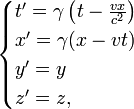
    in S'. Then the Lorentz transformation specifies that these coordinates are related in the following way:
    3d19435a89f6266f75ba4428624a1bc2.png
    where
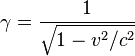
    3ddd7a11a3c82d824dc8204b3c740d49.png
    is called the Lorentz factor and
    08163b03d3a58471d7f88fc4e581a282.png
    is the speed of light in a vacuum.
    The
    ec9ff0a12771e750c2685d3b89a37c79.png
    and
    77698ae92ac0435f8da1e266eeb528e3.png
    coordinates are unaffected, but the
    6b206a28e60f665e235f89f460448467.png
    and
    0c68620ee2ea4f1286fcd672a47ea080.png
    axes are mixed up by the transformation. In a way this transformation can be understood as a hyperbolic rotation.
    A quantity invariant under Lorentz transformations is known as a Lorentz scalar.

    [edit] Simultaneity

    180px-Relativity_of_simultaneity_%28color%29.png
    magnify-clip.png

    Event B is simultaneous with A in the green reference frame, but it occurred before in the blue frame, and will occur later in the red frame.


    Main article: Relativity of simultaneity
    From the first equation of the Lorentz transformation in terms of coordinate differences
    532fc767d8b4fac5b36c40cf4faa9215.png
    it is clear that two events that are simultaneous in frame S (satisfying
    769fb77b3f855bce076350ec36de1fde.png
    ), are not necessarily simultaneous in another inertial frame S' (satisfying
    977a5928a0c3b56941099eb8f2e3903d.png
    ). Only if these events are colocal in frame S (satisfying
    110e15ea845293c80fd86b2ecded98d7.png
    ), will they be simultaneous in another frame S'.

    [edit] Time dilation and length contraction

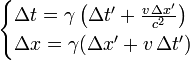
    Writing the Lorentz transformation and its inverse in terms of coordinate differences we get
    3491a6c9567162e3c7b087b89afb1cfd.png
    and
    2eb931bf3d165b17113d841d8c0ccd33.png
    Suppose we have a clock at rest in the unprimed system S. Two consecutive ticks of this clock are then characterized by Δx = 0. If we want to know the relation between the times between these ticks as measured in both systems, we can use the first equation and find:
    9171bfb675e35af3bc928c31f8d8a9be.png
    for events satisfying
    1e72d4936ea0c297c0e3c0dd3d07a5ea.png
    This shows that the time Δt' between the two ticks as seen in the 'moving' frame S' is larger than the time Δt between these ticks as measured in the rest frame of the clock. This phenomenon is called time dilation.
    Similarly, suppose we have a measuring rod at rest in the unprimed system. In this system, the length of this rod is written as Δx. If we want to find the length of this rod as measured in the 'moving' system S', we must make sure to measure the distances x' to the end points of the rod simultaneously in the primed frame S'. In other words, the measurement is characterized by Δt' = 0, which we can combine with the fourth equation to find the relation between the lengths Δx and Δx':
    2bc787848ed680ebda1c3cfbe2d90e50.png
    for events satisfying
    3669eefd79bd0397b462f2bdc31737ac.png
    This shows that the length Δx' of the rod as measured in the 'moving' frame S' is shorter than the length Δx in its own rest frame. This phenomenon is called length contraction or Lorentz contraction.
    These effects are not merely appearances; they are explicitly related to our way of measuring time intervals between events which occur at the same place in a given coordinate system (called "co-local" events). These time intervals will be different in another coordinate system moving with respect to the first, unless the events are also simultaneous. Similarly, these effects also relate to our measured distances between separated but simultaneous events in a given coordinate system of choice. If these events are not co-local, but are separated by distance (space), they will not occur at the same spacial distance from each other when seen from another moving coordinate system.
    See also the twin paradox.

    [edit] Causality and prohibition of motion faster than light

    See also: Causality
    180px-Light_cone.svg.png
    magnify-clip.png

    Diagram 2. Light cone


    In diagram 2 the interval AB is 'time-like'; i.e., there is a frame of reference in which event A and event B occur at the same location in space, separated only by occurring at different times. If A precedes B in that frame, then A precedes B in all frames. It is hypothetically possible for matter (or information) to travel from A to B, so there can be a causal relationship (with A the cause and B the effect).
    The interval AC in the diagram is 'space-like'; i.e., there is a frame of reference in which event A and event C occur simultaneously, separated only in space. However there are also frames in which A precedes C (as shown) and frames in which C precedes A. If it were possible for a cause-and-effect relationship to exist between events A and C, then paradoxes of causality would result. For example, if A was the cause, and C the effect, then there would be frames of reference in which the effect preceded the cause. Although this in itself won't give rise to a paradox, one can show[19][20] that faster than light signals can be sent back into one's own past. A causal paradox can then be constructed by sending the signal if and only if no signal was received previously.
    Therefore, one of the consequences of special relativity is that (assuming causality is to be preserved), no information or material object can travel faster than light. On the other hand, the logical situation is not as clear in the case of general relativity, so it is an open question whether there is some fundamental principle that preserves causality (and therefore prevents motion faster than light) in general relativity.
    Even without considerations of causality, there are other strong reasons why faster-than-light travel is forbidden by special relativity. For example, if a constant force is applied to an object for a limitless amount of time, then integrating F = dp/dt gives a momentum that grows without bound, but this is simply because p = mγv approaches infinity as v approaches c. To an observer who is not accelerating, it appears as though the object's inertia is increasing, so as to produce a smaller acceleration in response to the same force. This behavior is in fact observed in particle accelerators.
    See also the Tachyonic Antitelephone.

    [edit] Composition of velocities

    Main article: Velocity-addition formula
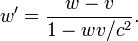
    If the observer in S sees an object moving along the x axis at velocity w, then the observer in the S' system, a frame of reference moving at velocity v in the x direction with respect to S, will see the object moving with velocity w' where
    291bfd8042576ef4c34fb191693e72c0.png
    This equation can be derived from the space and time transformations above. Notice that if the object were moving at the speed of light in the S system (i.e. w = c), then it would also be moving at the speed of light in the S' system. Also, if both w and v are small with respect to the speed of light, we will recover the intuitive Galilean transformation of velocities:
    01024237ce4b4758264717bfc5226ef7.png
    .

    [edit] Mass, momentum, and energy

    Main article: Mass in special relativity
    Main article: Conservation of energy
    In addition to modifying notions of space and time, special relativity forces one to reconsider the concepts of mass, momentum, and energy, all of which are important constructs in Newtonian mechanics. Special relativity shows, in fact, that these concepts are all different aspects of the same physical quantity in much the same way that it shows space and time to be interrelated.
    There are a couple of (equivalent) ways to define momentum and energy in SR. One method uses conservation laws. If these laws are to remain valid in SR they must be true in every possible reference frame. However, if one does some simple thought experiments using the Newtonian definitions of momentum and energy one sees that these quantities are not conserved in SR. One can rescue the idea of conservation by making some small modifications to the definitions to account for relativistic velocities. It is these new definitions which are taken as the correct ones for momentum and energy in SR.
    Given an object of invariant mass m traveling at velocity v the energy and momentum are given (and even defined) by
    0e419401477937951f338ef318c3d020.png
    0de7c35654c4a75d1799c03b4a5c9376.png
    where γ (the Lorentz factor) is given by
    9c9326e31375f7b1414ba44625f82617.png
    where
    4b7d8a868a6b40d0acedc244a1492e25.png
    is the ratio of the velocity and the speed of light. The term γ occurs frequently in relativity, and comes from the Lorentz transformation equations.
    Relativistic energy and momentum can be related through the formula
    f653e9c4c421742eebeca629813279d0.png
    which is referred to as the relativistic energy-momentum equation. It is interesting to observe that while the energy
    4b88f47f80273fd5788e1e20aa81c38a.png
    and the momentum
    5a34bb082daf037b3c4b14c13af6855b.png
    are observer dependent (vary from frame to frame) the quantity
    f653e9c4c421742eebeca629813279d0.png
    is observer independent.
    For velocities much smaller than those of light, γ can be approximated using a Taylor series expansion and one finds that
    027310ccc3a42491d3f9fc1b802ffb28.png
    7d80e8d905402dac56a5d950fd9eea3b.png
    Barring the first term in the energy expression (discussed below), these formulas agree exactly with the standard definitions of Newtonian kinetic energy and momentum. This is as it should be, for special relativity must agree with Newtonian mechanics at low velocities.
    Looking at the above formulas for energy, one sees that when an object is at rest (v = 0 and γ = 1) there is a non-zero energy remaining:
    f57148ca06805f12698851acbfafdbaf.png
    This energy is referred to as rest energy. The rest energy does not cause any conflict with the Newtonian theory because it is a constant and, as far as kinetic energy is concerned, it is only differences in energy which are meaningful.
    Taking this formula at face value, we see that in relativity, mass is simply another form of energy. In 1927 Einstein remarked about special relativity:
    Under this theory mass is not an unalterable magnitude, but a magnitude dependent on (and, indeed, identical with) the amount of energy.[21]
    This formula becomes important when one measures the masses of different atomic nuclei. By looking at the difference in masses, one can predict which nuclei have extra stored energy that can be released by nuclear reactions, providing important information which was useful in the development of nuclear energy and, consequently, the nuclear bomb. The implications of this formula on 20th-century life have made it one of the most famous equations in all of science.

    [edit] Relativistic mass

    Introductory physics courses and some older textbooks on special relativity sometimes define a relativistic mass which increases as the velocity of a body increases. According to the geometric interpretation of special relativity, this is often deprecated and the term 'mass' is reserved to mean invariant mass and is thus independent of the inertial frame, i.e., invariant.
    Using the relativistic mass definition, the mass of an object may vary depending on the observer's inertial frame in the same way that other properties such as its length may do so. Defining such a quantity may sometimes be useful in that doing so simplifies a calculation by restricting it to a specific frame. For example, consider a body with an invariant mass m moving at some velocity relative to an observer's reference system. That observer defines the relativistic mass of that body as:
    b14f7fe6981082bc7c748bace9149e70.png
    "Relativistic mass" should not be confused with the "longitudinal" and "transverse mass" definitions that were used around 1900 and that were based on an inconsistent application of the laws of Newton: those used f=ma for a variable mass, while relativistic mass corresponds to Newton's dynamic mass in which
    6c800c98064d48e822ad3db5a2ddb534.png
    and
    5d9efdf6aa0fb7a612740d2a786ac583.png
    . Note also that the body does not actually become more massive in its proper frame, since the relativistic mass is only different for an observer in a different frame. The only mass that is frame independent is the invariant mass. When using the relativistic mass, the applicable reference frame should be specified if it isn't already obvious or implied. It also goes almost without saying that the increase in relativistic mass does not come from an increased number of atoms in the object. Instead, the relativistic mass of each atom and subatomic particle has increased.
    Physics textbooks sometimes use the relativistic mass as it allows the students to utilize their knowledge of Newtonian physics to gain some intuitive grasp of relativity in their frame of choice (usually their own!). "Relativistic mass" is also consistent with the concepts "time dilation" and "length contraction".
     

    mutantlast

    Member
    Jul 25, 2008
    3,165
    9
    0
    Manu lowa Minisun Athara
    [edit] Force

    The classical definition of ordinary force f is given by Newton's Second Law in its original form:
    a0e352ec4c36fe245d8e8f12aefae9b1.png
    and this is valid in relativity.
    Many modern textbooks rewrite Newton's Second Law as
    bad7a3dfa148b8d91460887479cdc192.png
    This form is not valid in relativity or in other situations where the relativistic mass M is varying.
    This formula can be replaced in the relativistic case by
    6c3adfb901ca0e8b78ad13a65731c57c.png
    As seen from the equation, ordinary force and acceleration vectors are not necessarily parallel in relativity.
    However the four-vector expression relating four-force
    6b5c9f34a867390e015a73de6b4c7768.png
    to invariant mass m and four-acceleration
    85dad09955d0591fe6b69159d8855327.png
    restores the same equation form
    cc2b126adb7a9ccdc2800d87e218bcac.png

    [edit] The geometry of space-time

    Main article: Minkowski space
    SR uses a 'flat' 4-dimensional Minkowski space, which is an example of a space-time. This space, however, is very similar to the standard 3 dimensional Euclidean space, and fortunately by that fact, very easy to work with.
    The differential of distance (ds) in cartesian 3D space is defined as:
    d531b51aecf3401925695a3a31fffdb9.png
    where (dx1,dx2,dx3) are the differentials of the three spatial dimensions. In the geometry of special relativity, a fourth dimension is added, derived from time, so that the equation for the differential of distance becomes:
    2f1acb8b2fdd9eea4b76ad0323912c40.png
    If we wished to make the time coordinate look like the space coordinates, we could treat time as imaginary: x4 = ict . In this case the above equation becomes symmetric:
    88dcdf91e920635fcfc4b47aca5625e5.png
    This suggests what is in fact a profound theoretical insight as it shows that special relativity is simply a rotational symmetry of our space-time, very similar to rotational symmetry of Euclidean space. Just as Euclidean space uses a Euclidean metric, so space-time uses a Minkowski metric. Basically, SR can be stated in terms of the invariance of space-time interval (between any two events) as seen from any inertial reference frame. All equations and effects of special relativity can be derived from this rotational symmetry (the Poincaré group) of Minkowski space-time. According to Misner (1971 §2.3), ultimately the deeper understanding of both special and general relativity will come from the study of the Minkowski metric (described below) rather than a "disguised" Euclidean metric using ict as the time coordinate.
    If we reduce the spatial dimensions to 2, so that we can represent the physics in a 3-D space
    dae91985413e63aefc6e7aa08b7e16b1.png
    We see that the null geodesics lie along a dual-cone:
    134px-Sr1.svg.png
    defined by the equation
    a9114f064423d7f47a2fc95adba3b8d0.png
    or
    79f7cdedabf679384a8d9bb166eec55b.png
    Which is the equation of a circle with r=c×dt. If we extend this to three spatial dimensions, the null geodesics are the 4-dimensional cone:
    Sr3.jpg
    c72e1099f9fcceac1978f1cd3b3d1862.png
    98496bb56c45c8fb5213166671632065.png
    This null dual-cone represents the "line of sight" of a point in space. That is, when we look at the stars and say "The light from that star which I am receiving is X years old", we are looking down this line of sight: a null geodesic. We are looking at an event
    60f9a792ce08526a5d12f5df47eebf81.png
    meters away and d/c seconds in the past. For this reason the null dual cone is also known as the 'light cone'. (The point in the lower left of the picture below represents the star, the origin represents the observer, and the line represents the null geodesic "line of sight".)
    134px-Sr1.svg.png
    The cone in the -t region is the information that the point is 'receiving', while the cone in the +t section is the information that the point is 'sending'.
    The geometry of Minkowski space can be depicted using Minkowski diagrams, which are also useful in understanding many of the thought-experiments in special relativity.

    [edit] Physics in spacetime

    Here, we see how to write the equations of special relativity in a manifestly Lorentz covariant form. The position of an event in spacetime is given by a contravariant four vector whose components are:
    20bf8ba56d3be4008a6a2952d9a437a2.png
    That is, x0 = t and x1 = x and x2 = y and x3 = z. Superscripts are contravariant indices in this section rather than exponents except when they indicate a square. Subscripts are covariant indices which also range from zero to three as with the spacetime gradient of a field φ:
    035de9ff524fa8351c1b67a736b5ccc8.png

    [edit] Metric and transformations of coordinates

    Having recognised the four-dimensional nature of spacetime, we are driven to employ the Minkowski metric, η, given in components (valid in any inertial reference frame) as:
    a56bbc8865c96d757222af4927f7c91a.png
    Its reciprocal is:
    aee78a5d8bc51896cb05ba464cfce283.png
    Then we recognize that coordinate transformations between inertial reference frames are given by the Lorentz transformation tensor Λ. For the special case of motion along the x-axis, we have:
    2eb20e96de68a1847b4c14c7f8308596.png
    which is simply the matrix of a boost (like a rotation) between the x and t coordinates. Where μ' indicates the row and ν indicates the column. Also, β and γ are defined as:
    05dbd54b210913ced0694b00b6c68e6f.png
    More generally, a transformation from one inertial frame (ignoring translations for simplicity) to another must satisfy:
    94eac545386aa4b3fffe2079fd843d5f.png
    where there is an implied summation of
    fdfbfd67ccba1c81ca34f983664a067b.png
    and
    bbc801460b176072342e9bed0ab494bd.png
    from 0 to 3 on the right-hand side in accordance with the Einstein summation convention. The Poincaré group is the most general group of transformations which preserves the Minkowski metric and this is the physical symmetry underlying special relativity.
    All proper physical quantities are given by tensors. So to transform from one frame to another, we use the well-known tensor transformation law
    5f10063892eef437b2a03d2a0fa9d05d.png
    Where
    121820c3f09f47133fa2f786215f8ee7.png
    is the reciprocal matrix of
    3b9e81ec56f5ecc1fd839b9272259fa2.png
    .
    To see how this is useful, we transform the position of an event from an unprimed coordinate system S to a primed system S', we calculate
    c8016c400d6810228d972b8fd919d77b.png
    which is the Lorentz transformation given above. All tensors transform by the same rule.
    The squared length of the differential of the position four-vector
    fd7c72e78cf2a0fbe27e9ef243517c17.png
    constructed using
    2f961a078b51ab468af91c43ad3ebec6.png
    is an invariant. Being invariant means that it takes the same value in all inertial frames, because it is a scalar (0 rank tensor), and so no Λ appears in its trivial transformation. Notice that when the line element
    54e29c41cc5f8a4b4df7ee5736ff144e.png
    is negative that
    0122e9b396f8d82c11a9488a242dde91.png
    is the differential of proper time, while when
    54e29c41cc5f8a4b4df7ee5736ff144e.png
    is positive,
    5ee4ea10ddb1f8d18a3a3a07f489593a.png
    is differential of the proper distance.
    The primary value of expressing the equations of physics in a tensor form is that they are then manifestly invariant under the Poincaré group, so that we do not have to do a special and tedious calculation to check that fact. Also in constructing such equations we often find that equations previously thought to be unrelated are, in fact, closely connected being part of the same tensor equation.

    [edit] Velocity and acceleration in 4D

    Recognising other physical quantities as tensors also simplifies their transformation laws. First note that the velocity four-vector Uμ is given by
    0aad86fe0b286e12f78ac326a27a16c8.png
    Recognising this, we can turn the awkward looking law about composition of velocities into a simple statement about transforming the velocity four-vector of one particle from one frame to another. Uμ also has an invariant form:
    8010b2ba92ee3615ddf7d453d402108c.png
    So all velocity four-vectors have a magnitude of c. This is an expression of the fact that there is no such thing as being at coordinate rest in relativity: at the least, you are always moving forward through time. The acceleration 4-vector is given by
    89919d750add5a3d3ad0d827b7fe138f.png
    . Given this, differentiating the above equation by τ produces
    7633590f8789139bc8d39b5bc75a56c9.png
    So in relativity, the acceleration four-vector and the velocity four-vector are orthogonal.

    [edit] Momentum in 4D

    The momentum and energy combine into a covariant 4-vector:
    f88887b3fe8954b67947533903105c6e.png
    where m is the invariant mass.
    The invariant magnitude of the momentum 4-vector is:
    df2ea63a4adb76b34a45cde4e4b7d830.png
    We can work out what this invariant is by first arguing that, since it is a scalar, it doesn't matter which reference frame we calculate it, and then by transforming to a frame where the total momentum is zero.
    31bdac8d75746c13b1b81be222561913.png
    We see that the rest energy is an independent invariant. A rest energy can be calculated even for particles and systems in motion, by translating to a frame in which momentum is zero.
    The rest energy is related to the mass according to the celebrated equation discussed above:
    0cc50acadfdd9d19debfe42dcc154b21.png
    Note that the mass of systems measured in their center of momentum frame (where total momentum is zero) is given by the total energy of the system in this frame. It may not be equal to the sum of individual system masses measured in other frames.

    [edit] Force in 4D

    To use Newton's third law of motion, both forces must be defined as the rate of change of momentum with respect to the same time coordinate. That is, it requires the 3D force defined above. Unfortunately, there is no tensor in 4D which contains the components of the 3D force vector among its components.
    If a particle is not traveling at c, one can transform the 3D force from the particle's co-moving reference frame into the observer's reference frame. This yields a 4-vector called the four-force. It is the rate of change of the above energy momentum four-vector with respect to proper time. The covariant version of the four-force is:
    bad3b0056a37841aae558c3fbcd4fbf8.png
    where
    d95fd1519e587418ebe3da8fb081701f.png
    is the proper time.
    In the rest frame of the object, the time component of the four force is zero unless the "invariant mass" of the object is changing in which case it is the negative of that rate of change times c2. In general, though, the components of the four force are not equal to the components of the three-force, because the three force is defined by the rate of change of momentum with respect to coordinate time, i.e.
    d41044a139defbff470177ecc63e1da5.png
    while the four force is defined by the rate of change of momentum with respect to proper time, i.e.
    300d8a891d489cdfa1dca05a6fdacd71.png
    .
    In a continuous medium, the 3D density of force combines with the density of power to form a covariant 4-vector. The spatial part is the result of dividing the force on a small cell (in 3-space) by the volume of that cell. The time component is the negative of the power transferred to that cell divided by the volume of the cell. This will be used below in the section on electromagnetism.

    [edit] Relativity and unifying electromagnetism

    Main article: Classical electromagnetism and special relativity
    Theoretical investigation in classical electromagnetism led to the discovery of wave propagation. Equations generalizing the electromagnetic effects found that finite propagation-speed of the E and B fields required certain behaviors on charged particles. The general study of moving charges forms the Liénard–Wiechert potential, which is a step towards special relativity.
    The Lorentz transformation of the electric field of a moving charge into a non-moving observer's reference frame results in the appearance of a mathematical term commonly called the magnetic field. Conversely, the magnetic field generated by a moving charge disappears and becomes a purely electrostatic field in a comoving frame of reference. Maxwell's equations are thus simply an empirical fit to special relativistic effects in a classical model of the Universe. As electric and magnetic fields are reference frame dependent and thus intertwined, one speaks of electromagnetic fields. Special relativity provides the transformation rules for how an electromagnetic field in one inertial frame appears in another inertial frame.

    [edit] Electromagnetism in 4D

    Main article: Covariant formulation of classical electromagnetism
    Maxwell's equations in the 3D form are already consistent with the physical content of special relativity. But we must rewrite them to make them manifestly invariant.[22]
    The charge density
    fa41f50d9fc4c3a61a9b6c8370a958ce.png
    and current density
    bbda214f893097e844ca77ead238f3ea.png
    are unified into the current-charge 4-vector:
    29cf0ca2d7693909b43deac80d64dcc8.png
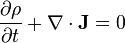
    The law of charge conservation,
    fa51da272998ef8891db042f65aedb70.png
    , becomes:
    ceca73a06f1342b70a10f71ee190becf.png
    The electric field
    d32f98f806351056af76cc06b92c6675.png
    and the magnetic induction
    4b079b6a4f51cb469344ef7055ab9ad5.png
    are now unified into the (rank 2 antisymmetric covariant) electromagnetic field tensor:
    d03beb615a71022a909d6406b79c20ae.png
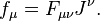
    The density,
    d1f54f559604fc13b5678b69df4afff6.png
    , of the Lorentz force,
    5375bcdc5fa6d4ef8618de597fad2bfd.png
    , exerted on matter by the electromagnetic field becomes:
    1ce6d159ad6aa075c9b67482edde3ca5.png
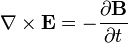
    Faraday's law of induction,
    9cab6787646062d6e658cd1e83ad468f.png
    , and Gauss's law for magnetism,
    57619c6a86c79e56ac806faf21502c90.png
    , combine to form:
    a6facdd8acf16f389e85db9b290061cf.png
    Although there appear to be 64 equations here, it actually reduces to just four independent equations. Using the antisymmetry of the electromagnetic field one can either reduce to an identity (0=0) or render redundant all the equations except for those with λ,μ,ν = either 1,2,3 or 2,3,0 or 3,0,1 or 0,1,2.
    The electric displacement
    c3e5dbe4aa735fb8c654c990852fdadf.png
    and the magnetic field
    e4a5c51917445501b7ac0e606c9bba14.png
    are now unified into the (rank 2 antisymmetric contravariant) electromagnetic displacement tensor:
    5cdebf66078fafc7602dee278423ecf2.png
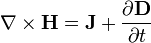
    Ampère's law,
    c8254b55c09edb6e6c394547b060efdf.png
    , and Gauss's law,
    eb8e03b942c5f551d3e4b2c3f1d522a4.png
    , combine to form:
    4ca03abedc8e5be470e22ff9476d3fd3.png
    In a vacuum, the constitutive equations are:
    874f2349d1a7679674f749d690ea9128.png
    Antisymmetry reduces these 16 equations to just six independent equations.
    The energy density of the electromagnetic field combines with Poynting vector and the Maxwell stress tensor to form the 4D electromagnetic stress-energy tensor. It is the flux (density) of the momentum 4-vector and as a rank 2 mixed tensor it is:
    020a125b76f7ceefdc1fdfbad8407463.png
    where
    ad8ca1c74b2f96df1236ac875e6bd7be.png
    is the Kronecker delta. When upper index is lowered with η, it becomes symmetric and is part of the source of the gravitational field.
    The conservation of linear momentum and energy by the electromagnetic field is expressed by:
    31319458233aabb429648ddf04475270.png
    where
    d1f54f559604fc13b5678b69df4afff6.png
    is again the density of the Lorentz force. This equation can be deduced from the equations above (with considerable effort).
     

    suppa malinda

    Member
    Jul 13, 2007
    1,392
    2
    0
    සිර ගෙදර...
    mutantlast said:
    [edit] Force

    The classical definition of ordinary force f is given by Newton's Second Law in its original form:
    a0e352ec4c36fe245d8e8f12aefae9b1.png
    and this is valid in relativity.
    Many modern textbooks rewrite Newton's Second Law as
    bad7a3dfa148b8d91460887479cdc192.png
    This form is not valid in relativity or in other situations where the relativistic mass M is varying.
    This formula can be replaced in the relativistic case by
    6c3adfb901ca0e8b78ad13a65731c57c.png
    As seen from the equation, ordinary force and acceleration vectors are not necessarily parallel in relativity.
    However the four-vector expression relating four-force
    6b5c9f34a867390e015a73de6b4c7768.png
    to invariant mass m and four-acceleration
    85dad09955d0591fe6b69159d8855327.png
    restores the same equation form
    cc2b126adb7a9ccdc2800d87e218bcac.png

    [edit] The geometry of space-time

    Main article: Minkowski space
    SR uses a 'flat' 4-dimensional Minkowski space, which is an example of a space-time. This space, however, is very similar to the standard 3 dimensional Euclidean space, and fortunately by that fact, very easy to work with.
    The differential of distance (ds) in cartesian 3D space is defined as:
    d531b51aecf3401925695a3a31fffdb9.png
    where (dx1,dx2,dx3) are the differentials of the three spatial dimensions. In the geometry of special relativity, a fourth dimension is added, derived from time, so that the equation for the differential of distance becomes:

    2f1acb8b2fdd9eea4b76ad0323912c40.png
    If we wished to make the time coordinate look like the space coordinates, we could treat time as imaginary: x4 = ict . In this case the above equation becomes symmetric:
    88dcdf91e920635fcfc4b47aca5625e5.png
    This suggests what is in fact a profound theoretical insight as it shows that special relativity is simply a rotational symmetry of our space-time, very similar to rotational symmetry of Euclidean space. Just as Euclidean space uses a Euclidean metric, so space-time uses a Minkowski metric. Basically, SR can be stated in terms of the invariance of space-time interval (between any two events) as seen from any inertial reference frame. All equations and effects of special relativity can be derived from this rotational symmetry (the Poincaré group) of Minkowski space-time. According to Misner (1971 §2.3), ultimately the deeper understanding of both special and general relativity will come from the study of the Minkowski metric (described below) rather than a "disguised" Euclidean metric using ict as the time coordinate.
    If we reduce the spatial dimensions to 2, so that we can represent the physics in a 3-D space
    dae91985413e63aefc6e7aa08b7e16b1.png
    We see that the null geodesics lie along a dual-cone:
    134px-Sr1.svg.png
    defined by the equation
    a9114f064423d7f47a2fc95adba3b8d0.png
    or
    79f7cdedabf679384a8d9bb166eec55b.png
    Which is the equation of a circle with r=c×dt. If we extend this to three spatial dimensions, the null geodesics are the 4-dimensional cone:
    Sr3.jpg
    c72e1099f9fcceac1978f1cd3b3d1862.png
    98496bb56c45c8fb5213166671632065.png
    This null dual-cone represents the "line of sight" of a point in space. That is, when we look at the stars and say "The light from that star which I am receiving is X years old", we are looking down this line of sight: a null geodesic. We are looking at an event

    60f9a792ce08526a5d12f5df47eebf81.png
    meters away and d/c seconds in the past. For this reason the null dual cone is also known as the 'light cone'. (The point in the lower left of the picture below represents the star, the origin represents the observer, and the line represents the null geodesic "line of sight".)

    134px-Sr1.svg.png
    The cone in the -t region is the information that the point is 'receiving', while the cone in the +t section is the information that the point is 'sending'.
    The geometry of Minkowski space can be depicted using Minkowski diagrams, which are also useful in understanding many of the thought-experiments in special relativity.

    [edit] Physics in spacetime

    Here, we see how to write the equations of special relativity in a manifestly Lorentz covariant form. The position of an event in spacetime is given by a contravariant four vector whose components are:
    20bf8ba56d3be4008a6a2952d9a437a2.png
    That is, x0 = t and x1 = x and x2 = y and x3 = z. Superscripts are contravariant indices in this section rather than exponents except when they indicate a square. Subscripts are covariant indices which also range from zero to three as with the spacetime gradient of a field φ:


    035de9ff524fa8351c1b67a736b5ccc8.png

    [edit] Metric and transformations of coordinates

    Having recognised the four-dimensional nature of spacetime, we are driven to employ the Minkowski metric, η, given in components (valid in any inertial reference frame) as:
    a56bbc8865c96d757222af4927f7c91a.png
    Its reciprocal is:
    aee78a5d8bc51896cb05ba464cfce283.png
    Then we recognize that coordinate transformations between inertial reference frames are given by the Lorentz transformation tensor Λ. For the special case of motion along the x-axis, we have:
    2eb20e96de68a1847b4c14c7f8308596.png
    which is simply the matrix of a boost (like a rotation) between the x and t coordinates. Where μ' indicates the row and ν indicates the column. Also, β and γ are defined as:
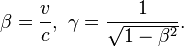
    05dbd54b210913ced0694b00b6c68e6f.png
    More generally, a transformation from one inertial frame (ignoring translations for simplicity) to another must satisfy:
    94eac545386aa4b3fffe2079fd843d5f.png
    where there is an implied summation of
    fdfbfd67ccba1c81ca34f983664a067b.png
    and
    bbc801460b176072342e9bed0ab494bd.png
    from 0 to 3 on the right-hand side in accordance with the Einstein summation convention. The Poincaré group is the most general group of transformations which preserves the Minkowski metric and this is the physical symmetry underlying special relativity.
    All proper physical quantities are given by tensors. So to transform from one frame to another, we use the well-known tensor transformation law
    5f10063892eef437b2a03d2a0fa9d05d.png
    Where
    121820c3f09f47133fa2f786215f8ee7.png
    is the reciprocal matrix of
    3b9e81ec56f5ecc1fd839b9272259fa2.png
    .
    To see how this is useful, we transform the position of an event from an unprimed coordinate system S to a primed system S', we calculate
    c8016c400d6810228d972b8fd919d77b.png
    which is the Lorentz transformation given above. All tensors transform by the same rule.
    The squared length of the differential of the position four-vector
    fd7c72e78cf2a0fbe27e9ef243517c17.png
    constructed using
    2f961a078b51ab468af91c43ad3ebec6.png
    is an invariant. Being invariant means that it takes the same value in all inertial frames, because it is a scalar (0 rank tensor), and so no Λ appears in its trivial transformation. Notice that when the line element
    54e29c41cc5f8a4b4df7ee5736ff144e.png
    is negative that
    0122e9b396f8d82c11a9488a242dde91.png
    is the differential of proper time, while when
    54e29c41cc5f8a4b4df7ee5736ff144e.png
    is positive,
    5ee4ea10ddb1f8d18a3a3a07f489593a.png
    is differential of the proper distance.
    The primary value of expressing the equations of physics in a tensor form is that they are then manifestly invariant under the Poincaré group, so that we do not have to do a special and tedious calculation to check that fact. Also in constructing such equations we often find that equations previously thought to be unrelated are, in fact, closely connected being part of the same tensor equation.

    [edit] Velocity and acceleration in 4D

    Recognising other physical quantities as tensors also simplifies their transformation laws. First note that the velocity four-vector Uμ is given by
    0aad86fe0b286e12f78ac326a27a16c8.png
    Recognising this, we can turn the awkward looking law about composition of velocities into a simple statement about transforming the velocity four-vector of one particle from one frame to another. Uμ also has an invariant form:
    8010b2ba92ee3615ddf7d453d402108c.png
    So all velocity four-vectors have a magnitude of c. This is an expression of the fact that there is no such thing as being at coordinate rest in relativity: at the least, you are always moving forward through time. The acceleration 4-vector is given by

    89919d750add5a3d3ad0d827b7fe138f.png
    . Given this, differentiating the above equation by τ produces
    7633590f8789139bc8d39b5bc75a56c9.png
    So in relativity, the acceleration four-vector and the velocity four-vector are orthogonal.

    [edit] Momentum in 4D

    The momentum and energy combine into a covariant 4-vector:
    f88887b3fe8954b67947533903105c6e.png
    where m is the invariant mass.
    The invariant magnitude of the momentum 4-vector is:
    df2ea63a4adb76b34a45cde4e4b7d830.png
    We can work out what this invariant is by first arguing that, since it is a scalar, it doesn't matter which reference frame we calculate it, and then by transforming to a frame where the total momentum is zero.
    31bdac8d75746c13b1b81be222561913.png
    We see that the rest energy is an independent invariant. A rest energy can be calculated even for particles and systems in motion, by translating to a frame in which momentum is zero.
    The rest energy is related to the mass according to the celebrated equation discussed above:
    0cc50acadfdd9d19debfe42dcc154b21.png
    Note that the mass of systems measured in their center of momentum frame (where total momentum is zero) is given by the total energy of the system in this frame. It may not be equal to the sum of individual system masses measured in other frames.

    [edit] Force in 4D

    To use Newton's third law of motion, both forces must be defined as the rate of change of momentum with respect to the same time coordinate. That is, it requires the 3D force defined above. Unfortunately, there is no tensor in 4D which contains the components of the 3D force vector among its components.
    If a particle is not traveling at c, one can transform the 3D force from the particle's co-moving reference frame into the observer's reference frame. This yields a 4-vector called the four-force. It is the rate of change of the above energy momentum four-vector with respect to proper time. The covariant version of the four-force is:
    bad3b0056a37841aae558c3fbcd4fbf8.png
    where
    d95fd1519e587418ebe3da8fb081701f.png
    is the proper time.
    In the rest frame of the object, the time component of the four force is zero unless the "invariant mass" of the object is changing in which case it is the negative of that rate of change times c2. In general, though, the components of the four force are not equal to the components of the three-force, because the three force is defined by the rate of change of momentum with respect to coordinate time, i.e.
    d41044a139defbff470177ecc63e1da5.png
    while the four force is defined by the rate of change of momentum with respect to proper time, i.e.
    300d8a891d489cdfa1dca05a6fdacd71.png
    .
    In a continuous medium, the 3D density of force combines with the density of power to form a covariant 4-vector. The spatial part is the result of dividing the force on a small cell (in 3-space) by the volume of that cell. The time component is the negative of the power transferred to that cell divided by the volume of the cell. This will be used below in the section on electromagnetism.

    [edit] Relativity and unifying electromagnetism

    Main article: Classical electromagnetism and special relativity
    Theoretical investigation in classical electromagnetism led to the discovery of wave propagation. Equations generalizing the electromagnetic effects found that finite propagation-speed of the E and B fields required certain behaviors on charged particles. The general study of moving charges forms the Liénard–Wiechert potential, which is a step towards special relativity.
    The Lorentz transformation of the electric field of a moving charge into a non-moving observer's reference frame results in the appearance of a mathematical term commonly called the magnetic field. Conversely, the magnetic field generated by a moving charge disappears and becomes a purely electrostatic field in a comoving frame of reference. Maxwell's equations are thus simply an empirical fit to special relativistic effects in a classical model of the Universe. As electric and magnetic fields are reference frame dependent and thus intertwined, one speaks of electromagnetic fields. Special relativity provides the transformation rules for how an electromagnetic field in one inertial frame appears in another inertial frame.

    [edit] Electromagnetism in 4D

    Main article: Covariant formulation of classical electromagnetism
    Maxwell's equations in the 3D form are already consistent with the physical content of special relativity. But we must rewrite them to make them manifestly invariant.[22]
    The charge density
    fa41f50d9fc4c3a61a9b6c8370a958ce.png
    and current density
    bbda214f893097e844ca77ead238f3ea.png
    are unified into the current-charge 4-vector:
    29cf0ca2d7693909b43deac80d64dcc8.png
    The law of charge conservation,
    fa51da272998ef8891db042f65aedb70.png
    , becomes:
    ceca73a06f1342b70a10f71ee190becf.png
    The electric field
    d32f98f806351056af76cc06b92c6675.png
    and the magnetic induction
    4b079b6a4f51cb469344ef7055ab9ad5.png
    are now unified into the (rank 2 antisymmetric covariant) electromagnetic field tensor:
    d03beb615a71022a909d6406b79c20ae.png
    The density,
    d1f54f559604fc13b5678b69df4afff6.png
    , of the Lorentz force,
    5375bcdc5fa6d4ef8618de597fad2bfd.png
    , exerted on matter by the electromagnetic field becomes:

    1ce6d159ad6aa075c9b67482edde3ca5.png
    Faraday's law of induction,
    9cab6787646062d6e658cd1e83ad468f.png
    , and Gauss's law for magnetism,
    57619c6a86c79e56ac806faf21502c90.png
    , combine to form:
    a6facdd8acf16f389e85db9b290061cf.png
    Although there appear to be 64 equations here, it actually reduces to just four independent equations. Using the antisymmetry of the electromagnetic field one can either reduce to an identity (0=0) or render redundant all the equations except for those with λ,μ,ν = either 1,2,3 or 2,3,0 or 3,0,1 or 0,1,2.

    The electric displacement
    c3e5dbe4aa735fb8c654c990852fdadf.png
    and the magnetic field
    e4a5c51917445501b7ac0e606c9bba14.png
    are now unified into the (rank 2 antisymmetric contravariant) electromagnetic displacement tensor:
    5cdebf66078fafc7602dee278423ecf2.png
    Ampère's law,
    c8254b55c09edb6e6c394547b060efdf.png
    , and Gauss's law,
    eb8e03b942c5f551d3e4b2c3f1d522a4.png
    , combine to form:
    4ca03abedc8e5be470e22ff9476d3fd3.png
    In a vacuum, the constitutive equations are:
    874f2349d1a7679674f749d690ea9128.png
    Antisymmetry reduces these 16 equations to just six independent equations.
    The energy density of the electromagnetic field combines with Poynting vector and the Maxwell stress tensor to form the 4D electromagnetic stress-energy tensor. It is the flux (density) of the momentum 4-vector and as a rank 2 mixed tensor it is:
    020a125b76f7ceefdc1fdfbad8407463.png
    where
    ad8ca1c74b2f96df1236ac875e6bd7be.png
    is the Kronecker delta. When upper index is lowered with η, it becomes symmetric and is part of the source of the gravitational field.
    The conservation of linear momentum and energy by the electromagnetic field is expressed by:
    31319458233aabb429648ddf04475270.png
    where
    d1f54f559604fc13b5678b69df4afff6.png
    is again the density of the Lorentz force. This equation can be deduced from the equations above (with considerable effort).


    :confused: :confused: :confused: :confused:
    හොදටම තේරැණා:rofl: :rofl: :rofl:
     

    mutantlast

    Member
    Jul 25, 2008
    3,165
    9
    0
    Manu lowa Minisun Athara
    This is very simple...

    Anything that can travel faster then light would have to be infinity which has not proven possible yet.

    M = Mo / sqrt(1 - (v^2 / c^2) )

    M is mass moving at speed v, Mo is rest mass (mass of body when it is at rest), c is speed of light.

    When v becomes equal to c then the denominator in the equation will become 0,
    so Mass M will become infinity.
     

    funkoluwa

    Active member
  • May 28, 2007
    4,081
    16
    38
    Yokohama Japan
    mutantlast said:
    This is very simple...

    Anything that can travel faster then light would have to be infinity which has not proven possible yet.

    M = Mo / sqrt(1 - (v^2 / c^2) )

    M is mass moving at speed v, Mo is rest mass (mass of body when it is at rest), c is speed of light.

    When v becomes equal to c then the denominator in the equation will become 0,
    so Mass M will become infinity.

    Dats what am talkin about "yet"
     

    mutantlast

    Member
    Jul 25, 2008
    3,165
    9
    0
    Manu lowa Minisun Athara
    funkoluwa said:
    Dats what am talkin about "yet"

    Unfortunately,
    "not proven possible yet" this expression has been misunderstand by you.


    Albert Einstein elaborated that faster-than-light travel is impossible.


    If Albert Einstein Elaborated that, how can you say about a conception which is developed by using his theories.

    Fried I have to say that again and again, PLS study about the root of this conception well.. then you will clearly understand, about this.

    If you let me I will learn you the basic conceptions of the theory of Relativity, if your maths knowledge is well.

    If not there is no use of taking about this, because it is only a personal sense..
     
    Last edited: