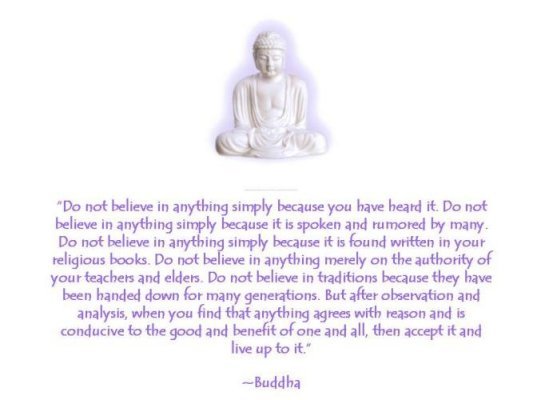
Blind Faith? ශ්රද්ධාව ගැන කතා කරමු.
[FONT=Arial, Helvetica, sans-serif]The following passages are from the Kalama sutta, copy-pasted from http://www.buddhanet.net/e-learning/kalama1.htm
Let's discuss these and 'ශ්රද්ධා' as discussed in Buddhism.
The criterion for rejection
4. "It is proper for you, Kalamas, to doubt, to be uncertain;uncertainty has arisen in you about what is doubtful. Come, Kalamas. Do not go upon what has been acquired by repeated hearing; nor upon tradition; nor upon rumor; nor upon what is in a scripture; nor upon surmise; nor upon an axiom; nor upon specious reasoning; nor upon a bias towards a notion that has been pondered over; nor upon another's seeming ability; nor upon the consideration, 'The monk is our teacher.' Kalamas, when you yourselves know: 'These things are bad; these things are blamable; these things are censured by the wise; undertaken and observed, these things lead to harm and ill,' abandon them.
Greed, hate, and delusion
5. "What do you think, Kalamas? Does greed appear in a man for his benefit or harm?" - "For his harm, venerable sir." - "Kalamas, being given to greed, and being overwhelmed and vanquished mentally by greed, this man takes life, steals, commits adultery, and tells lies; he prompts another too, to do likewise. Will that be long for his harm and ill?" - "Yes, venerable sir."
6. "What do you think, Kalamas? Does hate appear in a man for his benefit or harm?" - "For his harm, venerable sir." - "Kalamas, being given to hate, and being overwhelmed and vanquished mentally by hate, this man takes life, steals, commits adultery, and tells lies; he prompts another too, to do likewise. Will that be long for his harm and ill?" - "Yes, venerable sir."
7. "What do you think, Kalamas? Does delusion appear in a man for his benefit or harm?" - "For his harm, venerable sir." - "Kalamas, being given to delusion, and being overwhelmed and vanquished mentally by delusion, this man takes life, steals, commits adultery, and tells lies; he prompts another too, to do likewise. Will that be long for his harm and ill?" - "Yes, venerable sir."
8. "What do you think, Kalamas? Are these things good or bad?" - "Bad, venerable sir" - "Blamable or not blamable?" - "Blamable, venerable sir." - "Censured or praised by the wise?" - "Censured, venerable sir." - "Undertaken and observed, do these things lead to harm and ill, or not? Or how does it strike you?" - "Undertaken and observed, these things lead to harm and ill. Thus it strikes us here."
9. "Therefore, did we say, Kalamas, what was said thus, 'Come Kalamas. Do not go upon what has been acquired by repeated hearing; nor upon tradition; nor upon rumor; nor upon what is in a scripture; nor upon surmise; nor upon an axiom; nor upon specious reasoning; nor upon a bias towards a notion that has been pondered over; nor upon another's seeming ability; nor upon the consideration, "The monk is our teacher." Kalamas, when you yourselves know: "These things are bad; these things are blamable; these things are censured by the wise; undertaken and observed, these things lead to harm and ill," abandon them.' [/FONT]
[FONT=Arial, Helvetica, sans-serif]The following passages are from the Kalama sutta,
copy-pasted from http://www.buddhanet.net/e-learning/kalama1.htmLet's discuss these and 'ශ්රද්ධා' as discussed in Buddhism.
The criterion for rejection
4. "It is proper for you, Kalamas, to doubt, to be uncertain;uncertainty has arisen in you about what is doubtful. Come, Kalamas. Do not go upon what has been acquired by repeated hearing; nor upon tradition; nor upon rumor; nor upon what is in a scripture; nor upon surmise; nor upon an axiom; nor upon specious reasoning; nor upon a bias towards a notion that has been pondered over; nor upon another's seeming ability; nor upon the consideration, 'The monk is our teacher.' Kalamas, when you yourselves know: 'These things are bad; these things are blamable; these things are censured by the wise; undertaken and observed, these things lead to harm and ill,' abandon them.
Greed, hate, and delusion
5. "What do you think, Kalamas? Does greed appear in a man for his benefit or harm?" - "For his harm, venerable sir." - "Kalamas, being given to greed, and being overwhelmed and vanquished mentally by greed, this man takes life, steals, commits adultery, and tells lies; he prompts another too, to do likewise. Will that be long for his harm and ill?" - "Yes, venerable sir."
6. "What do you think, Kalamas? Does hate appear in a man for his benefit or harm?" - "For his harm, venerable sir." - "Kalamas, being given to hate, and being overwhelmed and vanquished mentally by hate, this man takes life, steals, commits adultery, and tells lies; he prompts another too, to do likewise. Will that be long for his harm and ill?" - "Yes, venerable sir."
7. "What do you think, Kalamas? Does delusion appear in a man for his benefit or harm?" - "For his harm, venerable sir." - "Kalamas, being given to delusion, and being overwhelmed and vanquished mentally by delusion, this man takes life, steals, commits adultery, and tells lies; he prompts another too, to do likewise. Will that be long for his harm and ill?" - "Yes, venerable sir."
8. "What do you think, Kalamas? Are these things good or bad?" - "Bad, venerable sir" - "Blamable or not blamable?" - "Blamable, venerable sir." - "Censured or praised by the wise?" - "Censured, venerable sir." - "Undertaken and observed, do these things lead to harm and ill, or not? Or how does it strike you?" - "Undertaken and observed, these things lead to harm and ill. Thus it strikes us here."
9. "Therefore, did we say, Kalamas, what was said thus, 'Come Kalamas. Do not go upon what has been acquired by repeated hearing; nor upon tradition; nor upon rumor; nor upon what is in a scripture; nor upon surmise; nor upon an axiom; nor upon specious reasoning; nor upon a bias towards a notion that has been pondered over; nor upon another's seeming ability; nor upon the consideration, "The monk is our teacher." Kalamas, when you yourselves know: "These things are bad; these things are blamable; these things are censured by the wise; undertaken and observed, these things lead to harm and ill," abandon them.' [/FONT]