


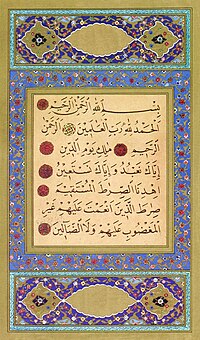
The Qur'an is considered by Muslims to be the literal, undistorted word of God, and is the central religious text of Islam. It has also been called, in English, "the Koran" and (archaically) "the Alcoran." Qur'an is the currently preferred English transliteration of the Arabic original (ÞÑÂä), which means “recitation”. Although the Qur'an is referred to as a "book", when Muslims refer in the abstract to "the Qur'an," they are usually referring to the scripture as recited in Arabic -- the words themselves -- rather than to the printed work or any translation of it. The printed work of Qur'an is referred to as "Mus-haf", which is a word etymologically derived from the word "Saheefah" (paper). "Mus-haf" is a word that is solely used to describe the Qur'an when it is in book form.
Muslims believe that the verses of the Qur'an were revealed to Muhammad by God through the Angel Gabriel on numerous occasions between the years 610 and up till his death on July 6, 632. In addition to memorizing his revelations, his followers wrote them down on parchments, stones, and leaves, to preserve the revelation.
Most Muslims regard paper copies of the Qur'an with veneration, washing as for prayers before reading the Qur'an. Old Qur'ans are not destroyed as wastepaper, but burned.
Many Muslims memorize at least some portion of the Qur'an in the original language (i.e. Arabic), at least the verses needed to recite prayers. Those who have memorized the entire Qur'an are known as hāfiz (plural huffāz). Muslims believe that the Qur'an is perfect only as revealed in the original Arabic. Translations, they maintain, are the result of human effort, and are deficient because of differences in human languages, because of the human fallibility of translators, and (not least) because any translation lacks the inspired content found in the original. Translations are therefore regarded only as commentaries on the Qur'an, or "interpretations of its meaning", not as the Qur'an itself. Many modern, printed versions of the Qur'an feature the Arabic text on one page, and a vernacular translation on the facing page


