


A team from Sydney, Australia has reported the first cases of Delta & Omicron co-infection. Two epidemiologically unrelated patients suffering from chronic kidney disease and requiring haemodialysis has been identified . Both Delta & Omicron variants were co-circulating locally in Sydney at the time of detection. Note that both these individuals are immunocompromised.
Case A aged between 60 to 70 years, presented with mild respiratory symptoms, and later tested positive for Covid (PCR) of a nasopharyngeal swab. Case B aged between 50 to 60 years, presented with fever, and was later diagnosed PCR-positive for Covid.
Samples from both patients has been subjected to whole genome sequencing as part of Health genomic surveillance program. The genomes from Cases A and B showed unexpectedly high "heterozygous" signals and could not be confidently assigned to one SARS-CoV-2 lineage.
This triggered a detailed case review. Neither of them had prior COVID-19 infection, Case A had received two doses of the Pfizer vaccine, the second dose ten weeks before the diagnosis, and Case B was not vaccinated by choice.
The researchers used amplicon- and probe-based sequencing with short- and long-read technologies to identify and measure Delta and Omicron subpopulations in respiratory samples taken from the patients.
Observations:
A review of the relative frequency of 10 Delta and 17 Omicron variant-defining markers showed co-infection with both variants. All three sequencing methods showed a highly similar overall proportion of Omicron and Delta. However, four lineage markers revealed amplification bias when amplifying SARS-CoV-2 using Midnight primers.
Population analysis of the genomic data obtained showed that the proportions of variants in samples from Case A were 77% Delta and 21% Omicron on Day 2, compared to 53% Delta and 45% Omicron on Day 3. In samples from Case B, the proportions were 53% Delta and 42% Omicron on Day 3 and 84% Delta and 11% Omicron on Day 11.
Despite having the same mixed infection pattern, the two patients were not genomically linked in the transmission pathway. The two Omicron sequences distinctly represented the Omicron sub-lineage BA.1, which was predominant in Sydney at the time of the study. In comparison, the two Delta sequences were part of different genomic clusters of the AY.39.1 sub-lineage of Delta that was also circulating locally at the time.
It appeared that Case B was initially infected by Omicron and then superinfected with Delta immediately prior to admission since the Day 0 sample of Case B had only Omicron sequences and Day 3 samples had high viral loads of Delta and Omicron.
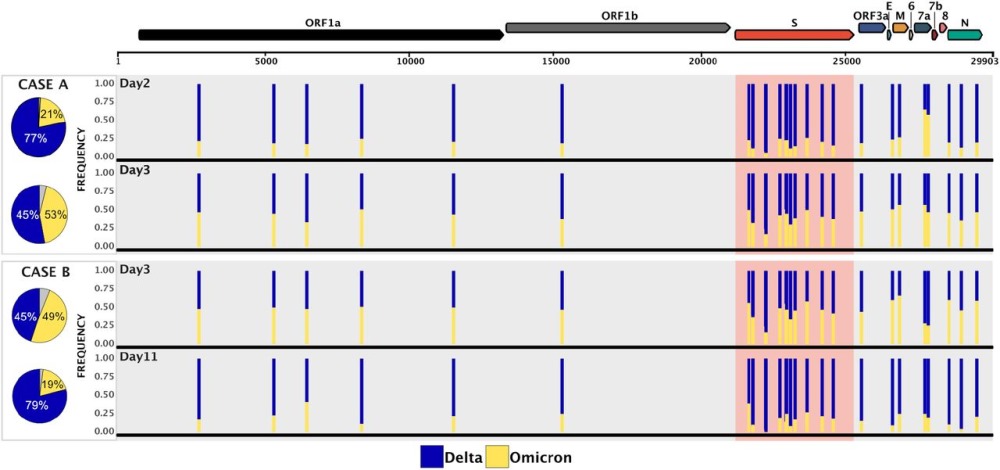
Genome-wide view of the variant frequency of the Delta and Omicron SARS-CoV-2 lineage defining polymorphisms in specimens sequenced using the RVOP SARS-CoV-2 enrichment protocol.
In conclusion, these findings demonstrated the capacity of clinically and epidemiologically informed genomic surveillance to diagnose co-infections with SARS-CoV-2 variants and highlight the needed for deeper analysis of genomic surveillance data in clinical and public health contexts. SARS-CoV-2 co-infections, particularly when they occur in vulnerable hosts may drive saltational evolution, thus emphasising the important role COVID-19 genomic surveillance will play in diagnostic virology, in the era of mass vaccination.
Case A aged between 60 to 70 years, presented with mild respiratory symptoms, and later tested positive for Covid (PCR) of a nasopharyngeal swab. Case B aged between 50 to 60 years, presented with fever, and was later diagnosed PCR-positive for Covid.
Samples from both patients has been subjected to whole genome sequencing as part of Health genomic surveillance program. The genomes from Cases A and B showed unexpectedly high "heterozygous" signals and could not be confidently assigned to one SARS-CoV-2 lineage.
This triggered a detailed case review. Neither of them had prior COVID-19 infection, Case A had received two doses of the Pfizer vaccine, the second dose ten weeks before the diagnosis, and Case B was not vaccinated by choice.
The researchers used amplicon- and probe-based sequencing with short- and long-read technologies to identify and measure Delta and Omicron subpopulations in respiratory samples taken from the patients.
Observations:
A review of the relative frequency of 10 Delta and 17 Omicron variant-defining markers showed co-infection with both variants. All three sequencing methods showed a highly similar overall proportion of Omicron and Delta. However, four lineage markers revealed amplification bias when amplifying SARS-CoV-2 using Midnight primers.
Population analysis of the genomic data obtained showed that the proportions of variants in samples from Case A were 77% Delta and 21% Omicron on Day 2, compared to 53% Delta and 45% Omicron on Day 3. In samples from Case B, the proportions were 53% Delta and 42% Omicron on Day 3 and 84% Delta and 11% Omicron on Day 11.
Despite having the same mixed infection pattern, the two patients were not genomically linked in the transmission pathway. The two Omicron sequences distinctly represented the Omicron sub-lineage BA.1, which was predominant in Sydney at the time of the study. In comparison, the two Delta sequences were part of different genomic clusters of the AY.39.1 sub-lineage of Delta that was also circulating locally at the time.
It appeared that Case B was initially infected by Omicron and then superinfected with Delta immediately prior to admission since the Day 0 sample of Case B had only Omicron sequences and Day 3 samples had high viral loads of Delta and Omicron.
Genome-wide view of the variant frequency of the Delta and Omicron SARS-CoV-2 lineage defining polymorphisms in specimens sequenced using the RVOP SARS-CoV-2 enrichment protocol.
In conclusion, these findings demonstrated the capacity of clinically and epidemiologically informed genomic surveillance to diagnose co-infections with SARS-CoV-2 variants and highlight the needed for deeper analysis of genomic surveillance data in clinical and public health contexts. SARS-CoV-2 co-infections, particularly when they occur in vulnerable hosts may drive saltational evolution, thus emphasising the important role COVID-19 genomic surveillance will play in diagnostic virology, in the era of mass vaccination.
Last edited:


