DirectX 11 and nVidia

Core

Member
Jan 23, 2010
3,120
195
0
Milky Way/Local Cluster/Local Sol/Earth
nvidia-logo.jpg


http://us.download.nvidia.com/downloads/FLVs/Fermi/FERMI_HEADER.flv

Nvidia's next-gen Compute architecture
G300-Fermi: Nvidia focuses on GPU Computing - Impressive Raytracing demo shots

At the GTC Keynote Nvidia has announced its next generation GPU and Cuda architecture - Fermi (G300). The Californians concentrated on flexible usability and high workload of the 512 Shader ALUs - DirectX 11 was only an aside.
Nvidia-Fermi-GT300-GPU-01.png


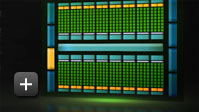
High-Level Diagram of the G300/Fermi [Source: view picture gallery]​


The architecture of the G300 is code-named Fermi and features about 3 billion transistors, 512 ALUs, up to 6 GiByte GDDR5 RAM and a 384-bit memory interface. Nvidia has not anything revealed about clock rates yet - therefore all details about capability are meant by clock which does not necessarily show the performance ratio of the final products to its predecessors.

With the Fermi architecture Nvidia more and more focuses on GPU computing and also uses those terms in their presentation. The former texture units turned into Load/Store units, the shader ALUs (which Nvidia formerly called stream processors) are Cuda core or Cuda processors now. Certainly chips basing on the Fermi architecture will be DirectX 11-compatible but Nvidia doesn't talk about that much.
 
Last edited:
  • Like
Reactions: Zeus

Core

Member
Jan 23, 2010
3,120
195
0
Milky Way/Local Cluster/Local Sol/Earth
The Next Generation CUDA Architecture, Code Named Fermi
The Soul of a Supercomputer in the Body of a GPU


The next generation CUDA architecture, code named “Fermi”, is the most advanced GPU computing architecture ever built. With over three billion transistors and featuring up to 512 CUDA cores, Fermi delivers supercomputing features and performance at 1/10th the cost and 1/20th the power of traditional CPU-only servers.

See video of Jen-Hsun Huang announcing Fermi
Hear details about the new GPU architecture
See details of the key architectural features
Fermi makes GPU and CPU co-processing pervasive by addressing the full-spectrum of computing applications. Designed for C++ and available with a Visual Studio development environment, it makes parallel programming easier and accelerates performance on a wider array of applications than ever before – including dramatic performance acceleration in ray tracing, physics, finite element analysis, high-precision scientific computing, sparse linear algebra, sorting, and search algorithms.
Fermi features several major innovations:
• 512 CUDA cores
• NVIDIA Parallel DataCache technology
• NVIDIA GigaThread™ engine
• ECC support
 

Core

Member
Jan 23, 2010
3,120
195
0
Milky Way/Local Cluster/Local Sol/Earth
As the foundation for NVIDIA’s family of next generation GPUs namely GeForce®, Quadro® and Tesla® − “Fermi” features a host of new technologies that are “must-have” features for the computing space, including:

  • C++, complementing existing support for C, Fortran, Java, Python, OpenCL and DirectCompute.
  • ECC, a critical requirement for datacenters and supercomputing centers deploying GPUs on a large scale
  • 512 CUDA Cores™ featuring the new IEEE 754-2008 floating-point standard, surpassing even the most advanced CPUs
  • 8x the peak double precision arithmetic performance over NVIDIA’s last generation GPU. Double precision is critical for high-performance computing (HPC) applications such as linear algebra, numerical simulation, and quantum chemistry
  • NVIDIA Parallel DataCache™ - the world’s first true cache hierarchy in a GPU that speeds up algorithms such as physics solvers, raytracing, and sparse matrix multiplication where data addresses are not known beforehand
  • NVIDIA GigaThread™ Engine with support for concurrent kernel execution, where different kernels of the same application context can execute on the GPU at the same time (eg: PhysX® fluid and rigid body solvers)
  • Nexus – the world’s first fully integrated heterogeneous computing application development environment within Microsoft Visual Studio
Images, technical whitepapers, presentations, videos and more on “Fermi” can all be found at:
 

Core

Member
Jan 23, 2010
3,120
195
0
Milky Way/Local Cluster/Local Sol/Earth
Test Your PC for DirectX 11


Software Description
Unigine Corp announced its release of the first DirectX 11 benchmark "Heaven" that is based on its proprietary Unigine engine. The company has already made a name among the overclockers and gaming enthusiasts for uncovering the realm of true GPU capabilities with previously released "Sanctuary" and "Tropics" demos. Their benchmarking capabilities are coupled with striking visual integrity of the refined graphic art.


Heaven benchmark excels at providing the following key features:


  • [*]Native support of OpenGL, DirectX 9, DirectX 10 and DirectX 11
    [*]Comprehensive use of tessellation technology
    [*]Advanced SSAO (screen-space ambient occlusion)
    [*]Volumetric cumulonimbus clouds generated by a physically accurate algorithm
    [*]Dynamic simulation of changing environment with high physical fidelity
    [*]Interactive experience with fly/walk-through modes
    [*]ATI Eyefinity support
Hardware requirements:


  • [*]The Tessellation feature REQUIRES a GPU with DirectX 11 support!
    [*]ATI Radeon HD 2xxx and higher or NVIDIA GeForce 7xxx and higher (recommended: NVIDIA 8800 / AMD 4800 series)
    [*]256 Mb of video memory
Earlier this month the company has announced full support of DirectX 11 features in its top-notch 3D middleware. Updated Unigine engine supports Windows 7 and has successfully incorporated the groundbreaking DirectX 11 capabilities, including the following core features:


  • [*]Hardware tessellation
    [*]DirectCompute
    [*]Shader Model 5.0


http://downloads.guru3d.com/Unigine-Heaven-DirectX-11-benchmark-download-2414.html