


A colossal structure in the distant Universe is defying our understanding of how the Universe evolved.
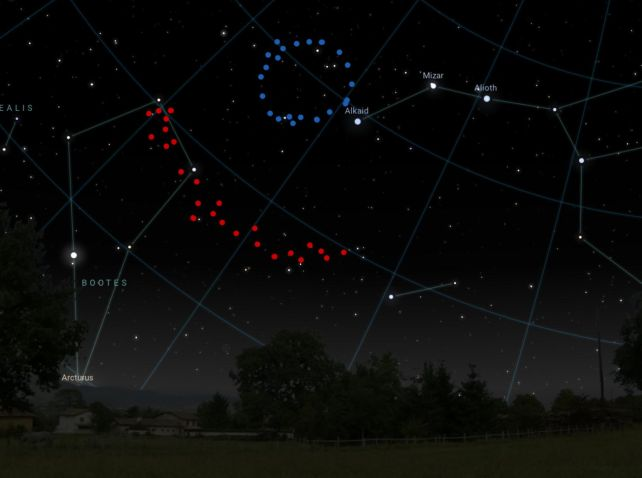
In light that has traveled for 6.9 billion years to reach us, astronomers have found a giant, almost perfect ring of galaxies, some 1.3 billion light-years in diameter. It doesn't match any known structure or formation mechanism.
The discovery, led by astronomer Alexia Lopez of the University of Central Lancashire, was presented at the 243rd meeting of the American Astronomical Society in January,
It's the second giant structure discovered by Lopez and her colleagues. The first, called the Giant Arc, is actually in the same part of the sky, at the same distance away. When the arc's discovery was announced in 2021, it puzzled astronomers. The Big Ring only deepens the mystery.
But the size is just one of the problems. The other is what it means for cosmology, the study of the evolution of the Universe. The current model is the one that currently fits the best with what we observe, but there are some features that are challenging to explain under its framework.
There are other models that have been put forward to address these features. Under one such model, Roger Penrose's conformal cyclic cosmology, in which the Universe goes through endless Big Bang expansion cycles, ring structures are expected – although it's worth noting that conformal cyclic cosmology has significant problems of its own.
------ Post added on May 14, 2024 at 2:37 AM
The Big Ring (blue) and Giant Arc (red
------ Post added on May 14, 2024 at 2:37 AM
In light that has traveled for 6.9 billion years to reach us, astronomers have found a giant, almost perfect ring of galaxies, some 1.3 billion light-years in diameter. It doesn't match any known structure or formation mechanism.
The discovery, led by astronomer Alexia Lopez of the University of Central Lancashire, was presented at the 243rd meeting of the American Astronomical Society in January,
It's the second giant structure discovered by Lopez and her colleagues. The first, called the Giant Arc, is actually in the same part of the sky, at the same distance away. When the arc's discovery was announced in 2021, it puzzled astronomers. The Big Ring only deepens the mystery.
But the size is just one of the problems. The other is what it means for cosmology, the study of the evolution of the Universe. The current model is the one that currently fits the best with what we observe, but there are some features that are challenging to explain under its framework.
There are other models that have been put forward to address these features. Under one such model, Roger Penrose's conformal cyclic cosmology, in which the Universe goes through endless Big Bang expansion cycles, ring structures are expected – although it's worth noting that conformal cyclic cosmology has significant problems of its own.
------ Post added on May 14, 2024 at 2:37 AM
The Big Ring (blue) and Giant Arc (red
------ Post added on May 14, 2024 at 2:37 AM
Last edited:


