Japanese PM announces resignation

David Webb

Member
Jan 17, 2009
550
8
0
මහ පොලොව උඩ
TOKYO - Japanese Prime Minister Yukio Hatoyama says he is resigning.
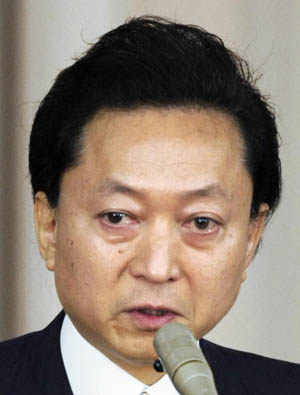
0013729e4abe0d7019764e.jpg

Japan's Prime Minister Yukio Hatoyama speaks during a general meeting of lawmakers of his ruling Democratic Party of Japan at the parliament building in Tokyo June 2, 2010.[Agencies]​
Hatoyama told a news conference broadcast nationwide on Wednesday that he will step down over his broken campaign promise to move a US Marine base off the southern island of Okinawa. With tears in his eyes, Hatoyama told a party gathering both he and party secretary-general Ichiro Ozawa would resign their posts.
After eight months in office, the embattled prime minister has faced growing pressure from within his own party to resign ahead of July elections.
His approval ratings have plummeted over the bungling of handling the Marine Air Station Futenma, reinforcing his public image as an indecisive leader.
Calls have built up in Hatoyama's Democratic Party for him to step down to revive the party's fortunes ahead of an election for the upper house of parliament expected on July 11 that it must win to smooth policymaking.
Analysts have tipped outspoken Finance Minister Naoto Kan as the likely successor if Hatoyama quits after just eight months on the job.
Kan has in the past pressed the Bank of Japan to do more to fight deflation and has sounded more positive than Hatoyama about raising the 5 percent sales tax in the future to fund bulging social welfare costs.
That stance would be welcomed by investors worried about Japan's huge public debt, which is nearly 200 percent of GDP.
Political confusion, including the recent departure of a tiny leftist party from the ruling coalition, has distracted the government as it thrashes out a plan to cut huge public debt and a strategy to engineer growth despite a fast-ageing population.
If Hatoyama resigns, he will be Japan's fourth straight leader to quit after a year or less in office.

 

David Webb

Member
Jan 17, 2009
550
8
0
මහ පොලොව උඩ
Japanese PM resigns amid Okinawa row

Mirvarzandeh20100602043128200.jpg


Japanese Prime Minister Yukio Hatoyama who took power less than nine months ago following a landslide victory has announced his resignation.

Hatoyama, 63, announced the decision on Wednesday at a special parliamentary meeting of lawmakers from his Democratic Party of Japan, AFP reported.

"The government's work has not reflected the public's wishes," the Japanese premier said.

Hatoyama further added that he had also asked party heavyweight and secretary general Ichiro Ozawa to quit.

The Japanese prime minister was forced out as his poll ratings plummeted after he broke an election promise to move an unpopular US military base off the southern island of Okinawa.

The move angered the people of Okinawa who have long been complaining about base-related noise, pollution and crime.

"I have caused trouble for the people of Okinawa," Hatoyama said.

"We will need to make efforts to move the US base outside of Okinawa. But the result was that we could not deliver," he further explained.

After months of tensions, Tokyo and Washington announced in a statement last week that the US base would be moved, as first agreed in 2006, from a crowded urban area to a coastal region of Okinawa.

The move infuriated Okinawans as many want the Futenma Marine Corps Air Station moved off the island entirely.

MVZ/JG/HRF


David Webb

Member
Jan 17, 2009
550
8
0
මහ පොලොව උඩ
Japanese Stocks Wobble After Prime Minister Resigns

HONG KONG — Japan’s stock market sagged on Wednesday as investors struggled to digest the implications of Prime Minister Yukio Hatoyama’s resignation amid intensifying criticism over broken campaign pledges to remove an American base from Okinawa.
By the end of the trading day in Tokyo, the Nikkei 225 index had more than given up gains it had made for a brief time after the news of the resignation, closing down 1.1 percent at 9,603.24 points.
A slide in the yen — a traditional beneficiary of global uncertainty because it is seen as a haven — also proved modest and short lived. By mid-afternoon, it took 91.4 yen to buy one dollar, little more than before the announcement.
The Japanese currency also briefly weakened to 112.5 yen against the euro, but by mid-afternoon, slide had evaporated, and it took 111.6 yen to buy 1 euro — nearly unchanged from where it was before Mr. Hatoyama announced his resignation.
Analysts struggled to find a consensus on what — if any — implications the resignation would have for financial markets, or for Japan’s economic prospects.
Some said the move might serve to resolve some of the political turmoil that has been brewing in the country for months.
“The latest developments have raised hopes that the political morass that was seen as an impediment to the government’s economic policies may be cleared, which explains the various reactions of the markets,” Koichi Ono, senior strategist at Daiwa Securities Capital Markets in Tokyo, told Reuters, as the Nikkei 255 index rose after the news of the resignation.
Others said Mr. Hatoyama’s departure was unlikely to give any short-term impetus to reforms in Japan.
“The government has said it will map out a growth strategy and fiscal reform plan in June, but everything will have to start from scratch under a new leader. Usually that kind of delay would be a concern for markets,” Yasuhide Yajima, senior economist at NLI Resesarch Institute, told Reuters.
Elsewhere in the region on Wednesday, stocks were mixed.
The Straits Times index in Singapore and the Sensex in India gained 0.4 percent.
But the benchmark S&P/ASX 200 in Australia fell 0.7 percent, and the Hang Seng in Hong Kong sagged about 0.5 percent. In Taiwan, the Taiex shed 1.3 percent, and in mainland China, the Shanghai composite index dropped 1.5 percent.
South Korea was closed for a public holiday.
Even with the recent declines in global stock markets, wealthy investors in Asia remain on average significantly less pessimistic than those elsewhere about the global economic recovery, according to a global survey of affluent individuals that was presented by analysts at Barclays Wealth in Hong Kong on Wednesday.
Given that much of Asia — notably China and India — is growing rapidly, this relative optimism is “reasonable,” they said.
Still, commented Manpreet Gill, Asia strategist at Barclays Wealth, “there’s a lot of nervousness out there.”
He added that it will be very hard to say when the stock markets have hit a bottom.
The downward moves in much of the Asia-Pacific on Wednesday followed a poor performance on Wall Street, where the Dow Jones industrial average shed 112.61 points, or 1.1 percent, on its first day of trading this week.
The U.S. market had been shut for a holiday on Monday, and investors there coming back to work Tuesday had fresh worries about Europe’s fiscal health — and the continent’s banking system — to digest: on Monday the European Central Bank had released a report that warned that European banks remained vulnerable to a daunting array of hazards that are expected to produce another round of sizable write-offs during the next couple of years.
That helped send the beleaguered euro lower on Tuesday: the currency slipped to a new four-year low of $1.2110 on Tuesday.
It was hovering around $1.222 during the Asian afternoon on Wednesday.
Christine Hauser contributed from New York.