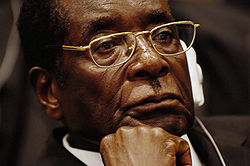
In 2008, Mugabe's party suffered a defeat in national elections, but Mugabe retained power after running unopposed in a subsequent run-off election.
[
The Times of London charged that on 12 June 2008, Mugabe's Militia murdered Dadirai Chipiro, the wife of Mugabe's political opponent, Patson Chipiro, by burning her alive with a petrol bomb after severing her hands and feet.
[123]
In June 2008, Mugabe and Grace purchased a high-end residential property in
Hong Kong (House No 3, JC Castle, 18 Shan Tong Road,
Tai Po), in a development owned by Hong Kong tycoon
Albert Yeung. The property was purchased for HK$45.24 million (US$5.8m) through an intermediary, South African-born Hsieh Ping-sung, in the name of a local shelf company controlled by the Mugabes.
[167][168]
On 13 February 2009, two journalists attempting to take photographs of the house were violently assaulted by the Zimbabwean occupants, two men and a woman. Hong Kong police are investigating.
[169]
On 17 August 1996, Mugabe married his former secretary,
Grace Marufu, 41 years his junior, with whom he already had two children; she first became pregnant by Mugabe while he was still married to his first wife, Sally, and while Grace was married to another man,
Stanley Goreraza, now a diplomat in
China.
Mugabe's office forbade the screening of the 2005 movie
The Interpreter, claiming that it was propaganda by the
CIA and fearing that it could incite hostility towards him.
[117] In 2007,
Parade magazine ranked Mugabe the 7th worst dictator in the world.
[118]
An official from
Chatham House suggested that Mugabe was unlikely to leave Zimbabwe, but that if he were to leave, he might go to
Malaysia, where some believe that he has "stashed much of his wealth".
[119]
Now, after success in the latest referendum on 15 February 2009, Chavez is eyeing staying in office beyond the end of his current term in 2012.
The referendum win means
he can run for office an unlimited number of times.
Mr Chavez has said he needs another 10 years for what he calls Venezuela's socialist revolution to take root.
It was the second time he had tried to change the constitution, having narrowly failed the first time in 2007.
At the time, Mr Chavez said the proposed changes would return power to the people, but critics accused him of a power grab.