What is it?
Meet the most advanced production car yet to wear the three-pointed star.
Not since the very first Mercedes-Benz models started rolling off the production line in 1926 to set the brand on course for global luxury car prominence has Stuttgart attempted to produce something approaching the engineering complexity and sheer technical ambition of the new S-Class saloon.
“In investment terms, no other Mercedes model comes close,” says Jürgen Weissinger, the man charged with the development of the seventh-generation S-Class and its upcoming new sister model, the electric EQS.
The Mk7 S-Class isn’t just new; it also represents an entirely different engineering and technical philosophy to the car it replaces. It’s one centered on electrification, digitisation and connectivity, albeit within the flagship model’s traditional values of comfort, refinement and performance.
It’s the first Mercedes developed to drive fully autonomously without a driver, if only within the confines of a suitably networked parking garage, where it will search for empty bays and park itself fully remotely. This is part of a newly developed Park Pilot system that draws on level-four autonomous driving technology not yet offered by any competitor.
Furthermore, the S-Class now supports level-three driving at an EU-prescribed top speed of 37mph (at first only on selected sections of German autobahn) as a function of a new Drive Pilot system that uses lidar, short- and long-range radar, ultrasonic sensors, cameras and, it’s claimed, the most advanced GPS yet to feature in a production car.
Another first is over-the-air capability, which allows remote software updates to be made for more than 50 different components via an embedded SIM card.
It’s a bold leap in technical terms even by S-Class standards, driven by recent advances made by rivals such as the latest Audi A8, BMW 7 Series, Lexus LS and Tesla Model S, no less, and Mercedes knows it. We could sense the nervousness of its normally self-assured engineers during the car’s launch in Germany last week.

Although the new S-Class heralds many new developments, it will rely on some tried-and-trusted powertrains as it enters the market. From the start of UK deliveries in December, it will offer two straight-six engines, both carried over from its predecessor with mild upgrades.
Included is a turbocharged 2.9-litre diesel developing 282bhp in the S350d (available in standard rear-wheel-drive and optional 4Matic four-wheel-drive guises) and 335bhp in the S400d 4Matic. It’s joined by a turbocharged 3.0-litre mild-hybrid petrol making 435bhp in the S500 4Matic, which we’re driving here.
Further options are planned to follow, including a new twin-turbocharged 4.0-litre mild-hybrid petrol V8 in the new S580, as well as a newly developed plug-in hybrid powertrain that’s claimed to provide the new S580e with an electric-only range of up to 62 miles – more than double that of its predecessor, the S560e – on the WLTP test cycle.
And that’s not all: the upcoming Maybach S650 will maintain an S-Class tradition started in 1992 by continuing with a twin-turbocharged 6.0-litre petrol V12.
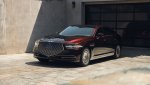
There will certainly be no lack of choice, then. But what of the looks, which are always a key S-Class identifier? The evolutionary styling changes brought to the exterior should go down well within the conservative realm of luxury car buyers. It’s a predictable update that brings a much bolder grille, more angular headlights (which offer as an option Mercedes’ outstanding Digital Light technology), traditionally smooth and unadorned flanks and new LED tail-lights that extend into the rear of a sloping bootlid to set up a rear-end appearance similar to that of the CLS.

What's it like?
Open a door and the apparent conservatism evident with the exterior is instantly wiped aside by a brilliant interior. It represents an entirely different approach in terms of not only design but ergonomics, comfort and accommodation, too.
The dashboard, trimmed with a large panel of wood that extends into the front door trims and topped by a quartet of small rectangular air vents, has distinctive maritime overtones. It’s the two separate digital displays on which you initially focus your attention from the broad and softly cushioned driver’s seat, though. Included is a 12.3in screen (with an optional 3D function) for the instruments alongside a separate 11.9in portrait-oriented central touchscreen that incorporates controls for the air conditioning and myriad other functions.
Ahead of the driver is a newly developed double-spoke steering wheel that features a dual-zone sensor within its leather-lined rim to detect when the driver is properly gripping the wheel, as well as new touch control buttons that function capacitively and shift paddles for the automatic gearbox.
It’s an appealingly uncluttered driving environment with a fitting richness to the materials – and it all proves relatively straightforward to operate right from the moment you hit the start button. Overall, there are 27 fewer analogue controls than before, with the emphasis shifted to swipe, conversational voice and gesture controls via Mercedes’ MBUX operating system, which is said to have 50% more computing power than the Comand system used by the previous S-Class.
Accessing the various functions via the main menu within the central touchscreen is easy, although it takes more time to familiarise yourself with the deeply stacked submenus. There’s no rotary controller any more, and the fiddly touchpad incorporated into recent Mercedes has thankfully been consigned to history, too. Supplementing the two high-definition displays is a terrific new head-up display featuring augmented reality functions for the first time within a much larger display area than before.
Another noteworthy option is the new flagship Burmester 4D sound system, which has 31 speakers and subwoofers integrated within the backrests of each of the front seats. The rear, meanwhile, can be specified with two high-definition 11.6in touchscreens mounted on the back of the front seats, also using the MBUX operating system, in combination with a portable tablet through which occupants can access various functions both inside and within close proximity of the car when the ignition is triggered.
While accommodation up front is virtually unchanged, the rear benefits from an additional 16mm of head room, 24mm of leg room and 11mm of elbow room compared with the old S-Class in long-wheelbase guise. Boot capacity has also been increased, by 20 litres to 550 litres.

All up, there are four different preset driving modes: Eco, Comfort, Sport and Sport Plus. An additional Individual mode allows you to tailor the characteristics of the steering, throttle and damping to your liking.
It’s in Comfort mode where the new S-Class is at its compelling best. Here, the electromechanical steering (in combination with the milder of the optional rear-axle steering systems) is light but encouragingly accurate; the engine is suitably subdued in stop-start traffic and at constant cruising speeds; and the ride, at least on the optional air suspension of our test car, is superbly supple in its actions, almost as if it’s gliding, totally isolated from its surroundings.
On smooth German roads, it filters out small bumps with outstanding shock absorption and great isolation from the road surface. Its overall refinement is truly exceptional, making it a very cosseting car to travel in over extended distances. There may be a distant hint of exhaust roar as engine revs rise before the gearbox quickly chooses a higher ratio but, like the lick of wind around the door-mirror housings and road noise, it always remains distanced from the serene surroundings of the leather-lined cabin.

Should I buy one?
Nevertheless, you invariably step out of the S-Class more relaxed than when you entered it. This is a luxury limo that enhances your wellbeing as competently as, if not better than, any contemporary on any given journey.
And there’s more to it than pure comfort and serenity of progress: the S-Class also delivers on the driving front. The variant tested here has greater performance potential and handles with far greater precision than the previous S500, despite the fact that had a 449bhp twin-turbocharged 4.7-litre V8.
More’s the pity for those who will only ever experience it from the rear seats.


 oya aluth nikan athat penakot mazda ekak wage