


A team of researchers from thw CHUM Research Center in Montreal has a new method that could herald a new turning point in the treatment of prostate cancer. They applied a combination of 'Raman microspectroscopy' with machine learning techniques to obtain results. They were able to collect Raman spectra of the samples and then trained algorithms to automatically identify and classify particular signatures of healthy tissue, intraductal carcinoma of the prostate, and other forms of prostate cancer.
“It's going to be easier to actually deal with the disease before it spreads and before it's generalised.” explained Dominique Trudel, one of the researchers on the project.
Additional testing is needed to validate this technique.
PS: Raman Spectroscopy.
The Raman microscope was first developed in Lille, France under the direction of Professor Michel Delhaye and Edouard DaSilva, and was commercially produced as the MOLE™ (Molecular Optics Laser Examiner)
Raman Spectroscopy is a non-destructive chemical analysis technique which provides detailed information about chemical structure, phase and polymorphy, crystallinity and molecular interactions. It is based upon the interaction of light with the chemical bonds within a material.
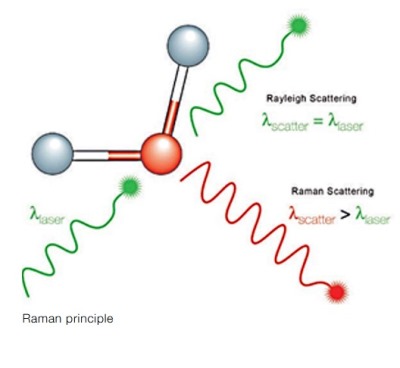
Raman is a light scattering technique, whereby a molecule scatters incident light from a high intensity laser light source. Most of the scattered light is at the same wavelength (or color) as the laser source and does not provide useful information – this is called Rayleigh Scatter. However a small amount of light (typically 0.0000001%) is scattered at different wavelengths (or colors), which depend on the chemical structure of the analyte – this is called Raman Scatter.
“It's going to be easier to actually deal with the disease before it spreads and before it's generalised.” explained Dominique Trudel, one of the researchers on the project.
Additional testing is needed to validate this technique.
PS: Raman Spectroscopy.
The Raman microscope was first developed in Lille, France under the direction of Professor Michel Delhaye and Edouard DaSilva, and was commercially produced as the MOLE™ (Molecular Optics Laser Examiner)
Raman Spectroscopy is a non-destructive chemical analysis technique which provides detailed information about chemical structure, phase and polymorphy, crystallinity and molecular interactions. It is based upon the interaction of light with the chemical bonds within a material.
Raman is a light scattering technique, whereby a molecule scatters incident light from a high intensity laser light source. Most of the scattered light is at the same wavelength (or color) as the laser source and does not provide useful information – this is called Rayleigh Scatter. However a small amount of light (typically 0.0000001%) is scattered at different wavelengths (or colors), which depend on the chemical structure of the analyte – this is called Raman Scatter.


