:::New P55 Motherboards:::

VSGM

Well-known member
  • Aug 2, 2007
    10,330
    213
    63
    First up we have Gigabyte's flagship P55-UD6.

    The P55-UD6 built around Gigabyte's signature blue PCB, and it features seven expansion slots (3 x PEG, 2 x PCIe x1, 2 x PCI), and large, aluminum heatinks on the VRM and chipset. If you look close at the heatsinks though, you'll notice that the one about in the middle of the board--in the traditional northbridge location--isn't really mounted to anything. It's sort of just floating there, connected to the VRM heatsinks via a heatpipe. This is due to the fact that, as we've mentioned already, Lynnfield based processes move virtually all of the legacy northbridge functionality, including PCI Express connectivity and a memory controller, onto the CPU die itself, so there's no need for a true northbridge chip.

    small_intel-core-i5-i7-p55-1.JPG


    The board's trio of PEG slots support SLI and CrossFire multi-GPU configurations and there's also plenty of connectivity in the I/O backplane--Gigabit LAN and HD Audio support come by way of Realtek chips and the Firewire ports are powered by a TI controller. The P55-UD6 is also outfitted with 10 SATA ports, 6 DIMM slots, which is currently a rarity with P55-based motherboards--although it is still dual-channel, a POST code error reporter, dual-Gigabit LAN, and a host of other features.

    The Gigabyte P55-UD6's main claim to fame, however, is its 24 phase power design. If you look around the CPU socket you can plainly see the 24 phase design and count the components for yourself. In fact, you'll count 27 phases, but three of them are dedicated to the memory slots. The P55-UD6 is also a member of Gigabyte's Ultra Durable 3 family of products, which means it sports 2oz copper layers in its PCB, solid Japanese capacitors, Lower Rds MOSFETs, and Ferrite core chokes.

    This is the motherboard we used for our overclocking tests, and we also feature a full set of benchmarks using this board later in this article. Overall, we definitely give it a thumbs up. As you'll see, performance was excellent and it found it to be very stable and overclockable too.

    big_intel-core-i5-i7-p55-2.jpg
     
    • Like
    Reactions: rehan1986

    VSGM

    Well-known member
  • Aug 2, 2007
    10,330
    213
    63
    small_core-i5-i7-asus-evga-intel-mobos-8.JPG


    Like the Intel board pictured on the previous page, the Asus Maximus III Formula is built around a dark colored PCB, but with red, white, and black accents. It has four DDR3 DIMM slots for dual-channel memory configurations, and each slot has an interesting retention clip configuration. If you look close, you'll see that the retention clips closest to the expansion slots are much smaller than those on the opposite side. That's to prevent the clips from interfering with long graphics cards or the two nearby SATA ports.

    Six more SATA ports are mounted horizontally behind the P55 chipset heatsink, which is comprised of a relatively large aluminum block with numerous fins. Although this heatsink isn't linked to any others via heat-pipes, the P55 chipset doesn't generate much heat at all, so this simple heatsink should be more than sufficient. Two more SATA ports rest along the bottom edge.

    The expansion slots consist of three PCI Express x16 slots--with SLI and CrossFire support--two x1 slots, and two legacy PCI slots. One of the x1 slots is crammed right in front of the heatsink adorned with the RoG badge, so it may be unusable with some expansion cards. Notice the PEG slots have extra-large retention clips, that should make it easy to remove cards.

    The layout of the board is typical of a RoG series product, and the I/O backplane is loaded with the usual suspects. One new feature making an appearance here, however, is dubbed RoG Connect. The RoG Connect port in the backplane will allow users to connect the board to a second system (like a notebook) for real-time hardware monitoring and tweaking.

    big_core-i5-i7-asus-evga-intel-mobos-9.jpg
     

    VSGM

    Well-known member
  • Aug 2, 2007
    10,330
    213
    63
    small_core-i5-i7-asus-evga-intel-mobos-15.JPG


    EVGA also chimed in with one of their P55 SLI motherboards. As its name suggests, the board obviously supports SLI (and CrossFire). But another interesting feature has to do with its CPU cooler retention holes. The EVGA P55 SLI is outfitted with CPU heatsink mounting holes that are compatible with both legacy socket 775 and new socket 1156 heatsinks, which could save upgraders some money.

    Additional features of the EVGA P55 SLI include Low Inductance Ceramic Capacitors in the CPU cavity, dual clock generators for the CPU and PCIe interface, to ensure clean signals while overclocking, and a POST code error reporter. Relatively large aluminum heatsinks reside on the VRM and chipset. On-board power, reset, and clear CMOS switches are situated along the bottom edge of the board.

    We did not have time to put the EVGA P55 SLI through its paces in time for this article, but we will be rounding up a number of P55-based motherboards in the not too distant future. So stay tuned for the full scoop.

    big_core-i5-i7-asus-evga-intel-mobos-16.jpg
     

    VSGM

    Well-known member
  • Aug 2, 2007
    10,330
    213
    63
    big_core-i5-i7-asus-evga-intel-mobos-7.jpg


    The DP55KG is built on a dark colored PCB, but blue and white accents. Generally speaking, the layout of the board is good and there are no major components that impinge on any others. The VRM on the board is treated to an array of blue, aluminum heatsinks, and the P55 itself gets its own heatsink as well. While the heatsink on the chipset may appear small, especially in comparison to the boards we'll show you next, we should note that even with this relatively miniscule heatsink, the chipset got just warm to the touch, even after hours of testing.

    If you look at the various shots of the DP55KG above, you'll see that it is legacy free, and devoid and any IDE, floppy, or PS/2 connectors. Its backplane is home to an assortment of USB, eSATA, Firewire, audio, and Ethernet jacks, and there is also an integrated Bluetooth transceiver on the board. The DP55KG also sports an LED POST code error reported, and because it is an Extreme Edition board, it has a full complement of overclocking and performance tuning options available, not only via the system BIOS, but via Intel's Desktop Control Center software as well.

    big_core-i5-i7-asus-evga-intel-mobos-1.jpg
     

    kasun.madhusanka

    Well-known member
  • Nov 17, 2008
    7,779
    134
    63
    small_core-i5-i7-asus-evga-intel-mobos-8.JPG


    Like the Intel board pictured on the previous page, the Asus Maximus III Formula is built around a dark colored PCB, but with red, white, and black accents. It has four DDR3 DIMM slots for dual-channel memory configurations, and each slot has an interesting retention clip configuration. If you look close, you'll see that the retention clips closest to the expansion slots are much smaller than those on the opposite side. That's to prevent the clips from interfering with long graphics cards or the two nearby SATA ports.

    Six more SATA ports are mounted horizontally behind the P55 chipset heatsink, which is comprised of a relatively large aluminum block with numerous fins. Although this heatsink isn't linked to any others via heat-pipes, the P55 chipset doesn't generate much heat at all, so this simple heatsink should be more than sufficient. Two more SATA ports rest along the bottom edge.

    The expansion slots consist of three PCI Express x16 slots--with SLI and CrossFire support--two x1 slots, and two legacy PCI slots. One of the x1 slots is crammed right in front of the heatsink adorned with the RoG badge, so it may be unusable with some expansion cards. Notice the PEG slots have extra-large retention clips, that should make it easy to remove cards.

    The layout of the board is typical of a RoG series product, and the I/O backplane is loaded with the usual suspects. One new feature making an appearance here, however, is dubbed RoG Connect. The RoG Connect port in the backplane will allow users to connect the board to a second system (like a notebook) for real-time hardware monitoring and tweaking.

    big_core-i5-i7-asus-evga-intel-mobos-9.jpg
    Maximus series eke dan year ekakata vithara issella apu mobo ekak mage yaluwekge gawa thiyenawa..
    Aka patta board eka gaming walata..

    Info walata tnx..
     

    VSGM

    Well-known member
  • Aug 2, 2007
    10,330
    213
    63
    00.jpg


    imageview.php


    Manufacturer: MSI
    SLI: Yes
    CPU Socket: 1156
    Chipset: Intel P55
    Intel i7 Compatible: Yes
    Memory Type: DDR3
    Memory Channel: Dual
    Expansion Slots: 2 x PCI (32 bit)
    2 x PCI-E 2.0 (x1)
    2 x PCI-E 2.0 (x16)(x16/x8 Bandwidth)
    1 x PCI-E 2.0 (x4)
    SATA: SATA 3Gb/s
     

    VSGM

    Well-known member
  • Aug 2, 2007
    10,330
    213
    63
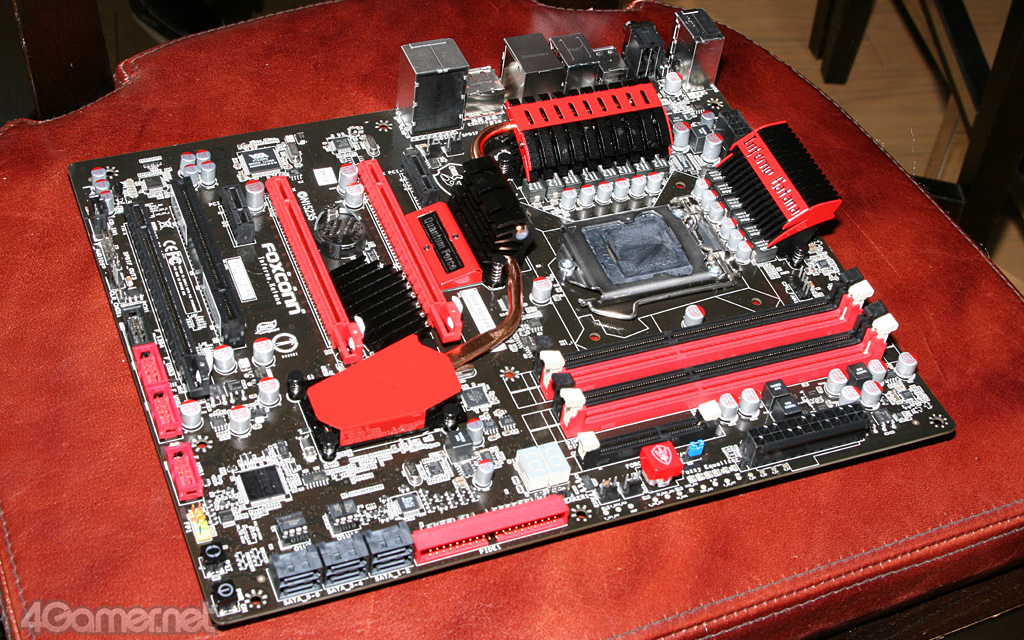
    Quantum Force P55 platform - Foxconn

    MB.gif


    002.gif


    Processor: Intel® Core™ i7,Core™ i5 processors, Socket LGA1156
    Chipset: Intel® P55
    Memory: Dual channel DDR3 1800(oc)/1600(oc)/1333 x 4 DIMMs, Max. 16GB
    VGA on Die: Discreted
    Expansion Slots: 3* PCIe2.0 x16, 2* PCIe2.0 x1, 1* PCI
    IDE: 1*ATA133
    Serial ATA(SATA)/RAID: 6* SATAII + 2*eSATA w / RAID 0, 1, 5, 10; Intel® Matrix storage technology
    Audio: 7.1 channel HDA support Dolby & DTS Surround sound technology
    LAN: Gigabit Lan
    IEEE1394: 2*IEEE 1394a
    Back Panel I/O Ports: 1 x PS/2 keyboard port
    1 x S/PDIF Coaxial port
    1 x S/PDIF Optical port
    2 x eSATA ports
    1 x Clear CMOS Button
    1 x Audio jack supports 6 jacks
    1 x RJ45 LAN port
    8 x USB 2.0 ports
    1 x IEEE 1394a port
    Internal I/O Connectors: 1 x ATX 24-Pin power connector
    1 x 8-Pin ATX 12V power connector
    1 x 4-Pin CPU Fan connector
    5 x 3-Pin System Fan connectors
    3 x Onboard On/Off/CCMOS/Force Reset buttons
    1 x S/PDIF out header
    1 x Onboard power_LED
    1 x IDE connector
    2 x USB 2.0 connectors support additional 4 ports
    6 x SATAII connectors
    1 x Front Audio Header
    1 x Front Panel header
    1 x Speaker header
    1 x CD-in connector
    1 x IEEE 1394a header
    BIOS Features: 8Mb flash EEPROM w/ LAN boot PnP, ACPI, WfM, DMI
    Support CD: Drivers, Adobe Reader, SuperUtilities, Norton Internet Security
    Standards/Manageability: PCI 2.3, USB2.0, DMI 2.5
    Form Factor: ATX (12" x 9.6")

    17b.jpg
     
    Last edited: