


A case of polio has been detected in New York, the first instance of the virus in almost a decade. Tests show that that the patient had contracted a strain of polio likely derived from an oral polio vaccine, which are no longer administered in the U.S. (Sabin Type 2 poliovirus)
However, this person is unvaccinated against Polio and also recently travelled to Hungary & Poland. He's a 20 year old and reported to be able to stand but unable to walk.
Polio is a very old disease and the reservoir is human. No other animal carries it. The origins are obscure and it may have started from another animal, but we really do not know. However, at present it's human carried and uses the faecal-oral contamination route for transmission. It;s a positive stranded RNA virus, small - about 30nm in diameter and was identified far back in 1906. But it took nearly fifty years to develop a vaccine. Dr Jonas Salk became a household name when he introduced the first Polio vaccine in 1955.
It's called the Salk vaccine, Inactivated Polio Vaccine (IPV) consists of inactivated (killed) poliovirus strains of all three poliovirus types. (Trivalent)
IPV is given by intramuscular or intradermal injection. This vaccine was safe, being inactvated it did not cause the disease, no risk of VAPP (vaccine-associated paralytic poliomyelitis) but at the same time if offered very low levels of immunity in the intestine.
It took several more years to develop the next vaccine. Albert Sabin (Polish born) who showed that the virus first infects the digestive tract developed an attenuated Oral Polio Vaccine, OPV in 1961. The attenuated poliovirus(es) contained in OPV are able to replicate effectively in the intestine, but around 10,000 times less able to enter the central nervous system than the wild virus. This enables individuals to mount an immune response against the virus.
OPV was quite cheap to manufacture and much easier to administer and many countries used these procured through the UNICEF.
There are a few other variants of the vaccine and recently in March 2021, to address the evolving risk of type 2 circulating vaccine-derived poliovirus (cVDPV2), GPEI (Global Polio Eradication Initiative) partners together with countries are deploying an innovative tool – novel oral polio vaccine type 2 (nOPV2). The vaccine is a modified version of the type 2 monovalent OPV (mOPV2), which clinical trials have shown provides comparable protection against poliovirus while being more genetically stable and less likely to be associated with the emergence of cVDPV2 in low immunity settings. This was granted WHO Emergency Listing Procedure (EUL) and used in a few selected countries.
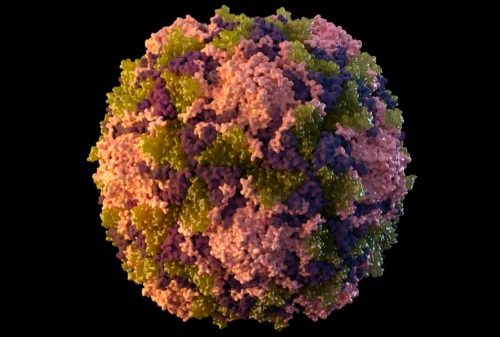
Polio virus - image CDC
However, this person is unvaccinated against Polio and also recently travelled to Hungary & Poland. He's a 20 year old and reported to be able to stand but unable to walk.
Polio is a very old disease and the reservoir is human. No other animal carries it. The origins are obscure and it may have started from another animal, but we really do not know. However, at present it's human carried and uses the faecal-oral contamination route for transmission. It;s a positive stranded RNA virus, small - about 30nm in diameter and was identified far back in 1906. But it took nearly fifty years to develop a vaccine. Dr Jonas Salk became a household name when he introduced the first Polio vaccine in 1955.
It's called the Salk vaccine, Inactivated Polio Vaccine (IPV) consists of inactivated (killed) poliovirus strains of all three poliovirus types. (Trivalent)
IPV is given by intramuscular or intradermal injection. This vaccine was safe, being inactvated it did not cause the disease, no risk of VAPP (vaccine-associated paralytic poliomyelitis) but at the same time if offered very low levels of immunity in the intestine.
It took several more years to develop the next vaccine. Albert Sabin (Polish born) who showed that the virus first infects the digestive tract developed an attenuated Oral Polio Vaccine, OPV in 1961. The attenuated poliovirus(es) contained in OPV are able to replicate effectively in the intestine, but around 10,000 times less able to enter the central nervous system than the wild virus. This enables individuals to mount an immune response against the virus.
OPV was quite cheap to manufacture and much easier to administer and many countries used these procured through the UNICEF.
There are a few other variants of the vaccine and recently in March 2021, to address the evolving risk of type 2 circulating vaccine-derived poliovirus (cVDPV2), GPEI (Global Polio Eradication Initiative) partners together with countries are deploying an innovative tool – novel oral polio vaccine type 2 (nOPV2). The vaccine is a modified version of the type 2 monovalent OPV (mOPV2), which clinical trials have shown provides comparable protection against poliovirus while being more genetically stable and less likely to be associated with the emergence of cVDPV2 in low immunity settings. This was granted WHO Emergency Listing Procedure (EUL) and used in a few selected countries.
Polio virus - image CDC


