pansil ganna sasa meditation karana aya methenata enna.

hansika2244

Member
Jan 14, 2010
199
3
0
pansil ganna saha meditation karana aya methenata enna.

machang kalina uwamanawak matha meka hadanna hithuwa.Buddhism promote karanna wagema ape adahas beda gena ewa improve karagamu . oyagollange piliwth gana methena katha karamu.:yes:

buddhism-symbol-thumb3251959.jpg
 
Last edited:

hansika2244

Member
Jan 14, 2010
199
3
0
Buddhism is a religion and philosophy encompassing a variety of traditions, beliefs and practices, largely based on teachings attributed to Siddhartha Gautama, commonly known as the Buddha (Pāli/Sanskrit "the awakened one"). Buddha lived and taught in the northeastern Indian subcontinent sometime between the 6th and 4th centuries BCE.[2] He is recognized by adherents as an awakened teacher who shared his insights to help sentient beings end suffering, achieve nirvana, and escape what is seen as a cycle of suffering and rebirth.
Two major branches of Buddhism are recognized: Theravada ("The School of the Elders") and Mahayana ("The Great Vehicle"). Theravada—the oldest surviving branch—has a widespread following in Sri Lanka and Southeast Asia, and Mahayana is found throughout East Asia and includes the traditions of Pure Land, Zen, Nichiren Buddhism, Tibetan Buddhism, Shingon, Tendai and Shinnyo-en. In some classifications Vajrayana, a subcategory of Mahayana, is recognized as a third branch. While Buddhism remains most popular within Asia, both branches are now found throughout the world. Various sources put the number of Buddhists in the world at between 230 million and 500 million,[3] making it the world's fourth-largest religion.
Buddhist schools vary significantly on the exact nature of the path to liberation, the importance and canonicity of various teachings and scriptures, and especially their respective practices.[4] The foundations of Buddhist tradition and practice are the Three Jewels: the Buddha, the Dharma (the teachings), and the Sangha (the community).[5][6] Taking "refuge in the triple gem" has traditionally been a declaration and commitment to being on the Buddhist path and in general distinguishes a Buddhist from a non-Buddhist.[7] Other practices may include renouncing conventional living and becoming a monastic, support of the monastic community, meditation, cultivation of mindfulness and wisdom, study of scriptures, physical exercises, devotion and ceremonies, or invocation of bodhisattvas.
 

hansika2244

Member
Jan 14, 2010
199
3
0
Life of the Buddha


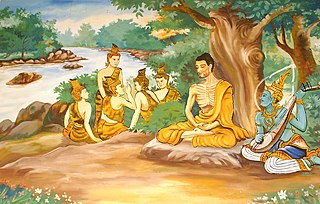
Ascetic Gautama with his five companions, who later comprised the first Sangha. Wall painting in a Laotian temple


Main article: Gautama Buddha
Conventional narratives on the Buddha's life, such as the following, draw heavily on Theravada Tipitaka scriptures. Later texts—such as the Mahayana Lalitavistara Sutra—give different accounts.
According to the conventional narrative, the Buddha was born in Lumbini, around the year 563 BCE, and raised in Kapilavastu; both in modern-day Nepal.[8][9]
Shortly after Siddhartha's birth, an astrologer visited the young prince's father—King Śuddhodana—and prophesied that Siddhartha would either become a great king or renounce the material world to become a holy man, depending on whether he saw what life was like outside the palace walls.
Śuddhodana was determined to see his son become a king so he prevented him from leaving the palace grounds. But at age 29, despite his father's efforts, Siddhartha ventured beyond the palace several times. In a series of encounters—known in Buddhist literature as the four sights[10]—he learned of the suffering of ordinary people, encountering an old man, a sick man, a corpse and, finally, an ascetic holy man, apparently content and at peace with the world. These experiences prompted Gautama eventually to abandon royal life and take up a spiritual quest.
Gautama first attempted an extreme ascetic life and almost starved himself to death in the process. But, after accepting milk and rice from a village girl in a pivotal moment, he changed his approach. He concluded that extreme ascetic practices, such as prolonged fasting, breath-holding, and exposure to pain, brought little spiritual benefit. He saw them as forms of self-hatred that were therefore counterproductive.[11] He abandoned asceticism, concentrating instead on anapanasati meditation, through which he discovered what Buddhists call the Middle Way: a path of moderation between the extremes of self-indulgence and self-mortification.
Gautama was now determined to complete his spiritual quest. At the age of 35, he famously sat in meditation under a sacred fig tree—also known as the Bodhi tree—in the town of Bodh Gaya, India, and vowed not to rise before achieving enlightenment. After many days, he finally awakened to the ultimate nature of reality, thereby liberating himself from the cycle of suffering and rebirth, and arose as a fully enlightened being. Soon thereafter, he attracted a band of followers and instituted a monastic order. Now as the Buddha, he spent the rest of his life teaching the path of awakening he discovered, traveling throughout the northeastern part of the Indian subcontinent,[12][13] and died at the age of 80 (483 BCE) in Kushinagar, India.
Scholars are hesitant to make unqualified claims about the historical facts of the Buddha's life. Most accept that he lived, taught and founded a monastic order but do not consistently accept the details in his biographies.[14][15] According to author Michael Carrithers, while there are good reasons to doubt the traditional account, "the outline of the life must be true: birth, maturity, renunciation, search, awakening and liberation, teaching, death."[16]
In writing her biography of Buddha, Karen Armstrong noted, "It is obviously difficult, therefore, to write a biography of the Buddha that will meet modern criteria, because we have very little information that can be considered historically sound... [but] we can be reasonably confident Siddhatta Gotama did indeed exist and that his disciples preserved the memory of his l
 

hansika2244

Member
Jan 14, 2010
199
3
0
Buddhist concepts

Main article: Buddhist terms and concepts
Life and the world


Traditional Tibetan Buddhist Thangka depicting the "Wheel of Life" with its six realms


Karma as the law of cause and effect

Main article: Karma in Buddhism
Karma (from Sanskrit: "action, work") in Buddhism is the force that drives saṃsāra—the cycle of suffering and rebirth for each being. Good, skillful deeds (Pāli: "kusala") and bad, unskillful (Pāli: "akusala") actions produce "seeds" in the mind which come to fruition either in this life or in a subsequent rebirth.[18] The avoidance of unwholesome actions and the cultivation of positive actions is called śīla (from Sanskrit: "ethical conduct").
In Buddhism, karma specifically refers to those actions (of body, speech, and mind) that spring from mental intent ("cetana"),[19] and which bring about a consequence (or fruit, "phala") or result ("vipāka"). Every time a person acts there is some quality of intention at the base of the mind and it is that quality rather than the outward appearance of the action that determines its effect[citation needed].
In Theravada Buddhism there can be no divine salvation or forgiveness for one's karma, since it is a purely impersonal process that is a part of the make up of the universe. Some Mahayana traditions however hold different views. For example, the texts of certain Mahayana sutras (such as the Lotus Sutra, the Angulimaliya Sutra and the Nirvana Sutra) claim that reciting or merely hearing their texts can expunge great swathes of negative karma. In like fashion, some forms of Buddhism (e.g. Vajrayana) regard the recitation of mantras as a means for cutting off previous negative karma.[20] Similarly, the Japanese Pure Land teacher Genshin taught that Amida Buddha has the power to destroy the karma that would otherwise bind one in saṃsāra.[21][22]
 

hansika2244

Member
Jan 14, 2010
199
3
0
Rebirth

Main article: Rebirth (Buddhism)
Rebirth refers to a process whereby beings go through a succession of lifetimes as one of many possible forms of sentient life, each running from conception[23] to death. However, Buddhism rejects concepts of a permanent self or an unchanging, eternal soul, as it is called in Christianity or even Hinduism. As there ultimately is no such thing as a self (the doctrine of anatta) according to Buddhism, rebirth in subsequent existences must rather be understood as the continuation of a dynamic, ever-changing process of "dependent arising" ("pratītyasamutpāda") determined by the laws of cause and effect (karma) rather than that of one being, transmigrating or incarnating from one existence to the next.
Each rebirth takes place within one of five realms, according to Theravadins, or six according to other schools.[24][25] These are further subdivided into 31 planes of existence:[26]

  1. Naraka beings: those who live in one of many Narakas (Hells)
  2. Animals: sharing some space with humans, but considered another type of life
  3. Preta: sometimes sharing some space with humans, but invisible to most people; an important variety is the hungry ghost[27]
  4. Human beings: one of the realms of rebirth in which attaining Nirvana is possible
  5. Asuras: variously translated as lowly deities, demons, titans, antigods; not recognized by Theravāda (Mahavihara) tradition as a separate realm.[28]
  6. Devas including Brahmas: variously translated as gods, deities, spirits, angels, or left untranslated
Rebirths in some of the higher heavens, known as the Śuddhāvāsa Worlds (Pure Abodes), can be attained only by skilled Buddhist practitioners known as anāgāmis (non-returners). Rebirths in the arupa-dhatu (formless realms) can be attained only by those who can meditate on the arūpajhānas, the highest object of meditation.
According to East Asian and Tibetan Buddhism, there is an intermediate state (Tibetan "Bardo") between one life and the next. The orthodox Theravada position rejects this; however there are passages in the Samyutta Nikaya of the Pali Canon (the collection of texts on which the Theravada tradition is based), that seem to lend support to the idea that the Buddha taught of an intermediate stage between one life and the next.[29][30]
 

hansika2244

Member
Jan 14, 2010
199
3
0
The cycle of saṃsāra

Main article: Saṃsāra (Buddhism)
Sentient beings crave pleasure and are averse to pain from birth to death. In being controlled by these attitudes, they perpetuate the cycle of conditioned existence and suffering (saṃsāra), and produce the causes and conditions of the next rebirth after death. Each rebirth repeats this process in an involuntary cycle, which Buddhists strive to end by eradicating these causes and conditions, applying the methods laid out by the Buddha and subsequent Buddhists.
Suffering's causes and solution

The Four Noble Truths

Main article: Four Noble Truths
According to the Pali Tipitaka, the Four Noble Truths were the first teaching of Gautama Buddha after attaining Nirvana.[31] They are sometimes considered as containing the essence of the Buddha's teachings and are presented in the manner of a medical diagnosis and remedial prescription—a style common at that time:[citation needed]

  1. Life as we know it ultimately is or leads to suffering/uneasiness (dukkha) in one way or another.
  2. Suffering is caused by craving. This is often expressed as a deluded clinging to a certain sense of existence, to selfhood, or to the things or phenomena that we consider the cause of happiness or unhappiness. Craving also has its negative aspect, i.e. one craves that a certain state of affairs not exist.
  3. Suffering ends when craving ends. This is achieved by eliminating delusion, thereby reaching a liberated state of Enlightenment (bodhi);
  4. Reaching this liberated state is achieved by following the path laid out by the Buddha.
This method is described by early Western scholars, and taught as an introduction to Buddhism by some contemporary Mahayana teachers (e.g., the Dalai Lama).[32]
According to other interpretations by Buddhist teachers and scholars, lately recognized by some Western non-Buddhist scholars,[33] the "truths" do not represent mere statements, but are categories or aspects that most worldly phenomena fall into, grouped in two:

  1. Suffering and causes of suffering
  2. Cessation and the paths towards liberation from suffering.
Thus, according to the Macmillan Encyclopedia of Buddhism[34] they are

  1. "The noble truth that is suffering"
  2. "The noble truth that is the arising of suffering"
  3. "The noble truth that is the end of suffering"
  4. "The noble truth that is the way leading to the end of suffering"
The early teaching[35] and the traditional Theravada understanding[36] is that the Four Noble Truths are an advanced teaching for those who are ready for them. The East Asian Mahayana position is that they are a preliminary teaching for people not yet ready for the higher and more expansive Mahayana teachings.[37]They are little known in the Far East.[38]. However, within the Nalanda/Tibetan tradition of Mahayana Buddhism, the Four Noble Truths remain essential to the path.[39]