


Latest ads
-
V2ray VPN for Tunneling
- hu KANNA
- Updated:
-
 ඕනම රටකට සෙට් වෙන CV එකක්
- ErMurazor
- Updated:
-
 Hambantota 7 Acres Beachfront Land For Sell DownSouth , PerPerch Price 420 000
- 1024 Digital
- Updated:
-
 Baseus PI LITE INDOOR CAMERA
- ErMurazor
- Updated:
phenomenons, people, occasions... which changed the world!
- Thread starter aye_sha90
- Start date
You are using an out of date browser. It may not display this or other websites correctly.
You should upgrade or use an alternative browser.
You should upgrade or use an alternative browser.

aye_sha90 said:lol..sexy
but he was kinda dumb in maths.
ya.lolz...but he s the man
 ...i mean in mathematics..
$kywalker said:ya.lolz...but he s the man
lol..even though he was kinda dumb at school
His marks werent that superb asa far as i know
aye_sha90 said:lol..even though he was kinda dumb at school
His marks werent that superb asa far as i know
lol..i think u have wnt thrugh his whole biogrphy.
..bt i dnt kno much about dat stuf lol..
FRENCH REVOLUTION

The French Revolution began in 1789 with the meeting of the States General in May. On July 14 of that same year, the Bastille was stormed: in October, Louis XVI and the Royal Family were removed from Versailles to Paris. The King attempted, unsuccessfully, to flee Paris for Varennes in June 1791. A Legislative Assembly sat from October 1791 until September 1792, when, in the face of the advance of the allied armies of Austria, Holland, Prussia, and Sardinia, it was replaced by the National Convention, which proclaimed the Republic. The King was brought to trial in December of 1792, and executed on January 21, 1793. In January of 1793 the revolutionary government declared war on Britain, a war for world dominion which had been carried on, with short intermissions, since the beginning of the reign of William and Mary, and which would continue for another twenty-two years.
The Committee of Public Safety and the Revolutionary Tribunal were instituted immediately after the execution of the King. The Reign of Terror, during which the ruling faction ruthlessly exterminated all potential enemies, of whatever sex, age, or condition, began in September of 1793 and lasted until the fall of Robespierre on July 27, 1794: during the last six weeks of the Terror alone (the period known as the "Red Terror") nearly fourteen hundred people were guillotined in Paris alone. The Convention was replaced in October of 1795 with the Directory, which was replaced in turn, in 1799, by the Consulate. Napoleon Buonaparte became Emperor in May of 1804.
The French Revolution was not only a crucial event considered in the context of Western history, but was also, perhaps the single most crucial influence on British intellectual, philosophical, and political life in the nineteenth century. In its early stages it portrayed itself as a triumph of the forces of reason over those of superstition and privilege, and as such it was welcomed not only by English radicals like Thomas Paine and William Godwin and William Blake, who, characteristically, saw it as a symbolic act which presaged the return of humanity to the state of perfection from which it had fallen away — but by many liberals as well, and by some who saw it, with its declared emphasis on "Liberty, Equality, and Fraternity," as being analgous to the Glorious Revolution of 1688: as it descended into the madness of the Reign of Terror, however, many who had initially greeted it with enthusiasm — Wordsworth and Coleridge, for example, who came to regard their early support as, in Coleridge's words, a "sqeaking baby trumpet of sedition" — had second thoughts.
The old regime in England, on the other hand, had from the first allied itself closely with Locke and Newton, those great advocates of reason and order, and Edmund Burke could denounce the Revolution in 1790 in his great Reflections on the Revolution in France, elegantly bound copies of which George III, who was not renowned for his intellect, gave to all his friends, saying that it was a book "which every gentleman ought to read." Burke maintained that the radicals who had begun the Revolution by releasing the enormous pent-up quasi-religious energies of the common people of France were interested first in the conquest of their own country and then in the conquest of Europe and of the the rest of the world, which would be "liberated" whether it wished to be or not. Tom Paine's great response to Burke's work,The Rights of Man, appeared in 1791, and the debate between conservatives and radicals raged on for many years, and certainly influenced, directly or indirectly, the thought and the work of every major English author for the remainder of the century and beyond.
http://www.victorianweb.org/history/hist7.html
http://en.wikipedia.org/wiki/French_Revolution
aye_sha90 said:
FRENCH REVOLUTION

The French Revolution began in 1789 with the meeting of the States General in May. On July 14 of that same year, the Bastille was stormed: in October, Louis XVI and the Royal Family were removed from Versailles to Paris. The King attempted, unsuccessfully, to flee Paris for Varennes in June 1791. A Legislative Assembly sat from October 1791 until September 1792, when, in the face of the advance of the allied armies of Austria, Holland, Prussia, and Sardinia, it was replaced by the National Convention, which proclaimed the Republic. The King was brought to trial in December of 1792, and executed on January 21, 1793. In January of 1793 the revolutionary government declared war on Britain, a war for world dominion which had been carried on, with short intermissions, since the beginning of the reign of William and Mary, and which would continue for another twenty-two years.
The Committee of Public Safety and the Revolutionary Tribunal were instituted immediately after the execution of the King. The Reign of Terror, during which the ruling faction ruthlessly exterminated all potential enemies, of whatever sex, age, or condition, began in September of 1793 and lasted until the fall of Robespierre on July 27, 1794: during the last six weeks of the Terror alone (the period known as the "Red Terror") nearly fourteen hundred people were guillotined in Paris alone. The Convention was replaced in October of 1795 with the Directory, which was replaced in turn, in 1799, by the Consulate. Napoleon Buonaparte became Emperor in May of 1804.
The French Revolution was not only a crucial event considered in the context of Western history, but was also, perhaps the single most crucial influence on British intellectual, philosophical, and political life in the nineteenth century. In its early stages it portrayed itself as a triumph of the forces of reason over those of superstition and privilege, and as such it was welcomed not only by English radicals like Thomas Paine and William Godwin and William Blake, who, characteristically, saw it as a symbolic act which presaged the return of humanity to the state of perfection from which it had fallen away — but by many liberals as well, and by some who saw it, with its declared emphasis on "Liberty, Equality, and Fraternity," as being analgous to the Glorious Revolution of 1688: as it descended into the madness of the Reign of Terror, however, many who had initially greeted it with enthusiasm — Wordsworth and Coleridge, for example, who came to regard their early support as, in Coleridge's words, a "sqeaking baby trumpet of sedition" — had second thoughts.
The old regime in England, on the other hand, had from the first allied itself closely with Locke and Newton, those great advocates of reason and order, and Edmund Burke could denounce the Revolution in 1790 in his great Reflections on the Revolution in France, elegantly bound copies of which George III, who was not renowned for his intellect, gave to all his friends, saying that it was a book "which every gentleman ought to read." Burke maintained that the radicals who had begun the Revolution by releasing the enormous pent-up quasi-religious energies of the common people of France were interested first in the conquest of their own country and then in the conquest of Europe and of the the rest of the world, which would be "liberated" whether it wished to be or not. Tom Paine's great response to Burke's work,The Rights of Man, appeared in 1791, and the debate between conservatives and radicals raged on for many years, and certainly influenced, directly or indirectly, the thought and the work of every major English author for the remainder of the century and beyond.
http://www.victorianweb.org/history/hist7.html
http://en.wikipedia.org/wiki/French_Revolution
ah nice...
$kywalker said:ah nice...
thanks
See the determination of people when they really want a thing !!!!

aye_sha90 said:thanks
See the determination of people when they really want a thing !!!!
hahhaaa.......
...true Chris Angel aka Mind Freak
Criss Angel is the star and creator of the A&E Network show Criss Angel Mindfreak. Seasons 1 and 2 were filmed at the The Aladdin in Las Vegas, with Season 3 at the Luxor Hotel. Premiering on July 20, 2005, the illusions have included walking on water, levitating above the Luxor Hotel (in the light of 39 lightbulbs that can be seen from space), floating between two buildings, causing a Lamborghini to disappear, surviving in an exploding C4 Crate, cutting himself in half in full view of an audience and getting run over by a steamroller while lying stomach down on a bed of glass.[1] Season 4 of Mindfreak debuted on July 23, 2008, and the show is scheduled to run for two more seasons after that.

Phenomenon
Starting in October 2007 he appeared as a judge on Phenomenon, with Uri Geller and in a CNN interview about the show he told Larry King "no one has the ability, that I'm aware of, to do anything supernatural, psychic, talk to the dead. And that was what I said I was going to do with Phenomenon. If somebody goes on that show and claims to have supernatural psychic ability, I'm going to bust [him] live and on television."[2]
On the October 31, 2007 episode of the reality show Phenomenon, Paranormalist Jim Callahan performed a summoning, purportedly of author Raymond Hill, to help discover the contents of a locked box.[3] Although fellow judge Uri Geller praised the performance, Angel called it "comical" and subsequently challenged both Callahan and Geller to guess the contents of two envelopes he pulled out of his pocket, offering a million dollars of his own money to whomever could do so. This led to an argument between Callahan and Angel, during which Callahan accused Angel of being an "ideological bigot", and after Angel rose from his chair and approached Callahan, the two were pulled apart as the show promptly went to a commercial break. Angel has since revealed the contents of one envelope and at the unveiling he challenged Geller one more time. Geller was unsuccessful, and the envelope was revealed to contain an index card with the numbers "911" printed on it for September 11, 2001. Criss' explanation was this: "If on 9-10 somebody could have predicted that 9-11 was going to happen, they could have saved thousands of lives". The other envelope's contents will be revealed on the first episode of Season 4 of Criss Angel: Mindfreak.
Callahan later vented his anger toward Criss in an interview for "Phenomenon", saying that his demonstration of walking on water is "his way of proving Jesus Christ was real." He also added, "Every Christian in the world should not be angry with him."
reference-wikipedia
Criss Angel is the star and creator of the A&E Network show Criss Angel Mindfreak. Seasons 1 and 2 were filmed at the The Aladdin in Las Vegas, with Season 3 at the Luxor Hotel. Premiering on July 20, 2005, the illusions have included walking on water, levitating above the Luxor Hotel (in the light of 39 lightbulbs that can be seen from space), floating between two buildings, causing a Lamborghini to disappear, surviving in an exploding C4 Crate, cutting himself in half in full view of an audience and getting run over by a steamroller while lying stomach down on a bed of glass.[1] Season 4 of Mindfreak debuted on July 23, 2008, and the show is scheduled to run for two more seasons after that.

Phenomenon
Starting in October 2007 he appeared as a judge on Phenomenon, with Uri Geller and in a CNN interview about the show he told Larry King "no one has the ability, that I'm aware of, to do anything supernatural, psychic, talk to the dead. And that was what I said I was going to do with Phenomenon. If somebody goes on that show and claims to have supernatural psychic ability, I'm going to bust [him] live and on television."[2]
On the October 31, 2007 episode of the reality show Phenomenon, Paranormalist Jim Callahan performed a summoning, purportedly of author Raymond Hill, to help discover the contents of a locked box.[3] Although fellow judge Uri Geller praised the performance, Angel called it "comical" and subsequently challenged both Callahan and Geller to guess the contents of two envelopes he pulled out of his pocket, offering a million dollars of his own money to whomever could do so. This led to an argument between Callahan and Angel, during which Callahan accused Angel of being an "ideological bigot", and after Angel rose from his chair and approached Callahan, the two were pulled apart as the show promptly went to a commercial break. Angel has since revealed the contents of one envelope and at the unveiling he challenged Geller one more time. Geller was unsuccessful, and the envelope was revealed to contain an index card with the numbers "911" printed on it for September 11, 2001. Criss' explanation was this: "If on 9-10 somebody could have predicted that 9-11 was going to happen, they could have saved thousands of lives". The other envelope's contents will be revealed on the first episode of Season 4 of Criss Angel: Mindfreak.
Callahan later vented his anger toward Criss in an interview for "Phenomenon", saying that his demonstration of walking on water is "his way of proving Jesus Christ was real." He also added, "Every Christian in the world should not be angry with him."
reference-wikipedia
Last edited:
$kywalker said:hahhaaa.......
We should get a nice example seeing these!
Our country is not literally democratic yet
mentor_ub said:Chris Angel aka Mid Freek
Criss Angel is the star and creator of the A&E Network show Criss Angel Mindfreak. Seasons 1 and 2 were filmed at the The Aladdin in Las Vegas, with Season 3 at the Luxor Hotel. Premiering on July 20, 2005, the illusions have included walking on water, levitating above the Luxor Hotel (in the light of 39 lightbulbs that can be seen from space), floating between two buildings, causing a Lamborghini to disappear, surviving in an exploding C4 Crate, cutting himself in half in full view of an audience and getting run over by a steamroller while lying stomach down on a bed of glass.[1] Season 4 of Mindfreak debuted on July 23, 2008, and the show is scheduled to run for two more seasons after that.
wooow..kool thanks

BERLIN WALL

Construction began on The Berlin Wall early in the morning of Sunday, August 13, 1961. It was a desperate – and effective - move by the GDR (German Democratic Republic) to stop East Berliners escaping from the Soviet-controlled East German state into the West of the city, which was then occupied by the Americans, British and French.
Berlin's unique situation as a city half-controlled by Western forces, in the middle of the Soviet Occupation Zone of Germany, made it a focal point for tensions between the Allies and the Soviets and a place where conflicting ideologies were enforced side-by-side. However, as more and more people in the Soviet-controlled East grew disillusioned with communism and the increasingly oppressive economic and political conditions, an increasing number began defecting to the West. By 1961 an estimated 1,500 people a day were fleeing to the West, damaging both the credibility and - more importantly - the workforce of the GDR. Soon rumours began to spread about a wall, and it wasn’t long after that those rumours were made a concrete reality.
In a masterfully-planned operation, spanning just 24 hours, the streets of Berlin were torn up, barricades of paving stones were erected, tanks were gathered at crucial places and subways and local railway services were interrupted, so that within a day the West of Berlin was completely sealed off from the East. As of that same day inhabitants of East Berlin and the GDR were no longer allowed to enter the West of the city (including the 60,000 who had been commuters). In response to international criticism that such drastic measures inevitably drew, the GDR claimed that the barricade had been raised as an ‘anti-fascist protection wall’, and that they had moved to prevent a third world war.
The version of the ‘Wall’ that started life in 1961, was in fact not a wall but a 96 miles barbed wire fence. However, after this incarnation proved too easy to scale, work started in 1962 on a second fence, parallel to the first but up to 100 yards further in. The area in between the two fences was demolished to create an empty space, which became widely known as "death strip" as it was here that many would-be escapers met their doom. The strip was covered with raked gravel, making it easy to spot footprints, it offered no cover, was mined and booby-trapped with tripwires and, most importantly, it offered a clear field of fire to the armed guards – who were instructed to shoot on sight.
Later on even these measures were deemed insufficient and a concrete wall was added in 1965, which served until 1975 when the infamous ‘Stützwandelement UL 12.11’ was constructed. Known also as Grenzmauer 75 (Border Wall ’75), it was the final and most sophisticated version of the Wall. It was made from 45,000 separate sections of reinforced concrete, each 3.6 m high and 1.5 m wide, and topped with a smooth pipe, intended to make it more difficult for escapers to scale it. The Grenzmauer was reinforced by mesh fencing, signal fencing, anti-vehicle trenches, barbed wire, over 300 watchtowers, and thirty bunkers… Just to be on the safe side!
Despite the various security measures enforced, escape attempts were commonplace, especially in the years immediately following the erection of the wall, when there was still a fighting chance of making it across alive. Climbing was the obvious way to go and some 5,000 were said to have reached the other side. However in its thirty year history 100 people were shot dead, most famously the eighteen year old Peter Fetcher, who, after he was hit in the hip, was left to bleed to death in no-man’s land as the world’s media watched on.
As security tightened, more ‘creative’ escape plans became the order of the day. Tunnels and jumping from bordering buildings were two more successful ways of getting to the West, although the Wetzel and Strlzyck families eloped in true style - floating to salvation in a hot air balloon which they had fashioned from hundreds of small pieces of nylon cloth (after which it became almost impossible to buy cloth in the East). Rivalling them for the coveted prize of brave escapes, is the citizen who drove up to the checkpoint barrier and, winding down the roof of his convertible at the last minute, slipped underneath! Needless to say that a lower barrier was subsequently installed.
For those unable or unwilling to abscond from the East, life was bleak; and things only continued to get worse throughout the 70s and 80s as Communism and the USSR began to collapse. Honecker and the GDR resolutely stuck to their guns, speaking out in support of their regime; but when Hungary opened its borders in the summer of 1989, a flood of East Germans made their way West. Meanwhile student protests in Leipzeig put pressure on the government to lower the borders into West Berlin.
As the Iron Curtain cracked the fall of the wall looked inevitable. In the evening of November 9th, 1989 Gunter Schabowski, Minister of Propoganda, read out a note at a press conference announcing that the border would be opened for "private trips abroad”. The news spread like wildfire and the German people immediately gathered in their thousands by the checkpoints, demanding passage. There was some confusion as to what the official line was and the border guards, uncertain of what to do and ill-equipped to deal with the huge and unyielding mob, were forced to let them pass. The Wall had fallen.
The days that followed saw chaotic celebrations erupt over the country as Germany celebrated the political fall of the Wall - and in the following days and weeks hundreds of citizens began physically tearing down the concrete division. These events were the first steps to the reunification of Germany, which was formally concluded on October 3rd, 1990. Today remnants of the Berlin Wall can be found at Bernauer Strasse and in front of the Neiderkirchnerstrasse, the former Prussian Parliament and current Berlin Parliament.
American Revolution -
1775-1783: The Complete History of The American Revolution
 We hold these truths to be self-evident, that all men are
created equal... that they are endowed by their Creator
with certain unalienable Rights, that among these are
Life, Liberty and the pursuit of Happiness.
The struggle by which the Thirteen Colonies on the Atlantic seaboard of North America won independence from Great Britain and became the United States. It is also called the American War of Independence.
The "shot heard round the world" fired at Lexington on April 19, 1775 began the war for American Independence. It ended eight and a half years later September 3, 1783 with the Treaty of Paris.
The Thirteen Colonies
 The term used for the colonies of British North America that joined together in the American Revolution against the mother country, adopted the Declaration of Independence in 1776, and became the United States. They were New Hampshire, Massachusetts, Rhode Island, Connecticut, New York, New Jersey, Pennsylvania, Delaware, Maryland, Virginia, North Carolina, South Carolina, and Georgia. They are also called the Thirteen Original States.
Causes and Early Troubles
By the middle of the 18th century, differences in life, thought, and interests had developed between the mother country and the growing colonies. Local political institutions and practice diverged significantly from English ways, while social customs, religious beliefs, and economic interests added to the potential sources of conflict. The British government, like other imperial powers in the 18th century, favored a policy of mercantilism; the Navigation Acts were intended to regulate commerce in the British interest. These were only loosely enforced, however, and the colonies were by and large allowed to develop freely with little interference from England.
Conditions changed abruptly in 1763. The Treaty of Paris in that year ended the French and Indian Wars and removed a long-standing threat to the colonies. At the same time the ministry (1763-65) of George Grenville in
 Great Britain undertook a new colonial policy intended to tighten political control over the colonies and to make them pay for their defense and return revenue to the mother country. The tax levied on molasses and sugar in 1764 caused some consternation among New England merchants and makers of rum; the tax itself was smaller than the one already on the books, but the promise of stringent enforcement was novel and ominous.
War's Outbreak
April 19, 1775, shots had been exchanged by colonials and British soldiers, men had been killed, and a revolution had begun. On the very day (May 10, 1775) that the Second Continental Congress met, Ethan Allen
 Before Congress met again the situation had changed. On the morning of and his Green Mountain Boys, together with a force under Benedict Arnold, took Fort Ticonderoga from the British, and two days later Seth Warner captured Crown Point. Boston was under British siege, and before that siege was climaxed by the costly British victory usually called the battle of Bunker Hill (June 17, 1775) the Congress had chosen (June 15, 1775) George Washington as commander in chief of the Continental Armed Forces.
Indecision and Declaration
The war was on in earnest. Some delegates had come to the Congress already committed to declaring the colonies independent of Great Britain, but even many stalwart upholders of the colonial cause were not ready to take such a step. The lines were being more clearly drawn between the pro-British Loyalists and colonial revolutionists. The time was one of indecision, and the division of the people was symbolized by the split between Benjamin Franklin and his Loyalist son, William Franklin.
Loyalists were numerous and included small farmers as well as large landowners, royal officeholders, and members of the professions; they were to be found in varying strength in every colony. A large part of the population was more or less neutral, swaying to this side or that or else remaining inert in the struggle, which was to some extent a civil war. So it was to remain to the end.
Civil government and administration had fallen apart and had to be patched together locally. In some places the result was bloody strife, as in the partisan raids in the Carolinas and Georgia and the Mohawk valley massacre in New York. Elsewhere hostility did not produce open struggles.
In Jan., 1776, Thomas Paine wrote a pamphlet, Common Sense, which urged the colonial cause. Its influence was tremendous, and it was read everywhere with enthusiastic acclaim. Militarily, however, the cause did not prosper greatly. Delegations to the Canadians had been unsuccessful, and the Quebec campaign (1775-76) ended in disaster. The British gave up Boston in March, 1776, but the prospects were still not good for the ill-trained, poorly armed volunteer soldiers of the Continental Army when the Congress decided finally to declare the independence of the Thirteen Colonies.
The Declaration of Independence is conventionally dated July 4, 1776. Drawn up by Thomas Jefferson (with slight emendations), it was to be one of the great historical documents of all time. It did not, however, have any immediate positive effect.
The British under Gen. William Howe and his brother, Admiral Richard Howe, came to New York harbor. After vain attempts to negotiate a peace, the British forces struck. Washington lost Brooklyn Heights, retreated northward, was defeated at Harlem Heights in Manhattan and at White Plains, and took part of his dwindling army into New Jersey. Thomas Paine in a new pamphlet, The Crisis, exhorted the revolutionists to courage in desperate days, and Washington showed his increasing military skill and helped to restore colonial spirits in the winter of 1776-77 by crossing the ice-ridden Delaware and winning small victories over forces made up mostly of Hessian mercenaries at Trenton (Dec. 26) and Princeton (Jan. 3).
Foreign Assistance
The warfare in the Middle Atlantic region settled almost to stagnation, but foreign aid was finally arriving. Agents of the new nationnotably Benjamin Franklin, Arthur Lee, Silas Deane, and later John Adamswere striving to get help, and in 1777 Pierre de Beaumarchais had succeeded in getting arms and supplies sent to the colonials in time to help win the battle of Saratoga. That victory made it easier for France to enter upon an alliance with the United States, for which Franklin and the comte de Vergennes (the French foreign minister) signed (1778) a treaty. Spain entered the war against Great Britain in 1779, but Spanish help did little for the United States, while French soldiers and sailors and especially French supplies and money were of crucial importance.
Aftermath
The Treaty of Paris formally recognized the new nation in 1783, although many questions were left unsettled. The United States was floundering through a postwar depression and seeking not too successfully to meet its administrative problems under the Articles of Confederation.
The leaders in the new country were those prominent either in the council halls or on the fields of the Revolution, and the first three Presidents after the Constitution of the United States was adopted were Washington, Adams, and Jefferson. Some of the more radical Revolutionary leaders were disappointed in the turn toward conservatism when the Revolution was over, but liberty and democracy had been fixed as the highest ideals of the United States.
The American Revolution had a great influence on liberal thought throughout Europe. The struggles and successes of the youthful democracy were much in the minds of those who brought about the French Revolution, and most assuredly later helped to inspire revolutionists in Spain's American colonies...........
1775-1783: The Complete History of The American Revolution

created equal... that they are endowed by their Creator
with certain unalienable Rights, that among these are
Life, Liberty and the pursuit of Happiness.
The struggle by which the Thirteen Colonies on the Atlantic seaboard of North America won independence from Great Britain and became the United States. It is also called the American War of Independence.
The "shot heard round the world" fired at Lexington on April 19, 1775 began the war for American Independence. It ended eight and a half years later September 3, 1783 with the Treaty of Paris.
The Thirteen Colonies

Causes and Early Troubles
By the middle of the 18th century, differences in life, thought, and interests had developed between the mother country and the growing colonies. Local political institutions and practice diverged significantly from English ways, while social customs, religious beliefs, and economic interests added to the potential sources of conflict. The British government, like other imperial powers in the 18th century, favored a policy of mercantilism; the Navigation Acts were intended to regulate commerce in the British interest. These were only loosely enforced, however, and the colonies were by and large allowed to develop freely with little interference from England.
Conditions changed abruptly in 1763. The Treaty of Paris in that year ended the French and Indian Wars and removed a long-standing threat to the colonies. At the same time the ministry (1763-65) of George Grenville in

War's Outbreak
April 19, 1775, shots had been exchanged by colonials and British soldiers, men had been killed, and a revolution had begun. On the very day (May 10, 1775) that the Second Continental Congress met, Ethan Allen

Indecision and Declaration
The war was on in earnest. Some delegates had come to the Congress already committed to declaring the colonies independent of Great Britain, but even many stalwart upholders of the colonial cause were not ready to take such a step. The lines were being more clearly drawn between the pro-British Loyalists and colonial revolutionists. The time was one of indecision, and the division of the people was symbolized by the split between Benjamin Franklin and his Loyalist son, William Franklin.
Loyalists were numerous and included small farmers as well as large landowners, royal officeholders, and members of the professions; they were to be found in varying strength in every colony. A large part of the population was more or less neutral, swaying to this side or that or else remaining inert in the struggle, which was to some extent a civil war. So it was to remain to the end.
Civil government and administration had fallen apart and had to be patched together locally. In some places the result was bloody strife, as in the partisan raids in the Carolinas and Georgia and the Mohawk valley massacre in New York. Elsewhere hostility did not produce open struggles.
In Jan., 1776, Thomas Paine wrote a pamphlet, Common Sense, which urged the colonial cause. Its influence was tremendous, and it was read everywhere with enthusiastic acclaim. Militarily, however, the cause did not prosper greatly. Delegations to the Canadians had been unsuccessful, and the Quebec campaign (1775-76) ended in disaster. The British gave up Boston in March, 1776, but the prospects were still not good for the ill-trained, poorly armed volunteer soldiers of the Continental Army when the Congress decided finally to declare the independence of the Thirteen Colonies.
The Declaration of Independence is conventionally dated July 4, 1776. Drawn up by Thomas Jefferson (with slight emendations), it was to be one of the great historical documents of all time. It did not, however, have any immediate positive effect.
The British under Gen. William Howe and his brother, Admiral Richard Howe, came to New York harbor. After vain attempts to negotiate a peace, the British forces struck. Washington lost Brooklyn Heights, retreated northward, was defeated at Harlem Heights in Manhattan and at White Plains, and took part of his dwindling army into New Jersey. Thomas Paine in a new pamphlet, The Crisis, exhorted the revolutionists to courage in desperate days, and Washington showed his increasing military skill and helped to restore colonial spirits in the winter of 1776-77 by crossing the ice-ridden Delaware and winning small victories over forces made up mostly of Hessian mercenaries at Trenton (Dec. 26) and Princeton (Jan. 3).
Foreign Assistance
The warfare in the Middle Atlantic region settled almost to stagnation, but foreign aid was finally arriving. Agents of the new nationnotably Benjamin Franklin, Arthur Lee, Silas Deane, and later John Adamswere striving to get help, and in 1777 Pierre de Beaumarchais had succeeded in getting arms and supplies sent to the colonials in time to help win the battle of Saratoga. That victory made it easier for France to enter upon an alliance with the United States, for which Franklin and the comte de Vergennes (the French foreign minister) signed (1778) a treaty. Spain entered the war against Great Britain in 1779, but Spanish help did little for the United States, while French soldiers and sailors and especially French supplies and money were of crucial importance.
Aftermath
The Treaty of Paris formally recognized the new nation in 1783, although many questions were left unsettled. The United States was floundering through a postwar depression and seeking not too successfully to meet its administrative problems under the Articles of Confederation.
The leaders in the new country were those prominent either in the council halls or on the fields of the Revolution, and the first three Presidents after the Constitution of the United States was adopted were Washington, Adams, and Jefferson. Some of the more radical Revolutionary leaders were disappointed in the turn toward conservatism when the Revolution was over, but liberty and democracy had been fixed as the highest ideals of the United States.
The American Revolution had a great influence on liberal thought throughout Europe. The struggles and successes of the youthful democracy were much in the minds of those who brought about the French Revolution, and most assuredly later helped to inspire revolutionists in Spain's American colonies...........

J. Robert Oppenheimer
"....the father of the atomic bomb.."

J. Robert Oppenheimer (April 22, 1904 – February 18, 1967) was an Americantheoretical physicist and professor of physics at the University of California, Berkeley. He is known for his role as the scientific director of the Manhattan Project: the World War II effort to develop the first nuclear weapons at the secret Los Alamos National Laboratory in New Mexico. For this reason he is remembered as "the father of the atomic bomb". In reference to the Trinity testBhagavad Gita: "If the radiance of a thousand suns were to burst at once into the sky, that would be like the splendor of the mighty one. Now I am become Death, the destroyer of worlds."
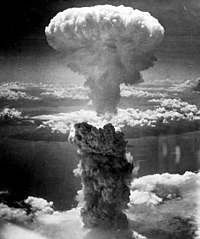
After the war Oppenheimer was a chief advisor to the newly created United States Atomic Energy Commission and used that position to lobby for international control of atomic energy and to avert the nuclear arms race with the Soviet Union. After provoking the ire of many politicians with his outspoken political opinions during the Red Scare, he had his security clearance revoked in a much-publicized and politicized hearing in 1954. Though stripped of his direct political influence Oppenheimer continued to lecture, write, and work in physics. A decade later President John F. Kennedy awarded him (and President Lyndon B. Johnson presented him) the Enrico Fermi Award as a gesture of political rehabilitation.
As a scientist Oppenheimer is remembered most for being the chief founder of the American school of theoretical physics while at the University of California, Berkeley. As director of the Institute for Advanced Study he would hold Einstein's old position of Senior Professor of Theoretical Physics. Oppenheimer's notable achievements in physics include the Born-Oppenheimer approximation, work on electron-positron theory, the Oppenheimer-Phillips process, quantum tunneling, relativistic quantum mechanics, quantum field theory, black holes, and cosmic rays.
read more...

Extinction of Dinosaurs
 Extinction of Dinosaurs
Deep into history, we find there is an event which decided the very existance of humans or for the matter mammals. If this event did not occur, mammals would never have come to prominence and the current world domination by the human animal would be dead impossible.
65 million years ago the world was dominated by reptiles we today know identify as dinosaurs. they were the predators they dominated the food chains, they grew to incredible sizes and was on earth sky and even the oceans. mammals were still evolving and was suppressed by the dominion of these saurians.
But suddenly something happened, the dinosaurs went extinct, and the vaccum was soon filled by mammals and evolution favored them to their current domination of our biosphere . . ultimately the evolution of the human species and their current command.
I feel this mass extinction event is the ultimate phenomenon which decided the very exisitance of humans. I'd like to imagine if this event didn't happen, would we find civilized dinos who would find languages, build cities and conquer the space

Read More on Wikipedia

Deep into history, we find there is an event which decided the very existance of humans or for the matter mammals. If this event did not occur, mammals would never have come to prominence and the current world domination by the human animal would be dead impossible.
65 million years ago the world was dominated by reptiles we today know identify as dinosaurs. they were the predators they dominated the food chains, they grew to incredible sizes and was on earth sky and even the oceans. mammals were still evolving and was suppressed by the dominion of these saurians.
But suddenly something happened, the dinosaurs went extinct, and the vaccum was soon filled by mammals and evolution favored them to their current domination of our biosphere . . ultimately the evolution of the human species and their current command.
I feel this mass extinction event is the ultimate phenomenon which decided the very exisitance of humans. I'd like to imagine if this event didn't happen, would we find civilized dinos who would find languages, build cities and conquer the space

Read More on Wikipedia
psyche said:
J. Robert Oppenheimer
"....the father of the atomic bomb.."

J. Robert Oppenheimer (April 22, 1904 – February 18, 1967) was an Americantheoretical physicist and professor of physics at the University of California, Berkeley. He is known for his role as the scientific director of the Manhattan Project: the World War II effort to develop the first nuclear weapons at the secret Los Alamos National Laboratory in New Mexico. For this reason he is remembered as "the father of the atomic bomb". In reference to the Trinity testBhagavad Gita: "If the radiance of a thousand suns were to burst at once into the sky, that would be like the splendor of the mighty one. Now I am become Death, the destroyer of worlds."
After the war Oppenheimer was a chief advisor to the newly created United States Atomic Energy Commission and used that position to lobby for international control of atomic energy and to avert the nuclear arms race with the Soviet Union. After provoking the ire of many politicians with his outspoken political opinions during the Red Scare, he had his security clearance revoked in a much-publicized and politicized hearing in 1954. Though stripped of his direct political influence Oppenheimer continued to lecture, write, and work in physics. A decade later President John F. Kennedy awarded him (and President Lyndon B. Johnson presented him) the Enrico Fermi Award as a gesture of political rehabilitation.
As a scientist Oppenheimer is remembered most for being the chief founder of the American school of theoretical physics while at the University of California, Berkeley. As director of the Institute for Advanced Study he would hold Einstein's old position of Senior Professor of Theoretical Physics. Oppenheimer's notable achievements in physics include the Born-Oppenheimer approximation, work on electron-positron theory, the Oppenheimer-Phillips process, quantum tunneling, relativistic quantum mechanics, quantum field theory, black holes, and cosmic rays.
read more...
heeey..thanks darling
mwah
POL POT

Pol Pot, who become responsible for the deaths of over two million of his own people, was born Saloth Sar in a small Cambodian village about 140 kilometers north of Phnom Penh. His date of birth is uncertain although French records give it as May 25, 1928. At age six he went to live with his brother at the Royal household in Phnom Penh. Here he learned Buddhist precepts and discipline. At age eight he went to a Catholic primary school, where he remained for six years. It was here that he picked up the basics of Western culture, as well as the French language.
In 1949, Pol Pot went to study in Paris on a government scholarship. It was here that he got his introduction to Communism, joining the French Communist Party. After four years of exposure to Stalinist Communism he returned to Cambodia in 1953. Within a month he had joined the Communist resistance, becoming a member of the Indochina Communist Party (IHC) which was dominated by the Viet Minh.
The 1954 Cambodian elections saw the Communists throw in support with the Democrats. The Democrats were soundly defeated, however, by the incumbent Government of Prince Sihanouk who now held absolute power. Pol Pot now took up a post as a teacher in a private college. He also spent his time recruiting the educated classes to the Communist cause. The Government, however, began a Communist crackdown and Pol Pot was forced to flee to the Jungles near the Vietnam border to avoid arrest. For the next seven years he would spend his time in the Cambodian jungle hiding from the police.
Over the ensuing years the communists bided their time as they built up their strength for a take-over attempt. They were bolstered by the North Vietnamese who were waging warfare against the Cambodian Government. A major Vietnamese victory in 1971 allowed the Communists to take control of certain areas of the country. In 1973 the communists launched a major attack on the Government but this was halted by American bombing. A final Communist assault began on January 1, 1975. This time they were victorious. On April 17, Communist forces entered Phnom Penh. Within 24 hours they had ordered the entire city evacuated. This process was repeated in other cities resulting in more than 2 million Cambodians being forced out of their homes. Many of them starved to death.
Pol Pot was now Prime Minister of Cambodia, which he promptly renamed Kampuchea. In August, 1976 he unveiled his Four Year Plan, which detailed the collectivisation of agriculture, the nationalization of industry and the financing of the economy through increased agricultural exports. This plan caused untold misery to the nation with many thousands dying in the paddy fields. Crops needed to feed the population were marked for export. Malnutrition was rampant, made worse by the Communist insistence on traditional Cambodian medicine. Pol Pot also started the infamous S-21 interrogation center where more than 20,000 men, women and children were tortured to death.
Throughout 1976 and ’77 skirmishes with Vietnam continued. In December 1977 The Vietnamese made real inroads in Kampuchea. Pol Pot, however, held on for another year. By January, 1979 the Vietnamese forces had actually reached Phnom Penh. The Kampuchean Government fled by train while Pol Pot was taken by helicopter to Thailand. His last public appearance was an interview in December 1979. For the next 19 years he remained in exile in the Thai jungle. Pol Pot died in 1998.

Pol Pot, who become responsible for the deaths of over two million of his own people, was born Saloth Sar in a small Cambodian village about 140 kilometers north of Phnom Penh. His date of birth is uncertain although French records give it as May 25, 1928. At age six he went to live with his brother at the Royal household in Phnom Penh. Here he learned Buddhist precepts and discipline. At age eight he went to a Catholic primary school, where he remained for six years. It was here that he picked up the basics of Western culture, as well as the French language.
In 1949, Pol Pot went to study in Paris on a government scholarship. It was here that he got his introduction to Communism, joining the French Communist Party. After four years of exposure to Stalinist Communism he returned to Cambodia in 1953. Within a month he had joined the Communist resistance, becoming a member of the Indochina Communist Party (IHC) which was dominated by the Viet Minh.
The 1954 Cambodian elections saw the Communists throw in support with the Democrats. The Democrats were soundly defeated, however, by the incumbent Government of Prince Sihanouk who now held absolute power. Pol Pot now took up a post as a teacher in a private college. He also spent his time recruiting the educated classes to the Communist cause. The Government, however, began a Communist crackdown and Pol Pot was forced to flee to the Jungles near the Vietnam border to avoid arrest. For the next seven years he would spend his time in the Cambodian jungle hiding from the police.
Over the ensuing years the communists bided their time as they built up their strength for a take-over attempt. They were bolstered by the North Vietnamese who were waging warfare against the Cambodian Government. A major Vietnamese victory in 1971 allowed the Communists to take control of certain areas of the country. In 1973 the communists launched a major attack on the Government but this was halted by American bombing. A final Communist assault began on January 1, 1975. This time they were victorious. On April 17, Communist forces entered Phnom Penh. Within 24 hours they had ordered the entire city evacuated. This process was repeated in other cities resulting in more than 2 million Cambodians being forced out of their homes. Many of them starved to death.
Pol Pot was now Prime Minister of Cambodia, which he promptly renamed Kampuchea. In August, 1976 he unveiled his Four Year Plan, which detailed the collectivisation of agriculture, the nationalization of industry and the financing of the economy through increased agricultural exports. This plan caused untold misery to the nation with many thousands dying in the paddy fields. Crops needed to feed the population were marked for export. Malnutrition was rampant, made worse by the Communist insistence on traditional Cambodian medicine. Pol Pot also started the infamous S-21 interrogation center where more than 20,000 men, women and children were tortured to death.
Throughout 1976 and ’77 skirmishes with Vietnam continued. In December 1977 The Vietnamese made real inroads in Kampuchea. Pol Pot, however, held on for another year. By January, 1979 the Vietnamese forces had actually reached Phnom Penh. The Kampuchean Government fled by train while Pol Pot was taken by helicopter to Thailand. His last public appearance was an interview in December 1979. For the next 19 years he remained in exile in the Thai jungle. Pol Pot died in 1998.
Linus Torvalds
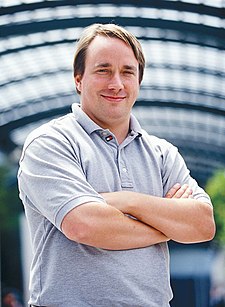
From Wikipedia, the free encyclopedia
Jump to: navigation, search
Linus Torvalds
Born December 28, 1969 (1969-12-28) (age 38)
Helsinki, Finland
Residence Portland, Oregon
Nationality Finnish
Occupation Software engineer
Employer Linux Foundation
Known for Linux kernel, Git
Spouse(s) Tove Torvalds
Parents Nils Torvalds (father)
Relatives Ole Torvalds (grandfather)
Website
www.cs.helsinki.fi/u/torvalds/
Linus Benedict Torvalds (pronunciation (help·info); [ˈliːnɵs ˈtuːrvalds]; born December 28, 1969 in Helsinki, Finland) is a Finnish software engineer best known for having initiated the development of the Linux kernel. He later became the chief architect of the Linux kernel, and now acts as the project's coordinator.
Contents
[hide]
* 1 Biography
o 1.1 Early years
o 1.2 Later years
* 2 The Linus/Linux connection
* 3 Authority on Linux
* 4 Linux trademark
* 5 Recognition
* 6 See also
* 7 Notes
* 8 References
* 9 External links
[edit] Biography
[edit] Early years
Linus Torvalds was born in Helsinki, Finland, the son of journalists Anna and Nils Torvalds,[1] and the grandson of poet Ole Torvalds. His family belongs to the Swedish-speaking minority (5.5%) of Finland's population. Torvalds was named after Linus Pauling, the American Nobel Prize-winning chemist, although in the book Rebel Code: Linux and the Open Source Revolution, Torvalds is quoted as saying, "I think I was named equally for Linus the peanut-cartoon character," noting that this makes him half "Nobel-prize-winning chemist" and half "blanket-carrying cartoon character."[2] Both of his parents were campus radicals at the University of Helsinki in the 1960s.
Torvalds attended the University of Helsinki from 1988 to 1996, graduating with a master's degree in computer science. His M.Sc. thesis was titled Linux: A Portable Operating System. From 1997 to 1999 he was involved in 86open helping to choose the standard binary format for Linux and Unix.
His interest in computers began with a Commodore VIC-20.[3] After the VIC-20 he purchased a Sinclair QL which he modified extensively, especially its operating system. He programmed an Assembly language and a text editor for the QL, as well as a few games.[4] He is known to have written a Pac-Man clone named Cool Man. In 1990 he purchased an Intel 80386-based IBM PC and spent a few weeks playing the game Prince of Persia before receiving his MINIX copy which in turn enabled him to begin his work on Linux.[2]
[edit] Later years
Linus Torvalds is married to Tove Torvalds (née Monni) – a six-time Finnish national Karate champion – whom he first met in the autumn of 1993.[5] Torvalds was running introductory computer laboratory exercises for students and instructed the course attendants to send him an e-mail as a test, to which Tove responded with an e-mail asking for a date.[2] Tove and Linus were later married and have three daughters, Patricia, Daniela, and Celeste.[6]
After a visit to Transmeta in late 1996,[7] he accepted a position at the company in California, where he would work from February 1997 through June 2003. He then moved to the Open Source Development Labs, which has since merged with the Free Standards Group to become the Linux Foundation, under whose auspices he continues to work. In June 2004, Torvalds and his family moved to Portland, Oregon to be closer to the consortium's Beaverton, Oregon-based headquarters.
Red Hat and VA Linux, both leading developers of Linux-based software, presented Torvalds with stock options in gratitude for his creation.[8] In 1999, both companies went public and Torvalds' net worth shot up to roughly $20 million.[9][10]
His personal mascot is a penguin nicknamed Tux, which has been widely adopted by the Linux community as the mascot of the Linux kernel.
Unlike many open source icons, Torvalds maintains a low profile and generally refuses to comment on competing software products.[dubious – discuss] Torvalds generally stays out of non-kernel-related debates. Although Torvalds believes that "open source is the only right way to do software", he also has said that he uses the "best tool for the job", even if that includes proprietary software.[11] He has been criticized for his use and alleged advocacy of the proprietary BitKeeper software for version control in the Linux kernel. However, Torvalds has since written a free-software replacement for BitKeeper called Git. Torvalds has commented on official GNOME developmental mailing lists that, in terms of desktop environments, he encourages users to switch to KDE.[12][13]
[edit] The Linus/Linux connection
Main article: History of Linux
Initially Torvalds wanted to call the kernel he developed Freax (a combination of "free", "freak", and the letter X to indicate that it is a Unix-like system), but his friend Ari Lemmke, who administered the FTP server where the kernel was first hosted for downloading, named Torvalds' directory linux.
[edit] Authority on Linux
Since Linux has had thousands of contributors, such a percentage represents a significant personal contribution to the overall amount of code. Torvalds remains the ultimate authority on what new code is incorporated into the standard Linux kernel.[14]
[edit] Linux trademark
Torvalds owns the "Linux" trademark, and monitors[15] use of it chiefly through the non-profit organization Linux International.
[edit] Recognition
* In 1996 Asteroid 9793 Torvalds was named after Linus Torvalds.
* In 1998 he received an EFF Pioneer Award.[16]
* In 1999 he received honorary doctor status at Stockholm University.
* The 1999 novel Cryptonomicon by Neal Stephenson features several characters who use "Finux" a Unix-like operating system developed in Finland.
* In 2000 he received honorary doctor status at University of Helsinki.
* In 2000 he was awarded the Lovelace Medal.[17]
* In the Time magazine's Person of the Century Poll, Torvalds was voted at #17 at the poll's close in 2000.[18]
* In 2001, he shared the Takeda Award for Social/Economic Well-Being with Richard Stallman and Ken Sakamura.
* The 2001 film Swordfish contains a Finnish character – the number one computer hacker in the world – named Axl Torvalds.
* In 2004, he was named one of the most influential people in the world by the Time magazine article "Linus Torvalds: The Free-Software Champion" by Lawrence Lessig, Time Magazine, posted Monday, Apr. 26, 2004, retrieved October 3, 2006.
* In the search for the 100 Greatest Finns of all time, voted in the summer of 2004, Torvalds placed 16th.
* In 2005 he appeared as one of "the best managers" in a survey by BusinessWeek.[19]
* In August 2005, Torvalds received the Vollum Award from Reed College.[20]
* In 2006, Business 2.0 magazine named him one of "10 people who don't matter" because the growth of Linux has shrunk Torvalds' individual impact.[21]
* In 2006, Time Magazine—Europe Edition named him one of the revolutionary heroes of the past 60 years.[22]
* In 2008, he was inducted into the Hall of Fellows of the Computer History Museum in Mountain View, California.[23][24]
From Wikipedia, the free encyclopedia
Jump to: navigation, search
Linus Torvalds
Born December 28, 1969 (1969-12-28) (age 38)
Helsinki, Finland
Residence Portland, Oregon
Nationality Finnish
Occupation Software engineer
Employer Linux Foundation
Known for Linux kernel, Git
Spouse(s) Tove Torvalds
Parents Nils Torvalds (father)
Relatives Ole Torvalds (grandfather)
Website
www.cs.helsinki.fi/u/torvalds/
Linus Benedict Torvalds (pronunciation (help·info); [ˈliːnɵs ˈtuːrvalds]; born December 28, 1969 in Helsinki, Finland) is a Finnish software engineer best known for having initiated the development of the Linux kernel. He later became the chief architect of the Linux kernel, and now acts as the project's coordinator.
Contents
[hide]
* 1 Biography
o 1.1 Early years
o 1.2 Later years
* 2 The Linus/Linux connection
* 3 Authority on Linux
* 4 Linux trademark
* 5 Recognition
* 6 See also
* 7 Notes
* 8 References
* 9 External links
[edit] Biography
[edit] Early years
Linus Torvalds was born in Helsinki, Finland, the son of journalists Anna and Nils Torvalds,[1] and the grandson of poet Ole Torvalds. His family belongs to the Swedish-speaking minority (5.5%) of Finland's population. Torvalds was named after Linus Pauling, the American Nobel Prize-winning chemist, although in the book Rebel Code: Linux and the Open Source Revolution, Torvalds is quoted as saying, "I think I was named equally for Linus the peanut-cartoon character," noting that this makes him half "Nobel-prize-winning chemist" and half "blanket-carrying cartoon character."[2] Both of his parents were campus radicals at the University of Helsinki in the 1960s.
Torvalds attended the University of Helsinki from 1988 to 1996, graduating with a master's degree in computer science. His M.Sc. thesis was titled Linux: A Portable Operating System. From 1997 to 1999 he was involved in 86open helping to choose the standard binary format for Linux and Unix.
His interest in computers began with a Commodore VIC-20.[3] After the VIC-20 he purchased a Sinclair QL which he modified extensively, especially its operating system. He programmed an Assembly language and a text editor for the QL, as well as a few games.[4] He is known to have written a Pac-Man clone named Cool Man. In 1990 he purchased an Intel 80386-based IBM PC and spent a few weeks playing the game Prince of Persia before receiving his MINIX copy which in turn enabled him to begin his work on Linux.[2]
[edit] Later years
Linus Torvalds is married to Tove Torvalds (née Monni) – a six-time Finnish national Karate champion – whom he first met in the autumn of 1993.[5] Torvalds was running introductory computer laboratory exercises for students and instructed the course attendants to send him an e-mail as a test, to which Tove responded with an e-mail asking for a date.[2] Tove and Linus were later married and have three daughters, Patricia, Daniela, and Celeste.[6]
After a visit to Transmeta in late 1996,[7] he accepted a position at the company in California, where he would work from February 1997 through June 2003. He then moved to the Open Source Development Labs, which has since merged with the Free Standards Group to become the Linux Foundation, under whose auspices he continues to work. In June 2004, Torvalds and his family moved to Portland, Oregon to be closer to the consortium's Beaverton, Oregon-based headquarters.
Red Hat and VA Linux, both leading developers of Linux-based software, presented Torvalds with stock options in gratitude for his creation.[8] In 1999, both companies went public and Torvalds' net worth shot up to roughly $20 million.[9][10]
His personal mascot is a penguin nicknamed Tux, which has been widely adopted by the Linux community as the mascot of the Linux kernel.
Unlike many open source icons, Torvalds maintains a low profile and generally refuses to comment on competing software products.[dubious – discuss] Torvalds generally stays out of non-kernel-related debates. Although Torvalds believes that "open source is the only right way to do software", he also has said that he uses the "best tool for the job", even if that includes proprietary software.[11] He has been criticized for his use and alleged advocacy of the proprietary BitKeeper software for version control in the Linux kernel. However, Torvalds has since written a free-software replacement for BitKeeper called Git. Torvalds has commented on official GNOME developmental mailing lists that, in terms of desktop environments, he encourages users to switch to KDE.[12][13]
[edit] The Linus/Linux connection
Main article: History of Linux
Initially Torvalds wanted to call the kernel he developed Freax (a combination of "free", "freak", and the letter X to indicate that it is a Unix-like system), but his friend Ari Lemmke, who administered the FTP server where the kernel was first hosted for downloading, named Torvalds' directory linux.
[edit] Authority on Linux
Since Linux has had thousands of contributors, such a percentage represents a significant personal contribution to the overall amount of code. Torvalds remains the ultimate authority on what new code is incorporated into the standard Linux kernel.[14]
[edit] Linux trademark
Torvalds owns the "Linux" trademark, and monitors[15] use of it chiefly through the non-profit organization Linux International.
[edit] Recognition
* In 1996 Asteroid 9793 Torvalds was named after Linus Torvalds.
* In 1998 he received an EFF Pioneer Award.[16]
* In 1999 he received honorary doctor status at Stockholm University.
* The 1999 novel Cryptonomicon by Neal Stephenson features several characters who use "Finux" a Unix-like operating system developed in Finland.
* In 2000 he received honorary doctor status at University of Helsinki.
* In 2000 he was awarded the Lovelace Medal.[17]
* In the Time magazine's Person of the Century Poll, Torvalds was voted at #17 at the poll's close in 2000.[18]
* In 2001, he shared the Takeda Award for Social/Economic Well-Being with Richard Stallman and Ken Sakamura.
* The 2001 film Swordfish contains a Finnish character – the number one computer hacker in the world – named Axl Torvalds.
* In 2004, he was named one of the most influential people in the world by the Time magazine article "Linus Torvalds: The Free-Software Champion" by Lawrence Lessig, Time Magazine, posted Monday, Apr. 26, 2004, retrieved October 3, 2006.
* In the search for the 100 Greatest Finns of all time, voted in the summer of 2004, Torvalds placed 16th.
* In 2005 he appeared as one of "the best managers" in a survey by BusinessWeek.[19]
* In August 2005, Torvalds received the Vollum Award from Reed College.[20]
* In 2006, Business 2.0 magazine named him one of "10 people who don't matter" because the growth of Linux has shrunk Torvalds' individual impact.[21]
* In 2006, Time Magazine—Europe Edition named him one of the revolutionary heroes of the past 60 years.[22]
* In 2008, he was inducted into the Hall of Fellows of the Computer History Museum in Mountain View, California.[23][24]

Adolf Hitler

Adolf Hitler (20 April 1889 – 30 April 1945) was an Austrian-born politician who was elected to lead the National Socialist German Workers Party (Nationalsozialistische Deutsche Arbeiterpartei NSDAP), the Nazi Party. He was Chancellor of Germany (1933–1945) and Führer und Reichskanzler of Germany (1934–1945).
Hitler was a decorated veteran of World War I who led the Nazi Party in Weimar Germany. Following his imprisonment after a 1923 failed coup, he gained support by promoting nationalism, antisemitism and anti-communism with charismatic oratory and propaganda. The Nazis executed or assassinated many of their opponents, restructured the state economy, rearmed the armed forces and established a totalitarian and fascist dictatorship. Hitler pursued a foreign policy with the declared goal of seizing Lebensraum ("living space"). The German invasion of Poland in 1939 caused the British and French Empires to declare war on Germany, leading to the outbreak of World War II in Europe.[3]
The Axis powers occupied most of continental Europe and parts of Asia and Africa until defeated by the Allies. By 1945, Germany was in ruins. Hitler's bid for territorial conquest and racial subjugation caused the deaths of 43 million people, including the systematic genocide of an estimated six million Jews as well as various additional "undesirable" populations in what is known as the Holocaust.
During the final days of the war in 1945, as Berlin was being invaded by the Red Army, Hitler married Eva Braun.[4] Less than 24 hours later, the two committed suicide in the Führerbunker.

Adolf Hitler (20 April 1889 – 30 April 1945) was an Austrian-born politician who was elected to lead the National Socialist German Workers Party (Nationalsozialistische Deutsche Arbeiterpartei NSDAP), the Nazi Party. He was Chancellor of Germany (1933–1945) and Führer und Reichskanzler of Germany (1934–1945).
Hitler was a decorated veteran of World War I who led the Nazi Party in Weimar Germany. Following his imprisonment after a 1923 failed coup, he gained support by promoting nationalism, antisemitism and anti-communism with charismatic oratory and propaganda. The Nazis executed or assassinated many of their opponents, restructured the state economy, rearmed the armed forces and established a totalitarian and fascist dictatorship. Hitler pursued a foreign policy with the declared goal of seizing Lebensraum ("living space"). The German invasion of Poland in 1939 caused the British and French Empires to declare war on Germany, leading to the outbreak of World War II in Europe.[3]
The Axis powers occupied most of continental Europe and parts of Asia and Africa until defeated by the Allies. By 1945, Germany was in ruins. Hitler's bid for territorial conquest and racial subjugation caused the deaths of 43 million people, including the systematic genocide of an estimated six million Jews as well as various additional "undesirable" populations in what is known as the Holocaust.
During the final days of the war in 1945, as Berlin was being invaded by the Red Army, Hitler married Eva Braun.[4] Less than 24 hours later, the two committed suicide in the Führerbunker.
Similar threads
- Replies
- 12
- Views
- 347


- Replies
- 0
- Views
- 122

- Replies
- 0
- Views
- 90