


Phil Hughes SAGA
worst thing can happen for a cricketer.

Being hit on the head is dangerous – but the neck is especially vulnerable
One thing you must not forget with neck injuries is the possible damage to the bones and the spinal cord itself. But your immediate priority is preventing secondary injury
Phils Hughes Helmet....

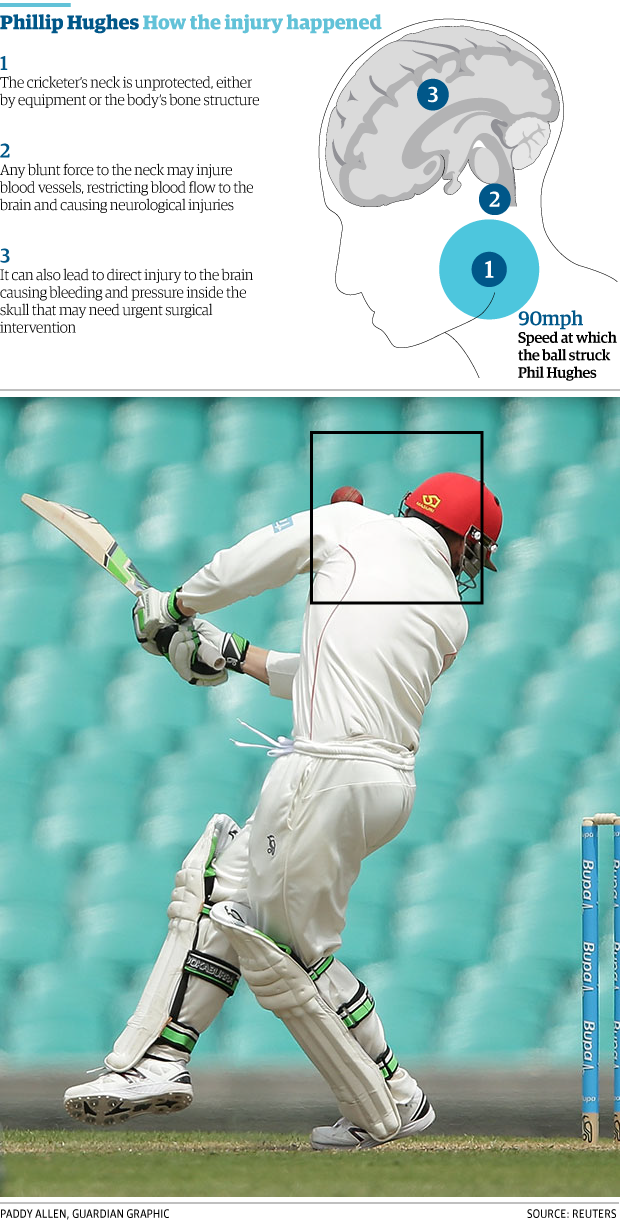
The side of the neck is probably the worst place you can be struck by a cricket ball. When you have one travelling at speeds of close to 90mph it is a hard missile; and although most injuries from the sport we see are minor – broken toes, split lips and suchlike – there are rare cases where cricketers have been struck in the chest over the heart and suffered cardiac arrest.
Being hit on the head is dangerous, of course, but the neck is particularly vulnerable because it is so exposed. The skull has evolved to protect your brain, and so even when it fractures it is not necessarily a bad thing because it is absorbing some of the shock. Unless we see a depressed skull fracture we would not be overly concerned: it is more the damage being done to the vital blood vessels, organs and structures that underlie it that worries us.
However, the neck has very little protection. And it has lots of important structures in it, not least some of the main arteries in the body which supply blood to the brain.
Any blunt force to the neck can damage these vessels, and if you restrict blood flow to the brain it can lead to serious neurological injuries. The other thing you worry about is a direct injury to the brain. If a patient develops bleeding around the brain, that puts pressure on the brain itself and that again will need urgent surgical intervention.


When anyone suffers a severe head or neck injury our first priority is to manage that person’s airway. There is very little we can do in the period between injury and surgery. So what we are aiming to do is prevent secondary brain injury. If you suffer an injury to the neck, blood vessels or any other structure to your neck, that can reduce or obstruct blood flow to the brain which causes more damage.
After establishing that the patient has a clear or secure airway, we then look at whether we are controlling their ventilation and blood pressure in the correct manner. Injuries to the vessels in the neck and brain can cause a rise in blood pressure because your body is trying to force blood to the brain.
The other thing you must not forget with neck injuries is injury to the bones and the spinal cord itself. But – again – your immediate priority is preventing secondary injury.
After the initial diagnosis at the scene, the most important thing is to get the patient to somewhere that has neurosurgical and vascular surgeons quickly, to diagnose and fix the injury as soon as possible. They will most likely take emergency scans down the neck to delineate the injury and to decide on the best treatment.
Within the neck itself, the damage it can do to the blood vessels is on a spectrum. A minor dissection of a blood vessel, when one of the layers is torn, can cause neurological complications similar to a stroke, which can be managed with drug treatment. On the further end of that spectrum, a patient can develop a pseudo-aneurysm which runs the risk of rupture or sending blood clots to the brain. In rare cases a patient can get transection of the blood vessel, where it is literally cut in half because of the blunt force, and that requires immediate surgery.
Outcomes are variable and it depends on the extent of the injury. Minor injuries to the blood vessels and the neck can be treated very successfully and have a good prognosis but the very serious injuries have a high morbidity and mortality rate even with surgical intervention.
worst thing can happen for a cricketer.

Being hit on the head is dangerous – but the neck is especially vulnerable
One thing you must not forget with neck injuries is the possible damage to the bones and the spinal cord itself. But your immediate priority is preventing secondary injury
Phils Hughes Helmet....

The side of the neck is probably the worst place you can be struck by a cricket ball. When you have one travelling at speeds of close to 90mph it is a hard missile; and although most injuries from the sport we see are minor – broken toes, split lips and suchlike – there are rare cases where cricketers have been struck in the chest over the heart and suffered cardiac arrest.
Being hit on the head is dangerous, of course, but the neck is particularly vulnerable because it is so exposed. The skull has evolved to protect your brain, and so even when it fractures it is not necessarily a bad thing because it is absorbing some of the shock. Unless we see a depressed skull fracture we would not be overly concerned: it is more the damage being done to the vital blood vessels, organs and structures that underlie it that worries us.
However, the neck has very little protection. And it has lots of important structures in it, not least some of the main arteries in the body which supply blood to the brain.
Any blunt force to the neck can damage these vessels, and if you restrict blood flow to the brain it can lead to serious neurological injuries. The other thing you worry about is a direct injury to the brain. If a patient develops bleeding around the brain, that puts pressure on the brain itself and that again will need urgent surgical intervention.


When anyone suffers a severe head or neck injury our first priority is to manage that person’s airway. There is very little we can do in the period between injury and surgery. So what we are aiming to do is prevent secondary brain injury. If you suffer an injury to the neck, blood vessels or any other structure to your neck, that can reduce or obstruct blood flow to the brain which causes more damage.
After establishing that the patient has a clear or secure airway, we then look at whether we are controlling their ventilation and blood pressure in the correct manner. Injuries to the vessels in the neck and brain can cause a rise in blood pressure because your body is trying to force blood to the brain.
The other thing you must not forget with neck injuries is injury to the bones and the spinal cord itself. But – again – your immediate priority is preventing secondary injury.
After the initial diagnosis at the scene, the most important thing is to get the patient to somewhere that has neurosurgical and vascular surgeons quickly, to diagnose and fix the injury as soon as possible. They will most likely take emergency scans down the neck to delineate the injury and to decide on the best treatment.
Within the neck itself, the damage it can do to the blood vessels is on a spectrum. A minor dissection of a blood vessel, when one of the layers is torn, can cause neurological complications similar to a stroke, which can be managed with drug treatment. On the further end of that spectrum, a patient can develop a pseudo-aneurysm which runs the risk of rupture or sending blood clots to the brain. In rare cases a patient can get transection of the blood vessel, where it is literally cut in half because of the blunt force, and that requires immediate surgery.
Outcomes are variable and it depends on the extent of the injury. Minor injuries to the blood vessels and the neck can be treated very successfully and have a good prognosis but the very serious injuries have a high morbidity and mortality rate even with surgical intervention.
Last edited:


