


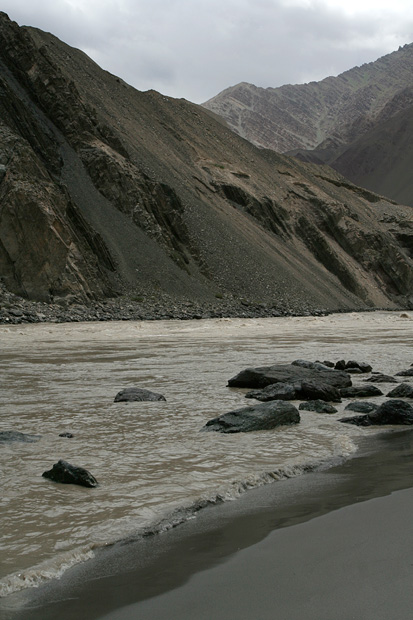
Just outside the monastery, Indus River flows swiftly in a depression carved by its currents. I walked down to the river bank and spent some time watching its fast flowing muddy current before making my way back to Leh in the evening.
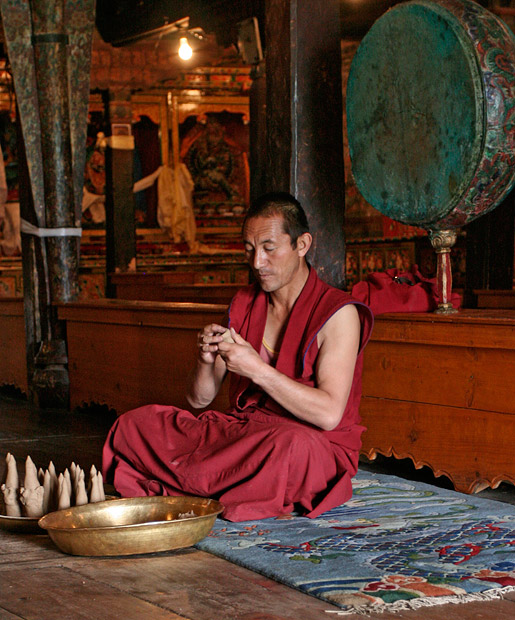
Lama Sherap was taking care of the du-khang that day. He was alone in the prayer hall as his companions had gone to the village to perform some rituals. He was friendly, approachable and smiled gently every time he spoke. Sitting on the floor close to the entrance of the hall, he busied himself kneading chunks of tsampa (barley flour) and preparing torma. He explained me what torma is and helpfully added that it is for some special prayers being performed tomorrow.
years old.’
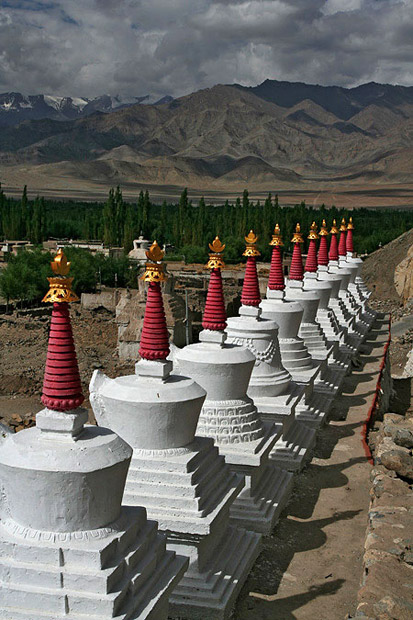
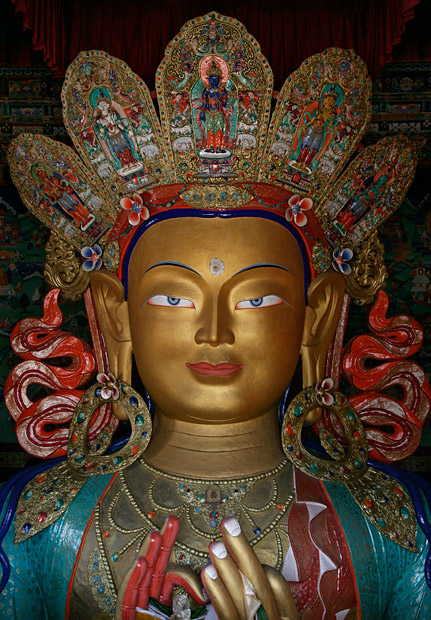
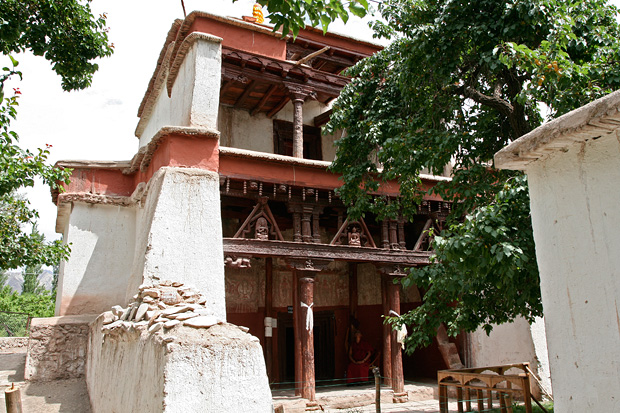
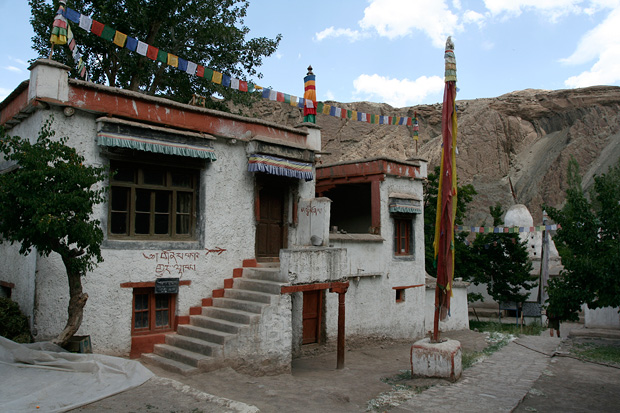
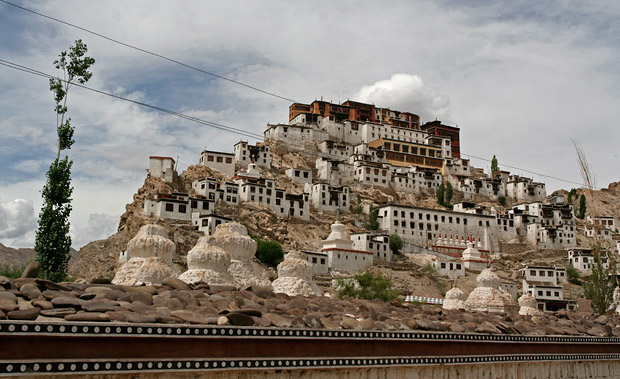
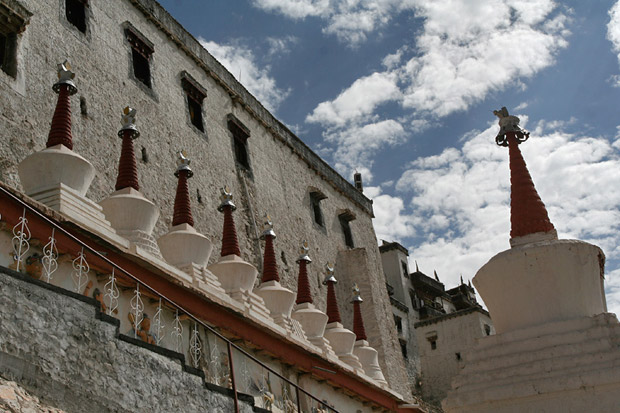
The Maitreya statue is relatively new, inaugurated in 1980 by Dalai Lama. The monastery itself was founded in early 15th century. Walking up the crag where a group of haphazardly built buildings of the monastery are located, it is evident that the institution has grown and expanded over the years. I climb up the steps leading to the monastery past a latest addition – a newly built row of chortens.
Inside, the du-khang seems to be old enough to be one of the first buildings built. To each side of its entrance are the colourful murals of the deities of the four directions, while inside walls are painted with various forms of Buddha and Yab Yum. At the rear side of du-khang is a small chapel with metallic statues of Tson-ka-pa and Manjushri.
The paintings on the outer walls have a curious diversion from tradition. The samsara-chakra has figures wielding guns and wearing clothes more suited for British and Indian men of the plains a few hundred years ago.
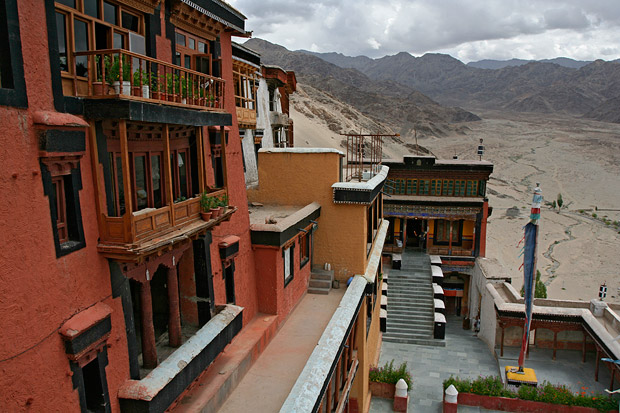
The stairs next to the du-khang lead to the terrace from where I can see the barley fields spread along the valley, the river coiling through the fields and the mountains beyond. In the corner of the terrace is a small room – a library filled with ancient Tibetan scriptures. As I descend from the stairs and head out to the valley, it is the smiles of Lama Sherap and the calm face of Maitreya that stay in my memory, etched stronger than the photographs I clicked in the monastery.
I took Marudhar express from Varanasi and arrived at Agra next morning. I checked into one of the hotels in Taj Ganj area which was just 5-minute walk from Taj Mahal. I had arrived on a Friday, when Taj Mahal remains closed and Agra was devoid of it’s tourist crowd. But not to worry, I had another day in Agra when I could take a look at the world-famous monument.
So I decided to walk around Taj Mahal and rest of the town. The region around Taj is green and well maintained. In fact it is such a thick forest that I happened to notice some jungle birds like the Rufous Treepie and Indian Grey Hornbill. After wandering around for a while, I decided to take a look at the Agra Fort.

Agra fort
As I arrived at the fort, a guide approached me asking if I needed his help. I wasn’t keen on a guide, but when he downed his rate to half of his initial quote of Rs.200, I decided to hire him. It was well worth getting his services.

Inside Agra fort
As I went around the fort, I could not help but wonder at the plush lives of the Mughal sultans. Marbles were used at every possible place and they were carved and finished to a good taste.

Taj Mahal and Yamuna, seen from Agra Fort
Taj Mahal at distance looked wonderful from the fort, with Yamuna at the backdrop. The next morning, I woke up early and was at the gates of Taj as early as six. But there was already a big queue and a lot of people seemed to be keen to be at Taj during sunrise. As the sun comes up, Taj appears pink and slowly turns white as the sun moves up.

Taj Mahal at sunrise
I spent nearly two hour walking in and around the Taj. It was beautiful and worth its name, but somehow I found the marble work at Agra Fort more intricate and beautiful than the Taj itself.
TAJ MAHAL
Agra fort
As I arrived at the fort, a guide approached me asking if I needed his help. I wasn’t keen on a guide, but when he downed his rate to half of his initial quote of Rs.200, I decided to hire him. It was well worth getting his services.
Inside Agra fort
As I went around the fort, I could not help but wonder at the plush lives of the Mughal sultans. Marbles were used at every possible place and they were carved and finished to a good taste.
Taj Mahal and Yamuna, seen from Agra Fort
Taj Mahal at distance looked wonderful from the fort, with Yamuna at the backdrop. The next morning, I woke up early and was at the gates of Taj as early as six. But there was already a big queue and a lot of people seemed to be keen to be at Taj during sunrise. As the sun comes up, Taj appears pink and slowly turns white as the sun moves up.
Taj Mahal at sunrise
I spent nearly two hour walking in and around the Taj. It was beautiful and worth its name, but somehow I found the marble work at Agra Fort more intricate and beautiful than the Taj itself.
In all the days that I was in Varanasi, I never missed morning and evening walks on the ghats. I would start from Assi Ghat where I stayed, and walk up to Dasaswamedh ghat, and sometimes to Manikarnika ghat. Twice, I took the boat but decided that the walks are more appealing. Each day there was something new and interesting to see and experience.

A view of the ghats from the boat early in the morning
Religion and religious practices are the most dominant experiences on the ghats. No matter what time you are there, you always see someone indulging in a ritual or the other. It could be as simple as a woman going round the peepul tree, a holy dip or a sadhu meditating, or a celebration as complex and elaborate as the Ganga Aarti.

A Sadhu makes offering(arghya) to sun god
For a keen observer, Varanasi has much more than the religious extravaganza. In the days that I walked on the ghats, I was amused to see even Mynahs, pigeons and water buffalos take time to bathe in the same holy water!

Water buffalos having a good time!
While the Mynahs hopped in and out of water, buffalos were blissfully happy to cool off in the river. Mynahs were lucky to be fed by the pilgrims every now and then. I liked it when they walked very close to me without any fear.

Myna’s Bath!
There were plenty of monkeys too that begged from the pilgrims and sat in a huddle when they had enough of food. Parakeets dwelling in the holes in the walls always made ruckus. I saw kingfishers diving into the black water and emerging out with fish in the beak. Street dogs did what they always do – fight within each other and bark at strangers. Some dogs keep trying to steal food from babas. They all make up a small animal kingdom that is oblivious to the eyes of most people.

A parakeet peeks out of it’s hole!
The ghats also take the role of a mini-mall. Many items of worship can be bought at Dasaswamedh ghat. Guesthouses, hotels and restaurants are frequently seen all along the ghats, but chai shops seem to be omnipresent.

One of the many chai shops
And every chai shop came with its share of squatters who never seem to be in a hurry for anything, and so, never seem to leave. There are children all around hoping to sell flowers(deep) or asking you to come and visit the business that their elders are running. Enterprising as they are, I heard them attempting to speak French and Spanish to potential customers from across the world!

Woman drying a sari at the ghat
There are washer men washing the clothes while their women spread the saris to dry on the steps. There are ads on the walls of the ghats offering every kind of service to the curious tourist, including those of guesthouses, restaurants, music classes and silk shops.

A family resting on the steps
And people of course, are always in plenty at any point of time. Herds of pilgrims are most common. Sometimes priests escort them and sometimes they are on their own, but almost always in groups. They indulge in their holy bath and hurry to visit the Kashi Vishwanath temple, or spend time performing shraddha karma and other rituals, or just take the famed boat ride on the Ganges.

A group of women enjoying the boat ride

Jain Munis walking on the ghat
Sometimes they just squat exhausted watching life on the ghats or waiting for the evening aarti to commence. Surprising to me, few people who take a dip in the river seemed to be bothered about the sewer like condition of the water. Only once did some one talk to me sad-faced. gangaji ka itnaa pradooshan ho raha hai.. – Mother Ganges is being polluted so much.., he said, and I nodded in agreement. It is really sad to see India’s most revered river being one of the most polluted too.

Busy ghats crowded with pilgrims early in the morning
The other set of people whom I often bumped into are the tourists. They come from all over the world, and each of them seems to be fascinated by Varanasi. They come with many motives. Some come to understand India, its life and religions. Some people come to learn music, meditation and Hinduism. Some of them are so fascinated that they stay on for months. A few people are photographers who come to capture the life at Varanasi. But most are casual backpackers who have heard so much about the place and want to check it all out in a short visit. These trotters are happy to take a boat ride, take a look at the burning corpses and bathing pilgrims like objects of exhibition, and quickly zip to their next destination which is typically Agra or Jaipur.

A tourist making notes
Despite wandering on the ghats for a week, there was much more to learn, see and understand about the ghats. I could not explore much of the network of confusing gallis besides the ghats which are a big marketplace besides being much more. There was plenty of Varanasi, including the ghats and the gallis that I wanted to photograph but a week was not enough. When I left, I left with a wish that I should have spared more time for Varanasi. And I left with the intent to return.


