


Ever since humans were aware of the vast void that he named the universe, they tried to give a meaning to how it was made and how it will eventually end, in the last century a lot of breakthroughs regarding these matters were made, several theories are available on how the universe formed and how it will eventually end, in this article Ill discuss the widely regarded Theories.
The formation of the universe
Widely accepted theory regarding the formation of the universe is the "Big Bang Theory" in simple terms this theory suggests that some 13.7 billion years ago every form of matter that are scattered across the universe were packed in a single spot in space the size of a pin head, then suddenly it exploded creating the most powerful explosion our universe have seen, matter and gas that was spread out in to the void from the big bang eventually created stars, galaxies, our solar system and everything else.
This theory is supported by the presence of the cosmic microwave background, observations done by the Hubble Space telescope and the red shift of the distance galaxies all of these suggest that universe is expanding rapidly, ill explain these in detail.
There is much debate whether the time existed before the big bang, Einstens Generel Theory of Relativity suggests that Any information that was there before the big bang is now lost so technically for our universe Time began with the moment the big bang occoured 13.7 -+ 0.2 Billion years ago. But some scientists belive that General theory of relativity is not valid in the time of the big bang because it happned from a singularity.
How our universe will end
There are two theories regarding this matter considering the Big Bang theory
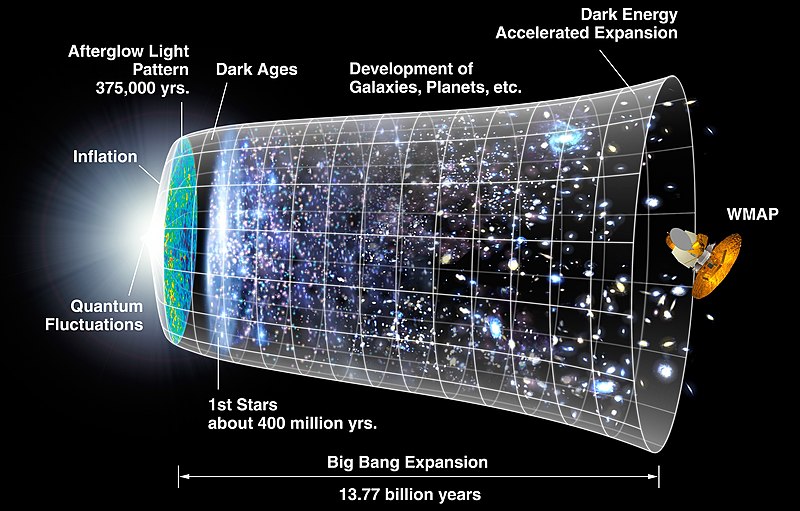
Expansion of the universe from the Big Bang image from the Wilkinson Microwave Anisotropy Probe
hope u got something out of this.
The formation of the universe
Widely accepted theory regarding the formation of the universe is the "Big Bang Theory" in simple terms this theory suggests that some 13.7 billion years ago every form of matter that are scattered across the universe were packed in a single spot in space the size of a pin head, then suddenly it exploded creating the most powerful explosion our universe have seen, matter and gas that was spread out in to the void from the big bang eventually created stars, galaxies, our solar system and everything else.
This theory is supported by the presence of the cosmic microwave background, observations done by the Hubble Space telescope and the red shift of the distance galaxies all of these suggest that universe is expanding rapidly, ill explain these in detail.
- Cosmic Microwave Background - This is a form of electro magnetic radiation that fills the entire universe, this was discovered in 1965. CMB suggests that the universe was once extremely hotter and it cooled down to the current levels over the time, this is one of the best evidences to support the big bang theory
- Red Shift of distant Galaxies - Red shifts happen when the galaxies are moving away from the observer because of Doppler effects, this suggests that our universe is expanding rapidly
There is much debate whether the time existed before the big bang, Einstens Generel Theory of Relativity suggests that Any information that was there before the big bang is now lost so technically for our universe Time began with the moment the big bang occoured 13.7 -+ 0.2 Billion years ago. But some scientists belive that General theory of relativity is not valid in the time of the big bang because it happned from a singularity.
How our universe will end
There are two theories regarding this matter considering the Big Bang theory
- The Big Crunch - If the mass density of the universe were greater than the critical density, then the universe would reach a maximum size and then begin to collapse. It would become denser and hotter again, ending with a state that was similar to that in which it started. and will eventually result in another big bang creating a a new universe.
- The Big Freeze - if the density in the universe were equal to or below the critical density, the expansion would slow down, but never stop. Star formation would cease as all the interstellar gas in each galaxy is consumed; stars would burn out leaving white dwarfs, neutron stars, and black holes. Very gradually, collisions between these would result in mass accumulating into larger and larger black holes. The average temperature of the universe would asymptotically approach absolute zero. Moreover, if the proton were unstable, then baryonic matter would disappear, leaving only radiation and black holes. Eventually, black holes would evaporate by emitting Hawking radiation. The entropy of the universe would increase to the point where no organized form of energy could be extracted from it, a scenario known as heat death. and nothing active will ever again happen in our universe.
Expansion of the universe from the Big Bang image from the Wilkinson Microwave Anisotropy Probe
hope u got something out of this.
Last edited:


