Truth behind the $ 6,361 loans

rocat90

Well-known member
  • Dec 14, 2012
    10,841
    1,392
    113
    Truth behind the $ 6,361 loans of the present Government

    The accusation by the former President
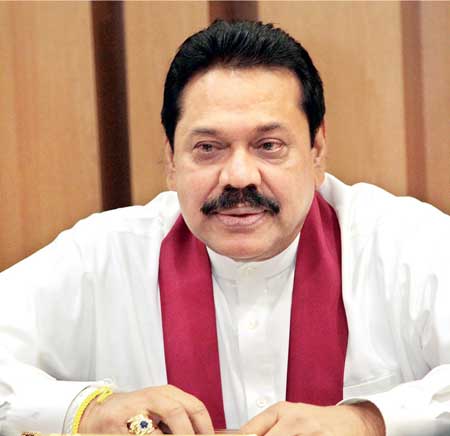
    Former President Mahinda Rajapaksa has been repeating ad nauseam over the last few weeks that the present Government has taken $ 6,361 million in foreign loans in its 15-month lifespan thus far but hadn’t even built a culvert with that money.
    He says that he could have built two Mattala Airports, one Hambantota Port, one Norochcholai Coal Power Plant, one Colombo-Matara Highway, one Colombo-Katunayake Highway, not one, but two Colombo Port cities and one 500 MW Sampur Coal Power Plant with that money.
    Finally, he says that the present Government is incapable of running the country and that he should be given the opportunity once again to ‘rescue’ Sri Lanka.

    The calculation of the $ 6,361 in loans
    Rajapaksa’s calculation of the $ 6,361 million the present Government borrowed is as follows:
    1. Currency swap of $ 400 million in March 2015 and $ 1,100 million in May 2016. So in currency swaps, the total is $ 1,500 million.
    2. International Sovereign Bond of $ 650 million in May 2015 and another $ 1,500 million ISB in October 2015. So in ISBs, the total is $ 2,150.
    3. Sri Lanka Development Bonds totaling $ 2,711 during the tenure of the new Government.
    So, adding together all of the above Rajapaksa comes up with the grand total of $ 6,361 million ‘debt’ that the present Government got into in the last 15 or so months. Let us analyse them one by one.

    Currency swaps
    What is a currency swap? It is a swap; meaning an exchange. In a central bank currency swap, two central banks exchange a particular currency with another with an agreement to unwind that swap at a given date at a given exchange rate and or a given interest rate.

    India has such swap agreements with each SAARC country for up to $ 2,000 million on which they can draw if needed. In fact, during Rajapaksa’s rule, in September 2014, Sri Lanka also entered in to a $ 1,600 million (or Yuan 10 billion) swap agreement with China.
    While most of the time currencies are exchanged, sometimes they are not, but is structured as a short-term loan to be paid back with interest. In the recent case of India, I understand it was the latter.
    These short term exchanges are, for the most part, used to either tide over currency pressure or to directly settle bilateral trade transactions. And these take place all the time around the world. As at present US, Canada, Euro Area, Switzerland, Japan, Australia, China, Australia, UK, India, Brazil, Singapore, Indonesia, Pakistan, Korea besides Sri Lanka and dozens of others have various swap agreements between and among them. They utilise them based on need.
    Rajapaksa attempts to portray that Sri Lanka got in to ‘debt’ with India to the tune of $ 1,500 million in currency swaps. The reality is quite different.
    A $ 400 million swap was entered into in April and unwound in October. Another $ 1,100 million swap was entered into in September 2015 and unwound in March 2016. This means the ‘short-term loans’ were taken and already settled. The two central banks can at any time re-enter into swaps to be unwound at agreed upon dates as per the SAARC or any other specific currency swap agreement. I believe they have entered into another $ 400 million short-term swap recently to be unwound soon and are discussing another $ 700 million swap. These, as described are short-term facilities that are cleared in a matter of months at the most (the $ 1,500 million referred to has already been settled) and not the kind of ‘debt’ as implied.
     

    rocat90

    Well-known member
  • Dec 14, 2012
    10,841
    1,392
    113
    662.jpg
     

    rocat90

    Well-known member
  • Dec 14, 2012
    10,841
    1,392
    113
    International Sovereign Bonds
    Now, let us take the International Sovereign Bonds, or ISBs. Yes, the new Government has issued 2,150 million in ISBs in 2015.
    If one takes a cursory glance at the history of ISBs, it becomes clear that it was during Rajapaksa’s time the ISB program was started. In fact, there is nothing wrong with ISBs if used for productive purposes, and in 2014 his Government issued $ 1,500 in such bonds. But, as far as we know, by and large the proceeds were not used for the intended purposes but instead for general budgetary support.
    In addition to the ISBs that year Rajapaksa’s Government used SriLankan Airlines and the National Savings Bank, among others, to issue international bonds for an additional $ 175 million and $ 250 million respectively bringing the total international bonds, both sovereign and corporate, to $ 1,925 million.
    The year prior to that, in 2013, his Government got NSB to issue $ 750 million in five-year international bonds for the highest ever interest rate of 8.875% plus fees when the global five-year benchmark was only 1.3%. Some may recall that the then Chairman, who was brought in after the infamous transaction where NSB purchased shares of the bankrupt ‘The Finance Company’ for a hugely inflated amount, was replaced by a ‘yes person’ to proceed with the same as he was not willing to enter in to another disaster. For those interested, NSB purchased shares of TFC for Rs. 49.50 while today the shares are trading at just Rs. 3.25.
    The unbiased reader will appreciate that it is not easy to make drastic adjustments to the current ISB program which has been set in motion many years ago; meaning to pay back the amount without rolling over. Nevertheless, the present Government is doing its very best to bring the program to a manageable level, and utilise the proceeds for useful capital expenditure. The overall objective is to reduce the debt to equity ratio in projects by increasing foreign direct investments on public-private-partnership basis, among others.

    The hidden loans
    A point to note is that, as referred to earlier, Rajapaksa used SriLankan and NSB as well as the Urban Development Authority, the National Water Supply and Drainage Board and the Road Development Authority among others to ‘hide’ the debt from the national debt figure so that he could argue that national debt to GDP was coming down.
    The argument was that these State-Owned Enterprises had strong balance sheets and could borrow and repay on their own. However, it is well known that none of these SOEs have the capability of paying back the massive loans they have taken and at the end of the day the treasury is called upon to make payment. The recent exposé on the way SriLankan had borrowed and how it is becoming an unbearable burden on the Government to service the loans is a clear example of how wrong the thinking was; or perhaps how arrogant the decision makers were with no concern about being responsible to society.
    These ‘hidden loans’ are part of the $ 1 trillion that the Prime Minister has been speaking on recently for which a forensic audit is to be conducted to get accurate details.
     

    rocat90

    Well-known member
  • Dec 14, 2012
    10,841
    1,392
    113
    Sri Lanka Development Bonds
    Finally, let us take the case of Sri Lanka Development Bonds or SLDBs. I had argued many years ago that this was a misnomer; as SLDBs were never, or hardly ever used for development purposes. They were used to repay SLDBs, in particular, coming due; to rollover.
    SLDBs are issued locally for those who can invest in USD denominated debt instruments and the tenor usually ranges from a few months to a few years. They are typically taken up by local banks and other eligible parties to receive tax free interest income.
    Yes, SLDBs worth $ 2,491 million had been issued in 2015 to roll over loans taken in the past for the most part and some additional funding. Total outstanding SLDBs stood at $ 2,984 as at end of 2014. A total of $ 2,084 million is due in 2016 and at least that amount would have to be issued to roll them over unless other funds are found.
     

    rocat90

    Well-known member
  • Dec 14, 2012
    10,841
    1,392
    113
    Project costs and project loans
    Now, let us turn to the costs that Rajapaksa has provided for some of the large white elephant projects that were started during his period. The objective here is not to discuss whether the costs were competitive or whether they were inflated, but to show the amounts shown and the actuals spent are vastly different and that they were funded by project loans.
    For instance, he says the Magampura Mahinda Rajapaksa Port cost $ 426 million to construct, but the actual cost thus far has been over $ 1,300 million and it is not yet complete. This figure is without the associated costs including $ 130 million on oil storage tanks that have never been used.
    In fact, almost all of the funds that were utilised to build these infrastructure projects came from project specific loans be it from China or elsewhere. This includes the rest of the projects in his list; Mahinda Rajapaksa International Airport in Mattala included.
    So, even though Rajapaksa attempts to make it seem that the various loans that were taken by the present Government could have been used to build infrastructure, including culverts, the facts are totally opposite to that.
    Government-owned infrastructure is built using long-term project loans unless governments have surpluses or are public private partnerships. No infrastructure has ever been built using swap agreements anywhere in the world and short tenor ISBs are not suited for assets that take a fairly long time to start generating revenue. As mentioned earlier, SLDB is a misnomer and is not suited for development projects.
    For example, the first $ 306 million for the MMRP was from China EXIM Bank, originally agreed upon at LIBOR + 0.90%, or today’s rate of 1.78% but subsequently changed to fixed rate of 6.30% on a Cabinet paper presented by Rajapaksa himself; the next $ 140 million again from the same bank including the $ 45 million to blast a ‘rock’ that created much discussion and a further $ 808 million also from China EXIM Bank for Phase II. The Phase I loan, signed in 2007, has a 15-year tenor with a four-year grace. This is already 2016.
    Of the $ 130 million spent for the unused oil tanks at the port $ 76.5 was also a loan from the same bank while the rest came from local banks.
    MRIA was also similar. The original cost was $ 208 million funded by China EXIM Bank and a further $ 100 million for improvements later and some $ 40 million for oil storage facility; in excess of the said $ 190 million and from sources not divulged by him but in fact from project loans.
    So, it is clear that the money for the seaport and airport named after Rajapaksa was funded by a series of project specific loans and not by the ISBs, swaps, or SLDBs. This was the case with respect to all other developments in Hambantota; be it expressway-like roads, railways, overpasses, huge cricket stadium, tele-village, etc.

    Repaying project loans
    Before a project is financed thorough assessments are carried out to determine if the project to be undertaken will have revenue streams to repay the loan. In the case of the huge loans taken for the infrastructure that bears Rajapaksa’s name, the question is if feasibility studies were done. In fact, the details available at the Department of National Planning indicates no proper feasibility studies were ever conducted on any of the projects that have now become ‘white elephants’.
    So, in such situations the government has no choice but to borrow in the international markets using various types of instruments to make payments that are becoming due.
    In 2011 Rajapaksa said that $ 650 million investments by foreign investors at the first stage of the port had “strengthened the confidence of global industrial and commercial giants regarding the success of this innovative project in southern Sri Lanka.”
    The country was told that 27 investment proposals had been received and the Cabinet had approved seven of them. They were a sugar refinery plant, a cement grinding and bagging plant, a fertiliser plant, a petro-chemical plant and three warehouse complexes.
    His top port expert, the then Chairman of the nation’s Port Authority, boasted that “effective intervention of President Mahinda Rajapaksa to lure the international community to commence business in sustainably peaceful environs in the country has brought about the dawn of an era of prosperity for all Sri Lankans” and that at the second stage of the investment, 11 more investors were to arrive with investments of $ 1.15 billion, which would increase the total investment at the port to $ 1.8 billion by 2013.
    The unfortunate truth is none of that has happened and the meagre income from the seaport itself is based on the roll-on roll-off business created through a combination of deep discounts and effective banning of unloading vehicles at Colombo. The airport has no regular income.
    Therefore, as mentioned earlier, the present Government has no option but to obtain dollar funds from further borrowings to repay the high cost loan payments coming due now.

    The truth behind the use of proceeds of loans
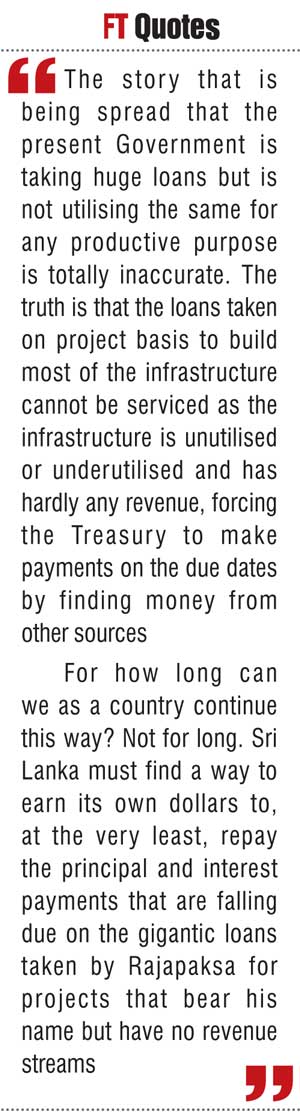
    What I wished to clarify from this short explanation is that the story that is being spread that the present Government is taking huge loans but is not utilising the same for any productive purpose is totally inaccurate. The truth is that the loans taken on project basis to build most of the infrastructure cannot be serviced as the infrastructure is unutilised or underutilised and has hardly any revenue, forcing the Treasury to make payments on the due dates by finding money from other sources.
    Therefore, the ‘story’ that the present Government is so inept that it is just borrowing large amounts without using the funds for any productive purposes, even to build a culvert, has been carefully crafted to mislead the people. So, whoever fabricated it did so fully aware of the fact that he or she was doing so purely to deceive the people of Sri Lanka for cheap political advantage.
     

    rocat90

    Well-known member
  • Dec 14, 2012
    10,841
    1,392
    113
    Can we go on like this?
    For how long can we as a country continue this way? Not for long. Sri Lanka must find a way to earn its own dollars to, at the very least, repay the principal and interest payments that are falling due on the gigantic loans taken by Rajapaksa for projects that bear his name but have no revenue streams.
    The Government must reverse the direction of Sri Lanka’s exports to GDP ratio. It must export a lot more than it is doing now. Particularly with the stagnant remittances from the middle East, which could start to decline, sent by the million or so workers who suffer untold misery to do so, the challenge becomes even tougher.
    A fact that is stubborn but is very revealing is that during Rajapaksa’s regime exports to GDP ratio fell from 34% to 14.5%. Just this figure will help the unbiased reader understand the present Government’s predicament. It inherited an economy that was in massive difficulty on the external front but window dressed by certain creative accountants to deceive the people.

    Way forward is to integrate Sri Lanka with the rest of the world
    In my role as the Deputy Minister of Foreign Affairs I am doing my best to push the agenda of economic diplomacy forward so that we can change directions of the exports to GDP ratio. To export more we need to bring in those who can invest in Hambantota and other areas of Sri Lanka.
    To get FDI the investors need to see a potential export market. Given ours is a small 20 million lower middle income economy, it is imperative we expand our reach to the region. We must be able to tap in to the emerging South Asian middle class in India, Pakistan and Bangladesh as well as in Central Europe. From the early days it was during the times that we as a nation was integrated with the world that we prospered.
    The challenge for us is to once again make Sri Lanka a hub. This time the hub of the ‘Asian oceans’, like the Prime Minister has already said. There are many who are attempting to derail this Government’s economic plan by blocking the initiatives to integrate Sri Lanka with the rest of the world. But I am convinced this Government will succeed in this endeavour.

    (The writer is Deputy Minister of Foreign Affairs.)
     

    lkzombie

    Well-known member
  • Feb 24, 2013
    2,587
    1,113
    113
    technoext.blogspot.com
    හොදටම තේරැනා බං නියමයි $ 6,361 ක ලෝන් එකක් අරන් අවුරැද්දක් ජීවත් වෙන හැටි නේ කියල තියෙන්නෙ? ට්‍රයි කරල බලන්න ඕන:nerd:
     

    rocat90

    Well-known member
  • Dec 14, 2012
    10,841
    1,392
    113
    Sri Lanka’s debt situation: What are our options?

    The external financing situation for Sri Lanka is certainly a big worry for both the Government and the private sector. This is largely due to monstrous financial profligacy of the past not yet fully explained. However, it is also due to a large trade deficit and a drop in exports and worker remittance.

    65dfh.jpg

    In 2015, our trade deficit was around $ 8.5 billion. Worker remittance was around $ 6.9 billion. Capital flows were negative. We had a balance of payment deficit of $1.5 billion. The only upside in 2015 was tourism – $ 3 billion – a 24% increase. If the trade deficit can be managed to around $ 7 billion, the higher income from tourism, exports and technology services could help our balance of payments to have a surplus.
    However, there are many other challenges for our external finances like the stability of the rupee, declining reserves and capital flows. Our export income is only around 55% of our imports. Therefore it is a must that Sri Lanka in the short-term limits the foreign debt financing only for projects that have multiple benefits for the economy.
    Furthermore, we need to focus more on debt refinancing, debt swaps, work hard to attract more FDI by introducing investment friendly policies and restructure the BOI to support that drive and more importantly manage the export trade supply side of the equation.

    647.jpg


    Government debt
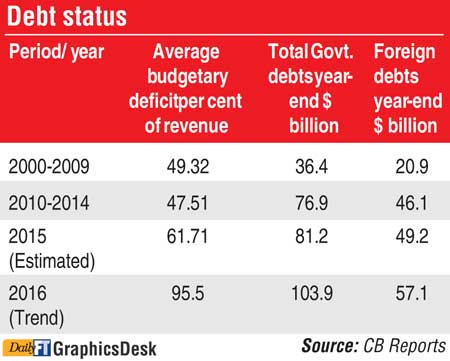
    Sri Lanka’s total Government debt at the end of 2015 was $ 81 billion; out of this foreign debt was around 60%. According to Central Bank data, our total debt will touch $ 103 billion this year – around 98% of revenue and – foreign debt will increase to $ 57 billion this year.
    Today public debt is almost 100% of GDP. Therefore there is lot of work that needs to be done given that we have BOP deficit of $ 1.5 billion from 2015 to manage first. Many of the short-term loans got at exorbitant rates taken for unproductive projects is one of the root causes for this situation.
    For e.g., the Mattala Airport debt arrangement needs to be renegotiated and those assets needs to be productively used for the betterment of society. The IMF Structural Adjustment Facility if effectively negotiated could help the economy to ride over this crisis, however the policy direction to improve the supply side is a must as well as tightening of fiscal and monetary policies.

    Way forward for Sri Lanka
    While the Government is looking for short-term options to ride over this crisis like the recent currency swap with India for $ 1.1 billion and the proposed one with China for $ 1 billion, all these arrangements have their cost and political consequences.
    It is important from now on to only invest in ongoing projects if there are clear benefits over cost and projects that don’t drain our foreign exchange reserves. Some of the big-ticket projects like the Megapolis and mega road development projects may need to be phased over the next few years.
    However, if we are to attract more FDI, we need to invest more on education and skills to improve the productivity of the workforce and to improve our inward remittances, given that the dependency of inward remittance may no longer be sustainable in the long term.
    FDI instead of debt financing and foreign borrowings is what we need: That however would require a conducive investment climate that protects equity rights, and property rights and deregulation. Sri Lanka urgently needs a medium-term plan to increase commercial exports and services.
    The Sri Lankan economy has faced much bigger challenges before. Therefore, given its strategic location within South Asia and the goodwill we have earned in the last 12 months with the international community, Sri Lanka should look to exploit those opportunities to improve the living standards of all the people.

    (The writer is a senior company director.)


    rocat90

    Well-known member
  • Dec 14, 2012
    10,841
    1,392
    113
    Tea should have a wider angle than a mere beverage
    Untitled-269.jpg
    At a panel discussion following an evening presentation organised by the Institute of Certified Professional Managers or CPM in Colombo last week, a questioner from the audience put an interesting poser to Anil Cooke, CEO of Asia Siyaka, a leading tea brokering company in the city.

    The questioner, apparently dismayed by the current gloomy situation faced by the country’s tea industry, asked Cooke: “Why should I invest in Sri Lanka’s tea plantations?” Cooke was quick to correct the questioner before answering his question. He said: “Tea should not be taken as a plantation crop or even an industry. It should be viewed as a beverage. It faces all the problems which any beverage faces and its salvation too lies in the salvation of beverages in a global sense.”
    Cooke here has looked at tea from a wide angle, an angle which many concerned about it normally miss out. However, Cooke’s wide angle can be developed further into a wider angle. In that wider angle, tea is not only a beverage, but also an essential ingredient for manufacturing medicines, cosmetics and perfumes – three industries which are growing faster than the growth of the global output.
    Tea marketing in Sri Lanka is still where it was left by British planters
    When tea is considered from this wider angle, it boils down to a problem of long-term strategising, marketing, inventions and innovations. It is in these four areas where Sri Lanka has failed.
    The country, while boasting of producing the best tea in the world called the ‘Ceylon Tea’ has not moved even a single step forward from where the industry was left by British planters.
    It has continued to grow tea, manufacture orthodox black tea and sell to consumers in a selected number of countries either in the form of ‘bulk tea’ or tea in ‘teabags’. Hence, when the market prices depress due to oversupply, adverse regional political turmoil or global economic recessions, the tea growers back at home are forced to undergo enormous economic hardships.
    If the period is long, many of them become bankrupt. This is specifically true with low country tea smallholders who at present produce about 65% of the country’s tea output. Their woes are then capitalised by interested political parties which create a political issue out of the economic issue faced by the country.
    The vicious cycle of price fluctuations
    The present situation in Sri Lanka is such an economic catastrophe. The average tea price per kilo was $ 3.51 or Rs. 459 at end 2014. This has now fallen to $ 2.80, according to the latest market reports. Despite the depreciation of the Sri Lanka rupee from Rs. 130 per dollar to Rs. 145 per dollar between these two periods, the rupee earnings have been just Rs. 407 per kilo, recording a fall of
    Untitled-359.jpg
    Rs. 52 or 11%. This price is pretty much below the estimated cost of production amounting to Rs. 434 per kg.

    If the tea producers are to be elevated to the income level which they had enjoyed at end 2014, the rupee has to depreciate to a level of Rs. 165 per dollar. However, given the increases in labour charges and other expenses during this period, even this level of income support may not be sufficient to sustain the tea growers.
    Hence, the country has been embroiled in a vicious and expanding cycle of price depression, cost increases, currency depreciation, political capitalisation and further depression of prices. This vicious cycle and political capitalisation do not allow the country to go for long-term strategising for curing the ailments faced by the tea sector.
    Rising costs in a background of low yields
    Sri Lanka’s tea suffers from both the high cost of production and low yields. No commodity can compete in the world market unless it reduces its average cost. That reduction comes from increasing the yield levels.
    According to Food and Agricultural Organisation or FAO of United Nations, Sri Lanka’s tea yield standing at 1532 kg per hectare is only marginally higher than the world average of 1518 kg per hectare (available at: http://www.factfish.com/statistic/tea, yield).
    Thus, Sri Lanka is ranked 26th position in terms of the global tea yields. This has to be compared with high yield countries such as Malaysia (with a yield of 6778 kg or Number one position), Kenya (2177 kg or 13th position) India (2143 kg or 14th position) or Tanzania (1573 kg or 24th position).
    Accordingly, in a background of high costs and low yields, any fall in the international price of tea will make Sri Lanka sick because it has no back-up resources to go through the crisis. Since price changes occur frequently in cycles, Sri Lanka’s tea industry, though it is the second highest foreign exchange earner after garments, is driven to a high level of vulnerability.
    The need for raising industry earnings
    Sri Lanka cannot increase its tea yield levels overnight. However, it can increase industry earnings by diversifying its use. The diversification can be in the beverage sector itself as a novel drink, on one hand, and into non-beverage industry sector as an ingredient for producing pharmaceuticals, cosmetics and perfumes, on the other. Both require investments in better marketing and continued research and development.
    Untitled-438.jpg
    Britons popularising tea as a panacea for all illnesses
     

    rocat90

    Well-known member
  • Dec 14, 2012
    10,841
    1,392
    113
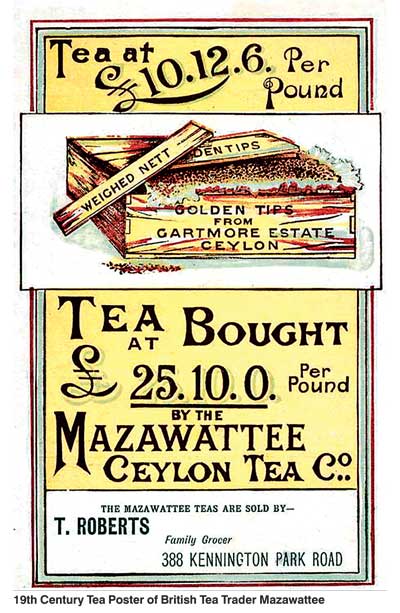
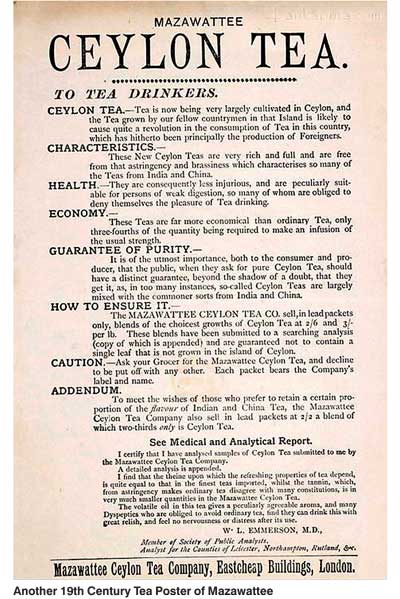
    Tea was promoted by British planters and tea traders by using ingenious marketing methods. When Ceylon tea began to face competition from other tea producing countries in late 19th Century, it was presented to British and European tea drinkers as a uniquely branded product. A separate tea culture was developed with British and European aristocracy meeting frequently over a cup of tea and discussing many topics of interest.
    Thus, tea was associated with exchange of new ideas and the British and European aristocracy could not do without it. It was the aspiration of the nouveau riche to become a part of this high society tea culture.
    Tea was presented to them as ‘a brain tonic’, ‘delicious drink’, ‘panacea for all illnesses’ or ‘a drink that improved one’s digestion’. In the late 19th century, there was another marketing campaign to popularise tea among the working class as well. Since they did not have the wherewithal to buy tea, arrangements were made for them to buy once-brewed tea from aristocrats at bargained prices (available at: http://www.panix.com/~kendra/tea/tea_to_england.html).
    Unlike coffee, tea leaves could be reused to brew tea again and again; though it reduced the tastes in subsequent brewing, the working class people compensated for the loss of taste by allowing the reused tea leaves to be brewed longer. Thus, through a weaker taste cup of tea, even the working class people were introduced to tea drinking. The ultimate result of these ingenious marketing campaigns was to promote tea as a universal beverage. Thus, Ceylon got the market for its tea without labouring anything on its part and remained passive in targeting new consumers.
    Remaining apathetic when competitors have been active
    But the competitors to tea ‘as a beverage’ were active all the time in reaching out to new consumers. One such competitor was the soft drink manufacturer, Coca-Cola, which was penetrating the global market almost with an aggressive tone.
    It had a long-term vision to promote Coca-Cola as the world’s number one drink. In 1986, the Chairman and CEO of the Coca-Cola Company, Roberto Goizueta, made a historic speech before Coca-Cola sales representatives (available at: https://www.youtube.com/watch?v=tpF_-BbaV1g). He said: “Right now at this point in time in the United States, people consume more soft drinks than any other liquid, including ordinary tap-water. We’ll take full advantage of our opportunities. Someday, not too many years into our second century, we’ll see the same wave catching on markets after markets on to eventually the number one beverage on earth will not be ‘coffee or tea or wine or beer’. It will be soft drinks – our soft drink”.
    Untitled-528.jpg
    So, the Coca-Cola Company took note of the declining consumer tastes for traditional liquids which was naturally happening and reoriented its strategic vision to cut a notch for itself in the new opportunity set that was offering to it in the market. Having such a long term vision is a must for any commodity producer. Sri Lankan tea manufacturers and exporters were all the time happy about living in the nostalgic past of ‘Ceylon Tea World’ – an icon for which they would even fight unto their death – while the market was slipping away from them gradually quite unknown to them.
     

    rocat90

    Well-known member
  • Dec 14, 2012
    10,841
    1,392
    113
    History of changing marketing strategy of Coca-Cola, the main competitor for tea
    Thus, Coca-Cola started to rope in the young of the world as its consumer base in its new marketing strategy. In fact, the history of Coca Cola, ever since it was invented by pharmacist John Pemberton in 1886, was a story of changing strategies – all relating to new marketing techniques (available at: https://www.youtube.com/watch?v=SG6bFhwFKvU).
    Initially, it distributed free samples of Coca-Cola to Americans throughout the continent by engaging travelling sales representatives because if someone is to be roped in as a Coke fan, he should first taste its flavour and savour in its unparalleled deliciousness.
    This is similar to the marketing strategy used by old Ceylon’s tea traders to send teams of sales reps in late 19th century in decorated bullock carts to Ceylonese villages and offer the wide-eyed villagers free cups of tea posing it as a delicious medicinal drink. Coca-Cola then offered its liquid in a specially designed bottle that took the shape of a cocoa fruit to give it a unique appearance.
    Then, it created the ‘six-pack Coke’, which in later years was emulated by beer manufacturers. This was followed by an offer of Coke in bottles of three different sizes, normal, king size and family size.
    It was during World War II that it made its major marketing breakthrough. Coke was offered to GIs fighting on war fronts far away from their home country so that they felt as if they were fighting in their home backgrounds. But to ensure an uninterrupted supply, bottling plants were shifted to war fronts, a decision which carried enormous risks with it. But it paid dividends because those returning GIs were unquestionably loyal Coke fans and so were their children who were known as ‘baby-boomers’.
    Now that generation of captive Coke fans was dying out, it was necessary for Coca-Cola to reach out to the next generation of youngsters to assure a continuously safe market for its products. That was the essence of the vision unveiled by Chairman Roberto Goizueta in the Sales Convention held in 1986: Rope in the youngsters throughout the globe to the ‘Delicious World of Coke’ by the turn of the new century.
    Should tea marketing ignore the new taste buds of youngsters?
    This changing marketing strategy of Coca-Cola is an eye-opener for Ceylon Tea. It is losing the market among the young people not only in the wider world but also back at home. It still offers tea as a beverage in its traditional form: tea shops would brew tea in hot water, add sugar and milk and serve tea as a hot drink.
    Even on a very hot day, this is the way tea is served and therefore it is not a beverage for all seasons. It may be an acceptable form of serving to old tea addicts but not for the young people. Hence, when the old generation dies out, so will Ceylon Tea which has failed to cultivate a new generation of fans.
    That is why tea is losing ground in the world markets with frequent fluctuations in prices. When the prices fluctuate, so will the incomes of the tea growers back at home. As such, it is essentially a marketing issue for Ceylon Tea when it is presented to the market as a beverage. It calls for innovative marketing tactics targeting the young generations so that they could be served chilled and bottled tea to their taste. At events where young people gather such as sports events, it is this bottled tea that would have a
    Untitled-173.jpg
    competitive edge over its main rivals.

    Tea as an ingredient in pharma, cosmetic and perfume industries
    It is time now that tea should be taken out as a comforting beverage. Its health properties have been carefully documented by W.W.T Modder and A.M.T Amarakoon in their 2002 book titled ‘Tea and Health’.
    They have, in terms of reported scientific research, reconfirmed the 19th century rule of thumb marketing slogan used by British tea traders that it was a ‘panacea for all ailments’. But further research has to be done in order to use tea extracts in pharmaceutical developments.
    Furthermore, India has successfully used tea for the development of 150 varieties of perfumes as reported by fragrantica.com website (available at: http://www.fragrantica.com/notes/Tea-106.html).
    In this game, Sri Lanka may have missed the bus to India but scientific research into perfume and the cosmetic industry does not have a limit on the new opportunities available. What is necessary is to have a long-term strategic vision for Sri Lanka’s tea industry. That vision should offer tea as an innovative beverage, on one hand, and use tea extracts in pharmaceutical, cosmetic and perfume industries, on the other.
    Both these new horizons need further research and development in biotechnology. That ‘need’ can be filled by research outfits like Industrial Technology Institute or ITI with its state-of-the-art facilities in its new abode at Malabe.
    Thus, it is time for the Government, industry doyens and research outfits to get together and map out a suitable long-term strategy to rescue Sri Lanka’s ailing tea industry.
    (W.A Wijewardena, a former Deputy Governor of the Central Bank of Sri Lanka, can be reached at [email protected]m )
     

    rocat90

    Well-known member
  • Dec 14, 2012
    10,841
    1,392
    113
    Some FDI is like taking Panadol

    Untitled-93.jpg
    The Panadol pack says it provides relief from the symptoms of pain and fever. It does not claim to cure the cause of these symptoms. A tranche of Foreign Direct Investment to buy land, to build apartments or to buy shares is very similar in its impact. It will provide temporary relief by increasing foreign reserves. If the underlying causes that are creating a drain of foreign reserves is not addressed, the outflow will continue.

    Taking action
    If a country does not have the determination and will to take tough measures to cure the ills of the economy, the best solution to the problem is to go to the IMF for a loan or facility. This would be like abandoning Panadol and going for a ‘kasaya’. It’s bitter, has to be taken for a prolonged period, but will ultimately cure the disease.
    The IMF loan will always come with conditions. These reforms are intended to resolve the underlying economic problems. If you take a loan from the IMF you have to accept the stipulated reforms, as they are a part of the package!
    The IMF
    Some of the conditions could be difficult. Often, curbing subsidies, increasing taxation, reducing Government expenditure, and devaluation, are components of the package of reforms.
    When you borrow from the IMF, it is important to manage the relationship. The IMF is said to have a softer approach now, but during the days when the IMF was very demanding, the Treasury and Dr. PBJ did a good job in managing the relationship. When I was the Senior Advisor to the Ministry, I had a ringside view of this successful dialogue.
    The bottom line was to accept the IMF view of the problem, and the solution. This created good vibes with the IMF. From this platform of mutual respect, it was possible to get them to appreciate local sensitivities and to soften the demands and pace of reforms. Never fight with the IMF. They have the money and we want it.
    A soft landing
    Reforms can hurt and are not popular. Going to the IMF provides a soft landing for the Government. The thesis is that the previous Government left the finances in a parlous state. The only option was to go the IMF for help and this meant having to follow the reforms prescribed to get out of the mess created by the previous Government!
    The long run
    Foreign Direct Investment (FDI) that comes in with a long-term perspective can indeed be a strong contributor to the development of the economy. Good law and order, conditions that facilitate doing business, a handsome Prime Minister, a honest President are all helpful but they alone will not bring in any foreign investment.
    Meaningful FDI is an inward investment that sets up a business that in the future will bring in regularly a stream of foreign income. This could be exports from the venture or it could be fee income. Such FDI will come in (only come in) if it makes good commercial sense to the foreign investor.
    Target good DFI
    The approach used by Singapore in the early days was very successful. They created the Singapore Economic Development Board to identify individual businesses that would benefit by moving their operations to Singapore. They worked out the case for investment in good detail and then presented it to the target company.
    I have personal experience of this. When I was responsible for the Reckitt Benckiser businesses in the East, they made a detailed presentation making the case for moving manufacture from the UK to Singapore to supply the markets in the Far East. Largely using their data I put up a paper to the Main Board for moving manufacture. The Board approved it and we moved manufacture to Singapore. It was a momentous step for a British company to move manufacture out of the UK and was bitterly opposed by those responsible for exports, but the economic rationale won the day.
    The point of the story is simple. Foreign investors will come and set up operations if it makes good economic sense to them. A bad law and order situation may result in an investor not pursuing what is a good economic opportunity, but the key starting point is whether the investment is a good commercial proposition.
    Getting DFI
    The Government should use the successful Singapore technique and target specific companies, and make the case that demonstrates that it will be good economic sense to move operations to Sri Lanka
    Three people who worked for the Singapore Economic Development Board became Ministers, and Pillay became Chairman of Singapore Airlines.
    We must look for big hits. Like 20 over cricket must look for the sixes and fours and partnerships and not the singles. However to do so like Singapore we must have good batsmen.
    We should look for big hits like for example, to persuade Durex which make latex condoms to set up a global manufacturing plant; get global leaders in medical gloves, to collaborate with local industry. Deep mining of gems to create the world’s leading provider of blue sapphires. Explore opportunities in graphene, the new wonder material derived from graphite (our friends in China have most of the patents). Coconut water is now in the UK supermarkets. Collaborate with a big bottled water company and set up a major bottled coconut water project.
    Privatise the two State banks and create joint ventures with foreign investors (like SLT). Persuade the big apparel firms like Brandix and MAS to sell equity to foreign firms who would be good partners. Go hard for money into tourism-related projects. Hotels, helitours, exclusive golf courses for Japanese, mini Orlando entertainment parks, create a mini Macao, etc.
    The team
    To get meaningful foreign investment, we must have a team that can go and demonstrate to individual investors that it is in their economic interests to move their operations to Sri Lanka. At present we do not have an organisation that mirrors what the Singapore Economic Development Board did in the early days of Singapore.
    (The writer has done this, that, and the other, here and abroad, including a MA from Cambridge University in Economics.)
     

    rocat90

    Well-known member
  • Dec 14, 2012
    10,841
    1,392
    113
    Sri Lanka must focus on Baby Boomers just like Millennials

    Sri Lanka must focus on Baby Boomers just like Millennials

    14-02.jpg
    Sri Lankan consumers are challenged due to the changing policy decisions and pressure on the consumer purse
    The challenge
    As Sri Lanka celebrates ‘Consumer Rights Day’ today, we see the country challenged with the rising cost of living, changes to policy due to BOP issues of 1.8 billion dollars and the trade deficit ballooning to 8.5 billion dollars. The fact of the matter is smart marketing calls for sharper strategies during tough economic conditions.
    New segments – Boomers
    In this backdrop we see in Sri Lanka the market segment ‘Millennials’ displaying their youth with a new range of lifestyles like parties, adventure and wanting to express their ideas in reality shows of TV challenge but let’s not forget that Baby Boomers have the money. The latest trend globally is that we must not call them seniors but Boomers wanting their space when it comes to consumer purchasing.
    They may have been born during the post-World War II period (1946-1964) but this group has lived through unparalleled social and technological changes, and they do not see themselves as elderly. They travel often, they are not slaves to their job and they tend to have a higher disposable income says the latest research insights. They spend more time with their families and we now see many brands in the health conscious products, low fat milk powder, diet jams, new types of housing and insurance brands coming to play in this market in this market.
    Boomers want to learn new skills and stay current. Given their higher disposable income, they have the capacity to put themselves in youthful situations where they can feel “sexy” and travel to exotic destinations will have their attention. Boomers do not want to hear that there is something wrong with them or have diminished capacity. They want to be improved; which is what Sri Lanka marketers need to focus on.
    14-01.jpg

    Millennials
    From a pure marketing point of view Millennials on the other hand, whom many of focus our marketing efforts on, tend to have a higher share of voice among marketers as they are a more attractive target for every product. Born from 1980-1999, Millennials (also known as Generation Y) represent a sizeable number strictly from a numbers point of view though their disposable income is lower due to the focus on education, housing and increasing spend on clothes.
    While Millennials are a very attractive target market from a sheer value perspective and certainly should be part of the marketing mix of a company, the fact remains that a larger share of the marketing spend is on the Baby Boomers.
    Misconceptions globally
    There is a misconception that Boomers spend less, have little interest in new products and technology and have brand preferences that are not likely to change. This is not true! Boomers spending is growing at a pace that leaves younger generations trailing behind.
    14-IN.jpg
    For instance in the US, 116 million US consumers 50+ spent $2.9 trillion in 2012 – a 45% increase over the past 10 years. In fact, Boomers are among the biggest buyers of new technology, new types of food and new cars.
    Boomers are wealthy. The 55+ controls more than three-fourths of America’s wealth, have a median household income that is 55% greater than post-Boomers and 61% more than pre-Boomers. The US Government Consumer Expenditure Survey finds that Boomers outspend other generations by an estimated $400 billion each year on consumer goods and services.
    Hence we see that this is a market that should be a major target market for marketing companies; however, research indicates that less than 7% of advertisers target this generation. Latest research reveal that Boomers are the most neglected wealthy people in the history of marketing and most companies fail to effectively reach them.
    Boomer dynamics
    People are living longer and 65 does not mean that the remaining years will be spent entirely on reading books and spending time with the grandchildren. This market tends be very active and continues to be actively participating in the “real world”.
    Boomers are online. They constitute the web’s largest constituency. In 2012 Boomers (47-65) spent 27 hours online per week – two hours longer than millennial demographics. The internet is the main information source – outpacing television and print media. They also search online for news and weather, shopping, coupons, travel and discounts, food information and gaming, frequently visiting dating sites and watching videos for entertainment. One-third of Boomers described themselves as “heavy internet users”.

    • Individuals aged 50+ own 80% of financial assets and dispose of 50% of discretionary income but received only 10% of ad messages; seniors as a consumer group are largely being ignored
    • Boomers see travel as a necessity spending a greater share of money on trips every year and polls rank travel at their No. 1 leisure activity
    • Smartphone usage: 44% of users 50+ access the internet or check email daily
    • Online videos: 41% of internet users 50-64 and 27% of adults 65+ report watching online videos
    • Social networking: 55+ engage in social networking higher than the Millennials. Strange but true.
    • 87% of Boomers are high school graduates; more than 50% have attended college – they are smart and successful
    Boomers – What they want
    The most important fact is that Boomers do not see themselves as aging they put in the effort to stay physically fit; some are in better shape today than when they were in their 20s. They are very interested in adventure travel and holidays but have a stronger share for family time.
    Because they do not identify with “old people”, Boomers do not want to be like their parents and they relate best to younger images. Boomers are willing to pay for the luxury, expertise and convenience they are seeking.
    This group is redefining ageing. Boomers grew up in the age of consumerism. Their sheer size helped define brands. They continue to be rebellious and they what they want and when they want it.
    They want to:

    • Have fun and this includes companionship, stimulation, cultural/social experiences
    • Make travel purchases that are quick, easy and convenient
    • Experience immediate gratification
    • Control in designing their travel experiences; options are a necessity
    • Experience interactive activities. Rather than visit a museum, introduce them to living
    • They like to be made feel special
    • Associate with people like themselves; they do not identify with people older than they are
    How to market to Boomers
    Let me share a few insights to how a marketer should reach a Boomer:
    1.Relevant messages must be used with a clear explanation
    2.Virtual information must be used and not graphics. Baby Boomers can be reached through websites and Facebook.
    3.Experiential opportunities. Focus on the experience and not the just product features.
    4.Accurate descriptions with health tips attract them.
    5.Ease in closing the sale. Brands are important but referrals, timely messaging and promotional offers help to close the sale. Boomers have spent more than 40 years digesting information and deciding what he/she wants.
    What next with Boomers
    Baby Boomers are turning 50 at a rate. This affluent group is among the wealthiest, best educated and most sophisticated purchasers in the marketplace and yet they are being overlooked as per latest research.
    They are willing to try new brands, products, services, destinations and eager to explore what is “new”. They have the money to spend and are willing to spend it if the experience will improve their health or the quality of their lives. It will be interesting to see how in a 20 million market focus on this market.
    [Twice ‘Marketing Achiever Award Winner’ of the Chartered Institute of Marketing. Outstanding twenty year experience of serving top multinationals in the Asian region whilst in the Public sector he has served the country as the Chairman Sri Lanka exports and Sri Lanka Tourism. For five years he also worked for the United Nations (UNOPS) where a global award was secured for Sri Lanka.]