


SARS-CoV-2, likely first spread to humans from animals in two separate transmission events in a Wuhan market in late November 2019, according to a pair of analyses by international teams co-led by Scripps Research scientists.
"Upstream events are still obscure, but our analyses of available evidence clearly suggest that the pandemic arose from initial human infections from animals for sale at the Huanan Seafood Wholesale Market in late November 2019."
Kristian Andersen, PhD, co-senior author of both studies and professor in the Department of Immunology and Microbiology at Scripps Research"
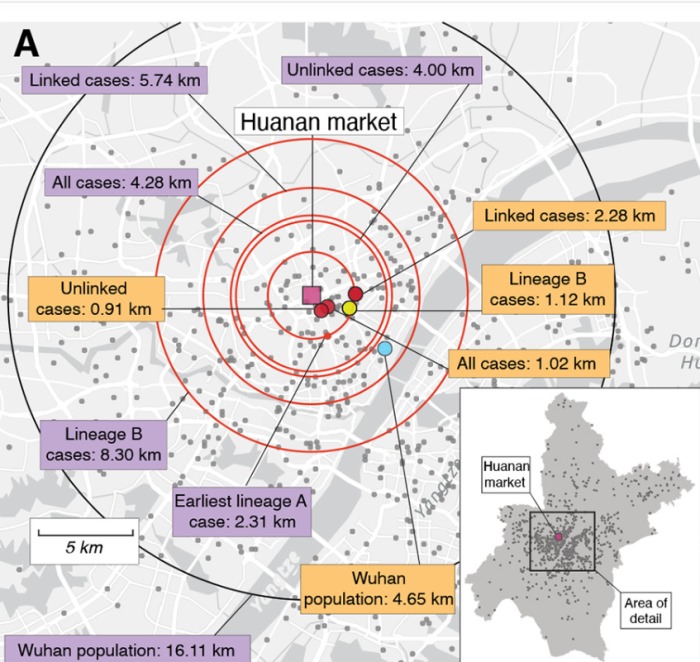
They were able to determine the locations of 155 of the 174 COVID-19 cases identified by the World Health Organization for that month. Their statistical analysis showed that these cases clustered tightly around the Huanan Market, whereas later cases were dispersed widely throughout Wuhan-;a sprawling megacity of 11 million people. One striking finding was that early COVID-19 patients with no history of having recently visited the market resided significantly closer to it, on average, than patients who had visited the market, showing the close association between early cases and the market.
The two studies collectively show that SARS-CoV-2, like SARS-CoV-1 before it, originated via jumps from animals to humans-; in this case from animals being sold at a specific market in Wuhan, likely following transmission to those animals from coronavirus-carrying bats in the wild or on farms in China.
"To more fully understand the origin of SARS-CoV-2, we need to more fully understand events upstream of the Huanan market, which will require close international collaboration and cooperation,"
"Upstream events are still obscure, but our analyses of available evidence clearly suggest that the pandemic arose from initial human infections from animals for sale at the Huanan Seafood Wholesale Market in late November 2019."
Kristian Andersen, PhD, co-senior author of both studies and professor in the Department of Immunology and Microbiology at Scripps Research"
They were able to determine the locations of 155 of the 174 COVID-19 cases identified by the World Health Organization for that month. Their statistical analysis showed that these cases clustered tightly around the Huanan Market, whereas later cases were dispersed widely throughout Wuhan-;a sprawling megacity of 11 million people. One striking finding was that early COVID-19 patients with no history of having recently visited the market resided significantly closer to it, on average, than patients who had visited the market, showing the close association between early cases and the market.
The two studies collectively show that SARS-CoV-2, like SARS-CoV-1 before it, originated via jumps from animals to humans-; in this case from animals being sold at a specific market in Wuhan, likely following transmission to those animals from coronavirus-carrying bats in the wild or on farms in China.
"To more fully understand the origin of SARS-CoV-2, we need to more fully understand events upstream of the Huanan market, which will require close international collaboration and cooperation,"


