
call Atula. By the time he's finished talking, you are sure to be dead.
That's the most painful way to die, i think he should go hunting zombies


call Atula. By the time he's finished talking, you are sure to be dead.

can someone tell me who the heck this OSHO is ??
can someone tell me who the heck this OSHO is ??
why the devil do we need to listen to an ex con ??the only thing i know abt the bugger is he was arrested and send to prison once in USA
can someone tell me who the heck this OSHO is ??
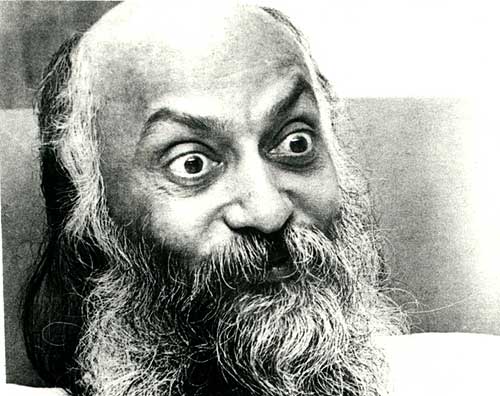
we need to listen to this guy ?i think he is talking about this guy

why the devil do we need to listen to an ex con ??
we need to listen to this guy ?
why ? Because he has a long beard and looks like be just got something showed up his ass ??
we need to listen to this guy ?
why ? Because he has a long beard and looks like be just got something showed up his ass ??


 "I am not a logician. I am an existentialist. I believe in this meaningless, beautiful chaos of existence, and I am ready to go with it wherever it leads. I don't have a goal, because existence has no goal. It simply is, flowering, blossoming, dancing - but don't ask why. Just an overflow of energy, for no reason at all. I am with existence."
 ok, so he's a well learned fruit cake..
Osho Biography
Childhood and adolescence: 1931–1950
Osho was born Chandra Mohan Jain (Hindi: चन्द्र मोहन जैन) in Kuchwada,[10] a small village in the Narsinghpur District of Madhya Pradesh state in India, as the eldest of eleven children of a cloth merchant.[11] His parents, who were Taranpanthi Jains, sent him to live with his maternal grandparents until he was seven years old.[12] By Osho's own account,[13] this was a major influence on his development, because his grandmother gave him the utmost freedom, leaving him carefree without an imposed education or restrictions.
At seven years old, his grandfather, whom he adored, died, and he went back to live with his parents.[14] He was profoundly affected by his grandfather's death, and again by the death of his childhood sweetheart and cousin Shashi from typhoid when he was 15, leading to an extraordinary preoccupation with death that lasted throughout much of his childhood and youth.[14][15] In his school years, he was a rebellious, but gifted student, and acquired a reputation as a formidable debater.[16] As a youth, Osho became an atheist; he took an interest in hypnosis and was briefly associated with socialism and two Indian independence movements: the Indian National Army and the Rashtriya Swayamsevak Sangh.[16][17][18]
University years and public speaker: 1951–1970
In 1951, aged nineteen, Osho began his studies at Hitkarini College in Jabalpur.[19] After acute conflicts with an instructor, the principal asked him to leave the college, and he transferred to D. N. Jain College, also in Jabalpur.[20] He began speaking in public, initially at the annual Sarva Dharma Sammelan held at Jabalpur, organised by the Taranpanthi Jain community into which he was born, participating there from 1951 to 1968.[21] He resisted his parents' pressure to get married.[22] Osho later said he became spiritually enlightened on 21 March 1953, when he was 21 years old.[23] He said he dropped all effort and hope.[24] After what he describes as an intense seven-day process he says he went out at night to the Bhanvartal garden in Jabalpur, where he sat under a tree:[23]The moment I entered the garden everything became luminous, it was all over the place – the benediction, the blessedness. I could see the trees for the first time – their green, their life, their very sap running. The whole garden was asleep, the trees were asleep. But I could see the whole garden alive, even the small grass leaves were so beautiful. I looked around. One tree was tremendously luminous – the maulshree tree. It attracted me, it pulled me towards itself. I had not chosen it, God himself has chosen it. I went to the tree, I sat under the tree. As I sat there things started settling. The whole universe became a benediction.[25]He completed his B.A. in philosophy at D. N. Jain College in 1955 and joined the University of Sagar, where he earned his M.A. in philosophy in 1957 (with distinction).[26][27] He immediately secured a teaching post at Raipur Sanskrit college, but soon became controversial enough for the Vice Chancellor to ask him to seek a transfer, as he considered him a danger to his students' morality, character and religion.[28] From 1958, he taught philosophy as a lecturer at Jabalpur University, being promoted to professor in 1960.[28] A popular lecturer with a "golden tongue" in Hindi, he was acknowledged by his peers as an exceptionally intelligent man who had been able to overcome the deficiencies of his early small-town education.[29]
In parallel to his university job, he travelled throughout India, giving lectures critical of socialism and Gandhi, under the name Acharya Rajneesh (Acharya means teacher or professor; Rajneesh was a nickname he had acquired in childhood).[16][28][30] Socialism, he said, was a dead loss that would only socialise poverty.[30] Gandhi was a masochist and reactionary who worshipped poverty.[16][30] To escape its backwardness, Osho said, India needed capitalism, science, modern technology and birth control.[16] He criticised orthodox Indian religions as dead, filled with empty ritual, oppressing their followers with fears of damnation and the promise of blessings.[16][30] Such statements made him controversial: they shocked and repelled many, but attracted others.[16] He gained a loyal following that included a number of wealthy merchants and businessmen.[31] These sought individual consultations from him about their spiritual development and daily life, in return for donations – a commonplace arrangement in India, where people seek guidance from learned or holy individuals the way people elsewhere might consult a psychologist or counsellor.[31] The rapid growth of his practice was somewhat out of the ordinary, suggesting that he had an uncommon talent as a spiritual therapist.[31] From 1962, he began to lead 3- to 10-day meditation camps, and the first meditation centres (Jivan Jagruti Kendra) started to emerge around his teaching, then known as the Life Awakening Movement (Jivan Jagruti Andolan).[32] After a speaking tour in 1966, he resigned from his teaching post.[28]
In a 1968 lecture series, later published under the title From Sex to Superconsciousness, he scandalised Hindu leaders by calling for freer acceptance of sex.[33] His advocacy of sexual freedom caused public disapproval in India, and he became known as the "sex guru" in the press.[2] When he was invited in 1969 – despite the misgivings of some Hindu leaders – to speak at the Second World Hindu Conference, he used the occasion to raise controversy again.[33] In his speech, he said that "any religion which considers life meaningless and full of misery, and teaches the hatred of life, is not a true religion. Religion is an art that shows how to enjoy life."[34] He characterised priests as being motivated by self-interest, incensing the shankaracharya of Puri, who tried in vain to have his lecture stopped.[34]
Mumbai: 1970–1974
At a public meditation event in spring 1970 Osho presented his Dynamic Meditation method for the first time.[35] At the end of June 1970, Osho left Jabalpur for Mumbai.[36] On September 26, 1970 he initiated his first group of disciples or sannyasins at an outdoor meditation camp, one of the large gatherings where he lectured and guided group meditations.[37] His concept of neo-sannyas entailed assuming a new name and wearing the traditional orange dress of ascetic Hindu holy men, including a mala (beaded necklace) carrying a locket with his picture.[38] However, his sannyasins were expected to follow a celebratory, rather than ascetic lifestyle.[39] They would be free, creatively responding to the present situation, as comfortable with being loving as with being alone.[39] He himself was not to be worshipped, but was rather like a catalytic agent, "a sun encouraging the flower to open, but in a very delicate way".[39]
He had by then acquired a secretary, who as his first disciple had taken the name Ma Yoga Laxmi.[16] Laxmi was the daughter of one of his early followers, a wealthy Jain who had been a key supporter of the National Congress Party during the struggle for Indian independence, with close ties to Gandhi, Nehru and Morarji Desai.[16] She raised the money that enabled Osho to stop his travels and settle down.[16] In December 1970, Osho thus moved to Woodlands Apartments in Mumbai, where he gave lectures and received visitors, among them the first Western visitors.[36] He now travelled very rarely, and stopped speaking at open public meetings.[36] In 1971, he adopted the title Bhagwan Shree Rajneesh.[38] Shree means Sir or Mister; the Sanskrit title Bhagwan means "blessed one", indicating a human being in whom the divine is no longer hidden, but apparent.[40][41]
http://en.wikipedia.org/wiki/Osho_(Bhagwan_Shree_Rajneesh)#cite_note-Gordon94-73


